
Custom Forged Hollow Ring for a French Hydraulic Equipment Manufacturer
- A French hydraulic equipment manufacturer required a customized large forged hollow ring for use in mold equipment.
- The original specification called for CuSn12 bronze, with a single-piece weight of approximately 607 kg, tight dimensional tolerances, and demanding surface-finish requirements.
Project Overview
The customer is a French manufacturer of hydraulic equipment requiring a large custom hollow ring for mold-related machinery.
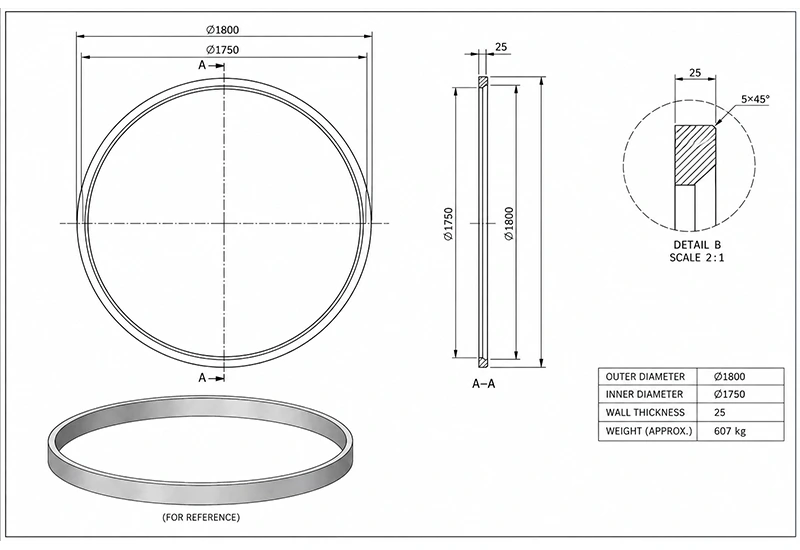
The initial design specified CuSn12 material. Because the component had a relatively thin wall compared with its overall diameter, machining stability & deformation control were critical to achieving the required dimensions & surface quality.
The project requirements included:
- Manufacturing Process: Forging + Heat Treatment + Precision Machining
- Critical Tolerance:±0.1 mm
- Surface Roughness:Ra ≤ 3.2 μm
- Key Requirement:Thin-wall dimensional stability
- Additional Goal:Reduce material and manufacturing cost
- Product: Custom forged hollow ring
- Application: Mold equipment
- Original Material: CuSn12
- Approx. Weight:607 kg per piece
- Wall Thickness: Approx. 25 mm
The project Challenge:
The main challenge was maintaining dimensional stability during machining while evaluating whether the originally specified material was necessary for the actual application.
Project Challenge
Challenge 1 : Controlling Deformation in a 25 mm Thin-wall Ring
Large hollow rings with relatively thin walls have limited structural rigidity during machining.For this project, the customer required critical dimensions within ±0.1 mm while maintaining a surface roughness of Ra 3.2 μm or better.
Uneven clamping forces or excessive material removal can cause:
- Local wall deformation
- Out-of-roundness
- Dimensional variation
- Machining vibration
- Unstable surface finish
- Loss of final machining accuracy
Our Solution: Controlled Machining for Thin-wall Stability
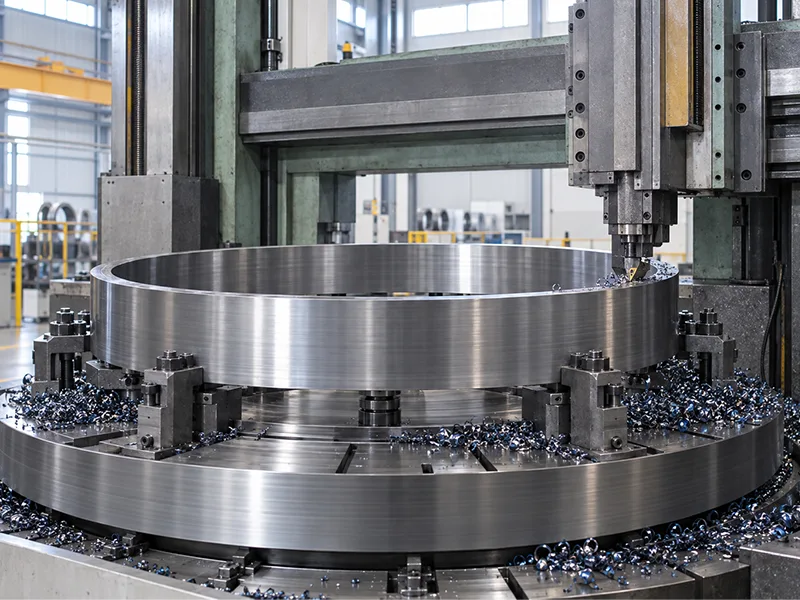
The machining sequence was planned specifically around the thin-wall geometry of the hollow ring.
- Key controls included:
- Balanced machining allowance
- Controlled clamping force
- Symmetrical material removal
- Rough and finish machining in separate stages
- Multiple dimensional checks during machining
- Stress-release consideration between machining stages
- Final precision finishing
- Surface roughness verification
By controlling the machining sequence and reducing uneven stress release, deformation was minimized during final finishing.
Challenge 2 : Reducing Material Cost Without Sacrificing Performance
During the technical review, the team discussed the actual operating conditions of the component with the customer.
It was confirmed that the hollow ring would be used in mold equipment, where the originally specified CuSn12 material was not necessarily the most economical choice for the required mechanical function.
CuSn12 represented a significant portion of the total project cost due to the large single-piece weight of approximately 607 kg.
Our Solution: Material Optimization From CuSn12 to AISI 4140
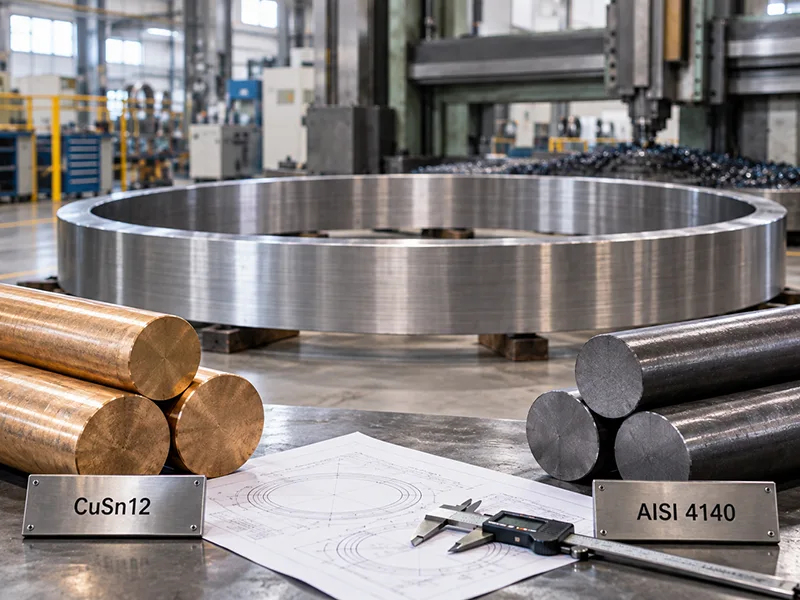
Based on the actual application, AISI 4140 alloy steel was proposed as an alternative material.
- Compared with the original CuSn12 specification, AISI 4140 offered:
- Higher mechanical strength
- Higher hardness potential after heat treatment
- Good machinability
- Strong wear resistance
- Better suitability for heavy mechanical mold applications
- Significantly lower raw-material cost
According to the project’s material-cost comparison, AISI 4140 was approximately one-tenth the cost of CuSn12, providing substantial savings on a component weighing more than 600 kg.
After reviewing the technical recommendation, the customer approved the material change.
Projest Results
The Result: Required Accuracy With Significant Cost Savings
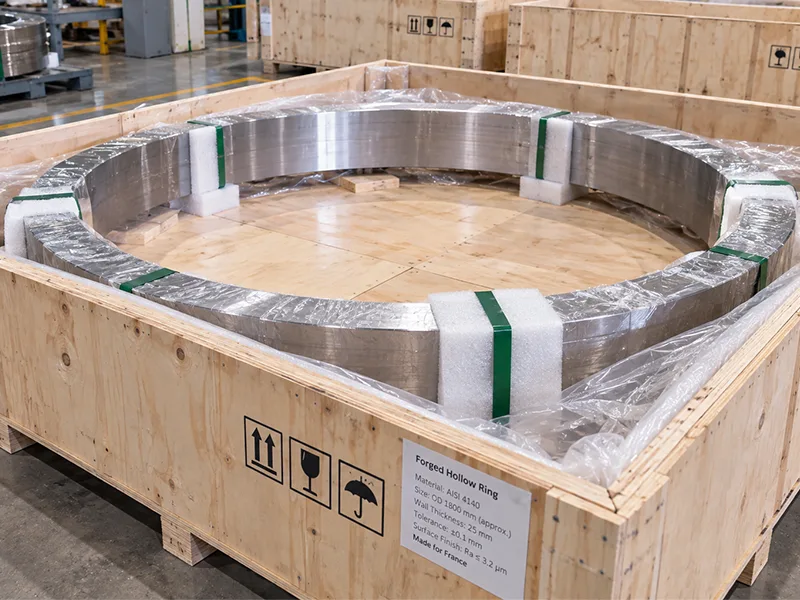
The completed hollow ring met the customer’s dimensional and surface-quality requirements while substantially reducing overall material cost.
- Final project results included:
- Critical Tolerance: Met ±0.1 mm requirement
- Surface Roughness: Met Ra ≤ 3.2 μm requirement
- Wall Thickness: Approx. 25 mm
- Dimensional Stability: Controlled throughout machining
- Final Material: AISI 4140
- Cost Result: Significant raw-material savings compared with CuSn12
- Application Fit: Suitable for the customer’s mold equipment
By combining thin-wall machining control with application-based material optimization, the project achieved both the required manufacturing accuracy and a more economical production solution.
The result helped the French customer reduce component cost without compromising the mechanical performance required for its equipment.