
High-precision Railway Main Shaft for a Slovak Rail Project
- A long-established Slovak rail equipment manufacturer required high-precision main shafts for new electric multiple units and battery-electric hybrid trains.
- Designed for high-speed railway operation, the shafts needed excellent fatigue resistance, stable internal structure, micron-level journal accuracy, and reliable long-term performance under demanding operating conditions.
Project Overview
The customer is a Slovakia-based rail transportation equipment manufacturer and core component supplier with extensive experience serving the European railway industry.
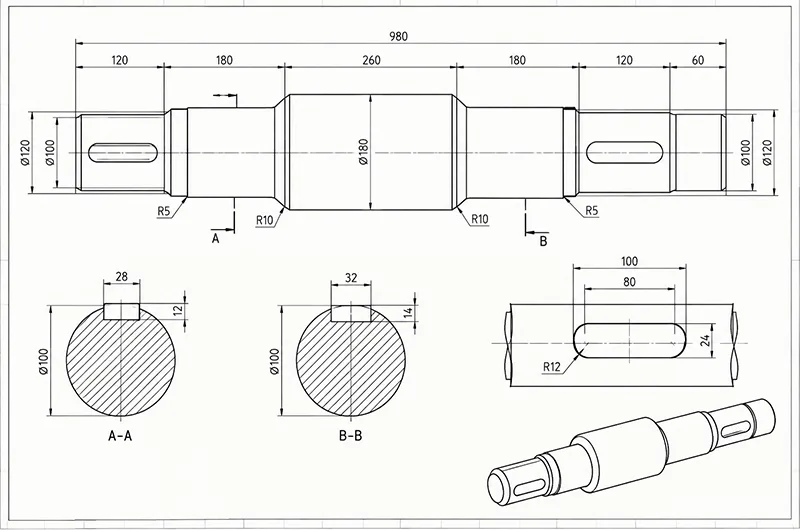
As new electric and hybrid train programs were introduced, the customer required high-precision transmission shafts capable of meeting demanding European railway requirements.
The project requirements included:
- Application: Electric and hybrid railway trains
- Operating Speed: Up to 160–200 km/h
- Product: High-precision railway main shaft
- Manufacturing Process: Forging + Heat Treatment + Precision Machining
- Material: High-quality railway axle steel
- Standard: Requirements aligned with EN 13261
- Key Requirement: High fatigue strength
- Journal Accuracy: Micron-level dimensional control
- Production Requirement: Stable and repeatable batch quality
Project Challenge
Challenge 1 : Maintaining Uniform Internal Structure in a Large Forged Shaft
Large solid forged shafts can develop uneven internal structures, localized stress concentration, or micro-defects if material quality, forging deformation, and heat treatment are not properly controlled.
For railway applications operating at speeds of up to 160–200 km/h, such internal inconsistencies may reduce fatigue strength and affect long-term operational reliability.
The customer therefore required the shaft to maintain stable mechanical properties and uniform internal quality throughout its critical sections.
Our Solution: Controlled Steelmaking, Forging, and Heat Treatment
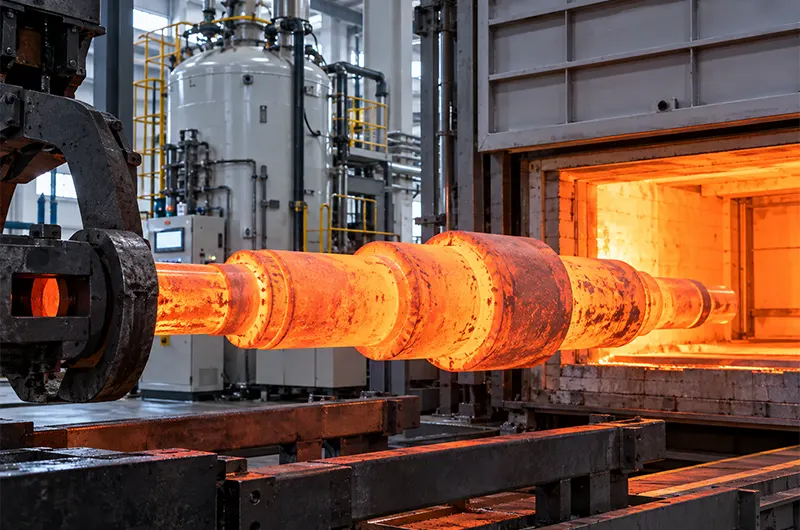
We selected high-quality railway axle steel suitable for EN 13261-related requirements and used vacuum degassing to reduce non-metallic inclusions and improve steel cleanliness.
- The manufacturing process focused on controlling:
- Steel cleanliness and inclusion levels
- Forging deformation and material flow
- Internal structural uniformity
- Heat-treatment temperature and holding time
- Surface hardness
- Core toughness
- Residual internal stress
A carefully controlled heat-treatment process was used to achieve an appropriate balance between surface strength and core toughness, providing a stable foundation for subsequent precision machining.
Challenge 2 : Achieving Micron-level Journal Accuracy Without Grinding Damage
The shaft journals directly interface with the bearing system, making dimensional accuracy, surface roughness, roundness, and residual stress particularly important.
Even small machining deviations can affect bearing fit and load distribution. Excessive grinding temperature can also cause grinding burns, surface hardening changes, or additional residual stress, potentially reducing bearing and shaft service life.
The customer therefore required micron-level dimensional control while maintaining a consistent, defect-free journal surface.
Our Solution: Precision Machining and Controlled Journal Finishing
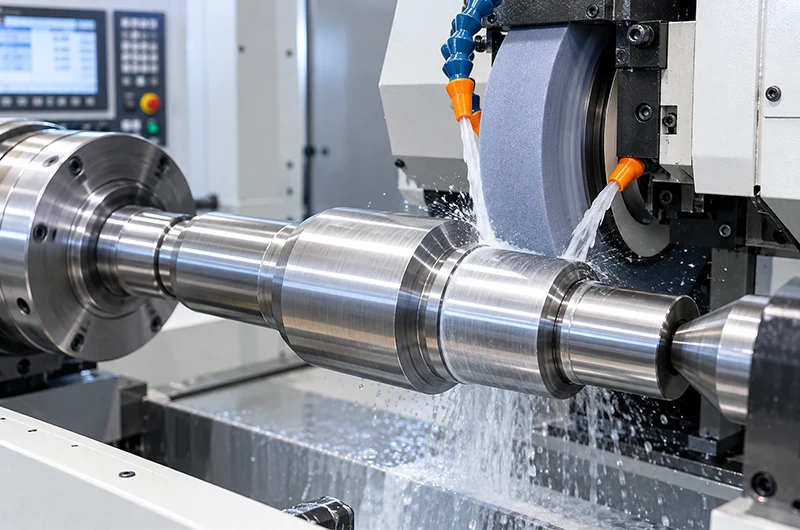
A controlled machining and finishing process was developed for the critical shaft journals, with particular attention to dimensional stability and surface integrity.
- Key controls included:
- Precision turning before final grinding
- Controlled machining allowance
- Micron-level dimensional inspection
- Strict roundness and cylindricity control
- Optimized grinding parameters
- Controlled grinding temperature
- Surface roughness inspection
- Prevention of grinding burns
- Final dimensional and surface verification
By coordinating forging, heat treatment, rough machining, and precision finishing instead of treating them as separate processes, machining-induced stress was minimized while maintaining stable journal dimensions.
Projest Results
The Result: Stable Railway Main Shafts for High-speed Operation
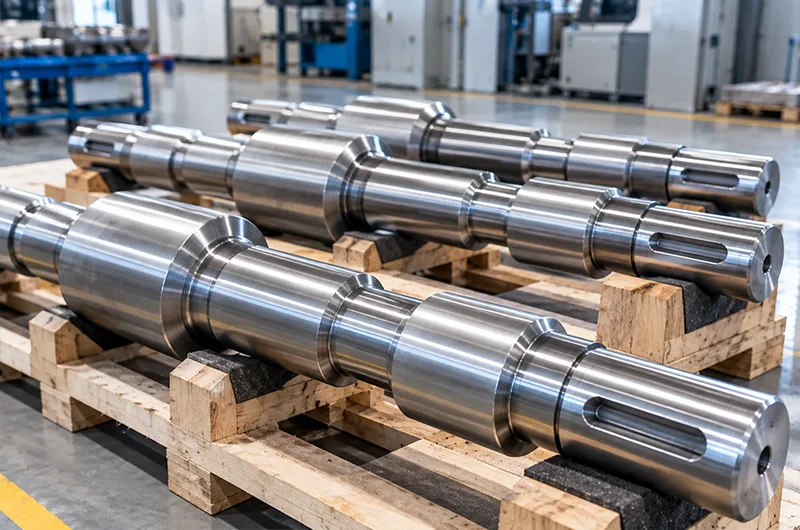
The completed railway main shafts met the customer’s requirements for high fatigue strength, uniform internal quality, micron-level journal accuracy, and stable surface condition.
Through controlled steelmaking, forging, heat treatment, and precision CNC machining, Boberry delivered components suitable for demanding railway operating conditions at speeds of up to 160–200 km/h.
Following successful delivery and quality verification, the project strengthened cooperation with the Slovak customer and further demonstrated strong manufacturing capability for critical railway transmission components.