
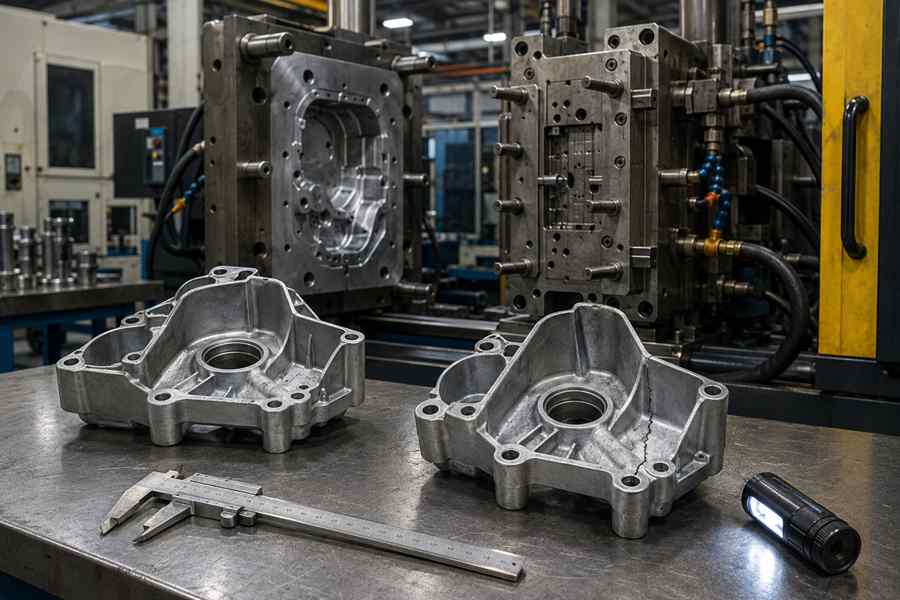
Cold shut represents a frequent surface and internal defect within aluminum die casting. It forms when two or more molten aluminum flow fronts meet after losing enough temperature or velocity that they cannot fully fuse.
Cold Shut Defect Troubleshooting
| Main Cause | Typical Sign | Main Prevention |
| Low Metal or Die Temperature | Cold shut appears during startup or in cold die areas | Stabilize melt and die temperature |
| Low Filling Velocity | Long seam near last-filled region | Adjust shot profile and gate velocity |
| Poor Gate and Flow Layout | Defect repeats where flow fronts meet | Optimize gate direction and flow path |
| Thin or Difficult Geometry | Cold shut stays in remote thin sections | Shorten flow distance or modify geometry |
1. Cold Shut From Insufficient Metal-Die Temperature
Temperature ranks among the primary parameters to inspect once cold shut defects occur. Aluminum must remain sufficiently fluid until separate flow fronts meet and fuse inside the cavity.
Cause
If molten aluminum enters the cavity too cold, or a section of the die removes heat too quickly, the front of the metal can begin to solidify before filling is complete.
Typical contributors include:
- Low pouring temperature
- Cold die surface
- Excessive local cooling
- Long machine interruptions
- Unstable startup conditions
- Excessive lubricant or spray
Consider a part where aluminum reaches the meeting point at 620°C under stable production but falls another 15–25°C during a cold startup condition. That smaller thermal margin can be enough to change a clean surface into a visible seam.
Identification
Temperature-related cold shuts often follow a recognizable production pattern.
For example:
- Defects are worse during the first 10–30 shots
- Quality improves as the die warms up
- Cold shuts appear near heavily cooled areas
- Defect frequency increases after long stops
- The same machine settings produce different results at different die temperatures
If the cold shut gradually disappears after thermal stabilization, temperature control is usually a stronger suspect than part geometry.
A useful check is to compare die-surface temperatures near the gate, center of the cavity, and last-fill region. A difference of 30–50°C across critical areas can indicate poor thermal balance.
Prevention
The goal is not simply to raise temperature as high as possible. Excessive die or metal temperature can create soldering, longer cycle times, and other defects.
More practical corrections include:
- Stabilize melt temperature before production
- Preheat the die adequately
- Reduce unnecessary local cooling
- Adjust spray quantity and duration
- Avoid long uncontrolled production stops
- Balance cooling channels between hot and cold areas
For buyers reviewing trial samples, it is useful to ask whether acceptable parts were produced only after an unusually long warm-up period. A process that works only within a very narrow temperature window may become unstable during mass production.
2. Cold Shut From Low Filling Velocity
Even when metal temperature is acceptable, cold shut can still occur if aluminum travels through the cavity too slowly.
High-pressure die casting relies on rapid cavity filling because thin aluminum sections lose heat quickly once they contact the steel die.
Cause
Low filling velocity allows the front of the molten metal to cool before it reaches another flow stream.
Common reasons include:
- Slow second-stage shot speed
- Incorrect fast-shot changeover position
- Low gate velocity
- Excessive filling time
- Inconsistent hydraulic pressure
- Oversized or poorly proportioned gate sections
Suppose one aluminum housing has a target filling time of around 40 ms, but unstable shot conditions extend actual filling to 55–60 ms. That extra 15–20 ms can be significant in remote thin-wall areas.
The effect becomes stronger when wall thickness falls below approximately 2–3 mm or flow length increases.
Identification
Velocity-related cold shuts often appear close to:
- Last-filled areas
- Long flow paths
- Thin outer walls
- Areas far from the gate
- Locations where several fronts reconnect
Shot data can help separate this issue from temperature problems.
If the defect rate increases when second-stage velocity falls from, for example, 4.0 m/s to 3.2 m/s, while melt and die temperatures remain stable, the shot profile deserves close attention.
Repeated defects in the same location combined with inconsistent filling time are another strong indicator.
Prevention
The first step is usually stabilizing the filling process rather than simply increasing pressure.
Possible corrections include:
- Optimize fast-shot velocity
- Adjust changeover position
- Stabilize accumulator pressure
- Review gate cross-section
- Reduce unnecessary filling time
- Keep shot-to-shot conditions consistent
Higher speed should still remain within a controlled process window. Excessive velocity can increase turbulence, air entrapment, flash, and die erosion.
The better target is fast enough to maintain a hot, continuous flow front without creating an uncontrolled filling pattern.
3. Cold Shut From Poor Gate and Flow Layout
Some cold shuts cannot be solved reliably by temperature or shot-speed adjustment because the basic problem is how the cavity is being filled.
This is especially common when two streams of aluminum travel around a large opening or rib network and meet near the far side of the casting.
Cause
A poor gate layout may send metal along unnecessarily long or opposing routes.
Typical design problems include:
- Gate located too far from a thin section
- Two flow fronts meeting after long travel
- Sudden changes in flow direction
- Large obstacles splitting the metal stream
- Poorly positioned overflow
- Unbalanced multiple gates
Imagine two metal fronts traveling 220 mm around opposite sides of an opening before meeting in a 2 mm wall.
Moving the gate or changing its direction so the meeting distance falls to 100–120 mm can provide a much larger thermal margin without changing alloy or part thickness.
Identification
Gate-related cold shuts are usually highly repeatable.
Look for defects that:
- Appear in almost exactly the same location
- Follow a visible flow junction
- Occur behind a large boss or opening
- Stay present even after temperature adjustment
- Match a predicted last-fill or flow-front meeting area
This is where flow simulation can be useful before tooling changes are made.
If the predicted fronts meet exactly where the physical seam appears, changing only melt temperature may hide the defect temporarily without correcting the filling pattern.
Prevention
The preferred correction is to make the metal reach the problem area by a shorter or more balanced route.
Options may include:
- Reposition the gate
- Change gate direction
- Adjust gate width or thickness
- Balance multiple gates
- Relocate overflow areas
- Reduce unnecessary flow obstacles
A tooling change can cost more upfront, but it may be cheaper than carrying a recurring 2–3% rejection rate through a high-volume program.
For example, a $4,000 gate modification that reduces scrap by $0.18 per part pays back after roughly 22,000 parts.
4. Cold Shut From Thin or Difficult Geometry
Sometimes the die-casting process is stable, but the part itself gives molten aluminum too little time or space to fill properly.
Long thin walls, isolated fins, deep ribs, and sharp thickness transitions can all create local cold-shut risk.
Cause
Thin sections cool rapidly because they have a high surface-area-to-volume ratio.
The problem becomes more severe when a thin area is also:
- Far from the gate
- Connected through a narrow passage
- Located behind a large boss
- Split by ribs or holes
- Part of a very long flow path
For example, a 1.5 mm wall with a 180 mm flow path creates a much more demanding filling condition than a 2.5 mm wall only 60 mm from the gate.
This does not mean every thin-wall casting will develop cold shut. The risk comes from the combination of thickness, distance, temperature, and filling pattern.
Identification
Geometry-related defects normally remain concentrated in the same difficult feature even when machine parameters are reasonably stable.
Typical signs include:
- Seam at the end of a thin rib
- Defect around remote fins
- Cold shut after a thin-to-thick transition
- Repeated failure around openings
- Incomplete fusion along long narrow walls
If increasing temperature or velocity only improves the defect slightly, the part geometry itself should be reviewed.
A useful DFM question is: How far must the aluminum travel after entering the thinnest section?
Prevention
Geometry should be adjusted where possible without compromising product function.
Possible changes include:
- Increase local wall thickness
- Shorten long thin sections
- Move critical features closer to the gate
- Reduce abrupt thickness changes
- Simplify excessive rib networks
- Improve transitions around openings
A change from 1.5 mm to 2.0 mm may look minor on the drawing, but it increases local section thickness by about 33%. In a difficult last-fill area, that extra thermal capacity can noticeably improve filling stability.
For buyers, a small CAD modification before final tooling approval is normally cheaper than solving the same problem repeatedly through machine adjustments.
How to Judge Cold Shut Severity?
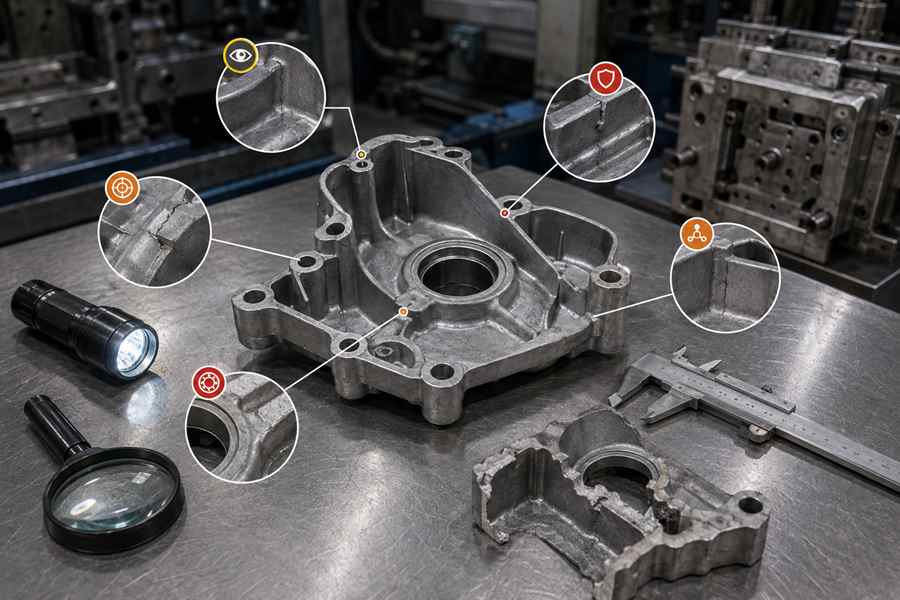
Not every cold shut creates the same risk. Location, depth, and part function should determine whether the casting can be accepted.
| Cold Shut Location | Typical Risk | Recommended Response |
| Hidden cosmetic surface | Low–Medium | Visual standard / sampling |
| External visible surface | Medium | Appearance review |
| Machined sealing face | High | Sectioning / rejection |
| Pressure wall | High | NDT or destructive validation |
| Structural boss or lug | High | Mechanical evaluation |
A shallow surface seam on a non-functional area may be manageable. A cold shut crossing an O-ring groove, threaded boss, or pressure-containing wall should be treated much more seriously.
For a 20,000-piece order priced at $7 per casting, even a 2% rejection rate means 400 rejected parts and $2,800 of part value before sorting, replacement production, inspection, and shipping are added.