
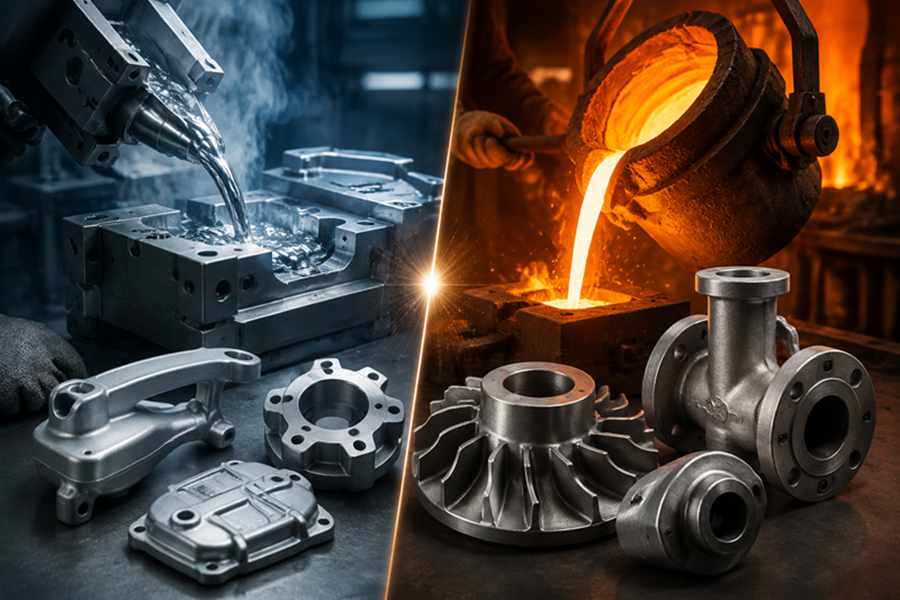
Zinc die casting is better for parts that need efficient mass production, fine details, smooth appearance, and controlled unit cost. Stainless steel casting is better for parts that must resist load, corrosion, heat, wear, or long-term service risk.
The stronger choice is not always the smarter choice. Buyers should match the process to the part’s real function, order quantity, working environment, and failure cost.
What Is Zinc Die Casting?
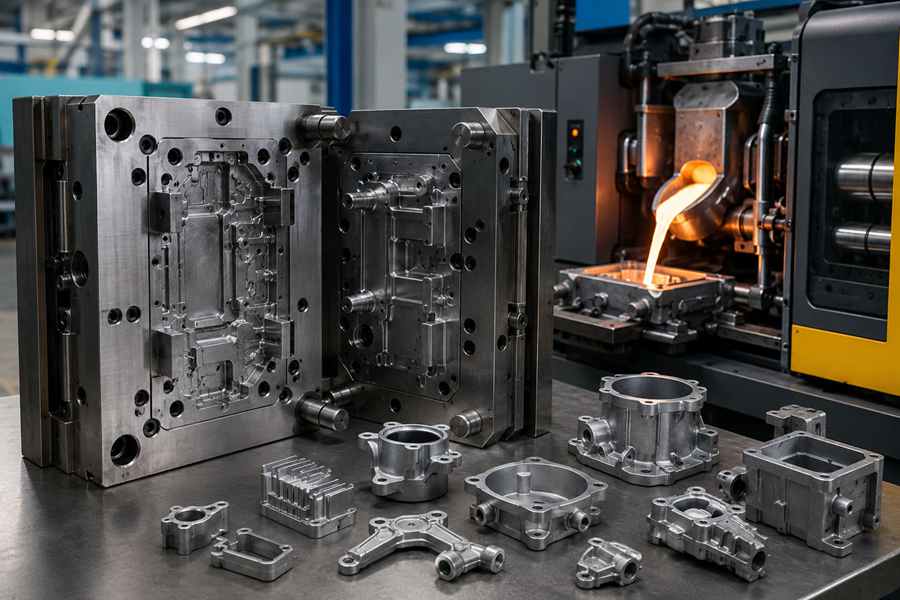
Zinc die casting uses high-pressure injection technology to fill a precision steel die with molten zinc alloy and create detailed metal parts. The process allows small and medium metal parts to be produced with clear details, smooth surfaces, and stable dimensions.
Key Characteristics of Zinc Die Casting
- Produced by high-pressure mold filling
- Good for thin walls, small ribs, holes, and logo details
- Smooth surface suitable for plating, painting, or coating
- Stable dimensions in repeated production
- Fast cycle time for high-volume orders
- Better for light to medium-duty parts
Typical Manufacturing Steps
- Mold Preparation:A steel die is designed and manufactured according to the part structure.
- Melting:Zinc alloy is heated until it reaches the required casting temperature.
- Injection: The melted zinc alloy is pushed into the mold cavity at high pressure to form the required shape.
- Cooling and Ejection:The part solidifies and is removed from the mold.
- Trimming and Finishing:After casting, excess material is removed, followed by necessary surface treatments or secondary machining.
Zinc die casting is mainly valued for production efficiency, detailed shape control, and lower unit cost in large-volume projects.
What Is Stainless Steel Casting?
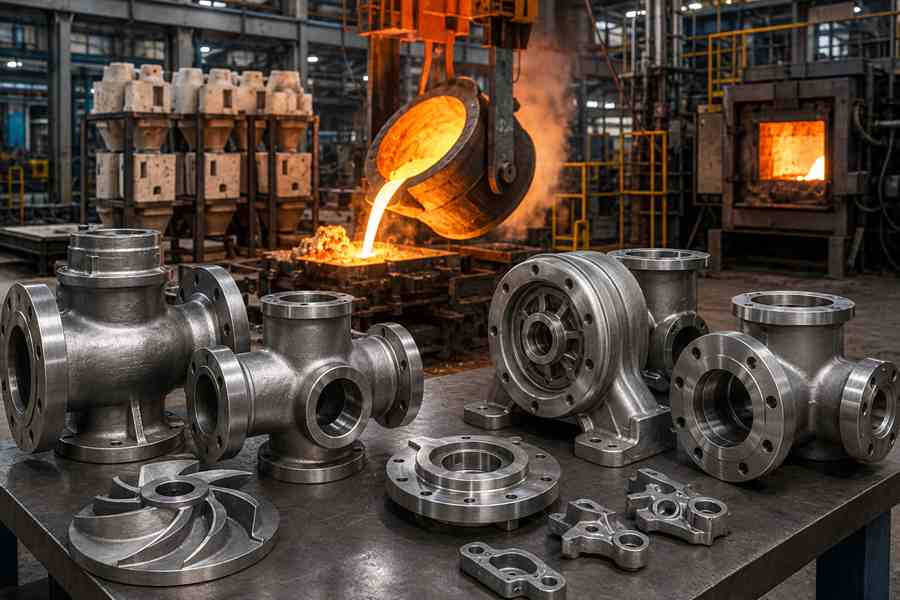
Stainless steel casting forms metal components by pouring molten stainless steel into a prepared mold, producing parts with high strength and corrosion resistance. It is often used when the component needs better durability, heat resistance, and long-term service performance.
Key Characteristics of Stainless Steel Casting
- Made from corrosion-resistant stainless steel alloys
- Stronger for heavy-duty and high-stress parts
- Suitable for complex shapes that are difficult to machine directly
- Better performance in wet, hot, or corrosive environments
- Higher machining and finishing requirements
- Longer service life in demanding applications
Typical Manufacturing Steps
- Pattern or Mold Preparation:The mold is prepared based on the required part shape and tolerance.
- Melting:Stainless steel is melted at high temperature.
- Pouring:Molten stainless steel is transferred into the prepared mold cavity for solidification.
- Cooling and Cleaning:The casting solidifies, and sand, shell, or surface residues are removed.
- Machining and Finishing:Critical dimensions are machined, and polishing, blasting, or passivation may be applied.
Stainless steel casting is mainly valued for strength, corrosion resistance, and reliability in parts where failure would cause higher replacement or maintenance cost.
Part Requirement Comparison
| Buying Factor | Zinc Die Casting | Stainless Steel Casting | Buyer Focus |
| Load Requirement | Good for light to medium-duty parts | Better for high-load or high-stress parts | Can the part handle real use? |
| Product Weight | Compact, solid, and suitable for small parts | Heavier but stronger | Does weight affect use or shipping? |
| Production Cost | Better for high-volume orders | Higher cost but longer durability | Is the quantity large enough? |
| Detail and Tolerance | Strong detail reproduction and stable dimensions | May need more machining after casting | Does the part need precision? |
| Surface Finish | Easy to plate, paint, or coat | Durable metal finish, can be polished | Is appearance or corrosion more important? |
| Service Environment | Best for indoor or mild conditions | Better for wet, hot, or corrosive use | Will the part face long-term exposure? |
Load Requirement
- Zinc Die Casting
Zinc alloy can support many daily-use and commercial parts, such as handles, locks, brackets, covers, and connectors. It is suitable when the part needs shape stability but does not carry extreme load. - Stainless Steel Casting
Stainless steel casting is better for parts exposed to heavy load, impact, pressure, or vibration. It is commonly selected for pump parts, valves, machinery components, marine hardware, and structural fittings.
For buyers, strength should be judged by the part’s real working condition. A decorative part does not need the same material strength as a pressure-bearing or load-bearing component.
Product Weight
- Zinc Die Casting
Zinc is not as light as aluminum, but die casting can create compact thin-wall structures. For small parts, it gives a solid hand feel without making the product too bulky. - Stainless Steel Casting
Stainless steel is heavier, and cast stainless parts often feel more substantial. This can be an advantage for industrial components, but it may increase shipping weight and handling difficulty.
Weight is not always a disadvantage. For consumer hardware, zinc often gives enough strength with better size control; for heavy-duty parts, the extra weight of stainless steel can support better durability.
Production Cost
- Zinc Die Casting
Zinc die casting usually requires mold investment, but the unit cost becomes attractive when the order quantity is high. It is suitable for OEM buyers who need repeated production with consistent dimensions. - Stainless Steel Casting
Stainless steel casting has higher material, melting, machining, and finishing costs. It is a better option when long-term durability matters more than achieving the lowest unit cost.
Cost Decision Guide
| Cost Factor | Zinc Die Casting | Stainless Steel Casting |
| Material Cost | Lower material cost | Around 3–8 times higher material cost |
| Tooling Cost | Around $1,000–$20,000 | Around $500–$10,000 |
| Small Batch Unit Cost | Around $2–$20 per piece | Around $10–$100+ per piece |
| Mass Production Unit Cost | Around $0.5–$8 per piece | Around $5–$50+ per piece |
| Surface Treatment Cost | Around $0.2–$5 per piece | Around $1–$20 per piece |
| Cost Advantage | Lower unit cost for high-volume production | Better value through durability and longer service life |
Zinc die casting usually provides better cost efficiency when production volume is high, while stainless steel casting is often preferred when strength, corrosion resistance, and service life are more important than the lowest initial cost.
Detail and Tolerance
- Zinc Die Casting
Zinc die casting performs well when the part has small details, thin walls, ribs, logos, holes, or complex outer shapes. It can reduce secondary machining if the mold design is accurate. - Stainless Steel Casting
Stainless steel casting can also make complex parts, but fine tolerance areas often need post-machining. It is more suitable when strength and corrosion resistance are more important than very fine molded detail.
For parts that must assemble smoothly with plastic covers, screws, shafts, or electronic components, zinc die casting is often easier to control in mass production. For parts that need strength first and precision second, stainless steel casting is more reasonable.
Surface Finish
- Zinc Die Casting
Zinc die casting can achieve a smooth surface and is easy to plate, powder coat, paint, or polish. This makes it suitable for visible products where appearance affects customer acceptance. - Stainless Steel Casting
Stainless steel castings can be finished through polishing, brushing, blasting, or passivation processes. Its surface value is not only visual; it also supports corrosion resistance and long-term use.
If the part is mainly for indoor display or consumer touch points, zinc die casting gives strong decorative flexibility. If the part faces moisture, chemicals, cleaning, or outdoor use, stainless steel is usually the safer surface choice.
Service Environment
- Zinc Die Casting
Zinc die casting is suitable for indoor use, mild outdoor exposure, furniture hardware, electronics, locks, and consumer product parts. With proper coating, it can handle normal daily environments. - Stainless Steel Casting
Stainless steel casting is well suited for wet, high-temperature, corrosive, marine, chemical, and industrial applications.Grade selection still matters, because different stainless steels provide different corrosion resistance.
Environment should be confirmed before price comparison. A zinc part may be cheaper at first, but stainless steel becomes more valuable when corrosion, heat, or failure risk is part of the application.
Application Cases
Case Study 1: Decorative Hardware
- Chosen Process:
Zinc Die Casting - Reason:
The part needs a smooth surface, plated finish, and stable batch production. Zinc die casting supports lower unit cost for large-volume decorative hardware.
Case Study 2: Pump Component
- Chosen Process:
Stainless Steel Casting - Reason:
The part works with fluid, pressure, and possible corrosion. Stainless steel casting provides better strength and longer service reliability.
Case Study 3: Electronic Housing
- Chosen Process:
Zinc Die Casting - Reason:
The housing needs accurate dimensions, thin walls, and a clean surface. Zinc die casting helps improve assembly consistency and production efficiency.
Selection Guide
Choose Zinc Die Casting When
- The order quantity is high
- The part is small or medium-sized
- Fine detail is important
- A smooth surface is needed
- Unit cost must be controlled
- The working environment is mild
- The part is not under heavy load
Choose Stainless Steel Casting When
- Strength is the priority
- Corrosion resistance is required
- The part works outdoors or in fluids
- Heat, pressure, or wear is involved
- Long service life matters
- Failure would cause shutdown or safety risk
- The buyer accepts higher initial cost for lower long-term risk