
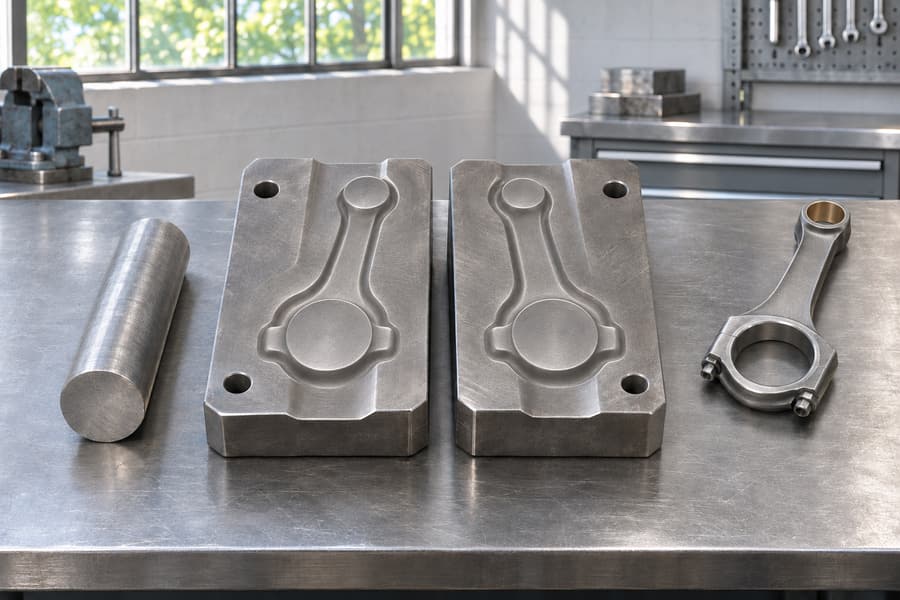
Types of drop forging are commonly described as open-die, closed-die, and impression-die forging, although these terms are not three mutually exclusive categories. Drop forging uses hammer impacts, while die terminology describes how tooling controls metal deformation.
Understanding these distinctions helps engineers and buyers evaluate component geometry, tooling requirements, production costs, and finishing needs.
Sorting Drop-Forging Methods by Their Tooling
Drop forging shapes heated metal through repeated hammer impacts. The workpiece undergoes plastic deformation as the hammer transfers energy into the material, producing a required shape.
Open-die and impression-die forging are the main tooling arrangements associated with this process. Closed-die forging commonly refers to impression-die forging, although stricter terminology distinguishes flashless closed-die operations.
How Drop Forging Is Classified
Drop forging can be classified by the equipment delivering the forming energy and the dies controlling metal deformation. The machine supplies the blow; the dies govern where the metal can move.
- Gravity drop hammer: A raised hammer falls under gravity, transferring its energy to the workpiece through impact.
- Power-assisted drop hammer: Additional mechanical, pneumatic, or hydraulic energy accelerates the ram during its working stroke, depending on equipment design.
- Hammer vs. press forging: Hammers deliver impact energy, while presses apply force through a pressing stroke. Both can operate with different die configurations.
The term drop forging most commonly describes hammer forging, particularly impression-die hammer forging. However, a falling hammer can also work with open dies.
When evaluating drop forging services, engineers should distinguish how forming energy is applied from how the dies control material movement.
Understanding Open-Die, Closed-Die, and Impression-Die Terminology
The three terms describe related tooling arrangements rather than three completely independent manufacturing processes.
- Open-die forging: Simple contact surfaces squeeze the stock while its exposed sides can spread beyond the tools.
- Impression-die forging: Shaped die cavities guide metal deformation to produce specified component features.
- Closed-die forging: Often another name for impression-die forging, including conventional arrangements that produce flash.
- Flashless closed-die forging: A more specific arrangement using a substantially enclosed cavity to restrict excess material from escaping.
These distinctions matter because tooling terminology alone does not establish equipment type, attainable tolerances, mechanical properties, or total manufacturing cost.
Open-Die Drop Forging: Process, Advantages, and Applications
Open-die drop forging uses repeated hammer blows to deform metal between relatively simple dies. Much of the billet remains outside the tool contact area throughout the shaping sequence.
This method provides flexibility when producing relatively simple shapes, particularly components requiring further machining. Its suitability depends on workpiece dimensions, available equipment, and manufacturing requirements.
Shaping a Billet with Open Hammer Dies
Production starts by choosing the specified alloy and preparing stock of the required size. The stock is heated to an appropriate forging temperature before being positioned between the working dies.
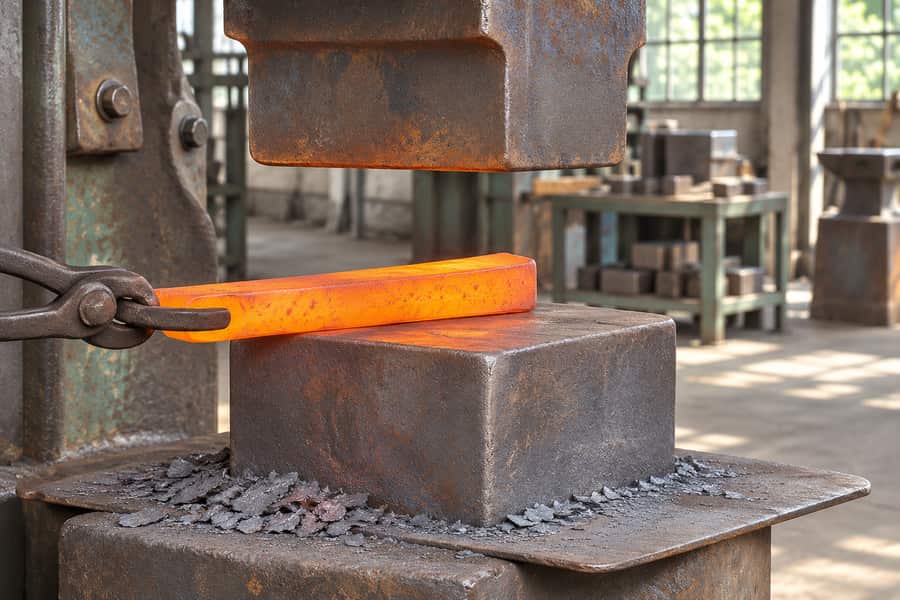
Repeated hammer impacts reduce or redistribute the material’s cross-section. The workpiece may be rotated or repositioned between blows to develop the required geometry.
Common operations include drawing out, upsetting, and local shaping. Each operation changes the material distribution without requiring a fully enclosed die cavity.
For open-die forging, the deformation sequence must account for material flow, temperature changes, and the machining stock needed to complete the component.
Advantages and Limitations
Open-die forging offers several practical advantages, particularly when component designs do not justify dedicated impression tooling.
- Tooling flexibility: Simple dies can accommodate different workpiece dimensions and relatively straightforward shapes.
- Production adaptability: The process may suit smaller batches, larger components, and projects requiring dimensional variations.
- Lower dedicated tooling investment: Complex component-specific die cavities may be unnecessary.
- Geometric limitations: Detailed external features are generally more difficult to produce directly.
- Machining requirements: Additional material removal may be necessary to achieve finished dimensions and surface conditions.
Dimensional consistency depends on the forging sequence, equipment control, temperature, and workpiece positioning. Open-die forging does not automatically produce less accurate finished components when suitable machining follows.
Common Open-Die Forging Applications
Typical open-die applications include shaft blanks, stepped shafts, cylindrical sleeves, discs, and other relatively simple mechanical shapes.
Large industrial components may also be produced using open-die methods where equipment capacity and tooling arrangements permit. Some are subsequently machined into more complex finished geometries.
These examples describe common open-die forging applications, not a requirement that every such component must be manufactured using a drop hammer.
Impression-Die Drop Forging: Process, Advantages, and Applications
Impression-die drop forging uses shaped die cavities to control material flow. Hammer impacts drive the heated workpiece into the impressions, progressively developing the required geometry.
Compared with open-die forging, this method can produce more detailed external shapes directly. However, dedicated tooling introduces additional design, manufacturing, and maintenance requirements.
How Impression-Die Hammer Forging Works
The manufacturing sequence starts with preparing a billet of suitable material and volume. The billet is heated before being positioned in the forging dies.
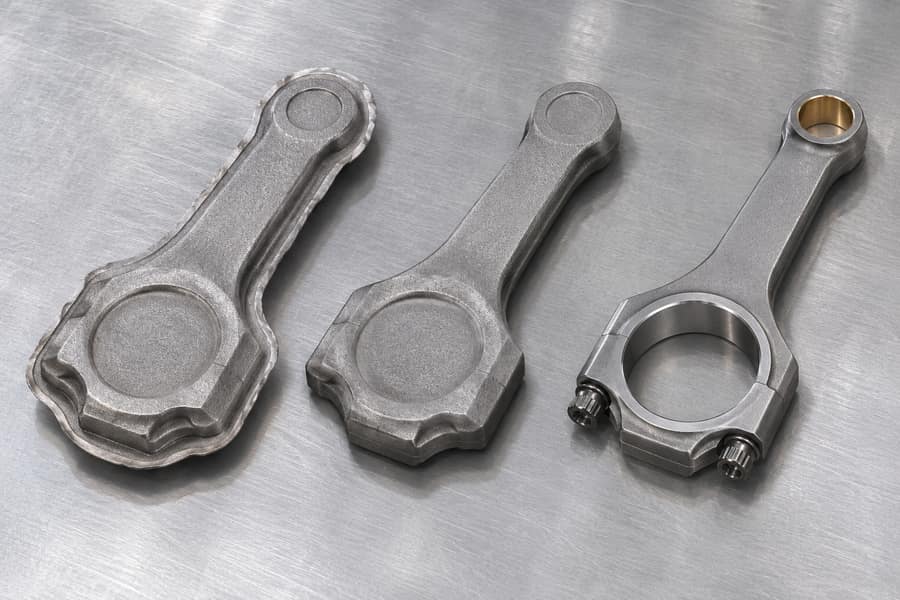
Hammer impacts force the metal to spread into the die impressions. Complex components may require preliminary forming cavities before the final shaping operation.
Conventional impression-die forging commonly allows excess metal to flow into a flash region. The flash helps establish resistance to outward material flow during cavity filling.
After forging, flash is trimmed where applicable. Heat treatment, cleaning, and CNC machining may follow according to the material and finished-component requirements.
Advantages and Limitations
Impression-die forging is particularly useful when a component requires defined external features that would otherwise involve substantial machining.
- Shape complexity: Dedicated cavities allow more detailed geometry than conventional open-die methods.
- Dimensional repeatability: Consistent tooling and controlled processing support repeated production of similar forged shapes.
- Machining reduction: Features formed directly during forging may reduce the amount of material removed later.
- Tooling investment: Dedicated dies involve design, manufacturing, setup, and maintenance expenses.
- Design restrictions: Draft angles, corner radii, parting lines, and cavity accessibility influence feasible component geometry.
- Material flow: Poor billet positioning or cavity design may cause underfilling, folds, or other forging defects.
Impression-die forging does not guarantee superior strength, accuracy, or lower cost. Results depend on the alloy, forming sequence, tooling condition, and subsequent processing.
Typical Impression-Die Forging Applications
Common applications include connecting rods, yokes, fork-shaped components, gear blanks, forged hooks, and shaped industrial brackets.
These examples often involve geometric transitions or localized features that benefit from shaped forging cavities. Their manufacturing routes still depend on material, dimensions, quantity, and specifications.
Some components may instead use press forging, casting, machining, or other processes. Their shape alone does not establish that drop forging was used.
Closed-Die Forging vs. Impression-Die Forging: Are They Different?
Closed-die forging and impression-die forging are frequently interchangeable terms in industrial manufacturing. Both commonly describe processes in which shaped dies constrain metal deformation.
The difference becomes important when closed-die is used more narrowly to mean flashless forging, which requires substantially greater control over material volume and confinement.
Why Closed-Die and Impression-Die Forging Often Mean the Same Thing
In conventional impression-die forging, opposing die cavities form the desired component geometry. The dies close around the workpiece, but excess material may escape through designed flash regions.
This arrangement is widely described as closed-die forging, even though the workpiece is not completely enclosed throughout deformation.
Consequently, closed-die forging should not automatically be interpreted as flashless manufacturing. The actual tooling arrangement must be established from the process description.
What Is Flashless Closed-Die Forging?
Flashless forging uses a substantially enclosed cavity designed to contain the required material volume without producing conventional peripheral flash.
Because the excess metal has no intended flash path, billet volume and positioning become particularly important. Overfilling can create excessive forming loads or tooling problems.
Underfilling may leave incomplete component features. Complex shapes also require careful evaluation of cavity filling, material flow, and die design.
Avoiding a flash fringe saves that portion of the input stock only when the part can fill the cavity reliably under a tightly controlled operation. Not every flashless forging operation uses drop-hammer equipment.
Flash-Producing vs. Flashless Forging
| Factor | Conventional Impression-Die Forging | Flashless Closed-Die Forging |
| Die cavity | Shaped cavity with a possible flash region | Substantially enclosed cavity |
| Flash formation | Common in conventional designs | Little or no flash intended |
| Billet volume | Some excess material can enter the flash region | More precise volume control required |
| Material utilization | May involve flash losses | Avoids conventional flash losses |
| Trimming | Often required | Flash trimming generally unnecessary |
| Main challenge | Controlling cavity filling and flash formation | Controlling stock volume, filling, and die loads |
Neither approach is universally better. Flashless forging may improve material utilization, while conventional flash-producing tooling can provide greater accommodation for excess stock during forming.
The preferred method depends on component geometry, alloy behavior, manufacturing equipment, required quality, and the economics of the complete process.
Open-Die vs. Closed-Die vs. Impression-Die Forging: Key Differences
Selecting a forging method requires comparing tooling investment, material flow, achievable geometry, and finishing requirements. The following comparison distinguishes three practical tooling arrangements.
| Comparison Factor | Open-Die Forging | Conventional Impression-Die Forging | Flashless Closed-Die Forging |
| Tooling | Flat or simple dies | Dedicated shaped cavities | Closely controlled enclosed cavities |
| Material flow | Relatively unrestricted | Directed by die impressions | Highly constrained |
| Shape complexity | Generally simple to moderate | More complex external shapes | Depends on cavity geometry |
| Tooling investment | Often lower | Dedicated tooling required | Specialized tooling and control |
| Machining needs | Often greater | May be reduced | Depends on final tolerances |
| Production suitability | Flexible for varied quantities | Often economical for repeated production | Application-specific |
What Matters Most in the Comparison?
Several engineering considerations determine whether the benefits of a particular die arrangement justify its manufacturing requirements.
- Geometry: Complex external features may favor impression-die tooling, while simpler blanks can be formed using open dies.
- Tooling: Dedicated cavities increase initial investment but can improve repeatability across production batches.
- Material utilization: Flash formation, billet selection, and machining allowances determine how much starting material becomes the finished component.
- Production volume: Larger production quantities can distribute dedicated tooling expenses across more accepted components.
- Accuracy: Forged dimensional control and final machining tolerances should be evaluated separately.
A process with lower initial tooling expenditure may still produce higher finished-part costs if machining time and material removal are substantial.
How Does Die Selection Affect Forging Quality and Manufacturing Requirements?
Die configuration influences material movement, achievable geometry, and potential defects. A die choice says little about strength or toughness until the alloy, deformation schedule, and subsequent thermal processing are defined.
Material Flow and Potential Forging Defects
During forging, metal moves according to applied deformation, temperature, friction, and die geometry. Poorly controlled material flow can produce defects that affect component acceptance.
Common problems include:
- Underfilling: Insufficient material flow prevents complete formation of an impression-die cavity.
- Laps and folds: Material folds against itself during unfavorable deformation, creating discontinuities.
- Cracking: Excessive deformation, unsuitable temperatures, or unfavorable material conditions may contribute to cracking.
- Dimensional variation: Die wear, positioning errors, and temperature changes can affect forged dimensions.
Appropriate billet preparation, die design, heating control, and forming sequences help manage these risks. The acceptance plan needs to address the loads, environment, and failure modes expected in use.
Post-Forging Operations and Dimensional Control
Forging commonly produces a component that requires additional processing before final acceptance. The necessary operations depend on the alloy, geometry, and specified finished condition.
- Trimming: Removes flash from conventional flash-producing impression-die forgings.
- Heat treatment: Adjusts material properties when required and appropriate for the selected alloy.
- Cleaning: Removes scale and prepares surfaces for inspection or further processing.
- CNC machining: Produces finished dimensions, functional surfaces, and specified tolerances.
- Inspection: Verifies dimensions, surface condition, and other specified acceptance requirements.
Final component performance depends on material grade, deformation history, heat treatment, and manufacturing quality. No die classification independently guarantees superior mechanical properties.
How to Choose the Right Type of Drop Forging
The appropriate forging method depends on the component’s functional requirements and production conditions. A useful tooling decision comes from reviewing the drawing, production demand, and acceptance criteria as one package.
Evaluate Component Geometry and Dimensions
Component shape is often the first consideration. Straightforward cylindrical blanks and relatively simple sections may be suitable for open-die hammer forging.
Components featuring branches, localized projections, or complex transitions may benefit from impression-die forging, provided the geometry can be formed reliably.
Critical dimensions also matter. Surfaces requiring tight tolerances or precise fits may still need machining regardless of the forging method.
Consider Material and Mechanical Requirements
Different alloys respond differently to heating and plastic deformation. Material selection therefore influences forging temperature, deformation control, tooling demands, and subsequent processing.
Carbon steels and alloy steels may offer various heat-treatment routes depending on composition. Stainless steels require grade-specific consideration of hot-working behavior and final properties.
Aluminum alloys also differ in forgeability and heat-treatment response. Some are precipitation-hardenable, while others cannot develop equivalent strengthening through conventional solution treatment and aging.
Required strength, toughness, fatigue performance, and inspection criteria should be established before finalizing the manufacturing route.
Compare Production Volume and Total Cost
A realistic cost comparison includes more than the forging operation itself. Tooling, material consumption, processing, and finishing all contribute to finished-component cost.
Important cost elements include:
- Tooling expenses: Die design, manufacturing, setup, maintenance, and cost allocation across production quantities.
- Material consumption: Starting billet mass, flash losses, and material removed during machining.
- Forging operations: Heating, equipment usage, forming sequences, and handling requirements.
- Finishing operations: Trimming, heat treatment, cleaning, and CNC machining.
- Quality requirements: Inspection procedures, testing, and acceptance-related costs.
For small production quantities, flexible tooling may offer an economic advantage. With repeated production, dedicated dies may become more economical despite higher initial expenses.
These relationships are not fixed. Material price, component geometry, equipment availability, and accepted production quantities can change the preferred manufacturing route.
Match the Process to Production Priorities
Open-die forging generally suits relatively simple shapes, dimensional flexibility, and applications where dedicated impression tooling offers limited benefit.
Conventional impression-die forging is often appropriate for repeated production of shaped components. Flashless forging may be considered when geometry and process control support its requirements.
The final selection should account for equipment suitability, required quality, and total accepted-part cost rather than treating any single method as universally preferable.
What Should Engineers and Buyers Confirm Before Ordering Drop-Forged Parts?
Clear technical requirements help manufacturers determine suitable equipment, die configurations, material quantities, and finishing operations before preparing a production quotation.
Essential Technical and Procurement Information
A complete inquiry should provide enough information to evaluate both the forging process and the finished component.
- Material specifications: Required alloy grade, applicable standards, and material condition.
- Component drawings: Finished dimensions, critical features, tolerances, and machining datums.
- Surface requirements: Surface finish expectations and any specified cleaning or finishing treatments.
- Heat treatment: Required final condition and applicable mechanical-property specifications.
- Inspection requirements: Dimensional checks, specified testing, and acceptance criteria.
- Production quantity: Initial order volume, anticipated repeat orders, and scheduling requirements.
- Manufacturing scope: Tooling responsibilities, forged blank condition, machining, and delivery expectations.
Reviewing Manufacturing Requirements with Boberry Machining
Engineers and buyers can review component drawings with Boberry Machining to discuss suitable forming arrangements and the operations required to produce the specified part.
The review should clarify material preparation, heating, forming, trimming where applicable, optional alloy-appropriate heat treatment, cleaning, and CNC finishing requirements.
Before requesting a final quotation, confirm the intended die arrangement, required finished condition, inspection scope, and tooling responsibilities. Freeze the drawing revision and acceptance rules before comparing bids; otherwise, apparent price differences may simply reflect different work.
Send each bidder the same information about quantities, material condition, critical dimensions, and delivery scope, so the proposed methods can be judged against one agreed set of requirements rather than several interpretations.