
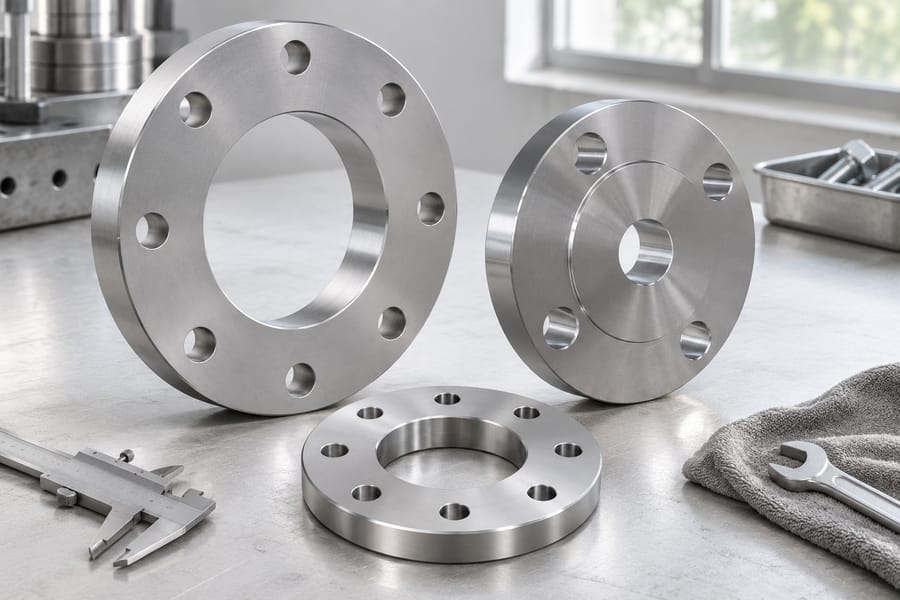
Stainless steel forged flanges are selected according to material grade, corrosion resistance, fabrication requirements, and operating conditions. Different stainless steel families offer distinct properties for industrial piping connections.
This guide examines common ASTM A182 grades, their metallurgical characteristics, industrial applications, and verification requirements to help engineers and buyers make informed material selection decisions.
From Stainless Stock to a Finished Connection
How the Forged Component Takes Shape
A stainless steel forged flange is a piping component manufactured by shaping suitable stainless steel stock through controlled deformation. It forms a removable interface at a pipe end or equipment nozzle, with the mating component connected through the specified gasket and bolting arrangement.
During forging, the material is heated when required and formed under compressive force using appropriate tooling. Subsequent operations may include heat treatment, machining, and inspection to achieve the specified material condition and finished geometry.
Compared with cast stainless steel flanges, forged products are produced through a different manufacturing route. Forging deforms solid material, whereas casting involves pouring molten metal into a mold.
These processes produce different material structures and require different manufacturing controls.
Neither manufacturing route automatically guarantees suitability for every application. Engineers should evaluate material specifications, manufacturing quality, inspection results, component geometry, and actual service requirements before approving a flange.
Specify the Material and Finished Flange Separately
For the stainless grades discussed here, A182 is the product specification used to order the applicable forged or rolled piping component. The chosen A182 grade entry sets the chemistry and property requirements that procurement must carry through to inspection.
ASME flange standards serve a different purpose. They establish dimensional requirements and pressure-temperature ratings for applicable flange configurations. Therefore, specifying an ASTM material grade alone does not fully define a finished flange.
A purchase specification should identify both the required material and the applicable flange standard. The specified pressure Class must also be interpreted through the relevant pressure-temperature tables rather than treated as an equivalent pressure value in psi.
For example, an F316L flange manufactured to a specified ASME dimensional standard must satisfy both the applicable ASTM material requirements and the relevant flange design requirements.
Changing the manufacturing route does not automatically change its standard pressure rating.
Common Stainless Steel Forged Flange Grades and Their Differences
F304 and F304L: General-Purpose Austenitic Stainless Steel
F304 is a commonly specified austenitic stainless steel grade for industrial piping components. For compatible general service, it combines established fabrication practice with resistance to the corrosion mechanisms relevant to that environment.
Typical applications include process piping, industrial equipment connections, and selected food-related systems. Its suitability depends on fluid chemistry, operating conditions, cleaning procedures, and the possibility of localized corrosion.
F304L is the low-carbon counterpart of F304. With less carbon available, carbide formation during relevant heating cycles is reduced, helping preserve chromium near grain boundaries and lower the associated intergranular-corrosion risk.
This distinction becomes important when flanges undergo welding or other thermal operations. However, low-carbon material is not completely immune to sensitization or other corrosion mechanisms.
Actual performance still depends on thermal history, fabrication practices, and the service environment.
When choosing between F304 and F304L, buyers should consider the fabrication route and applicable material requirements rather than assuming the low-carbon designation automatically makes every installation more reliable.
F316 and F316L: Austenitic Stainless Steel for More Demanding Corrosive Environments
F316 contains molybdenum, which improves resistance to certain forms of localized corrosion compared with F304. This makes it a common consideration for process systems exposed to more demanding chemical environments.
Depending on the process chemistry, it can be specified for pharmaceutical pipework, chemical plant connections, or some equipment near marine environments. Molybdenum improves the alloy’s response to some exposures, but chloride-driven damage remains possible in F316.
F316L has a lower carbon content than F316, helping reduce sensitization risk following welding or other relevant thermal exposure. The distinction is particularly useful when selecting material for welded piping assemblies.
For example, a chemical processing facility may specify F316L flanges where welded connections are expected and the process fluid is compatible with the alloy. The engineering review must still consider concentration, temperature, deposits, and cleaning chemicals.
F316 and F316L should not be treated as seawater-proof materials. Stagnant seawater, deposits, crevices, and elevated chloride exposure can create conditions for pitting and crevice corrosion. More demanding services may require duplex or super duplex alternatives.
F321 and F347: Stabilized Austenitic Stainless Steel
F321 and F347 are stabilized austenitic stainless steel grades designed to address sensitization concerns associated with certain thermal exposure conditions. Their stabilization mechanisms differ from the low-carbon approach used in F304L and F316L.
F321 uses titanium as a stabilizing element, while F347 uses niobium. These elements preferentially combine with carbon, helping reduce the formation of chromium carbides that can contribute to intergranular corrosion.
Both grades can be considered for suitable welded equipment, process piping, and thermal applications. Selection depends on the actual thermal history, fabrication procedure, design requirements, and applicable material specification.
Stabilization alone is insufficient grounds for substituting F321 for F347 or the reverse. Their individual material requirements and fabrication characteristics must be checked against the application.
Check the project’s permitted-material list before approving either stabilized option.
F51 (S31803) and F60 (S32205): Duplex Stainless Steel
F51 and F60 belong to the duplex stainless steel family. Their microstructure contains both ferrite and austenite, combining characteristics associated with these two phases.
This structure provides a different mechanical and corrosion-resistance profile from conventional austenitic grades. Duplex materials are frequently considered for offshore equipment, chemical processing systems, and selected marine applications.
On the order, pair F51 with S31803 and F60 with S32205; these UNS identifiers belong to separate A182 grade entries. Their close relationship does not remove the need to specify which duplex grade is being purchased.
Resolve the grade designation against the order and the invoked A182 edition before accepting the material.
Manufacturing quality is particularly important for duplex forgings. Heating, deformation, cooling, and solution heat treatment influence the resulting phase balance and microstructure.
Incorrect processing can produce excessive ferrite or promote undesirable secondary phases. Consequently, chemical composition alone cannot establish whether a duplex flange has achieved the required metallurgical condition.
F53 (S32750) and F55 (S32760): Super Duplex Stainless Steel
F53 and F55 are super duplex stainless steel grades intended for demanding corrosion environments. They are considered when conventional austenitic or standard duplex grades may not provide sufficient resistance under the specified service conditions.
Their alloy design targets greater resistance to pits and attack within crevices when the exposure remains appropriate for the selected grade. They may also be considered where chloride-related stress corrosion cracking is a significant design concern.
F53 corresponds to UNS S32750, while F55 corresponds to UNS S32760. Their individual alloy requirements and material specifications should be reviewed rather than assuming that all super duplex grades behave identically.
Typical applications include offshore production systems, seawater handling equipment, desalination facilities, and demanding chemical processing installations. The engineering review must still cover deposits and flow behavior alongside chemistry, temperature, and the condition left by fabrication.
Super duplex materials require careful control during forging and subsequent processing. Appropriate solution heat treatment and cooling help establish the required microstructure, while inspection may be necessary to evaluate phase balance and detect harmful secondary phases.
Comparison of Major Stainless Steel Forged Flange Grades
The following table provides a practical starting point for comparing common ASTM A182 stainless steel grades. Use the table for screening, then check the exact specification and the exposure conditions at the connection.
| Grade | Material Family | Main Selection Consideration | Typical Applications |
| F304/F304L | Austenitic | General corrosion resistance and fabrication requirements | Industrial and general process piping |
| F316/F316L | Austenitic | Improved resistance to selected localized corrosion conditions | Chemical and pharmaceutical systems |
| F321 | Stabilized austenitic | Titanium stabilization | Thermal and welded piping systems |
| F347 | Stabilized austenitic | Niobium stabilization | Process and thermal equipment |
| F51/F60 | Duplex | Phase balance and corrosion resistance | Offshore and chemical systems |
| F53/F55 | Super duplex | Enhanced localized corrosion resistance | Seawater and demanding offshore systems |
When comparing similar grades, engineers should examine more than their general corrosion classifications. Welding requirements, minimum design temperature, thermal exposure, microstructure, and inspection provisions can change the preferred choice.
Applications of Stainless Steel Forged Flanges by Industry
Chemical and Petrochemical Processing
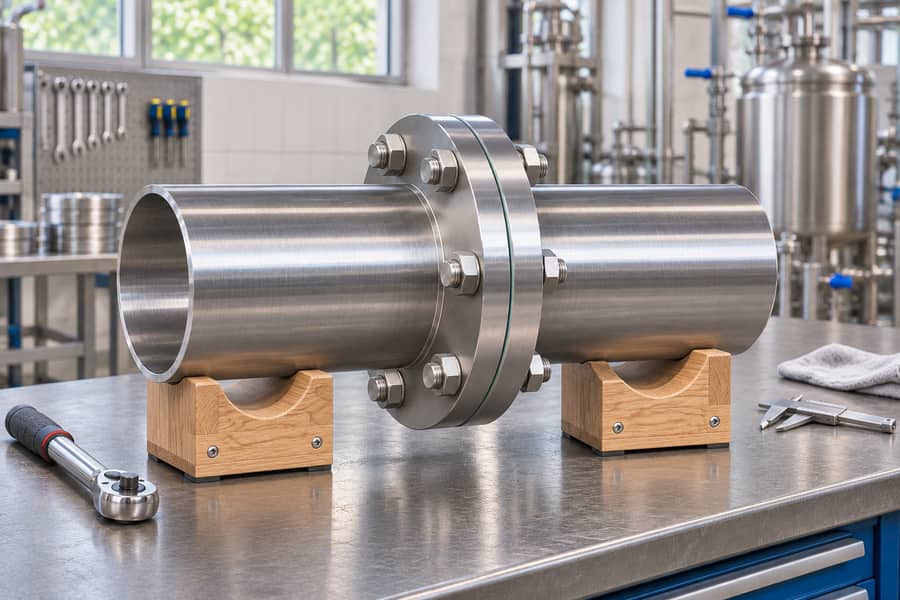
Chemical and petrochemical facilities use stainless steel forged flanges to connect process piping, pumps, vessels, and other equipment. Material selection depends heavily on the chemicals being transported and their operating conditions.
F304 and F304L may be appropriate for compatible general process fluids, while F316 and F316L offer improved resistance to selected corrosive environments.
If those austenitic options cannot satisfy both the corrosion review and the mechanical design, evaluate a suitable duplex or super duplex grade.
For example, a process line handling a chloride-containing solution requires more than a simple comparison of stainless steel grades. Engineers must examine chloride concentration, temperature, fluid velocity, deposits, and potential crevice locations.
Oil and Gas and Offshore Engineering
Oil and gas installations use forged flanges in piping networks, process equipment, and connections exposed to challenging operating conditions. Offshore systems may involve chlorides, produced fluids, chemicals, and changing environmental conditions.
Offshore selection often brings duplex families into the review because chloride-driven pits and crevice attack can govern material choice. Their selection must account for fabrication procedures, heat treatment, inspection requirements, and compatibility with connected materials.
Not every offshore connection requires super duplex stainless steel. A suitable specification should reflect the actual service environment rather than automatically selecting the highest alloy grade available.
Marine, Seawater, and Desalination Systems
Marine installations and desalination facilities expose components to chloride-containing environments. Flanges may encounter seawater, concentrated brine, deposits, and stagnant conditions that increase localized corrosion risks.
Although F316 is more resistant to certain localized corrosion conditions than F304, it is not universally suitable for direct seawater exposure. Duplex and super duplex materials may offer more appropriate alternatives depending on the design environment.
Engineers should also consider flange crevices, gasket interfaces, flow conditions, and maintenance access. Even a compatible alloy needs a joint arrangement and operating practice that manage stagnant zones and aggressive deposits.
Food, Pharmaceutical, and Hygienic Processing
Food and pharmaceutical facilities use stainless steel flanges where material compatibility, cleaning procedures, and contamination control are important. F304L and F316L may be considered depending on product chemistry and cleaning conditions.
Surface finish also matters. The sealing face and other product-contact surfaces should meet the applicable engineering and hygiene requirements. Material selection alone does not establish that a complete piping assembly meets a particular hygienic design requirement.
Traceability is especially useful when components are installed in systems with controlled material documentation. Buyers should confirm grade markings, inspection records, and relevant material certificates before installation.
Power Generation and Thermal Processing
Power generation and thermal processing systems may require stainless steel flanges exposed to welding, temperature changes, and demanding operating conditions. F321 and F347 can be considered for suitable applications where stabilization is relevant.
Selection should account for actual design temperature, thermal cycling, fluid composition, and the specified pressure-containing component requirements. Stabilized grades are not automatic replacements for every conventional austenitic grade.
Metallurgical and Fabrication Considerations for Stainless Steel Forgings
Sensitization and Low-Carbon Grades
Sensitization occurs when certain thermal exposure conditions promote chromium carbide precipitation near stainless steel grain boundaries. Chromium depletion beside the grain boundaries can leave those narrow regions more vulnerable to intergranular attack.
F304L and F316L reduce this risk through lower carbon content. However, the reduction should not be interpreted as complete immunity, particularly when fabrication procedures or service conditions are unsuitable.
For welded flange assemblies, engineers should review material grade, welding procedure, heat input, and thermal history. The selected filler material and post-weld treatment must also comply with applicable engineering requirements.
Phase Balance in Duplex and Super Duplex Forgings
Duplex stainless steel depends on an appropriate balance between ferrite and austenite. Both phases contribute to the intended material properties, so the final microstructure must be controlled throughout manufacturing.
Unsuitable heating, cooling, or solution heat treatment can disturb this balance. Excessive ferrite or the formation of undesirable secondary phases may reduce corrosion resistance and affect mechanical performance.
For this reason, duplex and super duplex forgings require more than chemical composition checks. Where specified, metallographic examination and other suitable verification methods should confirm that processing has produced an acceptable microstructure.
Welding, Heat Treatment, and Machining
Stainless steel grades require fabrication procedures suited to their individual metallurgical characteristics. Austenitic, stabilized austenitic, duplex, and super duplex materials should not be processed under one assumed universal procedure.
Welding controls may include filler selection, heat input, interpass temperature, and cooling practices. Duplex materials require particular attention because inappropriate thermal cycles can affect phase balance and promote unwanted phases.
Set the thermal-processing route to deliver the material condition required by the cited specification and approved production plan. Solution heat treatment is especially relevant to duplex and super duplex products, while post-weld treatment decisions depend on grade and application requirements.
Machining also requires attention to the selected alloy. Work hardening, cutting conditions, tool selection, and surface finishing can affect production consistency and the condition of finished flange features.
Important machining operations include bore finishing, bolt-hole drilling, bolt-circle machining, and sealing-face preparation. These features must match approved drawings and the applicable flange standard.
Keeping Finished Surfaces Clean
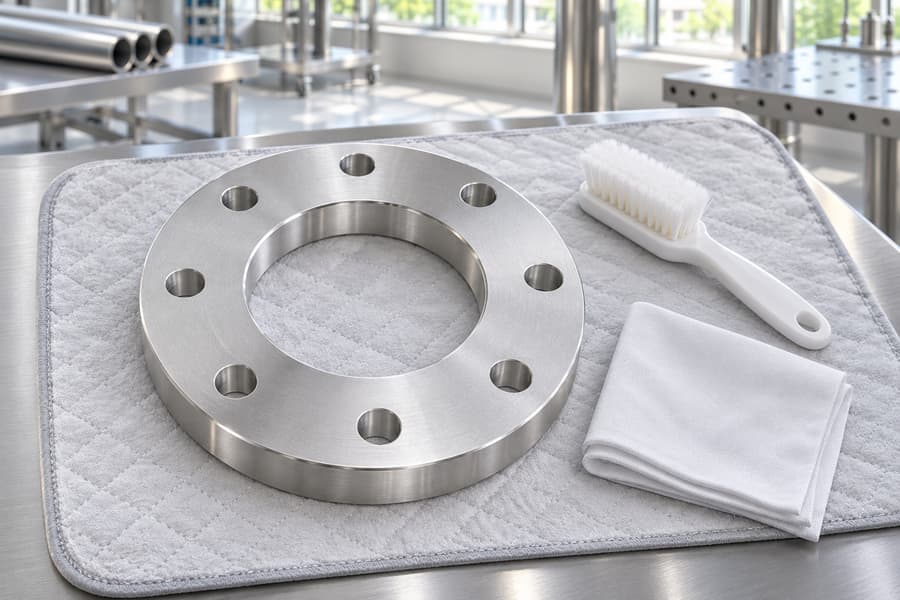
Keep stainless flanges separate from carbon steel grinding debris, wire brushes, and dirty lifting slings. Embedded iron can leave rust staining that obscures the condition of the finished surface.
Use clean supports and dedicated tools during handling. Protect machined gasket faces from knocks, grit, and adhesive residue; a bright appearance alone does not demonstrate correct surface preparation.
Specify cleaning or passivation when the project requires it. Neither operation repairs deep machining damage or compensates for the wrong alloy, unsuitable welding, or an unacceptable heat-treatment condition.
Material Verification, PMI, and Traceability
Positive Material Identification for Stainless Steel Flanges
Positive Material Identification, commonly called PMI, helps verify the alloy identity of stainless steel components. It is particularly useful when multiple grades are processed, stored, or installed within the same production environment.
PMI can identify important alloying elements and help distinguish material families. For example, checking chromium, nickel, and molybdenum content can help identify differences between common austenitic and duplex stainless steel grades.
Use PMI to answer the alloy-identity question; other tests and records must establish the remaining acceptance requirements. Its usefulness depends on the instrument, testing method, material condition, and acceptance criteria.
Limitations of Handheld XRF Testing
Handheld X-ray fluorescence equipment is widely used for alloy identification because it can detect many important metallic elements. It is useful for checking material identity during receiving inspection and production verification.
Ordinary handheld XRF equipment cannot reliably measure carbon content. Consequently, it cannot independently distinguish F304 from F304L or F316 from F316L through carbon measurement.
This limitation matters when the purchase specification requires a low-carbon grade. Buyers should review the material test certificate and use appropriate laboratory chemical analysis when carbon verification is necessary.
XRF also cannot establish whether a flange received the required heat treatment or achieved an acceptable duplex phase balance. Chemical composition and metallurgical condition are separate inspection questions requiring different evidence.
Heat-Treatment Verification and Microstructure Examination
Heat-treatment verification begins with reviewing applicable manufacturing records. These should identify the relevant material heat, treatment condition, and processing information required by the governing specification.
For duplex and super duplex grades, microstructure examination may be necessary to assess phase balance and identify undesirable secondary phases. The examination method and acceptance criteria should follow the applicable specification or approved inspection requirements.
Mechanical test results provide additional information about material properties, but they do not independently establish every aspect of metallurgical condition. Each inspection method should address a clearly defined requirement.
Material Traceability and Inspection Documentation
Traceability connects the finished flange to its original material identification and manufacturing records. Without effective identification control, components with similar appearances can become mixed during storage, machining, or assembly.
Purchasers should review material test certificates, heat numbers, grade markings, and applicable inspection records. The identification on the finished component should correspond with its supporting documentation.
For components requiring PMI, records should identify the tested item and corresponding result. Additional documents may cover heat treatment, mechanical testing, dimensional inspection, and microstructure verification where applicable.
Stainless Steel Forged Flange Manufacturing and Customization at Boberry Machining
Boberry Machining offers stainless and duplex forged flange families with weld-neck, slip-on, blind, and other connections. Custom options include bore, bolt-circle and sealing-face machining.
Practical RFQ Checklist for Stainless Steel Forged Flanges
A complete request for quotation helps prevent misunderstandings between the purchaser and manufacturer. Use these fields to remove ambiguity from the material, geometry, and verification scope of the order.
| RFQ Item | Information to Provide | Purpose |
| Material grade | F304, F304L, F316, F316L, F321, F347, F51, F60, F53, or F55 | Identifies the required material |
| Material specification | Applicable ASTM A182 requirements and UNS designation where relevant | Defines material and product requirements |
| Flange standard | Applicable ASME dimensional and pressure-temperature standard | Establishes design and dimensional requirements |
| Flange configuration | Weld-neck, slip-on, blind, or another specified type | Defines the connection arrangement |
| Pressure Class | Specified flange Class and design conditions | Supports pressure-temperature rating verification |
| Facing | Raised face, flat face, or another specified arrangement | Establishes mating and gasket requirements |
| Dimensions | Bore, thickness, bolt circle, bolt holes, and sealing-face details | Defines manufacturing geometry |
| Inspection | Applicable PMI, testing, heat-treatment, and microstructure requirements | Establishes verification expectations |
| Documentation | Material certificates, heat identification, and required inspection records | Maintains material traceability |
For duplex and super duplex orders, purchasers should explicitly state any required phase-balance or microstructure verification. A general request for PMI does not establish that these metallurgical requirements have been satisfied.
Likewise, buyers specifying F304L or F316L should identify whether carbon verification is required. Ordinary handheld XRF testing cannot independently confirm the low-carbon designation.
Before approving production, review the quotation against the original technical specification. Resolve differences in grade designation, flange dimensions, facing, pressure Class, and inspection documentation before manufacturing proceeds.