
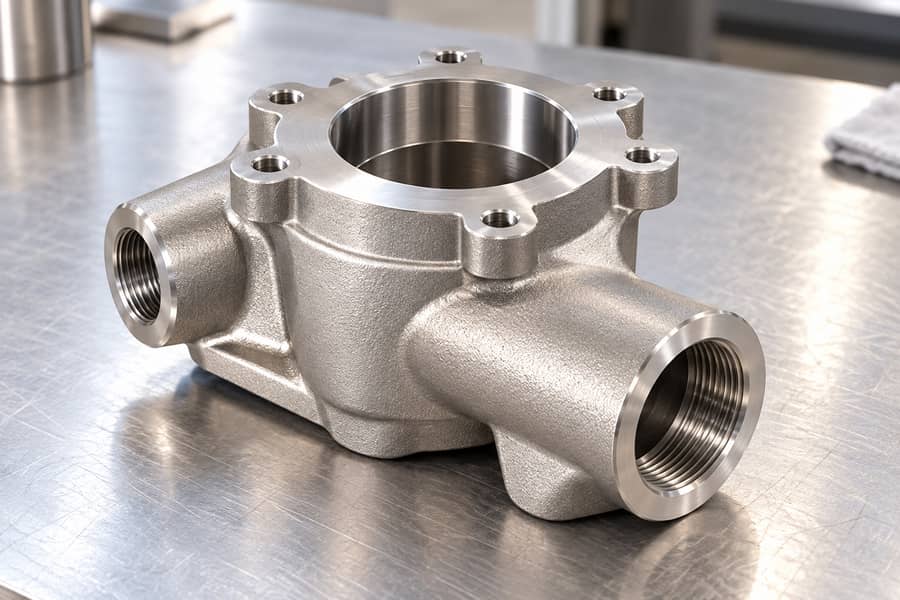
A stainless steel casting forms when molten alloy solidifies inside a mold, creating a component whose corrosion performance depends on its grade and processing.
Choosing a suitable grade requires more than comparing alloy names: engineers must assess the cast specification, operating environment, mechanical loads, manufacturing route, and inspection requirements for each component.
Understanding Stainless Steel Casting and Material Specifications
How Stainless Steel Casting Produces Complex Components
Stainless steel casting involves melting a specified alloy, pouring the molten metal into a suitable mold, and allowing it to solidify into the required geometry.
Subsequent operations may include mold removal, cleaning, heat treatment, machining, and inspection.
This manufacturing route accommodates complex contours, integrated mounting features, curved passages, and sections with different dimensions.
It can reduce the need to assemble multiple pieces, although component geometry must still support reliable mold filling and controlled solidification.
Unlike processes that shape solid metal through deformation, casting depends on molten metal flow, heat transfer, and solidification behavior. These factors influence the finished component’s microstructure, dimensional consistency, and susceptibility to internal discontinuities.
Cast Stainless Steel vs. Wrought Stainless Steel
Cast and wrought stainless steels may have related chemical compositions, but their manufacturing histories and material specifications differ.
Wrought products undergo deformation through processes such as rolling or forging, while cast products solidify directly from molten metal.
This distinction matters when engineers compare mechanical properties, inspect material certificates, or consider replacing one product form with another.
Similar alloy chemistry does not establish identical microstructures, mechanical performance, or compliance with a component’s governing design requirements.
For example, CF8 belongs to a cast austenitic grade family commonly associated with wrought 304 stainless steel, while CF8M is associated with the wrought 316 family.
Neither relationship makes the cast and wrought grades automatically interchangeable.
Casting Standards and Grade Designations
Material selection should begin with the applicable specification rather than a general stainless steel designation.
ASTM A351 addresses specified austenitic steel castings for pressure-containing service, while ASTM A743 and ASTM A744 cover other defined categories of corrosion-resistant alloy castings.
Engineers should verify the standard’s scope, the precise grade, required heat treatment, mechanical properties, and applicable acceptance criteria. The correct specification depends on the component’s service conditions and purchasing requirements, not simply its intended industry.
Common Stainless Steel Casting Grades and Their Differences
Austenitic Stainless Steel Casting Grades
Austenitic casting grades are widely considered for components requiring corrosion resistance and useful mechanical properties. Differences in carbon content, molybdenum addition, and stabilization influence their suitability for particular environments and fabrication conditions.
- CF8: A general-purpose austenitic casting grade considered for industrial components exposed to moderately corrosive environments. Final suitability depends on the process fluid, temperature, and specified mechanical properties.
- CF8M: A molybdenum-containing austenitic casting grade considered where resistance to certain forms of localized corrosion is important. Molybdenum improves resistance to some pitting environments but does not make the grade immune to chloride attack.
- CF3: A low-carbon austenitic casting grade used where reducing sensitization concerns during welding or thermal exposure is relevant.
- CF3M: A low-carbon, molybdenum-containing austenitic casting grade considered when both carbon-related welding concerns and particular corrosion requirements influence selection.
- CF8C: A stabilized austenitic casting grade considered for applications where its specified composition and service requirements are appropriate.
When comparing these grades, engineers should evaluate the complete specification and required delivery condition. A lower carbon content or additional alloying element can address particular concerns, but neither automatically resolves every corrosion or fabrication limitation.
Martensitic Stainless Steel Casting Grades
Martensitic casting grades are considered when strength, toughness, and selected corrosion resistance must be balanced. Their final properties depend significantly on chemical composition, heat treatment, and the requirements imposed by the component’s operating loads.
CA6NM: This low-carbon martensitic stainless steel casting grade is used in selected hydraulic, turbine-related, and mechanical applications.
Engineers should verify the specified heat treatment, strength, toughness, and corrosion requirements rather than assuming that the grade alone establishes suitability.
Duplex Grades for Strength and Corrosion Requirements
In duplex cast stainless steel, the metal contains a mixture of austenite and ferrite rather than a predominantly single-phase structure. Their microstructure can provide higher strength than many conventional austenitic grades, alongside resistance to selected corrosion mechanisms when composition and processing are properly controlled.
- CD3MN: A duplex casting grade associated with the wrought 2205 alloy family. For a heavily loaded pump in chloride-bearing liquid, engineers may shortlist this grade after reviewing temperature, chemistry, and the required casting specification.
- CD4MCuN: A copper-containing duplex casting grade considered for selected aggressive corrosion environments. Its suitability depends on the actual chemical exposure, temperature, and specified material condition.
Duplex grades require attention to heat treatment and phase balance because unsuitable processing can impair their intended properties. Neither grade should be selected solely because a component operates in seawater or another chloride-containing environment.
Comparison of Common Cast Stainless Steel Grades
The following comparison provides an initial screening reference. It does not replace the governing material specification, application-specific corrosion assessment, or verification of mechanical requirements.
| Cast grade | General characteristics | Primary selection consideration |
| CF8 | Austenitic, general-purpose corrosion resistance | General industrial service conditions |
| CF8M | Molybdenum-containing austenitic | Selected localized-corrosion concerns |
| CF3 / CF3M | Low-carbon austenitic | Welding and thermal-exposure requirements |
| CF8C | Stabilized austenitic | Specified composition and service conditions |
| CA6NM | Martensitic | Strength, toughness, and heat treatment |
| CD3MN | Duplex | Strength and selected corrosion conditions |
| CD4MCuN | Copper-containing duplex | Specific aggressive corrosion environments |
Properties That Determine Stainless Steel Casting Performance
Corrosion Resistance and Environmental Limitations
Stainless steel develops a chromium-rich passive film that helps protect its surface from corrosion. The effectiveness of this protection depends on alloy composition, environmental chemistry, temperature, and the condition of the finished surface.
Molybdenum can improve resistance to certain forms of localized corrosion, which is one reason CF8M may be considered where CF8 requires further evaluation.
However, neither grade is universally suitable for chloride-bearing solutions, concentrated chemicals, or every combination of temperature and exposure.
Identify whether the damage mechanism removes metal broadly, attacks small pits or sheltered crevices, or produces cracking under stress in a chloride-containing environment. Deposits, stagnant fluid, gasket interfaces, and narrow gaps can create local conditions that differ substantially from the surrounding environment.
Material assessment should therefore document the actual fluid composition, concentration, operating temperature, cleaning conditions, exposure duration, and potential deposits. Where published information does not adequately represent service conditions, application-specific corrosion testing may be necessary.
Mechanical Strength, Toughness, and Temperature Performance
Mechanical properties determine how a casting responds to operating loads. Tensile strength, yield strength, elongation, and impact toughness provide different information, so the relevant acceptance requirements must reflect the component’s intended function.
A pressure-containing valve body requires adequate structural integrity under specified pressure conditions, while a rotating impeller may face cyclic loading, vibration, and fatigue concerns.
These applications should not be evaluated using tensile strength as the sole indicator of performance.
Temperature also affects material suitability.
Elevated temperatures can change strength and microstructure, while low-temperature applications may require specific toughness verification.
Engineers should use values established for the specified cast grade and material condition rather than generic figures for a related alloy family.
Microstructure, Heat Treatment, and Weldability
Solidification creates a microstructure that differs from that of wrought products with related chemistry. Cooling conditions, section thickness, and subsequent heat treatment influence phase distribution and the resulting mechanical properties.
Heat treatment must follow the applicable grade requirements because an unsuitable cycle can adversely affect toughness, corrosion resistance, or dimensional stability.
The specified treatment should therefore be considered part of the material requirement rather than an optional finishing detail.
Weldability also varies with grade and service conditions. Low-carbon grades can reduce certain sensitization concerns, but welding procedures, joint design, filler selection, and any required post-weld treatment still need appropriate engineering review.
Industrial Applications of Stainless Steel Castings
Chemical Processing and Fluid Handling
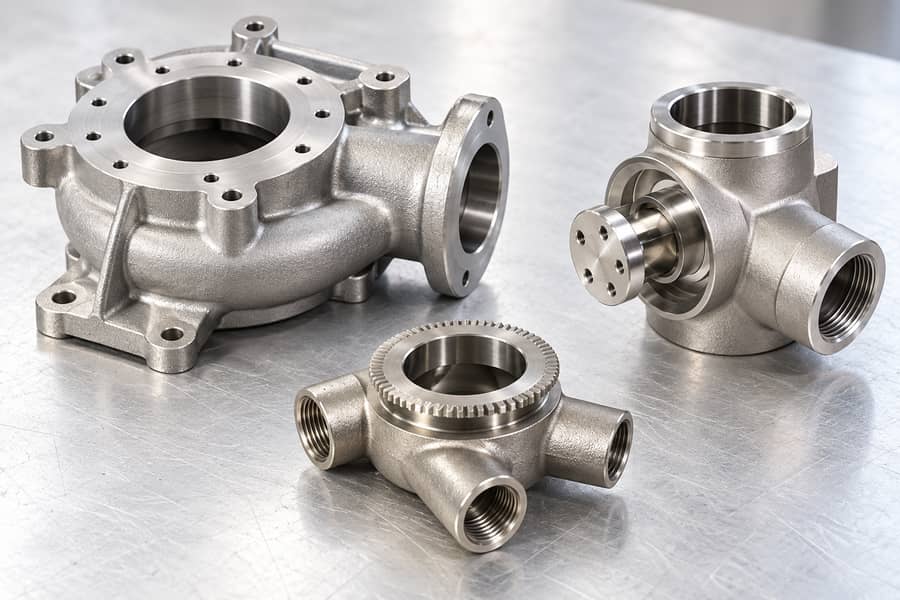
Stainless steel castings are used in selected pump casings, valve bodies, impellers, and process equipment components.
Casting can accommodate complex fluid passages and integrated mounting features, reducing the need to manufacture and assemble several separate parts.
Grade selection depends on fluid chemistry, concentration, pressure, temperature, and potential corrosion mechanisms. CF8 may be considered for some general industrial services, while CF8M or a duplex grade may warrant evaluation under more demanding conditions.
The decision should reflect the actual operating environment and applicable material requirements. A grade that performs adequately in one process fluid may not provide suitable resistance when concentration, temperature, or exposure conditions change.
Marine, Water, and Desalination Equipment
Selected marine and water-handling components encounter dissolved salts, moisture, and potentially aggressive fluids. Pump components, valve bodies, and related equipment may require particular attention to pitting and crevice corrosion.
Seawater exposure does not automatically establish which stainless steel grade is appropriate. Engineers should consider chloride concentration, temperature, stagnant regions, deposits, and maintenance conditions before approving a material for service.
Food, Pharmaceutical, and Hygienic Equipment
Selected cast components in food and pharmaceutical processing equipment must balance corrosion resistance, cleanability, and dimensional requirements. Applications may include pump housings, valve bodies, and other components exposed to process liquids or cleaning agents.
Material selection should consider cleaning temperatures, chemical concentrations, product-contact requirements, and contamination risks. Surface finish alone does not establish hygienic suitability; drainage, crevice avoidance, joint design, and applicable equipment requirements also influence the final design.
Power, Energy, and General Mechanical Equipment
Stainless steel castings can serve in selected turbine-related components, industrial housings, and mechanical equipment exposed to combined thermal and mechanical loads.
The appropriate grade depends on operating temperature, cyclic stress, fluid exposure, and governing design requirements.
For rotating components, fatigue resistance, dimensional consistency, balance, and casting discontinuities may require careful evaluation. Pressure-containing components need suitable material verification and any pressure or leak testing required by their design and applicable specifications.
Casting Processes, Design Considerations, and Manufacturing Risks
Sand Casting and Investment Casting
Stainless steel casting requires mold materials and process controls suited to steel’s melting temperature, fluidity, and solidification behavior. Sand casting and investment casting serve different component requirements rather than providing interchangeable solutions.
Sand casting uses a prepared sand mold and may suit larger components or geometries where mold preparation and production volume influence the manufacturing decision.
Investment casting uses disposable patterns and ceramic molds, making it useful for intricate shapes and features that may otherwise require extensive machining.
When evaluating stainless steel casting options, engineers should compare component dimensions, geometry, material grade, surface requirements, and machining allowances. Choose the manufacturing route with inspection in mind: critical internal regions and finished surfaces must remain accessible to the agreed examination methods.
Investment casting may be appropriate for components with complex contours, integrated features, or detailed surfaces. However, achievable dimensions and surface quality depend on the part design, casting route, and subsequent processing requirements.
Solidification, Shrinkage, and Dimensional Control
During solidification, stainless steel contracts as it cools. Abrupt changes in section thickness, poorly designed junctions, or inadequate feeding can contribute to shrinkage cavities, porosity, and dimensional variation.
Design reviews should identify heavy intersections, thin sections, difficult internal passages, and surfaces requiring machining. These features influence mold design, metal feeding, cooling behavior, and the amount of material needed for subsequent finishing.
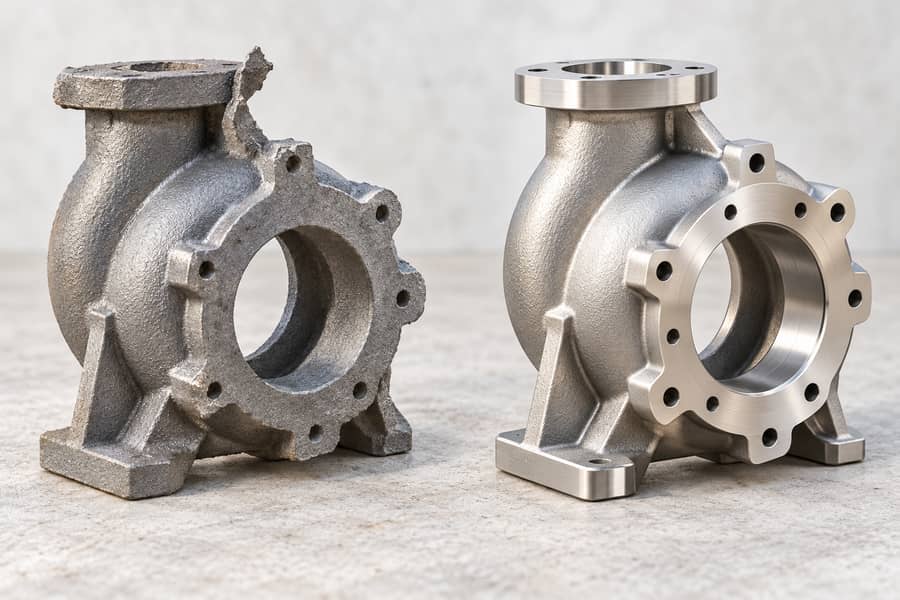
Dimensional tolerances should distinguish as-cast surfaces from machined interfaces.
Critical bearing seats, sealing faces, mounting holes, and alignment features may require additional machining, while other surfaces may remain as cast if their dimensions satisfy the approved drawing.
Common Casting Defects and Their Engineering Consequences
Potential casting defects include gas porosity, shrinkage cavities, inclusions, hot tears, and surface discontinuities. Their significance depends on location, size, loading conditions, corrosion exposure, and the function of the affected region.
- Pressure-containing components: Define internal soundness requirements and appropriate acceptance criteria for relevant discontinuities.
- Fatigue-loaded components: Examine highly stressed regions, geometric transitions, and areas where defects could initiate cracks.
- Corrosion-critical surfaces: Assess discontinuities that may retain deposits or create localized corrosion sites.
- Machined interfaces: Confirm sufficient machining allowance to achieve final dimensions without exposing unacceptable subsurface defects.
Selecting the Right Stainless Steel Casting Grade
Define the Service Environment
Start material selection with the actual operating conditions rather than a broad description such as corrosion-resistant service. Record the process fluid, chemical concentration, operating temperature, pressure, exposure duration, and cleaning conditions.
For chloride-bearing environments, evaluate pitting, crevice corrosion, and possible stress corrosion cracking.
Deposits, stagnant zones, and gasket interfaces can create localized conditions that differ from the bulk fluid, affecting the suitability of an otherwise reasonable candidate grade.
Match Material Properties to Component Design
Identify the governing mechanical requirements, including pressure loading, cyclic stress, impact, vibration, and temperature changes. A valve body, rotating impeller, and structural bracket may require different combinations of strength, toughness, fatigue resistance, and corrosion performance.
Review these requirements alongside wall thickness, geometry, welding, machining, and sealing arrangements.
Confirm that the proposed cast grade meets the applicable specification and design requirements instead of relying on properties associated with a related wrought alloy.
Validate Material Selection and Substitutions
Use specification-based material data to screen candidate grades, then investigate uncertainties that could affect service performance.
Corrosion testing or additional mechanical evaluation may be appropriate when the operating environment or loading conditions are not adequately represented by available data.
Material substitutions require documented technical review.
For example, replacing CF8M with CF8 changes the alloy composition and may reduce resistance to certain localized corrosion mechanisms, so approval should consider the actual fluid chemistry and service conditions.
Balance Manufacturing Requirements and Lifecycle Considerations
Compare casting complexity, machining requirements, inspection scope, expected maintenance, and replacement consequences alongside initial procurement cost.
A design requiring extensive machining or unusually demanding inspection may need a different manufacturing approach from a component with less critical dimensional requirements.
Lifecycle assessment should also consider corrosion-related maintenance, accessibility, spare-part compatibility, and the consequences of unexpected downtime. The preferred solution is the one that satisfies documented engineering requirements without adding unnecessary manufacturing or inspection complexity.
Quality Inspection and Practical Sourcing of Stainless Steel Castings
Verify Material Traceability and Documentation
Purchasing documents should identify the cast grade, governing specification, heat-treatment condition, and required acceptance criteria.
Material certificates should provide the specified chemical and mechanical test information, with heat or lot traceability maintained as required by the purchase order.
Review any supplementary requirements separately, including impact testing, corrosion testing, or special material verification. Check each required test against the supplied records; missing corrosion or impact results cannot be inferred from a certificate that reports chemistry alone.
Establish Dimensional and Nondestructive Inspection Requirements
Inspection planning should identify critical dimensions, sealing surfaces, interfaces, and regions exposed to significant mechanical stress.
Dimensional inspection verifies geometry, while nondestructive testing evaluates particular types of discontinuities according to the selected method and acceptance criteria.
A surface examination answers a different question from an internal scan. Penetrant methods, radiography, and ultrasound each need a procedure suitable for the particular casting.
Select methods according to the material, component geometry, expected defect type, and governing specification rather than assuming one method can detect every defect.
Evaluate Supplier Process Controls and Technical Compatibility
Review whether the proposed manufacturing route, grade, machining scope, and inspection plan match the component drawing. Clarify how material identification, heat treatment, nonconformance handling, and inspection results will be documented before production requirements are finalized.
Dimensional tolerances should be agreed for specific features and manufacturing stages. Distinguishing as-cast dimensions from finished machining dimensions helps prevent ambiguous acceptance decisions and unnecessary rework during final inspection.
Prepare a Complete Request for Quotation
A complete request for quotation allows engineering and procurement teams to compare proposals against consistent technical requirements. Include the drawing revision, quantity, material designation, operating conditions, finishing requirements, and required documentation.
| Requirement | Information to provide | Purpose |
| Component definition | Drawing, revision, dimensions, and quantity | Establish geometry and scope |
| Material specification | Cast grade, standard, and heat-treatment condition | Define material compliance |
| Operating conditions | Fluid chemistry, temperature, pressure, and loading | Support grade suitability assessment |
| Finishing requirements | Machining features, surface finish, and tolerances | Define final component acceptance |
| Quality requirements | Certificates, traceability, testing, and acceptance criteria | Establish inspection and documentation scope |
Discuss Your Casting Drawing with BOBERRY
For a BOBERRY project, confirm the proposed casting method, material grade, machining scope, inspection requirements, and achievable tolerances against the actual component drawing. Critical features and acceptance criteria should be agreed before production begins.
Send BOBERRY your component drawings and operating requirements to discuss suitable stainless steel casting options, material specifications, finishing needs, and project-specific inspection requirements.