
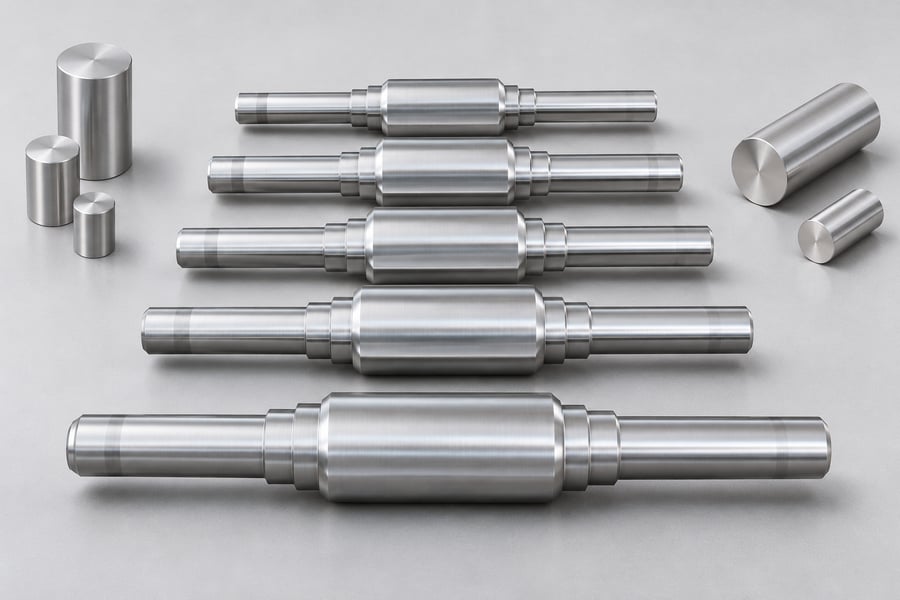
Longitudinal roll forging uses shaped rolls to form heated billets into elongated components, including shafts, rods, and stepped or tapered profiles. Material choice affects forming, heat treatment, machining, corrosion resistance, and service performance.
This guide compares representative grades and engineering tradeoffs. Examples are starting points, not confirmation that every grade or geometry is qualified for a particular roll-forging route.
Longitudinal Roll Forging and Its Process Scope
How Longitudinal Roll Forging Works
A heated billet passes through profiled rolls in successive passes. Each pass changes selected cross-sectional dimensions and redistributes material along the workpiece to develop the required elongated profile.
Unlike machining from solid bar, forging reshapes the billet through plastic deformation. Starting dimensions, alignment, reduction distribution, and intermediate handling influence material flow and the resulting profile.
Typical products include shafts, rods, and stepped components. Boberry lists these forms and five material families within its roll forging services; the specific grade and geometry still require technical review.
Longitudinal Roll Forging vs. Ring Rolling
Longitudinal roll forging develops elongated components through progressive forming along the workpiece. Ring rolling starts with an annular preform and expands its diameter while controlling the ring cross-section.
An annular component should not be assigned to longitudinal roll forging by name alone.
The processes also create different deformation patterns and tooling contacts. A grade suitable for one route is not automatically suitable for the other, so material and geometry must be reviewed together.
Key Factors in Selecting Materials for Roll Forging
Mechanical Properties and Service Requirements
Begin with expected loads and failure modes, not a material’s strength label. Shafts may experience bending, torsion, cyclic loading, impact, or local contact stresses, sometimes in combination.
A tensile test alone cannot establish whether the shaft will tolerate impact or repeated load cycles. Wear requirements should also be separated from bulk strength because a hard surface and a tough core may be needed together.
Record the working temperature and surrounding media, then check the mass budget and the amount of dimensional movement the assembly can tolerate. State these conditions in the drawing or specification rather than relying on assumptions about a material family.
Material Composition and Forgeability
Forgeability is grade-specific. Carbon content, alloying elements, microstructure, billet condition, and prior processing affect how a material deforms during hot working.
A family name is not a process specification: grades can differ in hardenability, work-hardening, and phase-transformation behavior.
Section size and geometry also matter. Risks such as cracking, laps, uneven material flow, or internal discontinuities depend on starting stock, tooling, deformation sequence, and the proposed pass schedule.
Manufacturing and Engineering Considerations
Assess the complete route, including heat treatment, straightening where permitted, machining, surface finishing, and inspection. These operations can change the practical material choice.
Drawings should identify critical dimensions, datums, and machining stock. This distinguishes the forged profile from the finished geometry and avoids unrealistic expectations for as-forged surfaces.
Carbon Steel for Roll Forging
Representative Carbon Steel Grades
- AISI 1020: Low-carbon steel often considered where formability and machinability are important; its response to through-hardening is limited compared with medium-carbon grades.
- AISI 1045: Medium-carbon steel used for many mechanical components, including shafts, where a different strength and hardness balance is required.
- AISI 1050: Higher-carbon steel considered for applications requiring a different hardening response, with correspondingly greater attention to processing sensitivity.
Two billets bearing the same grade number may arrive with different thermal histories and microstructures. Confirm the applicable standard, chemical composition limits, product form, and delivery condition.
Forgeability and Longitudinal Roll Forging Considerations
1020, 1045, and 1050 should not be assumed to share identical deformation limits. Increasing carbon content changes the steel’s hardening response and can affect processing sensitivity.
Billet quality and temperature uniformity influence forming consistency. Unsuitable reduction, uneven deformation, or poor starting-stock condition can contribute to defects that later machining may expose.
For shafts and rods, review section transitions because abrupt changes can concentrate deformation and affect the pass design and machining stock.
Alloy Steel for Roll Forging
Representative Alloy Steel Grades
- AISI 4140: Chromium-molybdenum steel commonly considered for mechanically loaded components requiring useful hardenability.
- AISI 4340: Nickel-chromium-molybdenum steel considered where a combination of strength and toughness is required.
- AISI 8620: Carburizing alloy steel used where a hardened surface case and comparatively tougher core are needed.
These grades serve different property objectives. A case-hardened component should not be specified as though it were equivalent to a through-hardened shaft.
Forgeability and Longitudinal Roll Forging Considerations
Chromium, nickel, and molybdenum affect hardenability and other material characteristics, but alloy content alone does not establish forgeability. Each grade requires its own processing assessment.
Hardenability describes a steel’s ability to develop hardness to a given depth under specified heat-treatment conditions. A hardness reading instead describes the tested material in its present state; it does not tell you how far a later quench will harden a thick section.
Actual hardening response depends on section size and heat transfer, so evaluate the component cross-section and intended thermal route.
A grade used successfully in another forging process is not automatically qualified for longitudinal roll forging. Review deformation, section transitions, and the proposed pass sequence against the actual drawing.
Stainless Steel for Roll Forging
Representative Stainless Steel Grades
- AISI 304 and 316: Austenitic stainless steels for corrosion-resistant applications; 316 contains molybdenum and may be preferred for certain environments, but neither grade resists every medium.
- AISI 410 and 420: Martensitic grades with different carbon levels and hardening responses.
- Duplex 2205: A stainless grade containing both ferrite and austenite; its thermal route must preserve the phase proportions required by the specification.
- 17-4PH (UNS S17400): Precipitation-hardening stainless steel whose final properties depend on the specified solution and aging condition.
Forgeability and Longitudinal Roll Forging Considerations
Austenitic 304 and 316 work-harden during deformation. Forming resistance can increase as strain accumulates, making pass design and intermediate condition important.
Martensitic 410 and 420 have different transformation behavior and subsequent hardening requirements. Their forming route should not be based on assumptions taken from austenitic grades.
Duplex 2205 requires attention to thermal history and phase balance. Unsuitable processing can promote unwanted microstructural changes, while 17-4PH requires control of its starting condition and later aging route.
Evaluate the exact stainless grade, section geometry, forming sequence, and required final condition; the family name alone does not establish feasibility.
Aluminum for Roll Forging
Representative Aluminum Grades
- 6061: Heat-treatable aluminum-magnesium-silicon alloy used in structural and mechanical applications.
- 6082: Heat-treatable aluminum-magnesium-silicon alloy used for structural components.
- 7075: Heat-treatable aluminum-zinc alloy considered where high strength relative to weight is important.
These alloys are not interchangeable. Their processing characteristics, corrosion behavior, and achievable conditions differ, so the grade and temper must be specified.
Forgeability and Longitudinal Roll Forging Considerations
Starting temper affects deformation because prior work and heat treatment change the material condition. A billet in a hardened temper may not behave like one supplied in a softened condition.
For 6061, 6082, and 7075, assess the proposed hot-working route against the alloy’s processing characteristics. Surface tearing, cracking, or nonuniform deformation may result when billet condition and forming sequence are unsuitable.
Not all aluminum alloys are precipitation hardenable. Many alloys in the 1xxx, 3xxx, and 5xxx series rely mainly on solid-solution effects and work hardening; that distinction does not itself establish suitability for roll forging.
Titanium for Roll Forging
Representative Titanium Grades
- Commercially Pure Titanium Grade 2: Considered where corrosion resistance and suitable mechanical properties align with the design.
- Ti-6Al-4V Grade 5: Alpha-beta titanium alloy used in demanding structural applications, with different processing requirements from commercially pure titanium.
Selection should reflect required properties, corrosion exposure, fabrication route, and final material condition.
Forgeability and Longitudinal Roll Forging Considerations
Titanium’s response to hot deformation depends on grade, microstructure, prior condition, and process control. Grade 2 and Grade 5 therefore require separate evaluation.
At elevated processing temperatures, titanium can react with oxygen and other contaminants, producing an oxygen-enriched surface layer commonly called alpha case. Surface protection and atmosphere control help limit contamination.
Review section geometry, strain distribution, material flow, surface condition, and whether affected surface material can be removed during finishing.
Grade-Specific Heat Treatment, Machining, and Corrosion Considerations
Heat Treatment Across Material Families
Heat treatment must match the grade and required final condition; there is no single route for an entire material family.
- Carbon steel: Normalizing may be specified for structure control. Quenching and tempering may suit 1045 or 1050, while 1020 has limited response to conventional through-hardening.
- Alloy steel: 4140 and 4340 may use quenching and tempering. 8620 is commonly associated with carburizing to create a hardened case and tougher core.
- Stainless steel: A quench-and-temper schedule intended to harden 410 cannot give austenitic 304 or 316 the same transformation-based response. Austenitic grades may be solution annealed; 410 and 420 can be hardened and tempered; 2205 needs solution treatment and phase-balance control; 17-4PH uses solution treatment and aging.
- Aluminum: 6061, 6082, and 7075 can be solution treated and aged, but schedules and final tempers are grade-specific. Non-heat-treatable alloys rely mainly on work hardening.
- Titanium: Grade 2 may be annealed or stress relieved as specified. Grade 5 may use grade- and condition-specific annealing, stress relief, or solution treatment and aging.
| Material examples | Post-forging route to evaluate | Main control |
| 1020, 1045, 1050 | Normalizing or suitable quenching and tempering | Carbon content, section size, required property location |
| 4140, 4340, 8620 | Quenching and tempering or carburizing, as applicable | Hardenability, case/core requirements, distortion |
| 304, 316, 410, 420, 2205, 17-4PH | Solution treatment, martensitic hardening, or aging | Stainless family, phase balance, specified condition |
| 6061, 6082, 7075 | Solution treatment and aging for heat-treatable grades | Temper changes during forming and final condition |
| Titanium Grade 2 and Grade 5 | Grade-specific annealing, stress relief, or thermal processing | Surface contamination, microstructure, final properties |
Machining Allowance and Dimensional Control
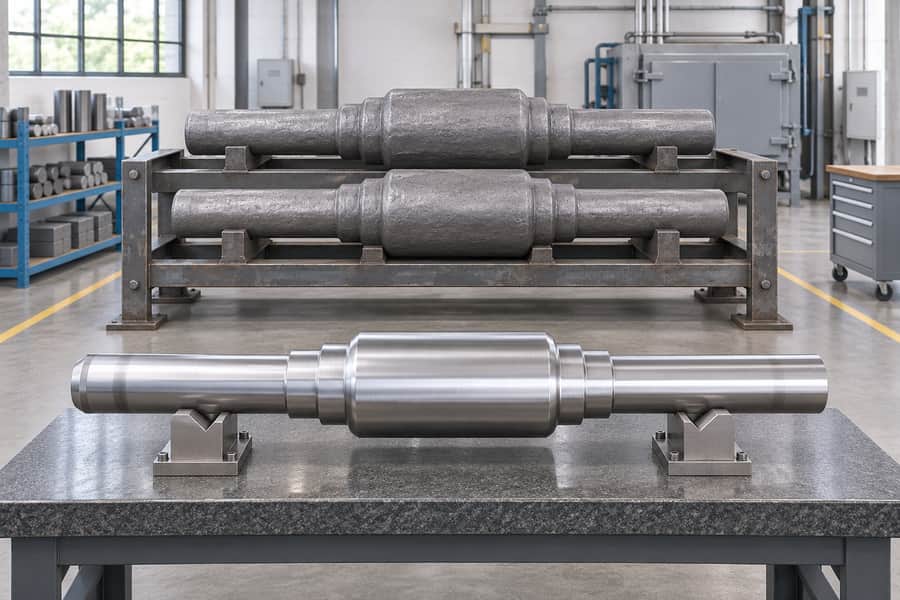
The forged profile and finished component are not necessarily identical. Machining stock should cover planned surface cleanup, datum creation, and final dimensional requirements.
Allocate allowance by feature rather than applying an arbitrary uniform addition. Critical diameters, shoulders, transitions, and end faces may require different machining strategies.
A thermally processed blank may leave the furnace with altered straightness or dimensions. Plan rough machining, heat treatment, straightening where permitted, and finish machining as one sequence when dimensions are critical.
Material condition also affects machining. Hardened alloy steel, work-hardened stainless steel, aged aluminum, and titanium require different cutting strategies and surface-integrity controls.
Corrosion and Surface Protection
Corrosion resistance depends on the actual medium, temperature, surface condition, and exposure pattern, not a broad material label.
Carbon and alloy steels may require coatings or other protection. Stainless grades must be selected for the corrosion mechanism, while aluminum and titanium require attention to galvanic contact and surface condition.
Surface treatments can affect dimensions, fatigue performance, friction, and assembly fit. Specify functional areas, treatment requirements, and post-treatment inspection where these factors matter.
Matching Roll Forging Materials to Different Service Requirements
The service requirement narrows the material candidates, but it does not prove that a grade and component geometry are suitable for longitudinal roll forging. The actual process route still needs review.
| Service requirement | Material candidates to evaluate | Decision focus |
| General mechanical shafts and rods | 1020, 1045 | Loads, machinability, final condition |
| Higher loading and toughness demands | 4140, 4340 | Hardenability, section size, heat treatment |
| Hardened surface with tougher core | 8620 | Carburizing route and case/core acceptance |
| Corrosive service | 316, 2205, selected titanium grades | Actual corrosion mechanism and exposure |
| Weight-sensitive components | 6061, 6082, 7075, Grade 5 titanium | Strength-to-weight needs and process feasibility |
| Specialized stainless requirements | 410, 420, 17-4PH | Hardening or aging condition and environment |
General Mechanical Shafts and Rods
Carbon steel may suit conventional mechanical requirements where corrosion can be managed. Alloy steel becomes relevant when a defined need for hardenability, strength, or toughness justifies its processing considerations.
Projects involving custom forged shafts should define load cases, finished interfaces, and heat-treatment condition before finalizing the grade.
For shafts, review torsion, bending, fatigue, keyways, shoulders, and bearing interfaces together. Meeting a tensile-property target alone does not establish suitability for the component’s complete loading condition.
High-Load and Wear-Resistant Components
4140 and 4340 may be evaluated for through-section mechanical requirements, subject to section-specific heat-treatment results. Specify test locations and acceptance criteria rather than relying on a grade name.
For an 8620 component, carburizing offers a route to a wear-resistant outer layer while retaining a less hard interior. Selected martensitic stainless grades may be considered where hardness and corrosion resistance both matter, subject to environmental limits.
Corrosive and Lightweight Applications
304, 316, and 2205 are possible stainless candidates, but chloride exposure, crevices, temperature, and stress can change corrosion performance. Titanium may suit selected aggressive environments when its processing demands are justified.
Aluminum alloys are candidates when low density matters and the design accommodates their mechanical characteristics. Grade 5 titanium may be considered where a different balance of strength, weight, and corrosion resistance is needed.
Material Specifications, Quality Control, and Procurement Requirements
Essential Material Information for RFQs
Identify the exact grade and standard rather than using shorthand such as “stainless,” “alloy steel,” or “aluminum.” Include the standard revision and required starting or delivery condition.
Include the following in the specification:
- Material: Exact grade, standard, and revision.
- Condition: Starting condition and required final heat treatment or temper.
- Properties: Mechanical requirements, test method, specimen location, and acceptance criteria.
- Geometry: Drawing revision, critical dimensions, datums, and machining stock.
- Service: Loads, temperature, corrosion exposure, and wear conditions.
- Inspection: Required chemical, mechanical, dimensional, and nondestructive examinations.
Where a standard permits several conditions, identify the intended one. This is particularly important for alloy steels, precipitation-hardening stainless steel, aluminum, and titanium.
Material Inspection and Quality Verification
Chemical analysis and material certificates help verify grade identity and traceability. Mechanical testing should match the specified condition, with test location and orientation defined where relevant.
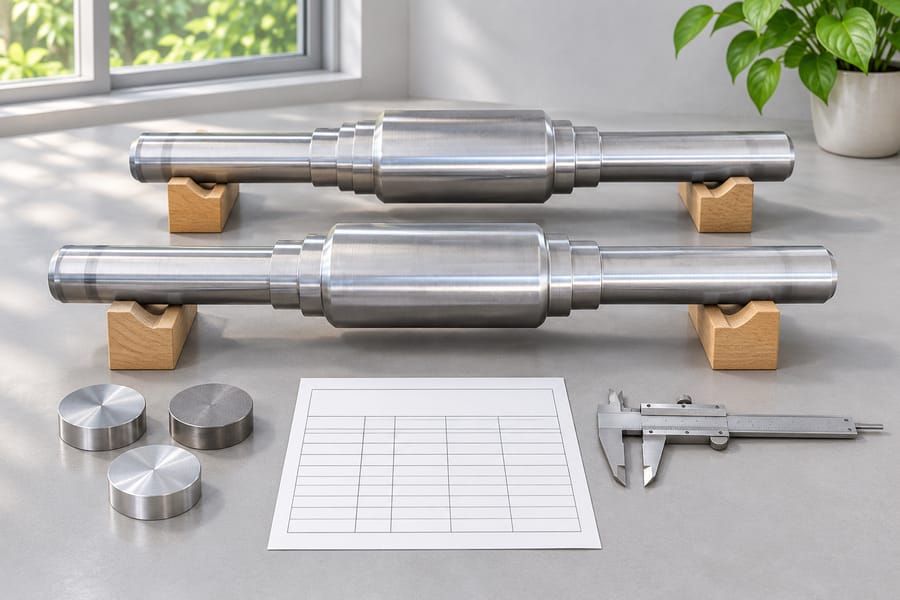
Dimensional inspection should use agreed datums and methods. For stock intended for machining, distinguish as-forged dimensions from finished-part acceptance dimensions.
Select surface and internal examinations according to material, geometry, likely defect types, and specification. Visual, magnetic-particle, penetrant, and ultrasonic methods are not interchangeable.
Confirming Grade-Specific Roll Forging Feasibility
A material’s suitability for a service environment does not prove that its grade and component geometry are suitable for longitudinal roll forging. Review billet size, profile changes, deformation requirements, tooling, and the proposed pass sequence.
Confirm the exact grade, starting condition, material availability, heat-treatment route, machining allowance, and inspection plan. A grade used in another forging process should not be treated as automatically qualified for this one.
Boberry’s roll forging manufacturing process provides process context, not grade-specific qualification. Feasibility should be established against the actual drawing and material specification.
Before production, agree on the forged condition, post-forging operations, final material condition, inspection scope, and acceptance criteria.