
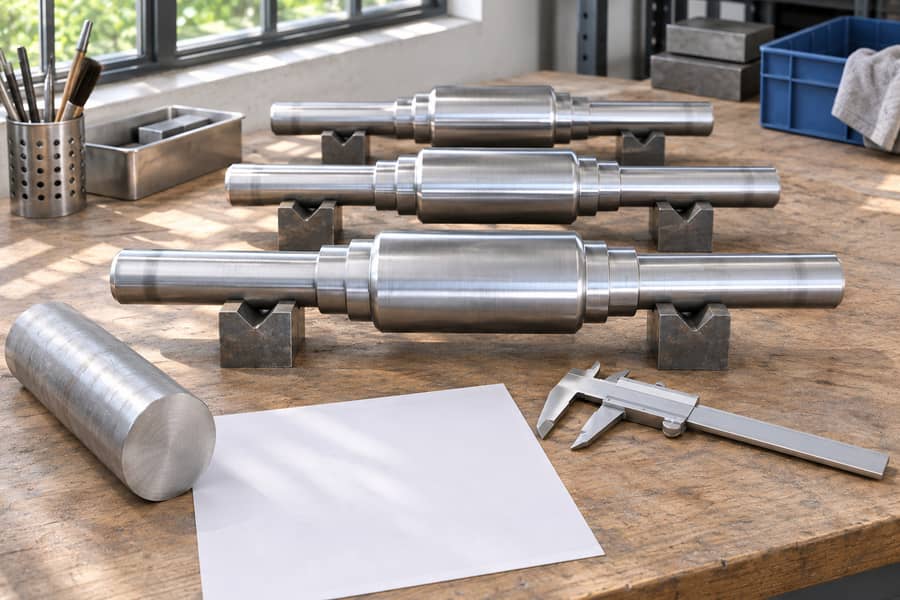
Longitudinal roll forging shapes heated billets through grooved-roll passes, producing shafts, rods, stepped sections, and tapered profiles. Manufacturing cost depends on material, blank preparation, tooling, forming, and downstream operations.
A sound cost review separates one-time tooling from recurring production, accounts for accepted parts without counting losses twice, and distinguishes manufacturing cost from selling price.
Scope and Cost Structure of Longitudinal Roll Forging
Longitudinal roll forging progressively deforms a heated billet between grooved rolls. Successive passes create an elongated profile with changes in diameter or cross-section. Unlike ring rolling, it produces long components rather than expanding an annular workpiece.
Typical products include shafts, rods, stepped sections, and tapered parts. The roll forging services page provides examples of this product scope, but the cost of an individual order depends on its drawing and delivery condition.
A quotation may cover a forged blank or a finished component. The latter may add heat treatment, machining, surface finishing, and inspection to material preparation and forming. Comparing different delivery conditions gives a misleading unit-price comparison.
Manufacturing cost covers material, labor, energy, tooling allocation, equipment overhead, and specified processing. Selling price may add commercial margin and selling or administrative expenses; freight, taxes, and installation should be identified separately.
| Cost Element | Typical Cost Behavior | Main Cost Drivers |
| Raw material | Recurring | Grade, blank dimensions, material yield |
| Blank preparation | Recurring | Cutting, handling, dimensional checks |
| Roll tooling | Mainly initial | Profile complexity, pass design |
| Setup and process development | Initial or batch-dependent | Engineering, alignment, trials |
| Heating and forging | Recurring | Energy, labor, equipment time |
| Tool maintenance | Recurring and condition-dependent | Wear, inspection, reconditioning |
| Post-forging processing | Order-dependent | Heat treatment, machining, finishing |
| Inspection and packaging | Order-dependent | Testing, documentation, protection |
Material Selection, Blank Preparation, and Material Yield
Material choice affects both purchase cost and the operations needed to form and finish the component. Projects may call for plain-carbon or alloyed steels; corrosion or weight requirements can instead lead to stainless grades, aluminum, or titanium.
Their availability, stock form, chemistry, and specification requirements can produce very different material budgets.
A lower-priced grade is not automatically the lower-cost choice. More demanding heating, deformation control, or machining can offset its purchase-price advantage. Selection should start with service properties and the applicable material standard.
For shaft applications, custom forged shafts illustrate why section changes matter when defining starting stock. Each region needs enough material for forming and later machining without carrying excessive stock along the entire length.
Billet diameter, length, and weight establish the starting material requirement. The blank must provide sufficient volume for the forged profile and machining allowance while remaining suitable for the forming sequence. Oversized stock increases material use, heating demand, and handling time.
Estimate the material charge from the stock issued to production: the delivered component weighs less than the billet that must be purchased.
The calculation needs to account for cutting kerf, end cropping, scale formation, and other normal process losses. These losses belong in the material input allocation and should not be charged again as a separate scrap allowance.
Material yield compares usable output with starting stock consumed. Suitable blank dimensions and cutting plans can improve it, but reducing machining allowance too aggressively may leave insufficient stock for cleanup or final dimensions.
Keep normal material loss distinct from rejected parts. Cutting waste and scale are expected process losses; a rejected forging is a component that fails an agreed acceptance criterion after some production cost has already been incurred. Rework is different again because the part may be recoverable through additional operations.
Blank Preparation Before Roll Forging
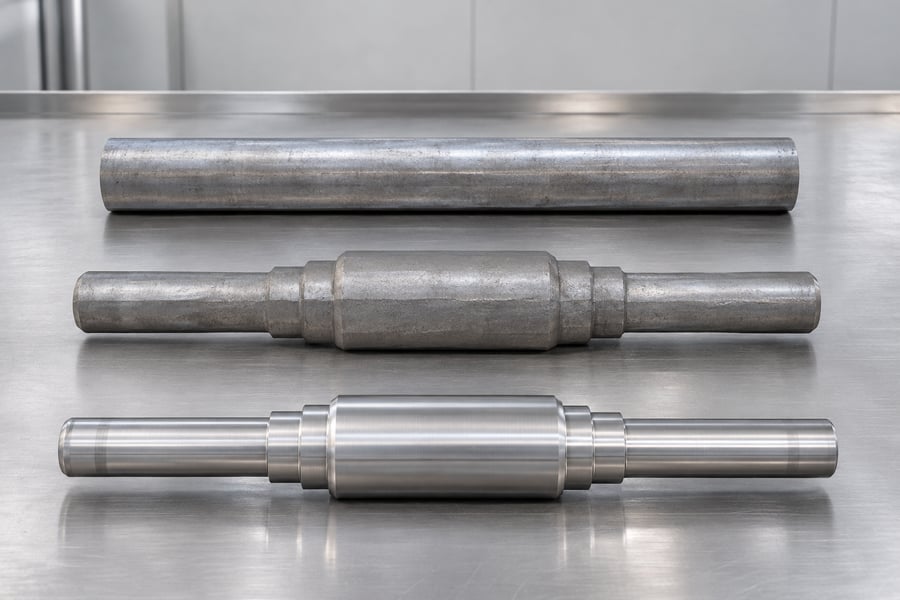
Blank preparation converts purchased bar or billet into workpieces ready for heating. Typical operations include sawing or cutting to length, end trimming, deburring, and checking dimensions. The cost depends on stock size, cutting method, batch quantity, handling, and the consistency required.
Blank length variation can complicate forming, particularly when the component has several stepped sections. Consistent starting dimensions make it easier to follow the intended pass sequence and reduce avoidable adjustment or material imbalance.
Material identification and preliminary checks may include verifying grade markings, reviewing material documents, and confirming blank dimensions. The inspection scope should match the order: routine identification is different from additional chemical analysis or mechanical testing requested by the customer.
Keep preparation costs separate from raw material value and post-forging machining. Cutting a billet to length is pre-forging work; turning a forged shaft to its final diameter is downstream processing.
Roll Tooling, Process Development, and Setup
Roll tooling is a significant initial cost when the component requires a dedicated groove profile.
Design effort depends on cross-sectional geometry, diameter changes, tapered transitions, pass sequence, material behavior, and the intended forged dimensions. More complicated profiles may require more detailed engineering and tooling manufacture.
The roll design must support progressive deformation. Process planning considers material movement between sections, reduction distribution, and workpiece handling. Several transitions may therefore require more development than a straight rod.
Initial setup includes drawing review, roll alignment, pass sequencing, and trials when necessary. First-piece inspection checks whether the forging is suitable for downstream operations; adjustments add development time before repeat production.
Separate initial tooling and process-development charges from recurring setup costs. A new component may require engineering and trial work, while later batches may need only routine changeover and alignment. Drawing revisions or material changes can trigger further development, so the quotation should state what the initial charge covers.
Rolls also require inspection and maintenance as production proceeds. Wear, cleaning, reconditioning, and eventual replacement are not the same as original tooling manufacture. Maintenance can be included in a conversion-cost allocation or listed separately, but it should not appear in both places.
Heating and Longitudinal Roll Forging Production Costs
Heating cost depends on material grade, billet dimensions, temperature requirements, furnace loading, and handling. Larger workpieces and different alloys may require different arrangements, so the procedure must be established for the material.
Energy is only one part of the heating expense. Furnace operating time, labor, loading arrangements, transfer equipment, and delays between heating and forming also consume production resources. Poor coordination can lead to additional handling or reheating, increasing both time and energy use.
Successive grooved-roll passes change the billet’s cross-section and length. Pass count and sequence depend on profile, reduction distribution, material response, and forged dimensions; complex stepped or tapered parts may need more handling and process control.
The roll forging manufacturing process explains the forming sequence in greater detail. For cost evaluation, the key point is that pass design, workpiece movement, and equipment time all contribute to the recurring conversion cost.
Labor may cover furnace operation, transfer, roll operation, handling, and in-process checks. Equipment cost reflects productive time as well as setup, changeovers, and interruptions.
Production scheduling can reduce repeated changeovers when compatible jobs share material, tooling, and process conditions, although combining orders is not always practical.
A more involved pass sequence may be necessary to achieve the profile while controlling deformation. Fewer passes do not automatically mean a better or cheaper route.
Production Volume, Batch Size, and Tooling Allocation
Initial engineering and tooling expenses are different from recurring production expenses. Tooling may be used across multiple batches, while material, heating, forming, and specified finishing costs recur with each production order. The way initial investment is charged has a direct effect on the quoted unit price.
When tooling is allocated across a small batch, each accepted part carries a larger share of the initial investment. A larger order spreads the same fixed amount over more parts, provided the tooling remains suitable and the agreed production scope does not change.
Repeat orders may avoid full initial development costs but still require setup, inspection, maintenance, or tooling changes. The planned order schedule gives purchasing teams a basis for negotiating an upfront tooling payment or recovery through successive batches.
Calculate actual unit manufacturing cost using accepted output. If a batch contains rejected parts, the material and processing costs consumed by those parts must be allocated across the accepted components or reported separately.
Rework should be treated as additional processing only when its cost has not already been included in the batch total.
Heat Treatment, Machining, and Post-Forging Finishing
Heat treatment depends on the material grade and required delivery condition. Depending on the specification, a component may require normalizing, quenching and tempering, or another grade-appropriate treatment. Furnace time, batch loading, handling, cooling arrangements, and required testing contribute to the cost.
Define treatment by material specification and component requirements. Forged shafts do not all need the same process; hardness or mechanical-property acceptance criteria must be agreed before production.
Once forming is complete, cutting operations establish the bearing seats, shoulders, end faces, and other interfaces specified on the finished drawing. Typical work may include rough turning, CNC turning, drilling, correcting selected features, and finish machining.
The amount of machining depends on the forged profile, machining allowance, dimensional tolerances, and number of features requiring controlled geometry.
The allowance must permit surface cleanup and final dimensions, but excess stock increases machining time and material removal. Coordinate forged dimensions with the finished drawing to avoid unnecessary machining.
Surface finishing may include descaling, cleaning, grinding, or other operations stated in the order. These are not universal steps. Their cost depends on the required surface condition, component geometry, handling, and whether finishing must be performed before or after other downstream operations.
Inspection, Documentation, and Packaging
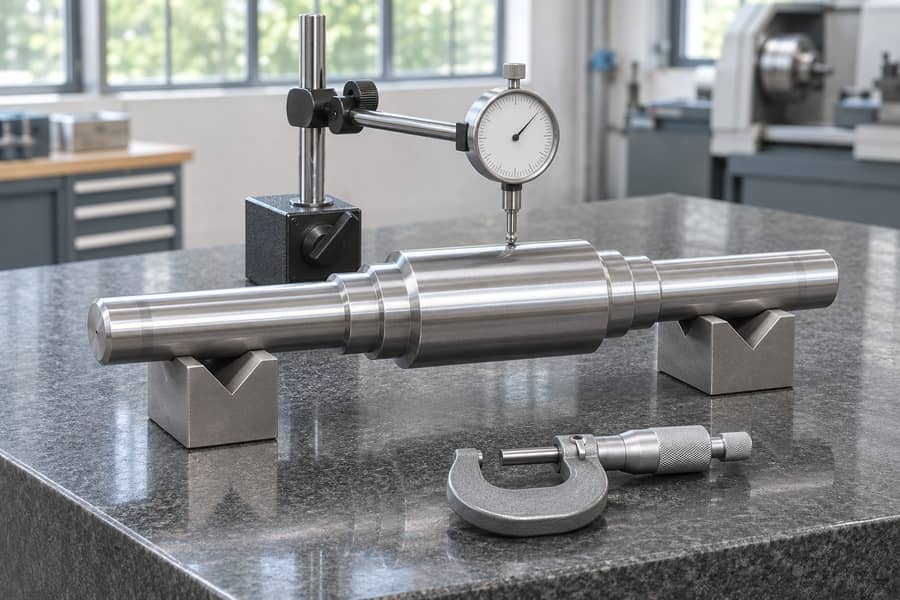
Inspection costs depend on the characteristics and acceptance plan. Dimensional checks may cover length, diameter sections, shoulders, taper geometry, and straightness, with frequency focused on critical drawing features.
Additional requirements may include hardness testing, mechanical-property testing, or nondestructive examination. These activities add cost through test preparation, equipment, specialist labor, and reporting. They should be included when required by the specification or purchase order, not assumed for every component.
Documentation may include material traceability, inspection results, heat-treatment records, and other agreed reports. The required documents should be listed in the RFQ so that preparation and review time are included in the quotation.
Packaging protects parts during storage and handling. Its cost depends on component size, surface condition, corrosion protection, and transport method; identify it separately from freight.
Hypothetical Longitudinal Roll Forging Cost Calculation
The following model illustrates how recurring manufacturing expenses and initial tooling investment can be allocated across accepted components. It uses a hypothetical order for 1,000 alloy-steel stepped shafts and assumes no rejected parts or rework.
All figures are hypothetical USD assumptions for arithmetic illustration only. They are not supplier prices, a quotation, or a market benchmark; no market region or actual price date applies. The example excludes freight, taxes, installation, and commercial margin.
| Cost Component | Hypothetical USD per Accepted Part |
| Raw material input, including normal material losses | $18.00 |
| Blank preparation | $1.20 |
| Heating and roll forging | $5.80 |
| Heat treatment | $3.00 |
| Machining and finishing | $7.50 |
| Inspection and packaging | $1.50 |
| Recurring manufacturing cost | $37.00 |
| Initial tooling and engineering allocation | $8.00 |
| Total manufacturing cost per accepted part | $45.00 |
Recurring cost is $18.00 + $1.20 + $5.80 + $3.00 + $7.50 + $1.50, or $37.00 per accepted part. The $18.00 material allocation already includes normal material losses, so no second scrap allowance is added.
The assumed initial tooling and engineering investment is $8,000. Dividing it by 1,000 accepted parts gives an allocation of $8.00 per part. Adding that amount to the $37.00 recurring cost produces a hypothetical manufacturing cost of $45.00 per accepted part.
The heating and forging amount is assumed to include production energy, labor, equipment time, and routine maintenance allocation. Maintenance is therefore not charged again. The example also assumes no rejected components or rework, so no separate reject allowance is added.
The quantity effect can be isolated by keeping recurring cost at $37.00 and allocating the same $8,000 investment over different accepted quantities.
| Accepted Quantity | Tooling Allocation per Part | Total Manufacturing Cost per Accepted Part |
| 500 | $16.00 | $53.00 |
| 1,000 | $8.00 | $45.00 |
| 2,000 | $4.00 | $41.00 |
This comparison isolates tooling amortization; it does not predict that recurring costs remain unchanged at different volumes. Material purchasing, batch setup, production scheduling, maintenance, and processing conditions may also change.
The $45.00 example is a manufacturing-cost illustration, not a selling price. A commercial quotation may include margin and selling expenses, while freight, taxes, and installation remain excluded unless separately stated. Actual costs require a defined drawing, material, quantity, delivery condition, and acceptance plan.
Cost-Control Decisions for Engineering and Purchasing Teams
Design review can reduce tooling and machining complexity. Check whether each step, taper, and transition is functional, and identify dimensions requiring close control. Simplifying nonessential features can streamline pass design and machining.
Blank dimensions should be selected against the forged geometry and machining allowance. Too much stock increases material consumption, heating demand, and machining time; too little can prevent complete cleanup or achievement of final dimensions. Material yield is therefore a design and process-planning issue, not simply a purchasing metric.
Tooling decisions should reflect initial quantity and repeat demand. Clarify whether the investment is charged separately or amortized, and agree how maintenance, reconditioning, storage, ownership, and drawing changes are handled.
Specify heat-treatment condition, critical machined features, surface finish, and inspection methods. Avoid unnecessary tests or finishing, but retain controls needed to verify the component.
RFQ Requirements for Boberry Longitudinal Roll Forging
A useful RFQ enables the manufacturing team to assess the forming route and calculate costs. Provide a controlled drawing with dimensions, revision, material, and functionally important features.
Include the following technical information:
- Drawing and geometry:
Overall dimensions, stepped sections, taper details, critical features, and CAD data where available. - Material:
Grade, applicable standard, material condition, and any required traceability. - Blank information:
Proposed starting dimensions, if known, and any restrictions on stock form. - Finished condition:
Machining allowances, final dimensions, surface condition, and required heat treatment. - Inspection:
Critical characteristics, acceptance criteria, testing methods, and required reports.
State initial quantity, annual demand, repeat-order frequency, and whether the request covers forged blanks or finished components. Identify trial requirements, packaging, and delivery expectations.
Ask for initial tooling and engineering charges to be separated from recurring production costs. The quotation should identify whether routine tool maintenance is included in the forging conversion cost, and how modifications or replacement tooling will be handled.
This makes the cost allocation understandable without counting the same expense twice.
For Boberry, component drawings can be reviewed against the stated roll-forging scope, including shafts, rods, stepped parts, and tapered components. Material options and downstream heat-treatment or finishing needs should be assessed against the specific order rather than assumed to be identical across projects.
Before comparing offers, confirm that each quotation uses the same material grade, blank assumptions, accepted quantity, delivery condition, machining scope, heat-treatment condition, inspection plan, and packaging basis.
Then review tooling, recurring manufacturing cost, and commercial charges separately. A complete RFQ and a clearly defined acceptance basis provide the strongest foundation for evaluating the actual cost of a longitudinal roll-forged component.