
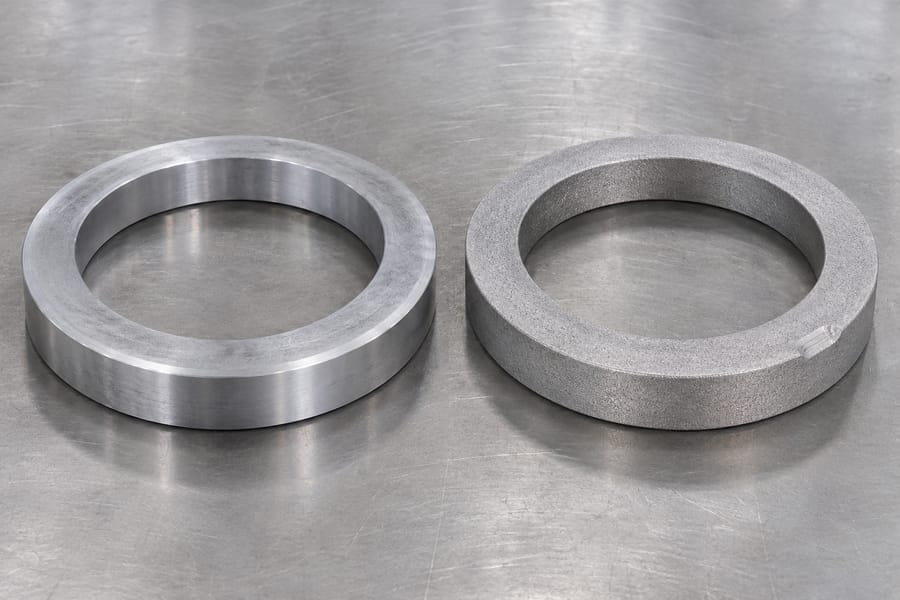
Forged rings take shape as hot solid stock is compressed and rolled. Cast rings begin as liquid metal poured into a mold, where cooling establishes their shape.
The choice depends on more than initial shape: alloy compatibility, loading direction, fatigue demands, section geometry, inspection, machining, production volume, and the required finished condition all matter.
How Do Ring Forging and Casting Processes Work?
Seamless Rolled Ring Forging Process
A solid billet is selected for the required alloy and dimensions, heated, upset to increase its cross-section, and pierced to create a central opening.
The workpiece rotates between forming rolls. Radial pressure reduces wall thickness while axial control shapes ring height; continued deformation increases diameter toward the specified profile.
Temperature, reduction, and section geometry influence material flow and dimensional development. Roll alignment and workpiece stability also affect section consistency as the diameter increases.
The ring is then heat-treated, cleaned, machined, and inspected as required by the drawing. The sequence depends on the specified supply condition and finished dimensions.
For seamless annular components, ring forging services provide a route to assess against the drawing, alloy, loading, and machining requirements.
Metal Casting Processes for Ring Components
Casting melts a suitable alloy and introduces the liquid metal into a prepared mold, where it fills the cavity and solidifies into the component shape.
Sand, investment, and centrifugal casting are distinct routes. Suitability depends on alloy behavior, dimensions, section thickness, surface requirements, and mold geometry.
After solidification, the casting is removed and cleaned, with gates and risers separated. The subsequent route includes the specified thermal cycle, finishing cuts, and acceptance checks.
For annular parts, mold and core design must address filling, feeding, shrinkage, wall thickness, and internal features. The design must also allow removal and inspection of the finished casting.
The Fundamental Manufacturing Difference
Forging changes solid metal through plastic deformation; casting forms the shape through liquid flow and solidification. This distinction affects microstructure and design options, but does not alone determine quality.
How Do Forging and Casting Affect Microstructure and Internal Defects?
Grain Flow in Forged Rings
During ring rolling, material flows around the circumference as the ring expands and its cross-section changes. This grain orientation can matter under circumferential loading.
Deformation may refine the starting grain structure, but the outcome depends on billet quality, temperature, reduction, and forming sequence. Uneven deformation can produce local property variations.
Grain flow must be assessed against principal stresses; it is not a universal strength guarantee. Its benefit depends on the actual loading direction and continuity of the worked section.
Solidification Structure in Cast Rings
Cast metal develops its structure during cooling. Dendritic growth, grain formation, and local chemical distribution depend on alloy composition, mold conditions, and cooling rate.
Different sections may cool at different rates, producing variations in grain structure or segregation. Feeding and solidification control help manage shrinkage; mold filling affects the risk of trapped gas or inclusions.
Heat treatment can modify selected properties, but it does not close shrinkage cavities or remove existing discontinuities. Such indications require evaluation against the component’s acceptance criteria.
Defects Associated with Each Route
Forging concerns include laps or folds, surface discontinuities, and inclusions inherited from the starting material. Poor deformation control may also leave regions insufficiently worked.
Casting concerns include gas or shrinkage porosity, inclusions, segregation, and hot tears. Their occurrence depends on alloy, mold design, filling, feeding, and solidification.
Evaluate each route by the discontinuities relevant to the component’s service conditions, not by assumptions of defect-free production. Starting-material quality and process controls remain important for both routes.
Mechanical Properties, Fatigue Performance, and Quality Inspection
Mechanical Properties Under Service Loads
Annular components may experience circumferential, radial, and axial stresses. The relationship between these loads and material orientation matters, particularly where the ring carries combined or changing loads.
A forged ring may develop directional properties through grain flow. A cast ring’s properties depend on alloy chemistry, solidification structure, section thickness, and heat treatment.
Check the specified limits for yielding and ultimate tensile load, then review ductility, hardness, and impact-test results required by the application. Results must identify material condition, test standard, specimen orientation, and sampling location.
The same nominal alloy designation does not ensure equivalent performance in forged and cast product forms. Compare specifications and heat-treatment conditions before attributing differences to process.
Fatigue and Discontinuity Sensitivity
Fatigue matters when rings experience repeated loading, vibration, rotation, or fluctuating stress. Crack initiation is influenced by surface condition, stress concentration, microstructure, and discontinuities.
Circumferential grain flow may benefit a forged ring when aligned with principal stresses, but laps or inclusions can still impair performance. In cast rings, porosity and inclusions may act as stress raisers.
Their significance depends on location, size, distribution, stress level, and acceptance criteria. Fatigue life cannot be inferred from tensile strength or process name; critical applications may require representative data or qualification.
Inspection and Quality Verification
Choose inspection for the material, geometry, likely discontinuity, and required acceptance level. No single method detects every defect, and access may limit examination coverage.
Ultrasonic testing examines suitable internal regions, subject to geometry and material response. Radiography can reveal certain internal casting indications, including some porosity and shrinkage.
Magnetic particle testing applies to suitable ferromagnetic materials and reveals surface or near-surface indications. Penetrant testing identifies surface-breaking indications on prepared, nonporous surfaces.
Mechanical tests, chemical verification, and dimensional inspection add complementary evidence. Define examination coverage, locations, reporting, and acceptance criteria before production begins.
| Manufacturing Route | Potential Concerns | Relevant Inspection |
| Ring forging | Laps, inclusions, internal or surface discontinuities | UT, MT, PT, visual examination as applicable |
| Casting | Gas or shrinkage porosity, inclusions, hot tears | UT, RT, PT, visual examination as applicable |
| Both | Property variation and dimensional deviation | Mechanical testing, material verification, dimensional inspection |
Geometry and Design Flexibility for Annular Components
Geometries Suited to Ring Forging
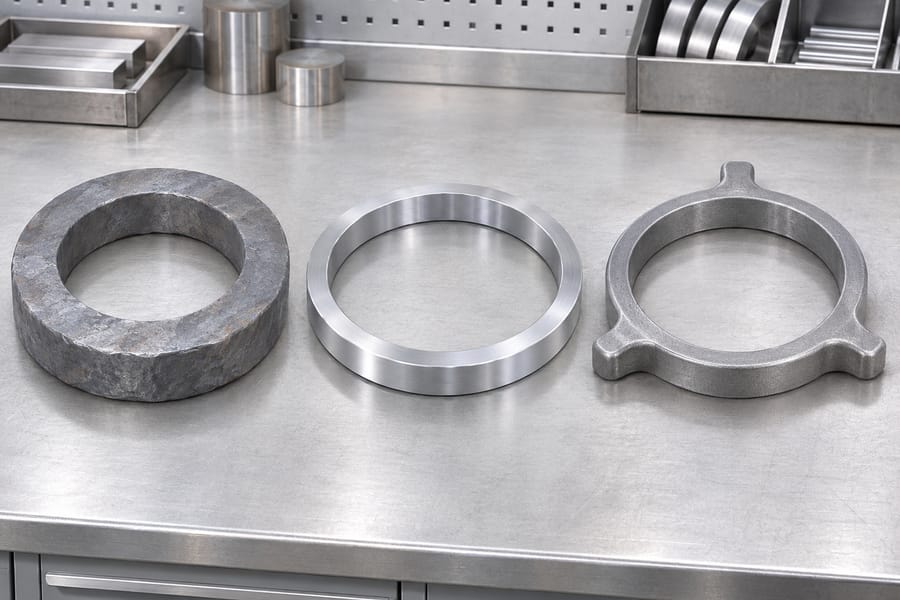
Ring rolling suits seamless annular components with continuous, relatively regular cross-sections, including rectangular, tapered, and selected profiled rings. It is less suited to creating isolated bosses or complex internal passages.
Outer diameter, inner diameter, height, and wall thickness define the geometry and influence starting stock, deformation sequence, and dimensional control.
Steps or contours may be rolled when the tooling and forming sequence support them. A suitable profile can reduce machining, but transitions must be checked for roll access and material flow.
Custom forged rolled rings are relevant when comparing plain and profiled seamless rings with drawing-specific dimensions and machining requirements.
Geometries Suited to Casting
Casting can form selected features that are difficult to roll, including integral bosses, ribs, and internal passages created by molds and cores.
This flexibility can consolidate features and reduce separate fabrication or assembly, provided the alloy, mold design, filling, and solidification behavior support the geometry.
Thin walls, abrupt thickness changes, and complex cores can complicate filling, cooling, machining, and inspection. Geometric flexibility does not guarantee manufacturability.
Design Trade-Offs
A continuous annular load path and regular section may favor evaluating ring forging first. Complex integral features may favor casting if the alloy and route are suitable.
Both designs require attention to wall transitions, stress concentrations, and access for machining and inspection. These constraints can determine whether an apparently feasible shape is practical to manufacture.
Matching the Alloy and Thermal Route to the Ring
Material Compatibility
Forged rings commonly use carbon steel, alloy steel, stainless steel, and selected specialty alloys. Selection depends on hot workability, deformation behavior, properties, and service environment.
The casting specification may call for a cast-steel grade, an appropriate stainless composition, or an aluminum alloy developed for that foundry route. An alloy suitable for forging is not necessarily suitable for every casting route.
Chemistry affects melting, fluidity, solidification, and defect sensitivity. Wrought and cast versions of similarly named alloys may also have different specifications and property expectations.
For cast-ring projects, Boberry’s casting services help frame route suitability, finishing operations, and downstream machining requirements.
Heat Treatment and Property Comparison
Normalizing, annealing, and quenching and tempering can produce specified strength, hardness, and toughness in suitable steels. Treatment depends on composition and section size.
Alloys respond differently: austenitic stainless steels, for example, are not hardened by conventional quenching and tempering like suitable martensitic or alloy steels.
Cast section thickness and cooling variation can affect heat-treatment response. Treatment can adjust properties but does not correct porosity or other discontinuities.
Compare the same material specification, heat-treatment condition, test method, and acceptance criteria; otherwise, differences may reflect product form rather than process.
Dimensional Accuracy, Surface Finish, and Machining Requirements
Dimensional Control in Forged Rings
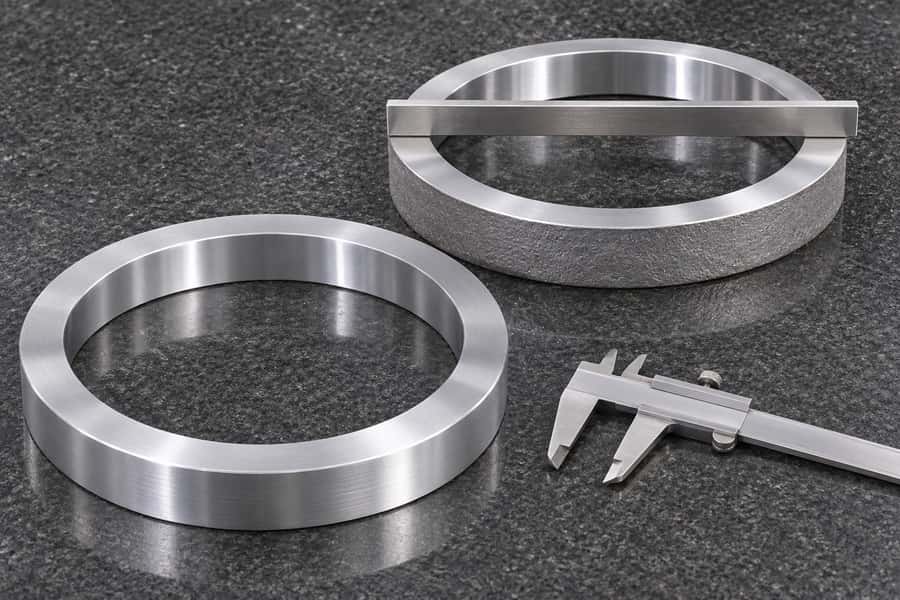
As-rolled rings are starting forms, not substitutes for machining where tight dimensions or functional surfaces are required. Drawings should distinguish stock dimensions from finished dimensions.
Key measurements include outer diameter, inner diameter, height, wall thickness, roundness, and face alignment. Rolling stability, temperature, and section geometry influence the as-rolled shape.
Machining allowance must provide enough stock for cleanup and finishing. Too little may leave uncleaned areas; excess stock increases removal and machining time.
Dimensional Control in Cast Rings
Casting dimensions depend on mold and pattern design, shrinkage, draft, and core position. Core movement can alter internal dimensions or wall thickness.
Uneven cooling and section transitions may cause distortion. Allowances should reflect the actual alloy, casting route, mold arrangement, and process control.
Bearing seats, mounting faces, and sealing interfaces may require machining. The casting must provide sufficient stock without making finishing unnecessarily extensive.
Surface Finish and Final Machining
As-forged surfaces may retain scale and forming irregularities; as-cast surfaces reflect mold condition and solidification. Both may need cleaning and machining.
CNC machining establishes specified dimensions and surface finishes on either product form. Work content depends on initial geometry, allowance, accessibility, and the number of critical features.
Final acceptance should follow the finished drawing, including datum references and geometric controls. Generic process-tolerance assumptions cannot replace component inspection.
Production Costs and Lead Time: Ring Forging vs Casting
Tooling and Setup
Forging may require forming tools and rolling setup; casting may require patterns, molds, and cores. Their scope varies with ring profile, internal geometry, and repeat-order plans.
Tooling effort rises with profile complexity, internal features, and design changes. Intricate casting cores require preparation, while profiled rings may need additional forming development.
Assess initial investment against order quantity and repeat production. Apparent tooling simplicity does not establish lower total cost, especially when downstream machining differs.
Material Use and Finishing Costs
Forging needs starting stock for deformation and machining allowance. Casting yield reflects the component and process metal used in gates, risers, and feeding systems.
Machining costs depend on material removal, finish, dimensional complexity, and access. Near-net-shape casting may reduce machining, but compare that benefit with mold preparation, yield, and inspection.
Include heat treatment, cleaning, inspection, and potential rework in the total comparison. Compare the stock consumed and components accepted in each route; purchasing fewer blanks is no saving if more finished pieces fail inspection.
Production Volume and Schedule
Prototype, small-batch, and repeat orders create different tooling economics. Material availability, scheduling, heat treatment, machining, and inspection also affect lead time.
Forging involves billet preparation, heating, forming, and finishing; casting involves mold preparation, melting, pouring, solidification, and finishing. The longer sequence is not necessarily the slower one.
Compare the actual route and production schedule, including material availability and required testing. Neither process is faster for every ring size, alloy, or quantity.
How to Choose Between Ring Forging and Casting for Your Project
When to Evaluate Ring Forging
Evaluate ring forging when the component needs a seamless annular structure with a cross-section compatible with rolling. It is relevant to continuous plain or profiled industrial rings.
It deserves attention when mechanical loading and grain orientation matter, but the choice must match stress direction, alloy, heat treatment, and defect acceptance.
The following conditions help identify when a forging route deserves priority during an initial engineering review of the complete ring design.
- Geometry:
Continuous annular sections that can be formed by ring rolling. - Performance:
Specified strength and toughness, with attention to loading direction. - Finishing:
Machining allowances that can be accommodated in the rolled form. - Material:
An alloy suitable for the intended forging and heat-treatment route.
When to Evaluate Casting
Evaluate casting when integral features or complex cross-sections are central to the design. Molds and cores may form bosses, ribs, passages, and nonuniform sections that are difficult to roll.
The alloy and casting route must be compatible, and properties and inspection results must meet application requirements. Complex geometry alone does not justify casting if sound filling or inspection is impractical.
These conditions indicate when a casting route may deserve priority during an initial review of the component’s design and material.
- Geometry:
Integral features or internal passages that favor mold-based forming. - Material:
An alloy with an appropriate, qualified casting route. - Finishing:
A casting shape that provides workable stock for critical machining. - Economics:
Tooling, yield, batch size, and downstream operations that suit the project.
Compare Complete Routes Against the Drawing
Some rings can be produced by either method. Compare the finished component, using the same drawing, alloy specification, heat-treatment condition, mechanical tests, inspection coverage, and acceptance criteria.
For a regular heavy-section ring, assess whether rolled grain orientation and the required inspection level justify forging. For a complex housing-like ring, test whether casting can reproduce its features without unacceptable solidification or machining risks.
| Project Requirement | Route to Evaluate | Main Decision Criteria |
| Heavy-duty seamless annular ring | Ring forging | Grain orientation, properties, fatigue, inspection |
| Plain industrial ring | Both | Alloy, dimensions, machining, production volume |
| Complex ring with integral passages | Casting | Mold and core feasibility, alloy compatibility |
| Profiled seamless ring | Ring forging | Rolling feasibility, section profile, machining stock |
| Fatigue-critical ring | Both | Loading direction, discontinuities, testing, acceptance |
| Complex near-net-shape component | Casting | Geometry, material suitability, finishing requirements |
Drawing Review with Boberry Machining
Route review starts with the drawing and material specification: geometry, alloy grade, heat-treatment condition, service loading, and finished acceptance requirements.
Boberry Machining can assess whether seamless rolled ring forging or a suitable casting route better fits the project, including forming or mold feasibility, machining stock, inspection, and production sequence.
Both routes should be judged against equivalent finished-part requirements, not assumed advantages. A technically acceptable starting form is only useful if it can be machined, inspected, and delivered in the specified condition.