
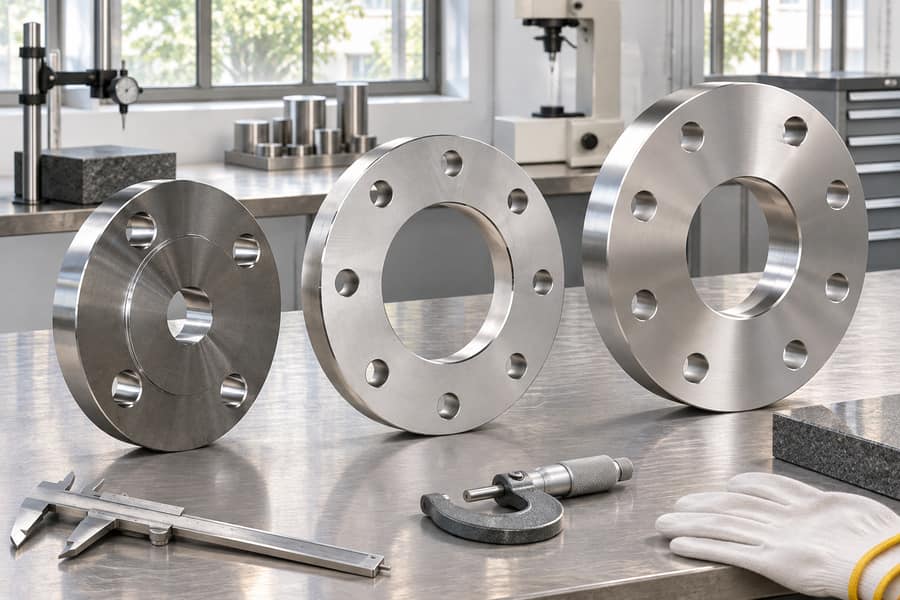
Forged flange material selection begins with the process fluid and surrounding environment, then accounts for design pressure, temperature extremes, corrosion mechanisms, and related fabrication conditions.
This guide compares common carbon, alloy, stainless, duplex, nickel-based, and titanium materials and explains how ASTM product specifications differ from ASME flange dimensions and ratings.
How to Select the Right Material for Forged Flanges
Select in a defined order: identify the fluid and environment, establish pressure and temperature limits, then assess corrosion, weldability, product form, and the governing specification.
Start with the Process Fluid and Environment
Identify the fluid composition, concentration, contaminants, and changes during operation, cleaning, startup, or shutdown. Trace water, deposits, and cleaning chemicals can alter material performance.
Assess the wetted surface and external exposure. Coastal air, buried installation, insulation, washdown, or contact with dissimilar metals may create additional corrosion risks.
Identify credible mechanisms rather than simply labeling a service corrosive. Identify whether damage would involve broad metal loss, localized pits or crevices, cracking under stress, or flow-assisted attack; each mechanism calls for a different review.
Establish Design Pressure and the Full Temperature Range
Use piping-system design conditions, not just normal readings. Pressure excursions, blocked-in conditions, thermal expansion, and operating cycles may affect the design basis.
Record maximum design temperature and minimum design metal temperature (MDMT). Minimum-temperature toughness may govern acceptance even when normal operation is relatively warm.
For the proposed thickness and delivery condition, check the invoked code and material standard, including any impact tests, before accepting a temperature limit. No single safe temperature limit applies to every grade and condition.
Evaluate Corrosion, Welding, and Product Requirements
Assess the candidate grade against the identified corrosion mechanisms. Chloride concentration alone is not a universal acceptance limit; temperature, pH, oxygen, deposits, crevices, stress, and exposure time also matter.
Review the connected pipe material, welding procedure, preheat, filler, hardness controls, and any post-weld heat treatment. Select a flange grade compatible with the complete joint.
Specify the product form and full material standard. The purchase description should identify the specification, grade, heat treatment, supplementary requirements, testing, and required records.
Carbon Steel Materials for Forged Flanges
Carbon steel is common where fluid, temperature, corrosion allowance, and design permit. A105, A350 LF2, and A694 address different product and service requirements.
ASTM A105 for General Piping Applications
ASTM A105 covers carbon steel piping-component forgings and is widely used for conventional industrial flange applications when design conditions permit.
Confirm pressure-temperature conditions and required properties. A105 is not automatically suitable for every low-temperature application; review applicable toughness requirements before finalizing the selection.
Carbon steel has limited inherent corrosion resistance. Depending on the fluid and consequences of material loss, the design may need corrosion allowance, protection, or a different alloy.
Choosing LF2 When Notch Toughness Governs
For an LF2 order, A350 provides the forged-product requirements, including notch-toughness testing for its covered carbon and low-alloy steels. LF2 is commonly specified when low-temperature toughness forms part of the design basis.
Specify the impact-test temperature, acceptance criteria, thickness considerations, and supplementary requirements. The LF2 designation alone does not resolve every low-temperature design question.
LF2 is not a corrosion-resistant upgrade over A105. It addresses toughness requirements; corrosion still requires a separate review of process chemistry and mechanisms.
A694 Grades in Transmission Piping
For transmission duty, A694 is a relevant forged-product specification covering applicable carbon and alloy steel flanges and other piping parts. Grades include F42, F52, F60, F65, and F70.
Each grade has defined mechanical-property requirements, but does not independently establish a standard flange’s pressure rating. The applicable dimensional standard, material group, temperature, and design conditions still govern.
Consider A694 when transmission piping has specified strength requirements. Check pipe-grade compatibility, welding, toughness, and project requirements; higher strength does not resolve corrosion or fabrication concerns.
A buyer specifying an A694 grade should identify the matching pipe grade and required supplementary impact tests or project controls. For mixed material joints, confirm welding and transition details before release.
These grades are not interchangeable: A105 serves general piping forgings, LF2 addresses specified toughness needs, and A694 covers high-pressure transmission components.
Alloy Steel Materials: ASTM A182 F11 and F22
Chromium-molybdenum alloy steels are considered for services where elevated-temperature properties and compatibility with the connected system are important. F11 and F22 appear within A182, the specification used for applicable alloy and stainless piping forgings and rolled components.
Both contain chromium and molybdenum, but F11 and F22 have their own chemistry limits and required properties. Select by the specified design conditions, not simply because service is described as hot.
Review design temperature, pressure, thickness, heat treatment, and applicable allowable stresses. The selected grade must match the design calculation and piping specification.
Define qualified welding procedures, applicable preheat and interpass controls, heat treatment, and hardness or inspection criteria. These controls manage fabrication risks but do not replace material verification.
For F11 and F22, verify the exact grade or class, required properties, and heat treatment. Neither is universally preferable; selection follows the design and fabrication basis.
F11 and F22 are not interchangeable choices simply because a line operates at elevated temperature. Verify allowable stresses, specified heat treatment, and code restrictions for the selected component.
Where a flange is welded to alloy steel pipe, confirm compatible consumables and post-weld treatment across the joint. Material records should identify the grade and heat-treatment condition supplied.
Stainless Steel Materials: ASTM A182 F304L and F316L
Austenitic stainless steels suit services where corrosion behavior, fabrication characteristics, and mechanical properties match the process. F304L and F316L are common forged-flange grades, but neither suits every corrosive fluid.
F304L for Compatible General Corrosion Service
F304L is a low-carbon austenitic stainless grade used where its corrosion resistance suits the process media and welded fabrication is required.
Its low-carbon designation helps address sensitization concerns during welding and thermal exposure, but does not make welds immune to corrosion or remove procedure controls.
Check fluid composition, temperature, contaminants, cleaning chemicals, and exposure. Stainless steel can still suffer localized attack in incompatible environments, even when general corrosion resistance appears adequate.
Reviewing F316L Against the Exposure
The austenitic F316L grade combines a restricted carbon level with molybdenum alloying. It is considered when the environment requires different corrosion performance from F304L.
F316L is not immune to chloride attack. Pitting and crevice corrosion depend on temperature, deposits, oxygen, surface condition, and joint geometry; no universal chloride threshold defines suitability.
Compare both grades against process data and corrosion mechanisms. Review welds, gasket contact areas, stagnant zones, and fabrication contamination; aggressive service may justify duplex or specialty alloys.
At procurement stage, state whether service includes intermittent cleaning, stagnant operation, or concentration during evaporation. An average composition can hide the more aggressive exposure during these intervals.
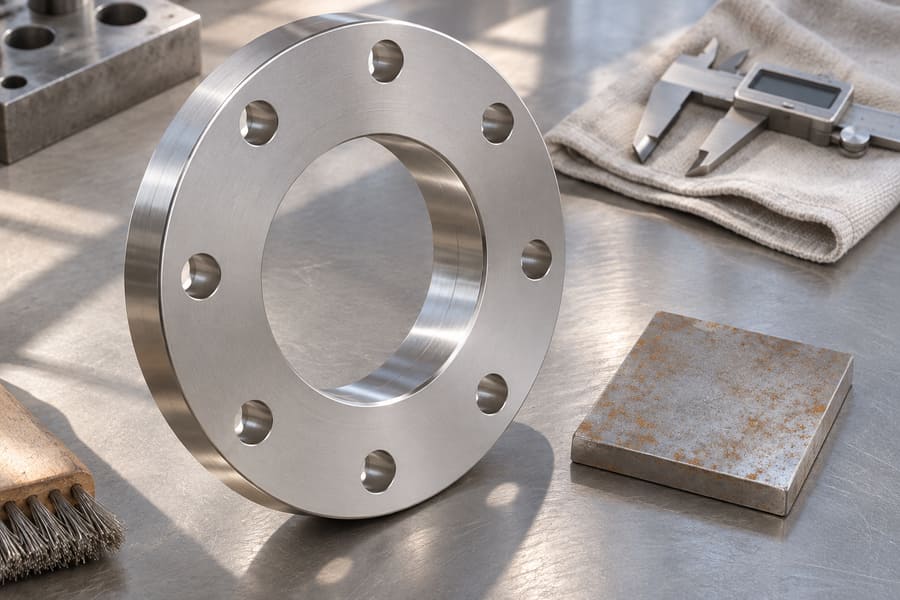
Comparing Standard and Super Duplex Forging Grades
Ferrite and austenite coexist in a duplex microstructure, making phase control part of the material-selection discussion. Their strength and corrosion resistance can suit demanding service, provided material condition and fabrication are controlled.
ASTM A182 F51 and F60 are standard duplex grades for forged piping components. Check the invoked specification and purchase order; similar service descriptions do not make grades interchangeable.
Where the corrosion review rules out standard duplex, the assessment may move to super duplex options such as F53 or F55. Select them through a service-specific assessment, not an assumption that super duplex is always necessary.
Heat treatment and phase balance require control. Thermal exposure or unsuitable welding can alter the microstructure, so procedures should address heat input, interpass temperature, consumables, and examination.
Compare grade, corrosion data, mechanical requirements, design limits, and fabrication plans. Chloride is only one factor; temperature, pH, oxygen, crevices, stress, and exposure time also affect performance.
Where a duplex flange is welded into a system, review the qualified procedure for both base materials and joint geometry. A procedure qualified for another grade is not automatically transferable.
Specialty Alternatives: Nickel-Based Alloys and Titanium
Nickel-based alloys and titanium are considered when conventional steels do not suit the process environment. They are specialized alternatives, not automatic upgrades.
Nickel-based alloys have varied corrosion behavior. Select an exact grade for the fluid, concentration, temperature, contaminants, and operating variations, particularly where stainless steel performance is inadequate.
Titanium suits selected services, but chemical compatibility must be checked carefully. Some reducing acids and fluoride-bearing media can change the assessment; titanium is not universally resistant to chlorides.
Check product specifications, availability, machining, welding, and dissimilar-metal interfaces. Document the corrosion problem and verify the specialty grade across the full service envelope.
Select specialty products by exact alloy designation and product specification, not broad labels such as nickel alloy or titanium. Each family contains grades with different corrosion behavior.
Comparison of Common Forged Flange Materials
The table provides an initial screening reference, not a substitute for checking the full specification or performing a service-specific materials review. Check the exact grade entry: a family label does not define its delivery and testing obligations.
| Material specification | Material family | Typical selection focus | Key verification |
| ASTM A105 | Carbon steel | General piping forgings | Design conditions and toughness needs |
| ASTM A350 LF2 | Low-temperature carbon steel | Specified notch-toughness service | Impact-test temperature and acceptance criteria |
| ASTM A694 grades | High-yield carbon and alloy steel | Transmission piping components | Grade, pipe compatibility, and design rating |
| ASTM A182 F11 / F22 | Alloy steel | Elevated-temperature piping service | Grade, heat treatment, welding, and design data |
| ASTM A182 F304L / F316L | Austenitic stainless steel | Corrosion resistance in compatible media | Localized corrosion and fabrication conditions |
| ASTM A182 F51 / F60 | Duplex stainless steel | Strength and corrosion-resistance requirements | Exact grade, phase balance, and welding controls |
| ASTM A182 F53 / F55 | Super duplex stainless steel | More demanding corrosion environments | Service-specific corrosion assessment and heat treatment |
| Applicable nickel alloy specifications | Nickel-based alloy | Selected aggressive chemical services | Exact alloy composition and media compatibility |
| Applicable titanium product specifications | Titanium | Selected highly corrosive services | Fluid compatibility and fabrication requirements |
How Material Selection Affects Flange Configuration and Machining
Coordinate material selection with connection type, facing, and machining. These details affect joint assembly and piping compatibility, although they do not change the material grade.
Connection Type and Facing
Weld-neck flanges provide a butt-weld connection where the hub geometry suits the design. Slip-on flanges use a different attachment arrangement and require review of their welding details.
Blind flanges close a piping end or equipment opening; verify pressure-temperature conditions, loading, dimensions, and facing. Other connection types serve particular installation needs.
Coordinate raised-face, flat-face, or ring-type joint facing with the mating flange and gasket. Choose by joint design, not by material grade alone.
Bore, Bolt Circle, and Face Machining
Match the bore to pipe inside diameter, wall thickness, and any required transition. A mismatch may create an internal step or disrupt the intended flow path.
Specify bolt circle, hole quantity and diameter, facing dimensions, and thickness through the drawing or standard. Identify nonstandard details and approve the final drawing before manufacture.
State face-finish and gasket-contact requirements clearly. Avoid vague terms such as smooth when the joint requires a defined surface condition.
Machining plans should account for material condition and finishing sequence. If heat treatment follows rough machining, identify which dimensions require final verification on the approved drawing.
ASTM Material Specifications and ASME Flange Standards
Material selection and flange compliance are separate tasks: ASTM specifications address the material product, while ASME standards define covered flange dimensions and pressure-temperature requirements.
What ASTM Specifications Establish
ASTM specifications define grade requirements and may address composition, mechanical properties, heat treatment, and testing. Apply the requirements in the edition and grade entry cited by the order.
A105, A350 LF2, A694, and A182 have different scopes. State the full specification and grade in the purchase order instead of writing only forged carbon steel.
What ASME Flange Standards Establish
ASME B16.5 and B16.47 define flange dimensions and pressure-temperature rating provisions within their respective scopes, including material groupings and Class designations.
Choose the standard by flange type, size range, design, and project requirements. Confirm its edition; a material specification does not establish dimensions, and a dimensional standard does not replace the material specification.
The Class number labels a rating category; it is not the reading permitted on a pressure gauge. Use the designated flange standard to look up the rating for the specified material and temperature, including any relevant restrictions.
Forging does not automatically raise a standard flange’s pressure-temperature rating. The component must still meet applicable material, dimensional, rating, and design requirements.
Where pressure-temperature tables use material groups, verify that the actual grade belongs to the correct group under the invoked edition. Do not infer grouping from a similar alloy.
Verifying Material Identity Before Machining
A material certificate is useful only when it can be traced to the supplied flange. Match the heat number and grade marking to the records before mixed batches reach machining.
Where positive material identification is specified, define the method and required elements. Ordinary handheld XRF can help separate alloy families but cannot independently verify low-carbon stainless designations.
Keep chemistry checks separate from heat-treatment verification. An alloy reading does not establish toughness, solution-treatment history, or duplex phase balance; each requirement needs appropriate records or tests.
If marking will disappear during turning, agree on an identification-transfer procedure first. This avoids losing the connection between a finished flange, its starting material, and its inspection documents.
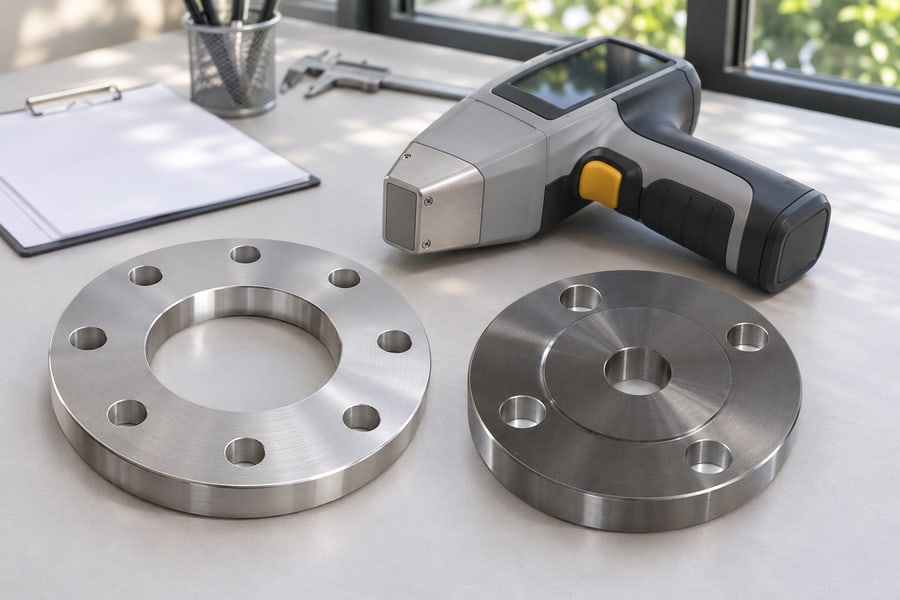
Practical Material Specification and RFQ Checklist
A useful RFQ identifies the required material and flange configuration without leaving engineering decisions implicit. State service conditions and standards, then define product and inspection requirements.
An RFQ line can state the complete ASTM grade, ASME flange standard and Class, nominal size, facing, bore, bolt circle, and drawing revision. Include design pressure and temperature in the service data.
| RFQ item | Information to provide | Why it matters |
| Service description | Fluid composition, contaminants, external environment, and corrosion concerns | Supports a service-specific material review |
| Design conditions | Design pressure, maximum temperature, minimum design metal temperature, and relevant transients | Establishes the mechanical and toughness requirements |
| Material designation | Full ASTM specification, grade, class where applicable, and edition | Prevents ambiguity between material families and product requirements |
| Flange standard | Applicable ASME standard, class, size, and facing | Defines the required flange geometry and rating basis |
| Connection details | Weld-neck, slip-on, blind, or other specified configuration; bore and end details | Ensures compatibility with connected piping or equipment |
| Machining dimensions | Bore, bolt circle, bolt holes, face dimensions, and drawing revision | Reduces interpretation errors during manufacture |
| Fabrication requirements | Heat treatment, welding-related requirements, and any project-specific controls | Aligns production with the approved engineering basis |
| Inspection and records | Required tests, examination methods, acceptance criteria, and documentation | Defines how conformity will be demonstrated |
Boberry Machining offers forged flanges in carbon, stainless, alloy, and duplex steel, with weld-neck, slip-on, blind, and other connections. Multiple facings and custom bore, bolt-circle, and face machining are available.
Before ordering, reconcile the material specification, flange standard, drawing, and inspection plan. State required impact tests, supplementary examination, and traceability records explicitly.
Resolve missing design or corrosion data before approving a substitution. A clear RFQ gives engineering, procurement, and manufacturing the same requirements to verify.
Route any material substitution through the project’s engineering-approval process. Compare its product specification, toughness, corrosion behavior, welding requirements, and standard rating before approval.
Keep cast steel and cast iron separate when describing alternatives; selecting one changes the material specification and the properties that must be evaluated. Assess any cast-steel alternative against its own specification and service conditions rather than rejecting all castings.
Forging does not guarantee a defect-free part, so inspection and acceptance criteria should be stated for the actual specification and application.