
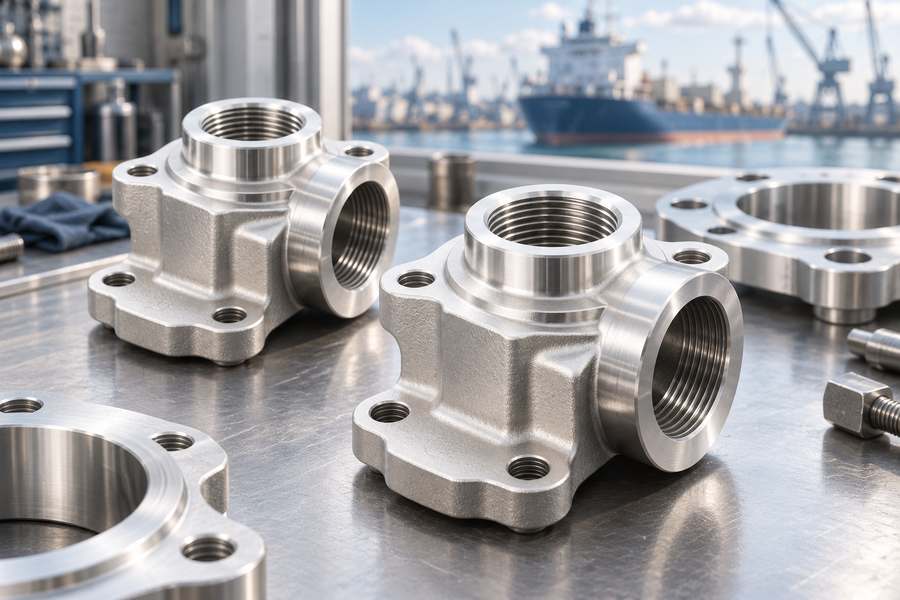
Marine castings serve structural, propulsion, and machinery functions, but no single alloy suits every shipboard duty. Selection depends on the component’s loading, geometry, operating fluids, corrosion exposure, and applicable classification requirements.
Engineers and procurement teams also need casting-grade specifications, traceable production records, appropriate testing, controlled repairs, and acceptance criteria tied to each component’s actual service conditions.
Service Conditions That Determine Marine Casting Requirements
Mechanical Loads and Component Functions
Marine castings perform different mechanical functions. A structural connection carries hull-related loads, while a pump casing contains fluid pressure and a gearbox housing supports rotating machinery.
For structural components, engineers evaluate static loading, impact, stress concentrations, and repeated loading. Fatigue resistance and toughness may become particularly important around highly stressed transitions and connections.
Machinery castings introduce different concerns. Bearing supports require dimensional stability and alignment, while housings exposed to vibration must resist distortion without transferring excessive loads to mounted equipment.
Geometry also influences performance. Thick sections may cool differently from thin walls, creating variations in microstructure and increasing the importance of solidification control and representative material testing.
A casting suitable for an auxiliary equipment housing may therefore be unsuitable for a rudder-related structural connection, even when both parts have similar dimensions or nominal strength.
Corrosion Exposure in Different Marine Environments
Above-water components experience salt-laden air, condensation, and atmospheric corrosion. Protective coatings, drainage provisions, and accessibility for maintenance can be as important as the base alloy.
Splash-zone components encounter repeated wetting and drying. Evaporation concentrates salts, while mechanical damage and coating deterioration can expose the underlying material to aggressive localized corrosion.
Continuously immersed components face different conditions, including seawater chemistry, crevice geometry, marine growth, and galvanic interactions. Selecting a casting material requires consideration of all environmental conditions the component will encounter during service.
Castings exposed to internal fluids must be assessed according to the specific fluids and operating conditions involved. A casting carrying lubricating oil faces different corrosion mechanisms from a pump casing circulating aerated seawater or chemically treated freshwater.
Temperature, flow velocity, deposits, and stagnant operating periods can change corrosion behavior. Buyers should document these conditions rather than describing every component simply as suitable for marine use.
Common Marine Casting Materials and Their Applications
Cast Steel for Structural and Machinery Components
Cast steel is widely used for selected hull-related structures and machinery components because suitable grades provide strength, toughness, and the ability to accommodate complex load-bearing geometry.
Typical applications include certain stern-frame components, rudder-related castings, machinery supports, and structural connections. Actual material and acceptance requirements depend on the component design and applicable rules.
Carbon steel castings may satisfy applications requiring moderate strength and suitable toughness. Alloy steel castings offer additional property combinations through composition and controlled heat treatment.
Steel selection must also consider weldability, section thickness, and inspection access. A large casting with thick junctions may require particular attention to internal soundness and heat-treatment consistency.
During early metal casting feasibility reviews, engineers should identify critical sections, machining allowances, and proposed joining details before finalizing the geometry and material specification.
Ordinary cast steel is not inherently resistant to seawater corrosion. Coatings, corrosion allowances, cathodic protection where appropriate, and planned maintenance may be necessary for the intended service.
Gray Cast Iron for Approved Machinery Applications
Gray cast iron contains graphite in flake form, giving it useful vibration damping and machinability. These characteristics can benefit selected machinery housings and equipment bases.
Its relatively low ductility limits its suitability for components exposed to severe impact or demanding tensile loading. Brittle fracture concerns require particular attention to geometry and stress concentration.
Potential applications include appropriate auxiliary machinery housings and equipment supports. However, the material must satisfy the component specification and any applicable classification requirements.
For procurement, specify the casting grade, mechanical properties, and inspection requirements rather than relying on the general description “cast iron.” Graphite structure alone does not define performance.
Ductile Iron for Selected Marine Equipment
Ductile iron contains predominantly spheroidal graphite, providing greater ductility than conventional gray iron. Certain ductile iron grades provide a practical balance of mechanical strength, ease of machining, and adaptability to complex casting shapes.
Selected pump casings, gearbox housings, and auxiliary equipment components may use ductile iron when the design and applicable rules permit its use.
Its mechanical advantages do not eliminate corrosion concerns. Unprotected ductile iron can deteriorate in seawater environments, making protective systems and fluid compatibility essential considerations.
Buyers must distinguish ductile iron from steel castings. Similar tensile-strength values do not establish equivalent toughness, fatigue behavior, weldability, or suitability for critical structural applications.
Copper Alloy Castings for Propulsion and Seawater Service
Copper alloys are important in marine propulsion and fluid-handling equipment. Nickel-aluminum bronze and other suitable copper casting alloys offer useful corrosion and mechanical characteristics.
Marine propellers are a prominent application. Their materials must withstand cyclic blade loading, hydrodynamic forces, cavitation exposure, and long-term contact with seawater.
Cavitation can damage propeller surfaces when collapsing vapor bubbles generate localized impacts. Alloy selection, casting integrity, blade geometry, and operating conditions influence resistance to this damage.
Copper alloys also appear in selected pumps, valves, and seawater equipment. However, alloy families differ significantly in corrosion behavior, mechanical properties, and manufacturing requirements.
For propeller procurement, define the approved casting alloy, blade geometry, inspection zones, permissible repairs, and acceptance requirements. Propeller manufacturing capability must be verified separately with the proposed supplier.
Stainless Steel and Duplex Stainless Steel Castings
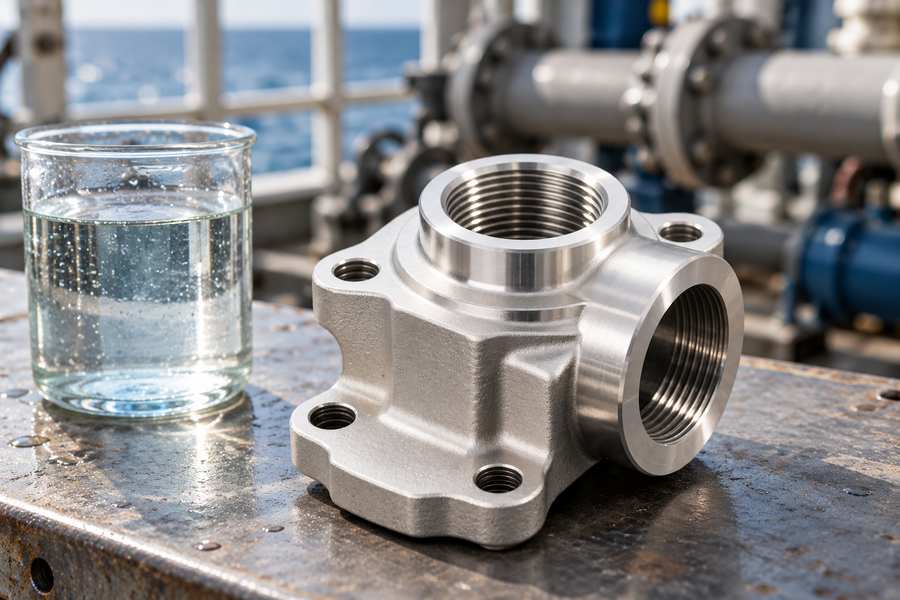
Stainless steel castings are used for selected marine fluid-handling and machinery applications where corrosion resistance, mechanical performance, and operating conditions justify their selection.
Austenitic stainless steel castings may include grades such as CF8M. However, the final specification must identify an applicable casting standard rather than merely naming a familiar wrought alloy.
CF8M is commonly associated with the 316 stainless family, but wrought 316 and cast CF8M are not interchangeable specifications. Their manufacturing routes and metallurgical characteristics differ.
Neither designation guarantees resistance to all seawater conditions. Stagnant seawater, deposits, tight crevices, and elevated temperatures can increase localized corrosion risks.
Duplex stainless steels combine austenitic and ferritic phases, offering higher strength and improved chloride resistance compared with many conventional austenitic grades under suitable conditions.
When evaluating duplex stainless steel castings, engineers must specify the actual casting grade, required heat treatment, phase balance, and relevant corrosion acceptance criteria.
Duplex materials also require careful manufacturing control. Inappropriate thermal exposure can produce undesirable phases, reducing toughness or corrosion resistance despite an apparently acceptable chemical composition.
For example, a continuously immersed seawater pump casing may warrant evaluation of a suitable duplex casting grade rather than assuming that CF8M will provide sufficient resistance.
Table 1. Marine Casting Materials and Suitable Component Duties
| Casting material | Potential applications | Main advantages | Key selection concerns |
| Carbon and alloy cast steel | Hull-related connections, machinery supports | Strength, toughness, structural capability | Fatigue, heat treatment, corrosion protection |
| Gray cast iron | Approved machinery housings and bases | Vibration damping, machinability | Low ductility, impact sensitivity |
| Ductile iron | Selected pumps and auxiliary equipment | Improved ductility over gray iron | Corrosion, pressure duty, approval |
| Copper alloys | Propellers, seawater equipment | Marine corrosion performance of suitable grades | Cavitation, fatigue, alloy compatibility |
| Austenitic stainless steel | Selected valves, pumps, fluid components | Corrosion resistance in appropriate service | Chloride pitting and crevice corrosion |
| Duplex stainless steel | Selected chloride-exposed equipment | Higher strength, improved chloride resistance | Heat treatment, microstructure, qualification |
The table identifies possible applications, not automatic material approvals. Final selection requires a specified casting grade, operating conditions, design assessment, and applicable acceptance requirements.
Classification Society Requirements for Marine Castings
Applicable Classification Rules and IACS Requirements
Classification requirements influence how certain ship components are manufactured, tested, inspected, and certified. Their application depends on component function, ship classification, and contractual arrangements.
The International Association of Classification Societies, or IACS, develops Unified Requirements used by its member classification societies. IACS itself does not issue individual component classification certificates.
IACS UR W8 addresses carbon, carbon-manganese, and alloy steel castings for specified hull and machinery applications. It is not a universal standard for every marine casting material.
Gray iron, ductile iron, copper alloys, and specialized stainless castings may be subject to different material provisions, depending on their intended applications and governing rules.
The purchase specification must identify the applicable classification society, rules, edition, and application criteria. A published future revision must not automatically be treated as mandatory for an earlier order.
Manufacturer Approval and Material Certification
Manufacturer approval, material certification, and component acceptance are separate matters. Approval of a manufacturing facility does not automatically establish acceptance of every alloy, process, or component.
Where classification rules require manufacturer approval, the purchaser must verify the supplier’s recognized manufacturing scope, relevant material categories, and any restrictions associated with that approval.
Material certificates document specified characteristics and test results. Their content and verification requirements depend on the governing specification and the inspection arrangements established for the order.
Some components require surveyor involvement or designated inspection hold points. Others may be accepted under different contractual and quality-control arrangements without identical classification procedures.
For example, a critical hull-related steel casting may require a more extensive approval and inspection process than a noncritical auxiliary equipment housing.
Procurement teams should therefore establish certification requirements early. Requesting unspecified “marine certificates” can create confusion about the actual evidence needed for acceptance.
Manufacturing Quality Control and Inspection Requirements
Material Traceability and Test Coupons
Traceability connects a delivered casting to its material origin, production history, and inspection results. Identification must remain reliable through heat treatment, machining, repair, and shipment.
Heat or batch numbers provide the basis for linking chemical analysis and manufacturing records. The applicable specification determines the required identification and traceability arrangements.
Chemical composition testing verifies whether the material meets the specified casting grade. However, chemical compliance alone cannot establish mechanical properties, casting soundness, or corrosion performance.
Mechanical test coupons or test blocks provide specimens for required testing. Their location, dimensions, production relationship, and heat-treatment condition must follow the governing specification.
A separately cast test block may not reproduce every cooling condition within a complicated casting. Representative test arrangements must therefore address the relevant sections and specified properties.
Heat Treatment and Mechanical Testing
Heat treatment controls the microstructure and mechanical characteristics of many marine castings. Heat-treatment methods must be selected according to the alloy chemistry, casting geometry, and required mechanical characteristics.
Steel castings may require normalizing, tempering, or quenching and tempering. Austenitic and duplex stainless castings may require controlled solution heat treatment.
Heat-treatment records should identify the casting or batch, process condition, temperature history, and other information required by the approved procedure or applicable specification.
Mechanical testing commonly evaluates tensile properties and, where required, impact toughness. The specified test temperature and acceptance values must reflect the component’s intended operating conditions.
A casting that meets tensile-strength requirements may still fail an applicable toughness requirement. Procurement specifications must identify both where the governing design or rules demand them.
Non-Destructive Testing of Marine Castings
Non-destructive testing detects relevant discontinuities without intentionally destroying the component. The method must match the material, defect type, casting geometry, and inspection objectives.
Visual testing examines accessible surfaces for visible cracking, cavities, surface damage, and workmanship defects. It also helps identify locations requiring further examination.
Magnetic particle inspection reveals discontinuities at or just below the surface of castings made from suitable ferromagnetic materials. It is not applicable to materials lacking the necessary magnetic characteristics.
Liquid penetrant testing identifies surface-breaking discontinuities in suitable nonporous materials. Reliable inspection results depend on thoroughly cleaning the casting and preparing its surface before testing.
Ultrasonic testing can investigate internal discontinuities, although coarse-grained casting structures and complicated geometry may limit examination effectiveness. Radiography offers another method for suitable internal inspection.
Inspection plans must identify examination locations, coverage, procedures, and acceptance standards. A statement such as “100% NDT” is insufficient unless the intended methods and coverage are defined.
Casting Defects and Repair Controls
Casting discontinuities can include shrinkage cavities, gas porosity, inclusions, and cracks. Their significance depends on size, orientation, location, and the stresses experienced during service.
Small discontinuities in noncritical regions may be acceptable under an applicable standard, while similar indications near highly stressed interfaces can require rejection or further assessment.
Weld repair may be permitted for certain castings, subject to material suitability, approved procedures, qualified personnel, and any required authorization before work begins.
Repair records should describe the defect location, removal method, welding procedure where applicable, post-repair treatment, and examination results.
For critical applications, the acceptance plan must establish repair restrictions before production. Otherwise, disagreements may arise after defects are discovered and manufacturing costs have accumulated.
Component-Specific Acceptance Requirements
Dimensional Accuracy and Critical Features
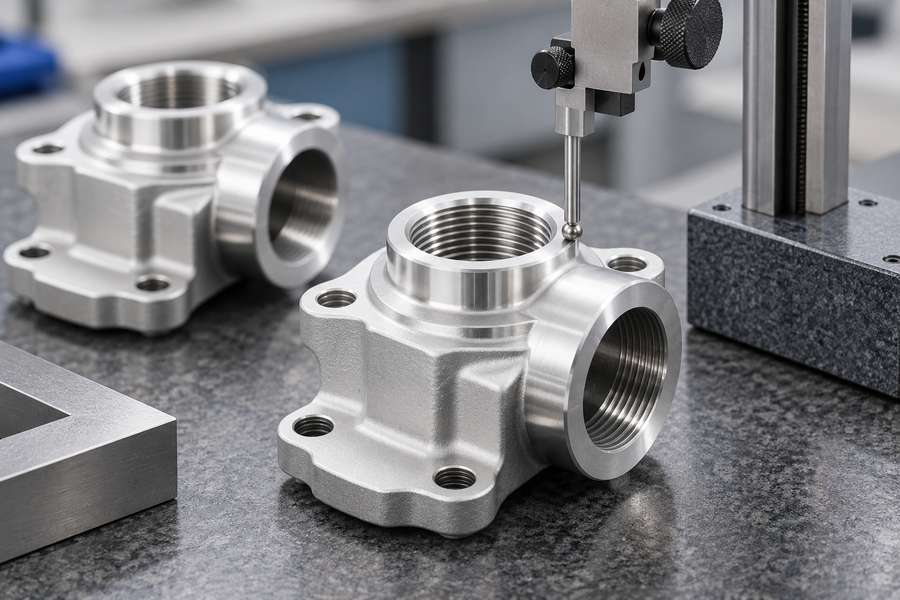
Casting dimensions influence assembly, loading, and equipment reliability. Critical features include bearing seats, mounting interfaces, flange faces, and locations controlling alignment between adjacent components.
General casting tolerances do not necessarily satisfy final functional requirements. Machined surfaces often require separate dimensions, datum references, geometric tolerances, and surface-finish specifications.
Machining allowance must accommodate casting variation without removing excessive material from critical sections. Insufficient stock can prevent the finished component from meeting dimensional requirements.
Large structural castings also require attention to distortion during cooling, heat treatment, and machining. Inspection plans should identify when critical dimensions are measured.
For a hypothetical machinery housing, the drawing might define bearing-bore alignment relative to mounting datums. Acceptance would use those drawing requirements rather than an assumed marine tolerance.
Functional Testing and Acceptance Records
Pressure-containing castings may require hydrostatic or other specified pressure testing. The test medium, pressure, duration, and acceptance criteria must be established from applicable requirements.
A pressure test evaluates the relevant containment function under defined conditions. It does not replace material verification or necessary internal discontinuity examinations.
Other components require different evidence. A structural connection may emphasize toughness and critical-zone inspection, while a propulsion casting may require detailed geometric and surface examinations.
Corrosion-exposed components may require verification of alloy condition, protective coatings, or specified corrosion testing. Requirements must reflect the particular material and operating environment.
Final acceptance combines dimensional results, material records, relevant inspection reports, functional tests, and approved repair documentation into a traceable package.
Table 2. Component-Specific Inspection and Acceptance Matrix
| Component duty | Critical acceptance concerns | Evidence to specify |
| Hull-related structural steel casting | Toughness, critical-section soundness, dimensions | Material test results, specified NDT, dimensional reports |
| Auxiliary machinery housing | Bearing alignment, mounting geometry, casting integrity | Material records, dimensional checks, applicable NDT |
| Pressure-containing pump or valve casting | Pressure integrity, sealing surfaces, wall condition | Applicable pressure test, inspection results, material certificates |
| Copper alloy propeller casting | Blade geometry, fatigue-sensitive regions, surface integrity | Alloy verification, specified NDT, dimensional and surface inspection |
| Corrosion-exposed stainless casting | Correct grade, metallurgical condition, corrosion suitability | Material verification, heat-treatment records, specified corrosion testing |
These are examples of inspection evidence to consider, not identical mandatory requirements for every component. The purchase agreement must define the applicable methods and acceptance criteria.
How to Specify Marine Castings for Procurement
Information Required in a Marine Casting RFQ
A complete request for quotation begins with the component’s function. Suppliers need to understand whether the casting carries structural loads, supports machinery, or contains pressurized fluid.
Provide engineering drawings with material specifications, critical dimensions, machining requirements, and expected operating conditions. Identify interfaces where dimensional variation would affect assembly or equipment performance.
Specify the casting-grade designation and applicable material standard. For stainless steel, a wrought designation such as 316 or 2205 alone is not a complete casting specification.
For example, an order might specify CF8M under an applicable ASTM casting specification, subject to design suitability. Duplex alternatives likewise require their own defined casting grades.
Include environmental information such as seawater exposure, operating temperature, pressure, flow conditions, and expected maintenance access. These details directly influence material and protective-system decisions.
The RFQ should also identify classification requirements, inspection coverage, test specimens, heat treatment, repair restrictions, and required acceptance documentation. Unspecified conditions often become procurement disputes.
Inspection Deliverables and Supplier Capability Review
Before placing an order, establish which documents must accompany the casting. Depending on the purchase requirements, suppliers may need to provide material certificates, chemical composition reports, mechanical test records, and documented heat-treatment histories.
Required NDT reports should identify examined areas, methods, acceptance standards, and relevant indications. Where repairs occur, the documentation must connect the repair to the original casting identification.
Inspection hold points deserve particular attention. Purchasers must distinguish inspections requiring advance notification or witnessing from activities verified through completed manufacturing records.
Manufacturing feasibility should be reviewed alongside quality requirements. Complex geometry, heavy sections, thin walls, and inaccessible internal surfaces can affect casting method, inspection capability, and machining cost.
When discussing a project with Boberry Machining, provide the required casting grade, technical drawings, service conditions, and certification expectations to determine the available manufacturing and inspection scope.
Any required classification-related manufacturing approvals, survey arrangements, material qualifications, or specialized testing capabilities must be confirmed before production commitments are made.
A clear purchase specification links every critical requirement to an acceptance method and supporting record. This reduces ambiguity during inspection and helps prevent disputes over finished marine components.