
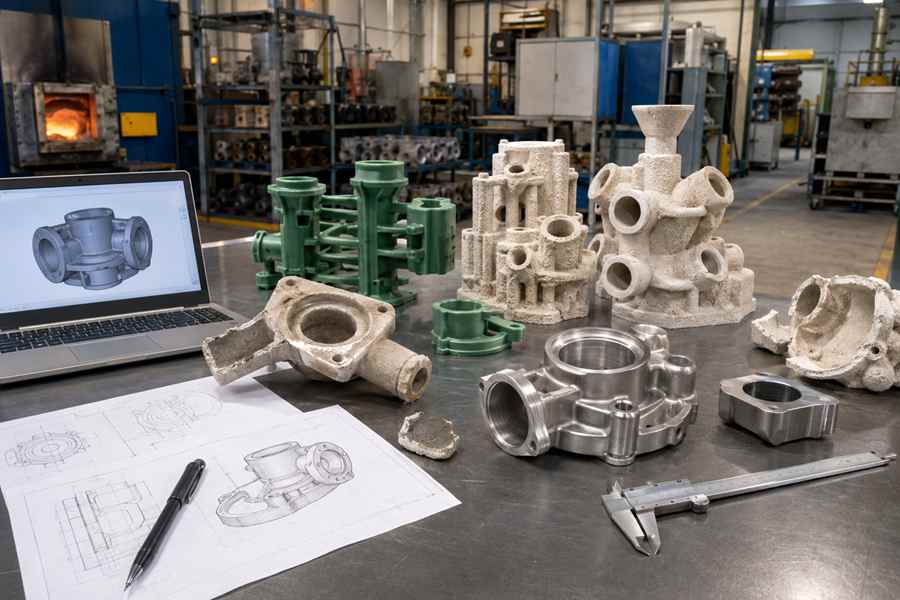
Superior part design can bring down investment casting costs by streamlining wax tooling, lowering ceramic core demands, improving casting tree efficiency, eliminating troublesome heavy sections, establishing proper gate positions, and reducing secondary machining work.
What Drives Costs in Investment Casting?
| Design Area | What to Improve | Main Cost Affected |
| Wax Pattern | Minimize undercuts and complex inserts | Tooling and pattern cost |
| Ceramic Cores | Simplify enclosed cavities and passages | Core tooling and recurring core cost |
| Casting Tree | Improve part spacing and orientation | Shell, pouring, and processing cost |
| Heavy Sections | Remove excessive local metal mass | Material, feeding, and scrap |
| Gate Location | Reserve practical cut-off areas | Grinding and finishing |
| Near-Net Shape | Form more geometry in the casting | CNC machining and finished-part cost |
Design 1: Simplify the Wax Pattern
Each investment casting originates from a wax pattern. This means geometries that complicate wax injection can drive up costs even prior to the pouring phase. Deep undercuts, enclosed recesses, lateral grooves and tricky demolding directions may call for slides, detachable inserts or extra manual labor.
For medium-size components, fitting a movable insert or slide onto the wax die can lift tooling investment by around 1000 to 5000 dollars or more. The exact value depends on feature sizes and mold construction.
Check Features That Complicate Pattern Release
Common areas to examine include:
- Deep external undercuts
- Lateral slots and grooves
- Trapped recesses
- Narrow internal pockets
- Long unsupported projections
If one challenging feature adds 3000 dollars to wax tooling, it brings an implied cost of roughly 0.60 dollars per casting for a 5000-unit order. This occurs even before accounting for wax injection and metal casting expenditures.
For low-to-medium volume production, streamlining wax tooling can hence generate bigger savings than trimming minor amounts of material from every single component.
Design 2: Reduce Ceramic Core Use
Ceramic cores enable investment casting of enclosed passages and inner geometries that standard wax tooling cannot directly produce. Nevertheless, every core adds extra tooling requirements and manufacturing procedures.
Ceramic cores may demand dedicated tooling, separate fabrication, installation inside the wax pattern, dimensional verification, and removal once the metal has solidified.
Compare Core Cost With the Alternative
Consider an internal passage with the following requirements:
- Core tooling: $4,000
- Ceramic core: $0.40/part
- Production quantity: 25,000 pcs
The recurring expenditure for cores alone can hit 10000 dollars. This brings total core-associated costs to roughly 14000 dollars, not counting extra handling work or possible scrap losses.
Ceramic cores become economically viable only when they eliminate expensive processes such as:
- Deep-hole drilling
- Welding
- Multi-piece assembly
- Multiple CNC setups
- Complex curved passage machining
For short straight bores or reachable inner features, post‑casting machining can at times deliver lower finished-part costs compared with fitting a ceramic core into each wax pattern.
Design 3: Fit More Parts on Each Casting Tree
Investment castings are generally attached to a central sprue and processed together as a complete casting tree. As a result, the number of patterns fitted onto each tree directly affects shell building, dewaxing, pouring, and knockout cost.
Oversized flanges, extended arms, and poorly positioned projections can force larger gaps between adjacent patterns. Even a relatively lightweight component may become expensive when its shape limits the number of parts carried by each tree.
Tree Density Changes Processing Cost
Consider a production order for 12,000 parts:
| Tree Layout | Parts per Tree | Trees Required |
| Original design | 10 | 1,200 |
| Improved layout | 15 | 800 |
| Difference | +5 parts/tree | 400 fewer trees |
Producing 400 fewer trees reduces repeated consumption and processing across:
- Wax tree assembly
- Ceramic slurry and stucco
- Dewaxing
- Furnace loading
- Molten metal pouring
- Shell removal
Raising tree capacity from 10 to 15 parts cuts the number of required trees by around 33% for the same production quantity.
For higher-volume investment casting, slightly changing the size or orientation of a flange, boss, or projection can therefore create more savings than removing only a few grams from the finished component.
Design 4: Reduce Heavy Metal Sections
A thick section costs more than the additional alloy it contains. Because it cools more slowly than the surrounding geometry, it can also make directional solidification and metal feeding more difficult.
For instance, joining a 3 mm wall directly to a 12 mm boss produces a concentrated thermal mass. The foundry may need a larger gate or additional feed metal, while the risk of shrinkage defects can also increase.
Practical design changes include:
- Hollowing oversized bosses
- Reducing excessively thick pads
- Removing unnecessary solid masses
- Creating smoother thickness transitions
- Taking metal from lightly loaded regions
Weight Reduction Can Also Improve Yield
Suppose a stainless steel investment casting is redesigned from 0.95 kg to 0.83 kg.
Across 30,000 parts, total finished casting weight decreases by 3,600 kg.
The financial benefit may extend beyond those 3.6 tonnes of alloy. When the removed metal also eliminates a difficult hot spot, metal yield can improve, feeding requirements may fall, and fewer castings may be rejected.
For investment casting, the most valuable material reduction is often metal that creates a solidification and feeding problem, rather than simply the easiest material to delete from the CAD model.
Design 5: Give the Gate a Better Location
The gate first connects the wax pattern to the casting tree and later provides the route for molten metal to enter and feed the component. Its location therefore influences both casting performance and the amount of post-casting work.
When every external face must remain free from gate traces, the foundry may be forced to place the gate in a less efficient or more difficult-to-finish position.
Practical gate areas often include:
- Hidden mounting pads
- Thick bosses
- Surfaces machined later
- Non-cosmetic edges
- Sections with sufficient thickness for feeding
Finishing Cost Repeats on Every Part
Assume a difficult gate position adds $0.30 of grinding cost per casting.
| Order Quantity | Additional Finishing Cost |
| 10,000 pcs | $3,000 |
| 40,000 pcs | $12,000 |
| 100,000 pcs | $30,000 |
At a volume of 100,000 pieces, that seemingly minor design restriction results in $30,000 of repeated finishing expense.
Allowing one suitable gate attachment area can therefore be more economical than requiring every surface on the component to remain completely free of gate marks.
Design 6: Use Near-Net Shape to Cut Machining
Investment casting provides the greatest economic benefit when more of the final geometry is created during casting rather than through later CNC operations.
Recesses, mounting bosses, raised markings, external profiles, pads, and selected holes can often be incorporated directly into the wax pattern without creating significant recurring processing cost.
Precision machining should remain concentrated on areas where it directly protects component performance, including:
- Bearing seats
- Sealing surfaces
- Assembly datums
- Precision bores
- Critical mating faces
Compare the Finished Part, Not Just the Casting
A casting with more incorporated geometry may have a slightly higher foundry price while still producing a cheaper finished component.
| Cost Item | Basic Casting | Near-Net Design |
| Investment casting | $8.20 | $8.55 |
| CNC machining | $1.80 | $0.85 |
| Finishing | $0.30 | $0.30 |
| Finished Part Cost | $10.30 | $9.70 |
The near-net version raises the casting price by $0.35, but the reduction in machining lowers finished-part cost by $0.60 per piece.
At a production quantity of 50,000 parts, the redesigned component generates approximately $30,000 in total savings.
This is why purchasing decisions based only on the lowest raw casting quotation can be misleading. A more useful comparison is the cost of the component when it is fully finished and ready for assembly.
Which Changes Should Be Prioritized?
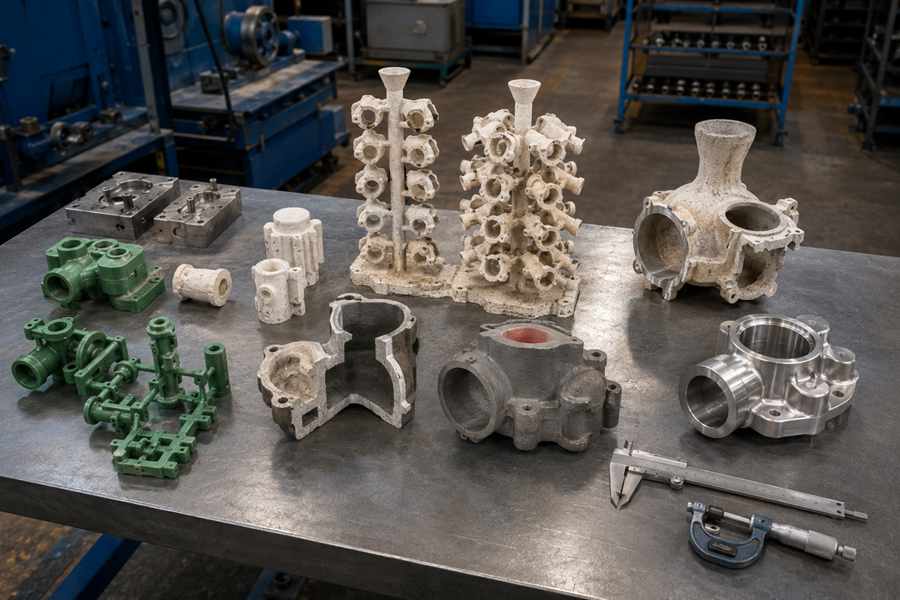
The most valuable design adjustment depends on which stage is currently driving the cost of the investment casting.
When initial tooling is expensive, wax-pattern complexity and ceramic core requirements should be checked first. When the recurring unit price is high, tree utilization, metal yield, gate finishing, and secondary machining usually offer greater potential.
A practical way to prioritize improvements is:
- High tooling cost:simplify wax tooling and core requirements.
- High casting cost:increase tree density and reduce heavy sections.
- High scrap rate:examine feeding and difficult solidification areas.
- High finishing cost:improve gate attachment and cut-off locations.
- High finished-part price:shift more geometry into the casting itself.
For example, saving $4,000 in tooling is worth $0.80 per part on a 5,000-piece order but only $0.04 per part at 100,000 pieces. In contrast, removing $0.40 of recurring machining cost saves $40,000 over a 100,000-piece production program.