
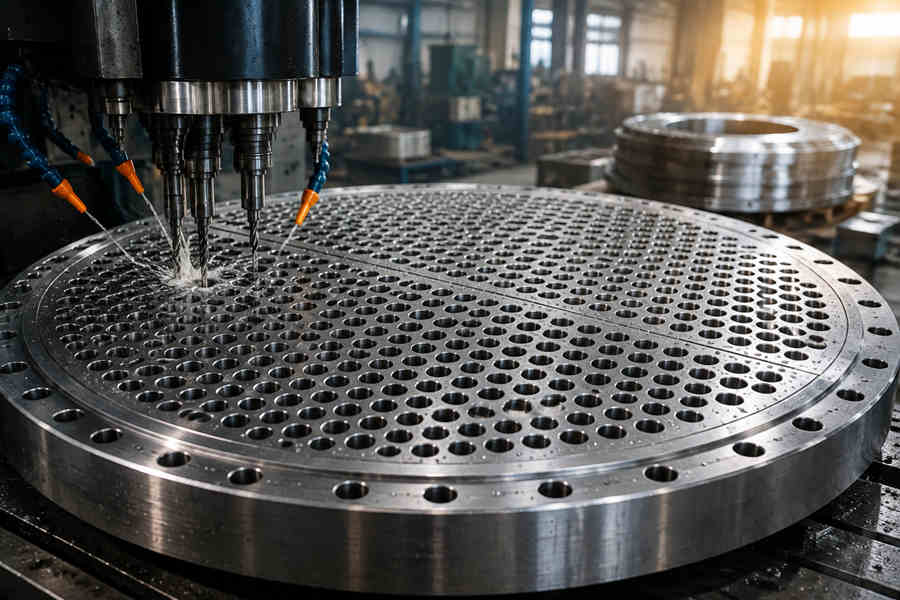
Tube-sheet discs for heat exchangers and pressure vessels are far more than simple drilled flat plates. Their performance relies on material strength, hole precision, surface quality, and stability under fluctuating pressure and temperature.
Dense hole drilling drives up costs for custom forged tube sheets, yet optimized hole patterns improve equipment performance. Don’t just cut hole numbers; balance hole density, manufacturing difficulty and real-world operational demands.
Main Cost Factors of High-Density Hole Drilling
High-density hole drilling impacts nearly every production step, from prepping raw material all the way through final checks. Unlike regular forged parts, tube-sheet discs have thousands of holes that must stay consistent on size, spacing and alignment, so tighter machining oversight is needed.
Take stainless steel forged tube sheets for example. A part with 800-1500 holes will go through two-three machining rounds, but push hole counts above 3000, and production time jumps sharply.
The extra cost mostly stems from:
- Longer CNC drilling runtime
- Faster wear on cutting tools
- Tricky positioning work
- Heavier inspection workload
- Extra risk management while machining
How Hole Quantity Changes Manufacturing Cost
Hole count drives how long machining will take. Adding a handful more holes barely moves costs, but things slow way down once you hit high-density drilling.
Drilling roughly 1000 standard tube holes takes a few hours. Hit 4000 precision holes, though, and you’ll need extra machine setups, tool swaps and frequent dimension checks.
| Tube Sheet Disc Type | Hole Quantity | Machining Difficulty | Additional Drilling Cost |
| Standard tube sheet disc | 500–1000 holes | Normal CNC drilling | +$300–$800 |
| Medium-density design | 1000–2500 holes | More positioning control | +$800–$1,800 |
| High-density hole drilling | 2500–5000 holes | Long machining cycle | +$1,800–$4,500 |
| Ultra-high density design | 5000+ holes | Multi-stage machining | +$4,500–$8,000 |
These figures vary with material hardness, hole dimension, plate thickness and tolerance specs. A forged stainless-steel tube-sheet blank costs $2,000-$8,000, subject to its size and material grade. Drilling work can account for a large share of total manufacturing expenses.
Material Selection Also Affects Drilling Cost
Common custom forged tube-sheet materials run from carbon steel, 304/316 stainless steel, duplex stainless steel through to nickel alloys. 304 and 316 are widely picked for corrosion resistance, while duplex grades handle much tougher working scenarios.
Harder materials deliver better real-world durability, but they drill slower and you’ll find yourself swapping out cutting tools every few runs. Drilling thousands of holes in duplex stainless steel, for example, needs completely different machining parameters compared to carbon steel.
| Material | Typical Application | Material Cost Difference for Tube Sheet Disc | Machining Impact |
| Carbon Steel | General pressure equipment | Base price: $1,500–$3,000 | Faster drilling |
| Stainless Steel 304 | General corrosion environments | $2,500–$5,000 | Moderate machining cost |
| Stainless Steel 316 | Chemical and marine equipment | $3,000–$6,500 | Higher tool wear |
| Duplex Stainless Steel | Seawater and harsh environments | $5,000–$10,000 | Slower drilling, higher machining cost |
Cheaper-grade materials help you save at quote stage, even if they may drive up maintenance work later. For equipment built for long-term operation, working conditions should guide your material pick, not just your initial budget.
Boberry also makes stainless steel castings for complex industrial parts needing corrosion resistance. Castings can reduce machining allowances for certain tricky shapes. Still, high-load tube sheet discs call for thoughtful comparison before you settle on casting versus forging.
Hole Diameter and Tolerance Influence Final Price
High-density drilling isn’t just about cranking out more holes. Hole precision is a big cost driver too.
Tube sheets demand consistent hole diameter, proper pitch spacing, smooth inner surfaces and reliable tube expansion performance. Tighter tolerances mean extra machining work and more advanced inspection gear.
Standard-tolerance tube sheets get by with basic CNC checks. Precision high-pressure variants need CMM scanning plus a couple rounds of corrective rework.
| Hole Requirement | Typical Processing | Added Cost Reference |
| Standard drilling tolerance | CNC drilling + basic inspection | Included |
| Precision tube hole machining | Additional machining control | +$500–$1,500 |
| Tight tolerance hole pattern | CMM inspection + correction | +$1,500–$3,000 |
| Critical pressure equipment requirement | Full dimensional report | +$2,000–$5,000 |
If you hand over full technical specs up front for your custom forgings, you can skip unplanned mid-production tweaks.
Secondary Operations Add Extra Cost
After drilling, some tube sheet discs may require additional processing depending on application requirements.
Common secondary operations include:
- Surface treatment
- Heat treatment
- Edge machining
- Cleaning
- Non-destructive testing
| Secondary Operation | Purpose | Typical Cost Addition |
| Heat treatment | Improve mechanical properties | $300–$1,500 |
| Surface polishing | Improve surface condition | $500–$2,000 |
| Ultrasonic testing | Detect internal defects | $800–$2,500 |
| Liquid penetrant testing | Check surface cracks | $300–$1,000 |
| Final cleaning | Remove machining residue | $200–$800 |
How Manufacturers Can Control the Cost of Custom Forged Tube Sheet Discs?
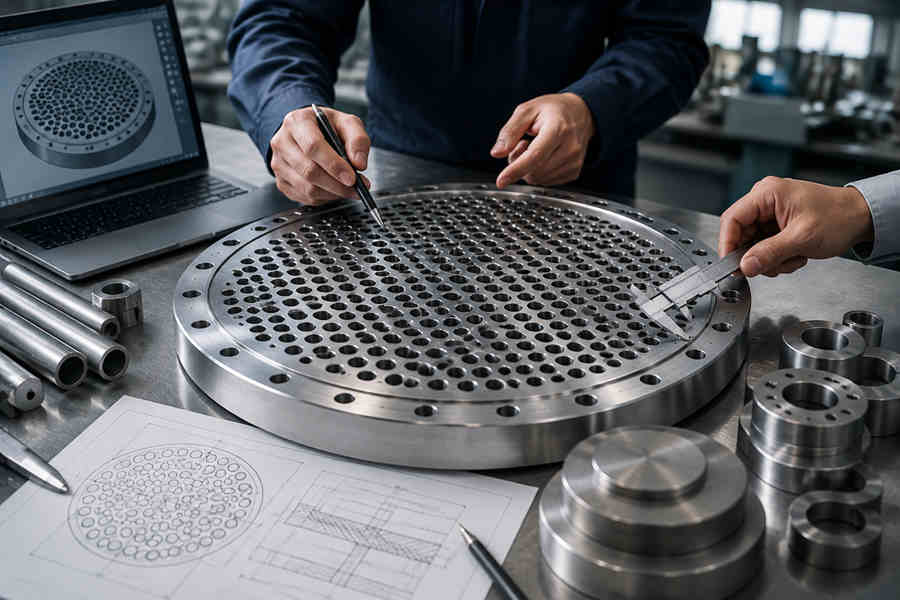
Cost reduction doesn’t rely on cutting hole quantities alone. More often than not, thorough design communication can eliminate unnecessary machining costs.
Several practical methods can help:
- Optimize Hole Pattern Design
Hole layout greatly impacts drilling efficiency. A well-designed pattern minimizes repeated positioning operations and boosts machine working efficiency.
- Select Suitable Material Grade
It’s wise to adopt high-end materials only when required to avoid excess material costs. 316 stainless steel fits most regular scenarios, while duplex stainless steel is reserved for environments demanding superior corrosion resistance.
- Confirm Tolerance Requirements Early
Unnecessarily strict tolerances drive up machining and inspection costs. Defining clear specs upfront helps manufacturers adopt the most appropriate production processes.
- Consider Manufacturing Process Capability
Suppliers with rich custom forging and casting experience can offer more feasible and cost-effective production solutions.
Boberry has extensive manufacturing experience in forged and cast industrial parts, delivering fully customized solutions matched to specific part structures, material needs and application scenarios.
High-Density Drilling Cost Example for a Custom Tube Sheet Disc
A practical example:
A stainless steel 316 forged tube sheet disc:
- Diameter: 1200 mm
- Thickness: 120 mm
- Hole quantity: 3500 holes
- Hole diameter: 25 mm
Estimated cost structure:
| Cost Item | Estimated Price |
| Forged stainless steel blank | $4,500–$6,000 |
| CNC high-density drilling | $2,500–$4,500 |
| Precision inspection | $1,500–$2,500 |
| Surface finishing | $800–$1,500 |
| Final processing and handling | $500–$1,000 |
| Total Estimated Cost | $9,800–$15,500 |
As custom-part buyers, we know high-density drilling pushes up tube-sheet disc costs. Pricing isn’t just about hole count; machining, material traits, tolerances and inspections all play big roles.
Rather than chasing fewer holes or cheap materials, partner with a manufacturer balancing design specs and production efficiency. Thoughtful process planning delivers solid performance without runaway costs.