
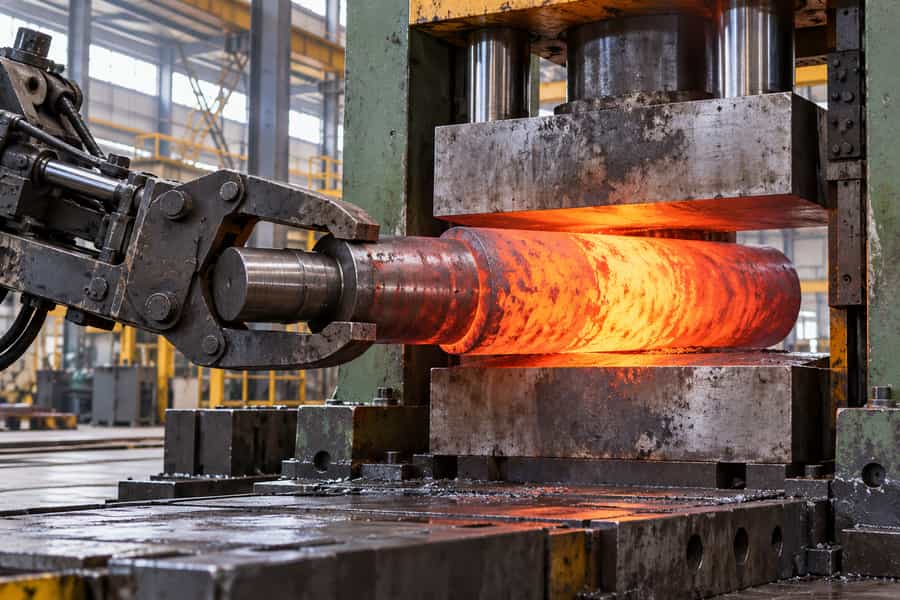
Hot forging shapes heated metal through compressive force, typically above the alloy’s recrystallization range. Lower deformation resistance enables significant shape changes while the metal remains solid.
It is used for load-bearing mechanical parts, although performance depends on material, tooling, heat treatment, and inspection. This guide explains the process, engineering tradeoffs, applications, and purchasing requirements.
What Is Hot Forging?
Hot forging is a metalworking process in which heated metal is plastically deformed into a required shape using compressive forces. Unlike casting, the material remains solid throughout the forming operation.
Heating reduces the metal’s flow stress, allowing substantial deformation without the excessive forming forces that might be required at room temperature. The resulting component geometry depends on tooling, equipment, and controlled material movement.
How Does Hot Forging Work?
During forging, a heated billet is compressed between dies or other forming tools. The applied force causes plastic deformation, moving material into the intended shape while changing its internal structure.
Depending on the component, deformation may occur in one operation or through several stages. Properly controlled forging can promote favorable grain flow and microstructural refinement, although mechanical properties also depend on subsequent processing.
What Temperature Is Required for Hot Forging?
Hot forging temperatures depend on alloy composition, deformation requirements, and the selected manufacturing process. For example, many steels are hot forged at approximately 900–1250°C, while certain aluminum alloys require substantially lower temperatures.
These are broad manufacturing ranges rather than universal operating settings. Initial heating temperature, deformation temperature, finishing temperature, and cooling behavior must be established for the specific material and component.
How Does the Hot Forging Process Work?
Hot forging involves a sequence of material preparation, heating, forming, cooling, and finishing operations. Each stage influences dimensional accuracy, mechanical properties, production efficiency, and the likelihood of manufacturing defects.
Step 1: Material Selection and Billet Preparation
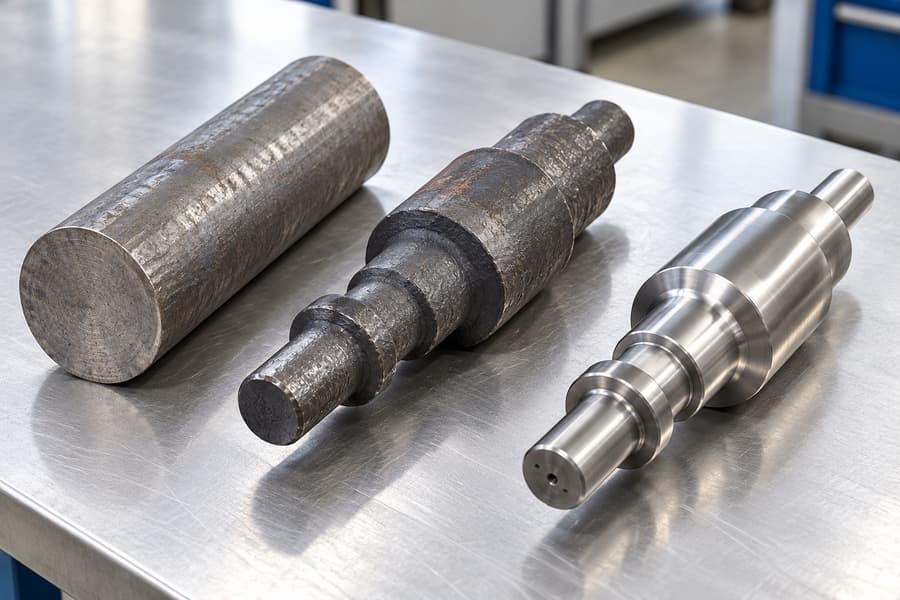
The process begins with selecting metal that meets the component’s mechanical, chemical, and service requirements. Material grade, hardenability, corrosion resistance, and intended heat treatment should be considered before production.
Metal bars or other suitable stock are cut into billets according to the required forging weight and geometry. Billet dimensions must account for the finished component, machining allowances, and any expected material loss.
Incorrect billet sizing can cause incomplete die filling, excessive flash, or unnecessary material consumption. Material identity and condition should therefore be verified before billets enter the heating process.
Step 2: Heating the Metal
Billets are heated using appropriate industrial equipment until they reach the specified forging temperature. Heating conditions depend on billet dimensions, thermal conductivity, alloy composition, and required temperature uniformity.
Insufficient heating increases deformation resistance and may contribute to cracking or incomplete forming. Excessive heating can promote oxidation, grain coarsening, or other metallurgical problems that affect component quality.
Temperature measurement methods should account for surface conditions and potential differences between billet surface and core temperatures, particularly when processing large sections.
Step 3: Die Preparation and Equipment Setup
Forging tools are prepared according to the component design and selected forming method. Die cavities, alignment, lubrication, and equipment capacity influence material flow and the consistency of forged geometry.
Manufacturers must also consider contact conditions between the heated workpiece and tooling. Improper lubrication, insufficient forming force, or unsuitable die geometry can produce defects or accelerate tool wear.
Step 4: Metal Deformation and Forging
The heated billet is positioned in the forging equipment and compressed using a press, hammer, or another suitable forming system. The applied force reshapes the metal through controlled plastic deformation.
Complex geometries may require preliminary forming stages before final shaping. These operations redistribute material, prepare critical sections, and reduce the risk of defects during subsequent deformation.
The deformation rate, temperature, and geometry must be considered together. Excessively rapid cooling or unsuitable material flow can increase forming resistance and compromise the intended component structure.
Step 5: Trimming and Controlled Cooling
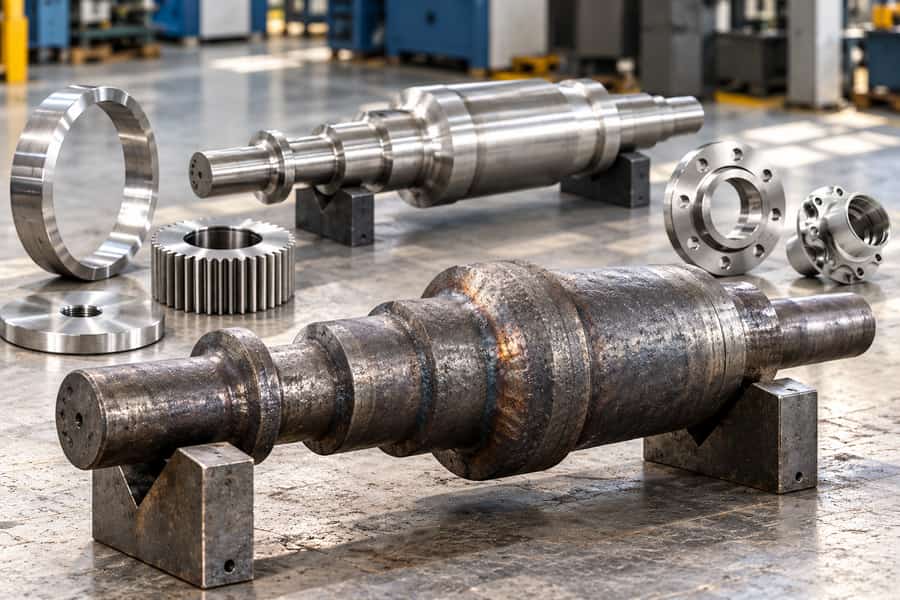
After forming, excess material may be removed through trimming, depending on the forging method. Open-die components and flashless processes do not necessarily require conventional flash trimming.
The forged workpiece is then cooled under conditions appropriate for its material and intended properties. Cooling rate influences microstructure, residual stress, hardness, and the possibility of dimensional distortion.
Step 6: Heat Treatment, Machining, and Finishing
Depending on material specifications, forged components may undergo normalizing, annealing, quenching, tempering, or other heat treatments. These operations help establish the required combination of strength, hardness, and toughness.
Machining is used when functional surfaces, hole locations, dimensional tolerances, or surface finishes cannot be achieved directly through forging. Cleaning and additional finishing operations prepare components for inspection or assembly.
Main Types of Hot Forging Processes
Hot forging methods differ in tooling configuration, deformation control, component geometry, and production economics. Selecting an appropriate method requires considering the part’s dimensions, shape, material, and anticipated manufacturing volume.
Open-Die Hot Forging
Open-die forging compresses a heated workpiece between relatively simple dies that do not completely enclose the material. Operators or automated systems reposition the workpiece through successive deformation operations.
This method is suitable for large shafts, rings, blocks, and other relatively simple geometries. However, achieving final dimensions often requires additional machining, particularly for precision interfaces and complex features.
Closed-Die Hot Forging
Closed-die forging uses shaped die impressions to control metal flow and produce defined component geometries. It is frequently considered for repeatable production of connecting rods, levers, hubs, and similar mechanical components.
Conventional impression-die forging may produce flash that requires trimming. Although tooling investment can be substantial, closed-die forging can be economical when production quantities justify the tooling.
Hot Upset Forging
Upset forging applies axial compression to increase the cross-sectional area of a selected workpiece region. It is commonly used to create enlarged heads, flanges, and localized thick sections.
Successful upsetting requires suitable workpiece proportions, temperature control, and alignment. Excessive unsupported length may cause buckling, while unfavorable deformation conditions can produce folds or other material-flow defects.
| Forging Method | Working Principle | Typical Components | Key Considerations |
| Open-Die Forging | Compresses material between relatively simple dies | Shafts, rings, blocks | Flexible sizing; machining allowances often required |
| Closed-Die Forging | Forms material within shaped die impressions | Connecting rods, levers, hubs | Tooling investment, die filling, production quantity |
| Upset Forging | Enlarges selected sections through axial compression | Headed parts, flanged components | Buckling prevention, alignment, deformation control |
What Are the Advantages of Hot Forging?
Hot forging offers several manufacturing advantages, particularly when components require substantial deformation or must withstand demanding mechanical loading. These benefits depend on appropriate material selection, process control, and component design.
Improved Metal Formability
Heating metal into its hot-working range reduces resistance to plastic deformation. This allows manufacturers to produce substantial cross-sectional changes and shapes that may be difficult to form through cold working.
Improved formability can also reduce the force needed for a given deformation. Nevertheless, equipment requirements still depend on workpiece size, alloy behavior, deformation rate, and tooling geometry.
Favorable Grain Flow and Mechanical Properties
Forging can develop grain-flow patterns that follow the component’s geometry, potentially supporting load-bearing performance. Controlled deformation and subsequent processing can also influence grain size and microstructural uniformity.
These characteristics may benefit strength, toughness, and fatigue resistance in suitable applications. However, favorable properties are not automatic; defects, unsuitable heat treatment, or poor component design can offset potential advantages.
Flexibility for Different Component Geometries
Hot forging accommodates shafts, rings, flanged components, and other structural shapes. Appropriate preforming and tooling can redistribute material into sections that would otherwise require extensive machining from solid stock.
Complexity remains limited by material-flow behavior, tooling access, minimum section dimensions, and available forming equipment. Design adjustments may be necessary to avoid incomplete filling or excessive deformation.
Production Efficiency and Material Utilization
For suitable production quantities, repeatable forging operations can support efficient manufacturing. Near-net-shape designs may reduce machining stock, machining time, and the amount of material removed during finishing.
These advantages must be evaluated against die costs, heating energy, trimming losses, and tooling maintenance. Actual material savings depend on the original stock geometry and the final component design.
Limitations and Challenges of Hot Forging
Despite its advantages, hot forging introduces thermal, dimensional, and economic challenges. Understanding these limitations helps engineers determine whether forging is appropriate and which additional operations should be included.
Oxidation, Scaling, and Decarburization
High-temperature exposure can produce oxide scale on the metal surface. Certain steels may also experience surface decarburization, which changes the carbon content and can affect hardness and wear-related performance.
Heating duration, furnace atmosphere, temperature control, and surface cleaning influence these effects. Critical surfaces may require suitable processing controls or machining allowances to remove affected material.
Dimensional Accuracy and Surface Finish
Hot-forged dimensions are influenced by thermal contraction, die wear, equipment conditions, and forming variation. As-forged components generally require larger dimensional allowances than precision-machined features.
Surface roughness and scale may also make additional finishing necessary. Bearing seats, sealing faces, mounting holes, and other precision interfaces should be evaluated separately from the general forged geometry.
Tooling Investment and Energy Consumption
Closed-die forging requires tooling design, manufacturing, and maintenance. These expenses can make small production batches less economical, particularly when component geometry requires multiple forming stages.
Heating also consumes energy, while tooling deterioration introduces maintenance costs. Process selection should therefore consider total manufacturing expenditure rather than comparing forming operations in isolation.
Potential Forging Defects
Forging defects can result from unfavorable material flow, inappropriate heating, unsuitable die design, or inconsistent processing. Common examples include laps, folds, cracks, underfilling, and internal discontinuities.
For example, a poorly positioned preform may cause metal surfaces to fold together during die filling. Process planning, temperature verification, and appropriate inspection are essential for controlling such risks.
Hot Forging vs. Warm Forging vs. Cold Forging
The main distinction between hot, warm, and cold forging is the working temperature relative to material behavior. Each method offers different combinations of formability, dimensional control, surface quality, and manufacturing cost.
Differences in Processing Temperature and Formability
Hot forging generally occurs above the effective recrystallization temperature, supporting extensive deformation. Warm forging operates at intermediate temperatures, while cold forging is commonly performed near room temperature.
As working temperature decreases, forming resistance generally increases. However, lower temperatures may improve dimensional control and reduce the oxidation associated with high-temperature processing.
Differences in Precision and Manufacturing Requirements
Cold forging can achieve accurate dimensions and favorable surface conditions for suitable geometries. Its higher deformation resistance, however, may require powerful equipment and place greater demands on tooling.
Warm forging offers an intermediate approach, balancing reduced forming loads with improved dimensional control compared with some hot-forging operations. Material characteristics determine whether this compromise is practical.
| Comparison Factor | Hot Forging | Warm Forging | Cold Forging |
| Operating Temperature | Generally above recrystallization range | Intermediate elevated temperature | Generally near room temperature |
| Deformation Resistance | Typically lower | Intermediate | Typically higher |
| Material Formability | Suitable for substantial deformation | Balances formability and control | More restricted by work hardening |
| Dimensional Accuracy | More affected by thermal contraction | Often better than hot forging | Often high for suitable geometries |
| Surface Condition | Greater oxidation risk | Generally reduced oxidation | Limited thermal oxidation |
| Main Consideration | Formability and large deformation | Balance of forming load and precision | Precision and tooling loads |
Process selection should prioritize component geometry, alloy formability, mechanical requirements, and production volume. No single forging temperature category provides the best technical and economic outcome for every application.
What Materials Are Suitable for Hot Forging?
Hot forging can process various ferrous and nonferrous metals, although each material requires an appropriate temperature range, deformation schedule, and cooling strategy.
Carbon Steel and Alloy Steel
Carbon steels are widely used for forged mechanical components because their properties can be adjusted through composition and heat treatment. Typical applications include shafts, gears, flanges, and structural components.
Alloy steels provide additional options for controlling hardenability, strength, and toughness. Their forging schedules must account for alloy-dependent hot workability, transformation behavior, and sensitivity to cooling conditions.
Stainless Steel
Many stainless steel grades can be hot forged into components requiring corrosion resistance and structural performance. Their forging behavior varies significantly between austenitic, martensitic, ferritic, and other stainless steel families.
Temperature control is important because some grades exhibit relatively high deformation resistance or narrower workable temperature ranges. Surface oxidation and post-forging heat treatment also require material-specific consideration.
Aluminum Alloys and Other Nonferrous Metals
Selected aluminum alloys are suitable for hot forging where component weight and mechanical performance are important. Their lower forging temperatures do not eliminate the need for precise thermal control.
Copper and titanium alloys may also be processed through appropriate forging methods. Their different oxidation behavior, deformation resistance, and temperature sensitivity require dedicated process planning rather than generalized steel-forging parameters.
Industrial Applications of Hot-Forged Parts
Hot-forged components serve industries where structural integrity, mechanical loading, and dimensional requirements influence manufacturing decisions. The appropriate forging method depends on each component’s operating environment and design specifications.
Automotive and Commercial Vehicles
Hot forging is used for connecting rods, crankshaft components, steering parts, and transmission components. These parts may experience repeated loading, impact, or torsional forces during operation.
Material selection, grain-flow direction, heat treatment, and dimensional inspection must be matched to functional requirements. Fatigue-sensitive regions deserve particular attention during component design.
Construction and Heavy Machinery
Construction equipment uses forged shafts, pins, couplings, and other load-bearing components. These parts may experience substantial mechanical loads, vibration, and intermittent impact.
Engineers should evaluate section transitions, stress concentrations, and wear surfaces. Forging provides a manufacturing route, but component durability still depends on material properties and service conditions.
Agricultural Equipment
Agricultural machinery incorporates forged shafts, gears, linkages, and drivetrain parts. Such components operate under variable loading and may encounter dirt, moisture, and abrasive environments.
Required hardness, toughness, surface protection, and machining accuracy should reflect the intended function. Heat treatment and protective finishing may be necessary alongside the forging operation.
Oil and Gas Equipment
Forged flanges, valve components, and pressure-containing blanks are used in oil and gas equipment. Material integrity and compatibility with the operating environment are important engineering considerations.
Pressure, temperature, corrosion exposure, and applicable component specifications influence material selection. Inspection requirements and traceability should be established before manufacturing rather than assumed from the forging method.
Power Generation and Industrial Equipment
Power generation and industrial systems may use forged rings, shafts, transmission components, and turbine-related forgings. Their operating conditions can involve sustained loads, rotation, and temperature variation.
Mechanical testing, dimensional verification, and material documentation may be necessary depending on application criticality. Forging specifications should address the actual service demands of each component.
Design Considerations for Hot-Forged Components
Designing for hot forging requires balancing functional geometry with achievable material flow, tooling requirements, and finishing operations. Early manufacturing review can prevent unnecessary complexity and avoidable production difficulties.
Component Geometry and Material Flow
Smooth transitions between thick and thin sections help promote controlled deformation. Sharp internal corners and abrupt cross-sectional changes can complicate die filling and create unfavorable local strain concentrations.
Generous radii and suitable preform geometry may improve manufacturability. However, these features must also satisfy assembly, clearance, and structural requirements in the finished component.
Draft Angles, Parting Lines, and Flash
For conventional closed-die forging, draft angles facilitate removal of the workpiece from the tooling. Required draft depends on cavity depth, surface geometry, die configuration, and manufacturing conditions.
Parting-line placement affects die construction and flash formation. Designers should avoid placing trimming-sensitive features or critical functional surfaces where flash removal could complicate final processing.
Dimensional Tolerances and Machining Allowances
As-forged tolerances should be distinguished from the final dimensional requirements. Features requiring accurate fits, surface finishes, or geometric relationships may need machining after forging and heat treatment.
Machining allowances must accommodate forging variation, surface scale, and possible distortion. Excessive allowances increase material removal, while insufficient allowances risk leaving unacceptable surfaces or undersized features.
Production Volume and Tooling Feasibility
Production quantity strongly influences the economic suitability of a forging method. Dedicated closed-die tooling may be justified for repeat orders but less attractive for small batches.
Open-die forging may offer greater flexibility for certain low-volume or large-section components. The comparison should include tooling, heating, forming, material utilization, machining, inspection, and potential rework.
Quality Control and Inspection of Hot-Forged Parts
Quality control evaluates whether forged components meet specified material, dimensional, and mechanical requirements. Inspection planning should consider the manufacturing process, component function, and consequences of potential defects.
Material Verification and Process Control
Incoming material checks may include identification, chemical composition verification, and review of material documentation. These activities help confirm that the intended alloy enters the forging process.
During production, relevant parameters can include billet temperature, forming conditions, tooling condition, and cooling practice. Consistent control helps reduce process variation, although records alone do not establish product conformity.
Dimensional and Visual Inspection
Dimensional inspection verifies critical sizes, geometric relationships, and machining allowances. Measuring methods should suit the component’s complexity and the accuracy required by the engineering drawing.
Visual examination can identify surface cracks, folds, excessive scale, incomplete forming, or trimming-related damage. Additional inspection is necessary when defects may extend below the visible surface.
Mechanical Testing and Nondestructive Testing
Mechanical testing may include hardness, tensile, or impact testing when specified. Test selection, specimen location, material condition, and acceptance criteria must correspond to the applicable component requirements.
Nondestructive testing methods are selected according to material properties, component geometry, and relevant defect types. Common options include:
- Ultrasonic Testing: Uses sound waves to evaluate certain internal discontinuities, subject to component geometry and inspection limitations.
- Magnetic Particle Testing: Detects surface and near-surface discontinuities in suitable ferromagnetic materials.
- Liquid Penetrant Testing: Reveals surface-breaking discontinuities in suitable nonporous materials.
No individual inspection method detects every possible defect. Testing scope, examination coverage, and acceptance limits should be defined according to the component’s service requirements.
Documentation and Material Traceability
Depending on purchase specifications, documentation may include material certificates, heat-treatment records, dimensional reports, and applicable test results. These records support verification of agreed manufacturing requirements.
Traceability requirements should identify how materials, production batches, and inspection results are associated with delivered components. The necessary level of documentation depends on the application and contractual requirements.
Sourcing Custom Hot-Forged Parts from BOBERRY
Engineering drawings, material specifications, inspection expectations, and production quantities should be established before requesting a quotation. Clear requirements help suppliers evaluate manufacturing feasibility and identify potential design changes.
What Information Is Needed for a Forging Quotation?
A detailed request for quotation reduces uncertainty in tooling selection, production planning, and secondary processing. Engineers and procurement teams should provide the following information where applicable:
- Component Drawings: Include dimensions, geometric tolerances, critical surfaces, and relevant technical notes.
- Material Specifications: Identify the required alloy grade, material condition, and applicable requirements.
- Mechanical Properties: Specify required hardness, strength, toughness, and heat-treatment conditions where necessary.
- Machining Requirements: Identify features requiring final machining and the intended surface finish.
- Inspection Requirements: Define necessary tests, acceptance criteria, documentation, and traceability.
- Production Requirements: Provide anticipated order quantities, delivery expectations, and any relevant repeat-order plans.
Evaluating Manufacturing Feasibility with BOBERRY
BOBERRY supplies custom forged mechanical components, including shafts, flanges, hubs, rings, and gears. Its publicly described forging services cover open-die and closed-die forging, along with post-machining.
For a specific project, the appropriate forging route should be evaluated against component geometry, material requirements, tooling feasibility, and anticipated production quantities.
Additional manufacturing requirements, including particular material grades, heat-treatment operations, inspection methods, and achievable tolerances, should be confirmed through project-specific technical review rather than assumed.
Confirming Quality, Cost, and Delivery Requirements
Before placing an order, sourcing professionals should confirm the quotation scope, tooling responsibilities, required finishing operations, inspection criteria, documentation, and agreed delivery arrangements.
Where alternative manufacturing routes are feasible, comparisons should consider total finished-part cost rather than forging cost alone. Machining allowances, material utilization, tooling investment, and quality requirements can materially influence the purchasing decision.
Early coordination between design engineers and BOBERRY can help clarify technical requirements, identify manufacturability concerns, and establish an appropriate production scope before manufacturing begins.