
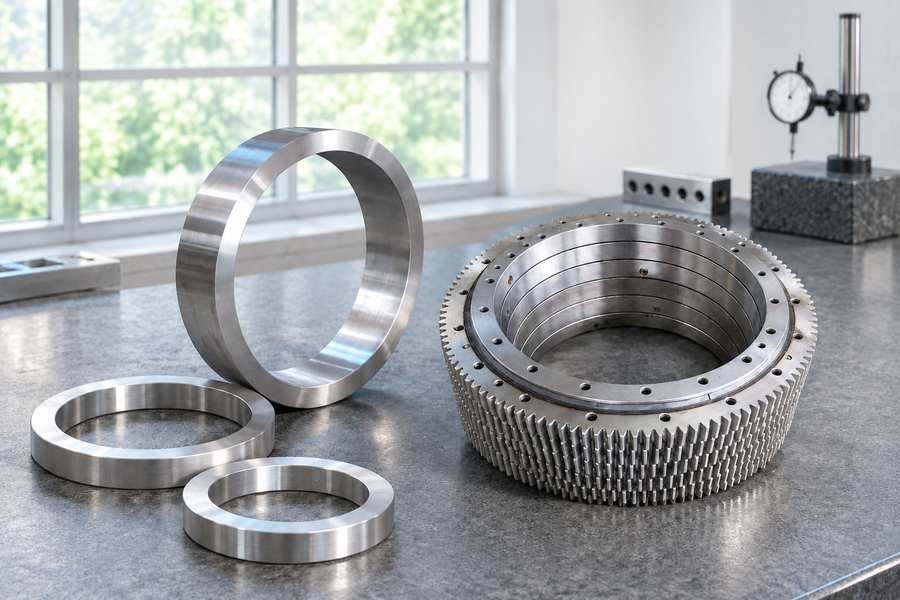
Forged rolled rings are seamless annular components shaped by rolling a pierced preform under controlled radial and, in some processes, axial pressure. Their diameter and cross-sectional geometry develop as the ring rotates between forming rolls.
Available designs include flat, tapered, and profiled rings, with materials and finishing conditions selected to suit the component drawing and service requirements.
What Are Forged Rolled Rings?
Definition and Basic Structure
A forged rolled ring is a metal component with a continuous annular structure, manufactured by deforming a hollow preform between specialized rolls. The operation changes its diameter, wall thickness, and cross-sectional geometry without joining separate material sections.
The term seamless describes the absence of a circumferential welded joint. However, it does not automatically mean that the component is free from internal discontinuities, surface imperfections, or dimensional variations.
Several geometric characteristics define a forged rolled ring and determine how it fits into a mechanical assembly:
- Inner diameter: Defines the central opening and determines clearance around shafts, housings, or adjoining components.
- Outer diameter: Establishes the external envelope and influences installation space and surrounding component dimensions.
- Axial height: Describes the ring’s dimension parallel to its rotational axis and affects the overall cross-sectional geometry.
- Cross-sectional profile: Defines the shape through the ring section, including uniform, tapered, and specially contoured configurations.
Forged Rolled Rings vs. Other Ring Manufacturing Methods
Ring rolling is one of several manufacturing methods for producing annular metal components. Other approaches include casting, welded fabrication, and machining from solid or hollow stock.
Casting forms metal inside a mold, while welded fabrication joins prepared material sections. Excess material is cut from a larger blank until the specified component shape and dimensions are achieved.
Ring rolling instead starts with a pierced preform and progressively expands it through controlled deformation. This process can develop circumferential grain flow, although the resulting material characteristics depend on the manufacturing route.
Each method has different material requirements, production constraints, and geometric capabilities. Selection should consider component design, material specification, manufacturing feasibility, inspection requirements, and intended operating conditions rather than relying on the manufacturing method alone.
How Does the Forged Ring Rolling Process Work?
Preform Preparation and Piercing
The manufacturing process begins with suitable metal starting stock, commonly prepared as a billet. Its material grade, dimensions, and initial condition must provide sufficient material for forming and subsequent machining.
For hot ring rolling, the starting material is heated according to its composition and forming characteristics. Temperature influences material flow, ductility, deformation resistance, and the behavior of the workpiece during rolling.
The billet may undergo upsetting to change its proportions before piercing. Piercing creates a central opening, producing a hollow annular preform with the wall thickness and height needed for the rolling operation.
Preform geometry influences how the material moves during subsequent deformation. Initial diameter, wall thickness, axial height, and material distribution must therefore be considered when planning the production sequence.
- Billet preparation: Establishes the starting material dimensions and condition for the intended manufacturing route.
- Upsetting: Changes the billet proportions to prepare a suitable section for the piercing operation.
- Piercing: Creates the central opening and produces the hollow preform required for ring rolling.
Radial and Radial-Axial Ring Rolling
During radial ring rolling, a driven main roll acts against the outside surface while a mandrel or supporting roll contacts the inside surface. The distance between these tools is progressively reduced.
As the ring rotates, its radial wall thickness decreases and its diameter increases. Repeated deformation allows the workpiece to expand gradually while maintaining its annular structure.
Radial-axial ring rolling introduces additional axial rolls that act on the upper and lower faces. These rolls help control the ring’s axial height while radial deformation continues.
The relationship between radial and axial deformation depends on the target cross-section, tooling arrangement, material behavior, and process controls. Flat, tapered, and profiled rings may require different forming strategies.
Maintaining section stability is important throughout the operation. Unbalanced deformation or unsuitable forming conditions can contribute to dimensional variation, local instability, or deviations from the intended cross-sectional shape.
Ring rolling must also be distinguished from longitudinal roll forging. Ring rolling expands a rotating annular preform, whereas longitudinal roll forging moves stock along its length between rolls to produce an elongated workpiece or preform.
Although both processes use rotating rolls, their workpiece movements, deformation paths, and intended products are different. Longitudinal roll forging should not be used as another name for ring rolling.
Post-Rolling Treatment and Finishing
After rolling, a ring may require controlled cooling, heat treatment, dimensional correction, or additional finishing. The selected sequence depends on the material grade, geometry, forming history, and required final condition.
Heat-treatment temperature, holding time, and cooling method vary according to the material grade and required metallurgical condition. Different steel grades and aluminum alloys have different processing requirements, so one universal treatment procedure cannot be applied to every forged rolled ring.
Some components proceed directly to an agreed supply condition, while others require machining. Rough machining establishes preliminary surfaces and dimensions, whereas precision machining achieves the specified finished geometry and tolerances.
Required machining stock needs to be incorporated into the component design and planned forming operations from the outset. Insufficient allowance may prevent complete surface cleanup, while excessive allowance can increase material removal and downstream machining requirements.
Main Types of Forged Rolled Rings
Flat Uniform-Section Forged Rolled Rings
Flat uniform-section forged rolled rings have a consistent cross-sectional shape around their circumference. Their radial thickness and axial height are designed to remain substantially uniform, subject to the specified manufacturing and dimensional tolerances.
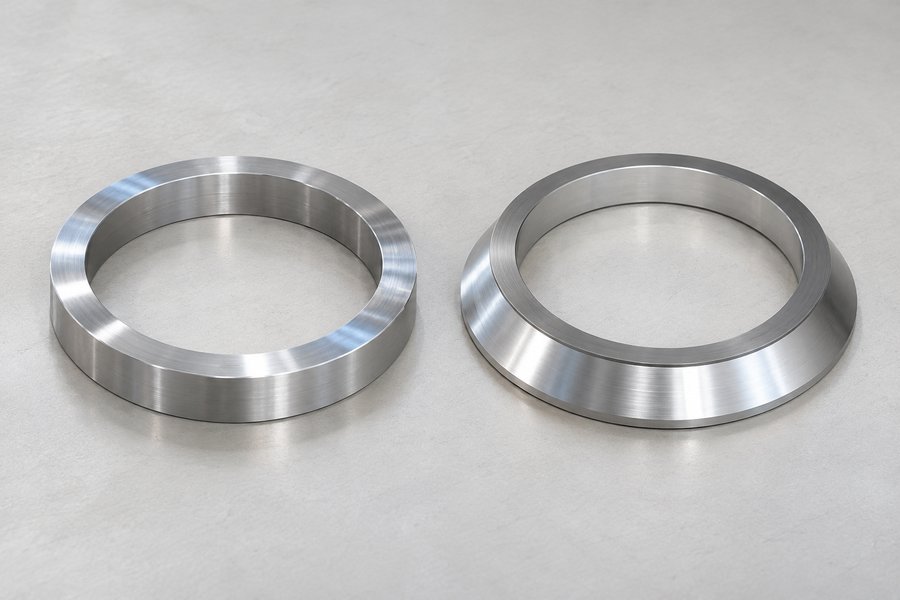
This configuration is suitable for components requiring a regular annular section without deliberate tapering or complex contour features. Its relatively straightforward geometry can simplify drawing interpretation and subsequent machining planning.
Engineers should still define the inner diameter, outer diameter, axial height, and reference surfaces accurately. Roundness, flatness, concentricity, and local dimensional variation may remain important for components requiring precise assembly interfaces.
Flat rings can serve as intermediate blanks for further machining or as finished annular components. The intended component function and drawing-defined dimensional requirements determine the most suitable delivery condition.
Tapered Forged Rolled Rings
Tapered forged rolled rings incorporate a gradual change in cross-sectional geometry. The variation may occur across the radial or axial section, depending on the intended component design and functional requirements.
The taper can accommodate particular mating interfaces, structural transitions, or installation requirements. Its orientation and dimensions influence how the ring connects with surrounding components and how much material remains for subsequent machining.
When specifying a tapered ring, the engineering drawing should identify the taper direction, reference surfaces, and dimensional changes. Section views help clarify the intended geometry and reduce interpretation errors during production.
A tapered section may require additional machining to establish accurate contact surfaces or final assembly dimensions. Whether the required geometry can be produced primarily through rolling depends on material behavior, tooling, and contour complexity.
Profiled or Contour Forged Rolled Rings
Profiled or contour forged rolled rings have specially shaped cross-sections designed around specific component requirements. Their geometry may include shoulders, steps, grooves, transitions, or other features defined by engineering drawings.
Compared with uniform-section rings, profiled designs offer greater flexibility in cross-sectional configuration. When the forming route permits, incorporating part of the required contour during rolling may reduce subsequent material removal.
Complex profiles require coordination between component design and manufacturing planning. Abrupt section changes, narrow features, and uneven material distribution can influence metal flow, forming stability, and the achievable finished geometry.
Drawings should distinguish rolled features from machined features. Critical transitions, radii, reference surfaces, and tolerances should be clearly identified so the manufacturing route and remaining machining requirements can be evaluated.
| Ring Type | Main Geometric Feature | Important Design Consideration |
| Flat uniform-section | Consistent cross-section around the circumference | Diameter, axial height, and section uniformity |
| Tapered | Gradually changing cross-sectional geometry | Taper direction, reference surfaces, and machining allowance |
| Profiled or contour | Specially shaped cross-section | Contour definition, section transitions, and machining access |
Key Features and Engineering Characteristics of Forged Rolled Rings
Seamless Annular Construction
A forged rolled ring produced from a pierced preform has no circumferential weld joining separate ends. This construction is relevant when a component requires a continuous annular form.
Compared with welded fabrication, the absence of a joining seam removes the weld joint from the component’s circumferential structure. However, material quality, forming conditions, and inspection remain essential to determining product quality.
Seamless construction alone does not establish fatigue life, pressure rating, or load capacity. These characteristics require engineering evaluation based on material properties, component geometry, manufacturing condition, and applicable design requirements.
Circumferential Grain Flow and Material Properties
Plastic deformation during ring rolling can orient material flow along the ring circumference. This occurs as the annular preform rotates and expands under repeated deformation from the forming rolls.
Grain-flow orientation can influence directional mechanical behavior, but it does not guarantee universally superior strength. Actual properties depend on material composition, initial stock, deformation history, heat treatment, and testing orientation.
For engineering applications, mechanical properties should be verified against the specified material condition and applicable testing requirements. Where directional properties are important, the required sampling orientation and acceptance criteria should be identified.
Material Utilization and Machining Requirements
Ring rolling can produce a near-net-shape annular component, potentially reducing material removal compared with machining the same geometry from a substantially larger solid billet.
The actual material utilization depends on the finished dimensions, starting stock, pierced preform, forming losses, and required machining allowance. Simple uniform rings and complex profiled components may have different material requirements.
Designers should account for sufficient machining stock to achieve the required finished surfaces and dimensions. Insufficient allowance may prevent surface cleanup, while excessive allowance can increase machining operations and material removal.
Near-net-shape production should therefore be treated as a manufacturing objective rather than a guaranteed material-saving percentage. A meaningful comparison requires the actual drawing and proposed production route.
Dimensional Accuracy and Geometric Control
Important dimensional characteristics include inner diameter, outer diameter, axial height, radial wall thickness, and cross-sectional profile. Their tolerances should reflect the ring’s function within the larger mechanical assembly.
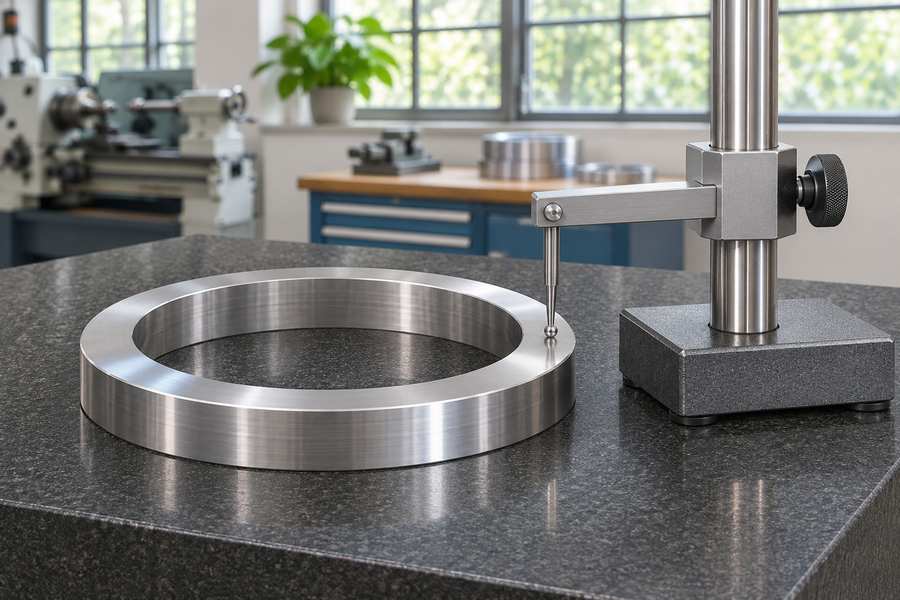
Roundness and concentricity may be important when a ring interfaces with a shaft, housing, or bearing arrangement. Flatness and parallelism can also affect axial contact surfaces and component alignment.
As-rolled dimensions should not automatically be treated as equivalent to precision-machined dimensions. Rolling establishes the basic shape, while subsequent machining may be necessary to achieve specified fits and functional surfaces.
Inspection should use appropriate reference datums and measurement methods. Checking a diameter at only one location may not identify ovality or local variation, so measurement planning should reflect the drawing requirements.
Materials and Supply Conditions for Forged Rolled Rings
Steel Forged Rolled Rings
Steel is a material option for many industrial forged rolled ring applications. However, the general term steel does not identify the exact mechanical properties, heat-treatment requirements, or processing characteristics of a particular component.
Material grade selection should consider loading conditions, operating temperature, toughness requirements, corrosion exposure, and machining needs. Components with similar geometries may require different grades because their service environments differ.
The ordered material specification and required condition should be confirmed before production. Any required mechanical-property testing, documentation, or traceability should also be identified in the purchasing requirements.
Aluminum Forged Rolled Rings
Aluminum is another material option, particularly for applications where reducing component weight is an important design consideration. Its density and deformation behavior differ from steel, affecting both manufacturing and mechanical performance.
Different aluminum alloys and tempers provide different combinations of strength, ductility, and heat-treatment response. Engineers should identify the required alloy and condition rather than specifying aluminum without further material details.
Forming temperature, deformation conditions, cooling, and subsequent heat treatment must be suitable for the selected alloy. These requirements should be evaluated alongside the ring’s geometry and intended service conditions.
Available Manufacturing and Machining Conditions
Supply condition describes the manufacturing stage at which the ring is delivered. It should be specified separately from material grade and finished dimensions because each requirement defines a different aspect of the order.
- As-forged: Supplied in the agreed forged condition before final machining. Additional processing may be required to achieve finished dimensions or functional surfaces.
- As-rolled: Supplied following the ring rolling operation, with subsequent treatment and finishing defined by the agreed requirements.
- Rough-machined: Receives preliminary material removal to establish approximate dimensions or selected surfaces, with further machining allowance remaining where specified.
- Precision-machined: Machined to the agreed drawing dimensions, tolerances, and surface requirements, with finished characteristics subject to inspection.
| Supply Condition | Main Characteristics | Typical Consideration |
| As-forged | Supplied in the agreed forged condition | Further processing or machining requirements |
| As-rolled | Supplied following ring rolling | Treatment and dimensional finishing requirements |
| Rough-machined | Preliminary material removal completed | Remaining machining allowance |
| Precision-machined | Finished to agreed drawing requirements | Final dimensional and surface inspection |
Buyers should state the required delivery condition clearly. If further machining will be performed after delivery, the order should identify unfinished surfaces and the expected remaining material allowance.
Industrial Applications of Forged Rolled Rings
Bearings and Rotating Equipment
Forged rolled rings can be used in suitable bearing components and large bearing assemblies. Their annular geometry supports designs requiring circular interfaces, controlled diameters, and specific cross-sectional configurations.
For bearing components, important evaluation criteria can include roundness, concentricity, surface texture, hardness, and dimensional consistency. The exact requirements depend on whether the ring functions as a raceway, support component, or another structural element.
Other rotating equipment may incorporate ring-shaped forgings as mounting or structural components. Engineers should evaluate operating speed, loading, alignment, and temperature when establishing material and machining requirements.
Gears and Mechanical Transmission Systems
Forged rolled rings can serve as blanks or finished components for gear rims and other annular transmission parts. Their initial geometry provides material for subsequent machining of teeth, bores, and mounting features.
The starting dimensions influence machining allowance and the material available for the finished gear geometry. Designers should consider the final bore, external envelope, axial width, and locating surfaces when specifying the ring.
Transmission applications also require accurate alignment and fit with adjoining components. The rolled ring provides the initial material form, but final gear accuracy depends on the subsequent machining and inspection processes.
Energy and Heavy Industrial Equipment
Energy-related equipment and heavy industrial machinery can contain large annular components used in rotating assemblies, structural connections, and support arrangements. Forged rolled rings may be suitable when their geometry and material options meet design requirements.
Service conditions vary considerably across these applications. Operating temperature, cyclic loading, vibration, corrosion exposure, and maintenance requirements should be evaluated before selecting the material and manufacturing condition.
Component size can also influence transportation, handling, machining access, and inspection planning. Considering these practical factors during the design stage helps establish a feasible production and finishing sequence.
Pressure Equipment and Industrial Piping
Forged ring components may be incorporated into suitable flanges and pressure-related assemblies. Their application must be evaluated against relevant design codes, material specifications, dimensional requirements, and operating conditions.
A forged or seamless manufacturing origin does not independently establish a pressure rating. The finished component must satisfy the applicable design and qualification requirements, including required material traceability, inspection, and testing.
For piping-related applications, drawings should identify connection geometry, bore dimensions, facing, bolt arrangements, thickness, and other relevant interfaces. Applicable standards and project specifications should govern dimensional and acceptance requirements.
How to Select and Specify Forged Rolled Rings
Determine Dimensions and Cross-Sectional Geometry
Start with the component’s intended function and establish its principal dimensions. Inner diameter, outer diameter, axial height, and radial wall thickness should be defined using clear reference datums.
Identify whether the required geometry is flat uniform-section, tapered, or profiled. Tapered and contoured designs should include sufficient section views and dimensions to communicate the intended geometry accurately.
Assign tolerances according to functional requirements. Locating surfaces may require closer control than nonfunctional external surfaces, while bearing and sealing interfaces may require additional geometric or surface specifications.
Select Materials According to Application Requirements
Specify the required material grade rather than identifying only a broad material family. Steel and aluminum include different grades and conditions, each with distinct forming, machining, and mechanical characteristics.
Consider static and cyclic loading, impact, operating temperature, corrosion exposure, and contact with adjoining materials. These factors help determine which material specification is appropriate for the component.
Mechanical-property requirements should correspond to the specified material condition and test method. If directional properties or additional inspection are important, include those requirements in the purchasing documentation.
Define Machining and Finishing Requirements
Select the delivery condition according to who will perform the remaining operations and which dimensions must be achieved before shipment. As-rolled rings may be suitable when additional machining is planned.
The drawing should distinguish preliminary stock dimensions from finished dimensions. This distinction establishes machining allowances and clarifies whether tolerances apply before or after material removal.
Specify required heat treatment, surface condition, dimensional correction, and machining operations where applicable. Requirements should reflect actual component functions rather than introducing unnecessary precision that does not improve assembly performance.
Prepare Technical Drawings and Inspection Requirements
A complete engineering drawing provides the main reference for manufacturing and acceptance. It should include overall dimensions, cross-sectional views, datums, tolerances, material specifications, and delivery conditions.
- Dimensional requirements: Identify inner and outer diameters, axial height, wall thickness, taper, contour, and critical tolerances.
- Material requirements: Specify the material grade, required condition, applicable specification, and supporting documentation.
- Machining requirements: Identify finished surfaces, machining allowances, surface finish, and features that may remain in the as-rolled condition.
- Inspection requirements: Define critical measurements, testing requirements, acceptance criteria, and traceability expectations where applicable.
Inspection procedures should prioritize the dimensions and material characteristics that are critical to the component’s intended service conditions. Depending on the drawing, this may include diameter, roundness, axial height, profile, surface condition, and mechanical properties.
Before ordering, engineers and buyers should review the drawing, material specification, delivery condition, and inspection requirements together. This helps resolve technical ambiguities before the manufacturing and machining sequence is finalized.
Forged Rolled Ring Solutions at Boberry Machining
Drawing-Based Forged Rolled Ring Production
Boberry Machining offers drawing-based production of forged rolled rings. Available geometries include flat uniform-section, tapered, and profiled or contour designs for different component configurations.
Steel and aluminum are available material options, with the specific selection determined by project requirements. Engineering drawings and material specifications provide the basis for evaluating the required ring geometry and production route.
A clear technical package should include principal dimensions, cross-sectional details, material grade, tolerances, and any special treatment or inspection requirements. These details help establish the intended manufacturing and finishing approach.
Machining Conditions and Product Requirements
Boberry Machining lists as-forged, as-rolled, rough-machined, and precision-machined supply conditions. These options allow buyers to select a delivery stage that corresponds to their drawings and downstream manufacturing plans.
The appropriate condition depends on whether further machining will take place after delivery and which dimensions must be achieved beforehand. Buyers should clearly distinguish finished surfaces from unfinished areas to define the required scope of supply.
Before production, the essential review points include ring type, material option, drawing dimensions, tolerances, and delivery condition. Confirming these requirements establishes a clear technical basis for manufacturing feasibility and agreed inspection arrangements.