
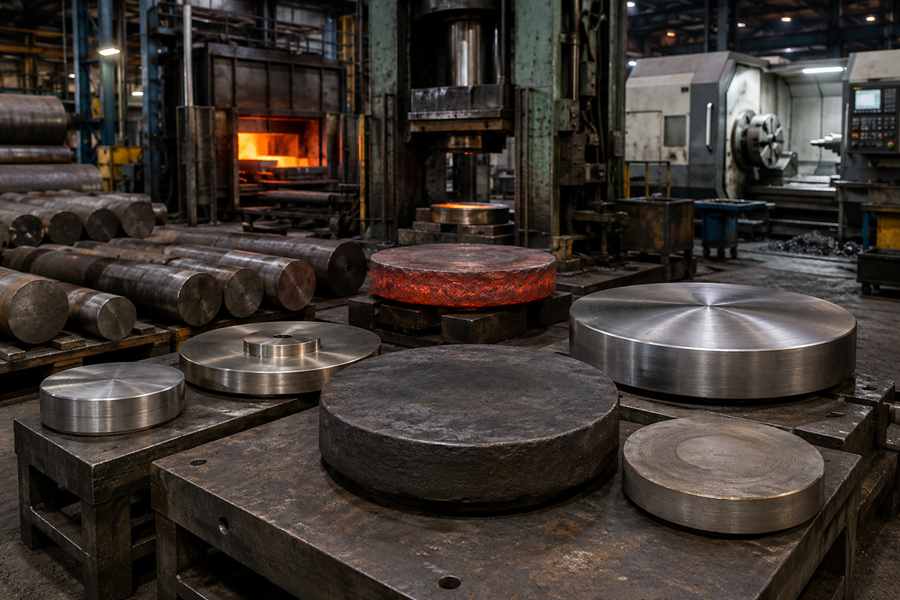
Forged disc cost is mainly shaped by material grade, diameter, and thickness. These three specifications affect billet weight, forging difficulty, press selection, heat treatment, and the amount of stock removed during machining.
Material Grade Considerations
Material grade affects both the value of the billet and the cost of converting that billet into a finished forging. Carbon steel, alloy steel, stainless steel, and nickel alloys can follow very different production routes even when disc dimensions are identical.
1. Raw Material Cost
For early budgeting, material cost can be compared with a relative index rather than a fixed market price.
| Material Type | Illustrative Cost Index* | Relative Cost |
| Carbon Steel | 1.0 | 100% |
| Cr-Mo Alloy Steel | 1.3–1.7 | 130–170% |
| Stainless Steel | 2.0–3.0 | 200–300% |
| Nickel-Based Alloy | 5.0–8.0 | 500–800% |
If the material portion of a 100 kg carbon steel disc is $300, a stainless grade with a 2.5 cost index would place the equivalent metal value near $750. The difference is already $450 before forging, testing, and machining are included.
For an order of 50 discs, that difference becomes roughly $22,500.
2. Forgeability and Heat Treatment
Higher-alloy materials may have narrower workable temperature ranges and lower forging productivity. More demanding grades can require additional reheating or controlled cooling between forging stages.
Possible added costs include:
- Extra furnace cycles
- Longer heating time
- More press time
- Controlled cooling
- Additional heat treatment
- Greater process monitoring
Assume an additional furnace cycle contributes $80–$150 per disc in equipment, energy, and handling. For 100 discs, that represents approximately $8,000–$15,000 in extra processing cost.
This is why two grades with similar finished dimensions can still receive very different forging quotations.
3. Machining and Testing
Material grade continues to influence cost after forging. Heat-resistant stainless and nickel alloys may require lower cutting speeds, more tooling, and longer machining cycles.
| Material | Example Machining Time | Cost at $90/hr |
| Carbon Steel | 30 min | $45 |
| Stainless Steel | 42 min | $63 |
| Nickel Alloy | 60 min | $90 |
A $45 difference per part becomes $9,000 across 200 discs.
Additional requirements may include:
- Ultrasonic testing
- Hardness testing
- Tensile testing
- Impact testing
- Chemical certification
- Heat-treatment records
Depending on specification and sampling method, these requirements may add $100–$500+ per lot or part. Buyers should therefore specify the exact ASTM, ASME, EN, or UNS grade rather than simply requesting an “alloy steel disc.”
Diameter Considerations
Diameter has a particularly strong influence on forged disc cost because weight rises with the square of diameter when thickness remains unchanged.
A modest OD increase can therefore cause a much larger increase in metal consumption and forging demand.
1. Diameter Raises Weight Quickly
For steel discs with a constant thickness of 60 mm:
| Finished Size | Approx. Weight | Increase vs. Ø500 |
| Ø500 × 60 mm | 92.5 kg | Baseline |
| Ø550 × 60 mm | 111.9 kg | +21% |
| Ø600 × 60 mm | 133.2 kg | +44% |
| Ø700 × 60 mm | 181.3 kg | +96% |
Increasing OD from 500 mm to 700 mm is only a 40% dimensional increase, but theoretical weight almost doubles.
At a processed material value of $4/kg, the additional 88.8 kg represents about $355 per disc. Across 100 pieces, the metal difference alone reaches approximately $35,500.
2. Larger Diameter Can Change Press Size
Diameter also affects deformation area and forging equipment selection. Once a disc moves beyond the economical range of one press, the supplier may need a larger machine, furnace, or manipulator.
A simplified cost comparison might look like this:
| Forging Route | Shop Rate | Press Time | Approx. Conversion Cost |
| Medium Press | $220/hr | 0.8 hr | $176 |
| Large Press | $320/hr | 0.9 hr | $288 |
| Large Press + Reheat | $320/hr + furnace | 1.2 hr | $384+ |
Moving to the next equipment range can add $100–$200+ per disc before the higher billet weight is considered.
For 100 pieces, that may mean another $10,000–$20,000 in processing expense. This is one reason buyers should question OD that exists only as a conservative design margin.
3. OD Allowance Adds Hidden Weight
The finished diameter is normally smaller than the rough forged diameter. Extra OD is needed to remove scale and provide sufficient machining cleanup.
For a 60 mm-thick disc:
| Diameter | Approx. Weight | Extra Weight |
| Ø500 mm | 92.5 kg | — |
| Ø510 mm | 96.2 kg | +3.7 kg |
| Ø520 mm | 100.0 kg | +7.5 kg |
Only 20 mm of extra OD adds about 7.5 kg before face allowance is included.
At an alloy value of $8/kg, that is around $60 per disc, or $6,000 on a 100-piece order. The allowance is necessary, but excessive stock means paying for metal that will eventually become machining chips.
Thickness Considerations
Thickness increases forged disc weight in a more direct way. With diameter fixed, a 25% increase in thickness creates about 25% more theoretical volume.
The cost effect can become larger once additional forging work, furnace time, and machining allowance are included.
1. Thickness Directly Adds Metal
For a Ø500 mm steel disc:
| Finished Size | Approx. Weight | Increase vs. 50 mm |
| Ø500 × 50 mm | 77.1 kg | Baseline |
| Ø500 × 60 mm | 92.5 kg | +20% |
| Ø500 × 70 mm | 107.9 kg | +40% |
| Ø500 × 75 mm | 115.6 kg | +50% |
Increasing thickness from 50 to 75 mm adds about 38.5 kg per disc.
For 100 pieces, that equals approximately 3.85 tonnes of additional finished metal. At a processed material value of $5/kg, the difference is around $19,250 before additional forging work is considered.
2. Thick Discs Need More Forging Work
A thicker finished section generally requires a larger starting billet and more deformation during upsetting and spreading.
An illustrative forging comparison:
| Finished Thickness | Typical Passes | Example Press Time |
| 50 mm | 3–4 | 30 min |
| 70 mm | 4–5 | 40 min |
| 90 mm | 5–6 | 50 min |
At a press rate of $250/hour, increasing press time from 30 to 50 minutes adds about $83 per disc.
Across 150 pieces, that equals roughly $12,450.
Thickness may also increase heating and cooling time. For critical forgings, sufficient deformation must still be maintained to achieve the required internal structure and mechanical properties.
3. Face Allowance Can Be Expensive
Finished thickness and rough-forged thickness can differ considerably when both faces require machining.
A finished Ø500 × 60 mm steel disc weighs about 92.5 kg, while a rough Ø510 × 70 mm forging is close to 112 kg.
That difference is almost 20 kg per part, or roughly 21% additional weight.
For an order of 100 pieces:
- Finished theoretical weight: about 25 tonnes
- Rough forging weight: about 2 tonnes
- Material removed later: about 95 tonnes
At a processed alloy value of $10/kg, approximately $19,500 of metal value is associated with the extra stock before CNC machining cost is included.
The objective is not to eliminate machining allowance. It is to keep that allowance consistent with the forge’s actual dimensional capability instead of applying an unnecessarily large safety margin.
Balancing Material Grade, Diameter, and Thickness
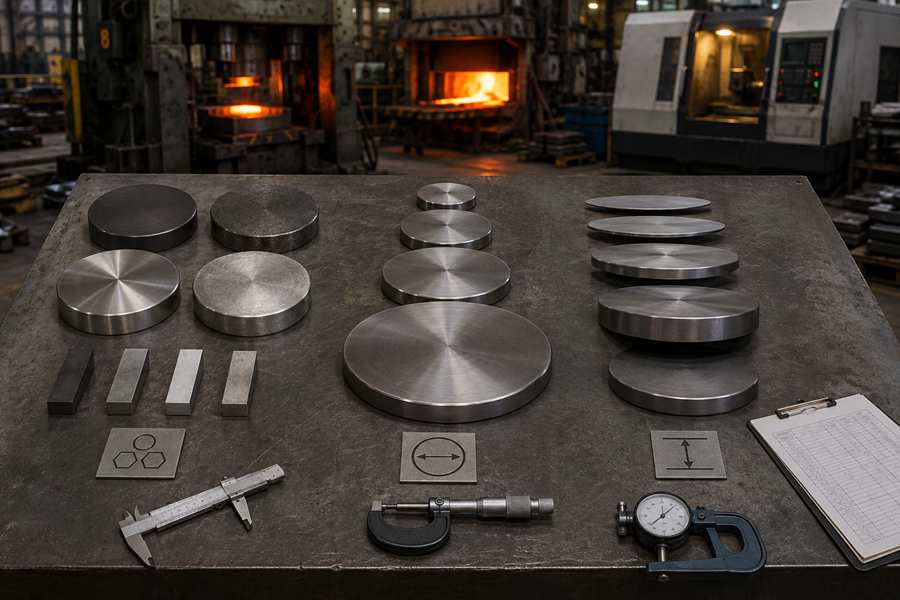
The three factors compound each other. A Ø500 × 60 mm carbon steel disc weighing about 92.5 kg has a very different cost structure from a Ø600 × 75 mm stainless steel disc weighing roughly 166 kg.
The second disc contains about 80% more metal, while its material may cost two or three times more per kilogram. Larger dimensions can also increase press demand, heating time, heat treatment, and machining.
For purchasing review, the three factors can be handled in this order:
- Material grade:confirm that the alloy level matches the actual service requirement.
- Diameter:remove unnecessary OD and check whether size pushes the forging into larger equipment.
- Thickness:review structural thickness and face machining allowance separately.
A low per-kilogram price does not always equal low final cost for forged discs. The better quotation comparison includes material grade, finished diameter, finished thickness, rough forging dimensions, heat treatment, testing, machining condition, and order volume.