
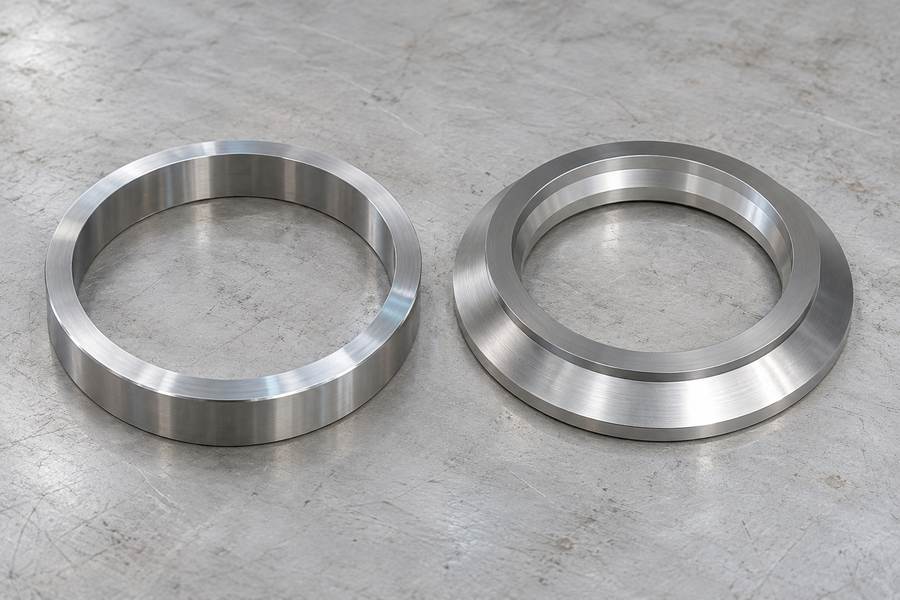
Rolled ring cross-sections influence material use, machining effort, dimensional control, and component fit. Flat uniform-section and profiled designs address different geometric requirements, so efficiency depends on the finished part rather than shape alone.
Boberry Machining produces drawing-based steel and aluminum rings in flat, tapered, and profiled forms, with delivery conditions ranging from as-forged or as-rolled to rough-machined and precision-machined.
Understanding Flat and Profiled Rolled Ring Cross-Sections
Cross-sectional geometry defines the material arrangement through a ring’s radial wall and axial height. It influences forming, machining stock, and inspection.
Flat Uniform-Section Rolled Rings
A flat uniform-section ring maintains substantially consistent radial thickness and axial height around its circumference. The section generally follows a rectangular profile, with its exact dimensions established by the finished component design.
This geometry suits components without substantial section changes and provides accessible surfaces for turning, facing, workholding, and measurement.
Flanges, bearing components, and rotating parts may use uniform-section rings when their design permits. Grooves, shoulders, holes, or recesses can be machined afterward.
- Consistent geometry: The principal section dimensions remain uniform around the circumference, within the specified manufacturing tolerances.
- Accessible machining: Regular surfaces generally simplify turning, facing, and the establishment of machining references.
- Direct inspection: Primary checks focus on inside diameter, outside diameter, radial thickness, and axial height.
The limitation appears when the finished component contains large steps, recesses, or local thickness changes. Producing those features from a flat blank can require substantial material removal.
Profiled or Contour Rolled Rings
A profiled ring has a non-uniform cross-section that may include steps, shoulders, recesses, or other shaped transitions.
A profile can place material closer to where the finished component needs it, potentially reducing machining when the rolled contour approximates the final geometry.
Gear blanks, races, and components with integrated features may justify this approach when the forming route can produce the required profile consistently.
- Potential stock reduction: A closer match to the finished geometry can reduce excess material in suitable regions.
- Forming considerations: Local material flow and transitions require evaluation because the section is not uniform.
- Profile inspection: Measurements may need to cover local heights, recesses, shoulders, and transition positions.
A profiled ring is not inherently more efficient. If the contour adds forming difficulty but removes little machining, a flat ring may remain the more practical starting point.
Tapered Rolled Rings as a Related Cross-Section Type
A tapered ring has angled surfaces or gradually changing section dimensions, useful for conical interfaces, inclined contact surfaces, or defined transitions.
Tapered geometry should be distinguished from stepped or irregular profiles because their forming and machining requirements differ.
Producing Different Cross-Sections Through Ring Rolling
The process uses a pierced annular preform as the initial workpiece. The preform is expanded between rolls, increasing its diameter while reducing its radial wall thickness through controlled deformation.
In radial-axial ring rolling, a main roll and mandrel control radial deformation while axial rolls regulate height. Their combined action influences diameter, wall thickness, and section shape.
For a flat ring, the forming objective is generally to maintain a consistent section as the ring expands. Tool alignment, material flow, and dimensional control all contribute to the resulting geometry.
A profiled ring adds the challenge of forming different section features within the same circumference. The process must move material into the intended regions while preserving sufficient stock for subsequent finishing.
- Tool configuration: The tooling arrangement must suit the intended ring dimensions and cross-sectional features.
- Material flow: Section changes affect how metal moves during expansion and profile formation.
- Dimensional control: Diameter, wall thickness, height, and local profile dimensions must meet the applicable requirements.
Ring rolling is distinct from longitudinal roll forging. Ring rolling expands a closed, ring-shaped preform circumferentially; longitudinal roll forging compresses and elongates material along its length.
The term profiled describes the resulting section, not a separate rolling process by itself. Feasibility depends on tooling, deformation sequence, and the material’s response.
Comparing Flat and Profiled Rolled Rings for Manufacturing Efficiency
Efficiency spans forming, machining, inspection, and component performance; savings in one operation may be offset elsewhere.
Material Utilization and Machining Waste
Material utilization depends on the difference between the starting blank and finished component. A flat ring suits parts with similarly consistent geometry.
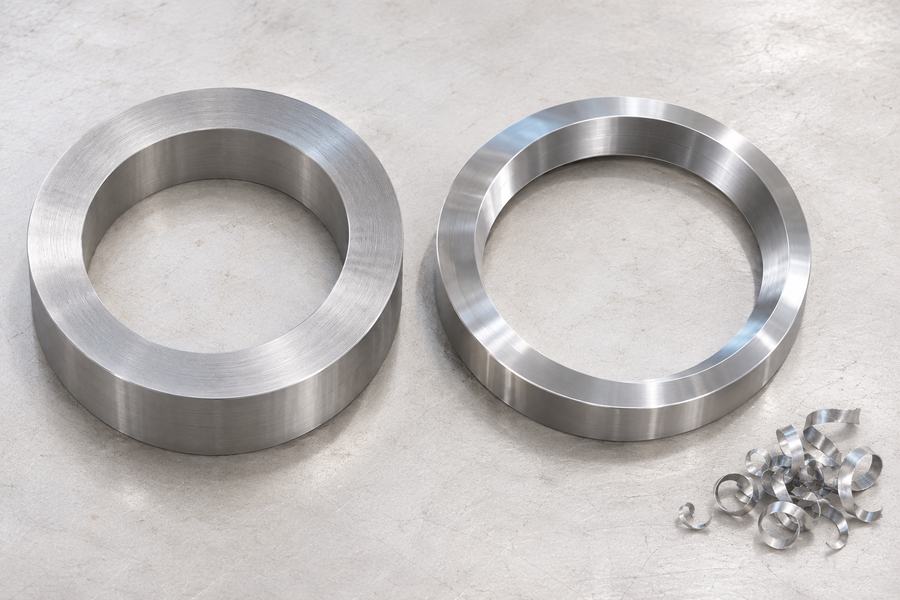
If the component contains substantial shoulders, recesses, or local thickness changes, machining those features from a flat blank may remove considerable material. The removed stock does not contribute to the finished component.
A profiled ring can incorporate some features during rolling, reducing material removal when its contour follows the finished geometry.
The comparison must include forming stock and finishing allowances. Some profiles need extra material locally to achieve final dimensions and surface requirements.
- Starting volume: Compare the material required for each proposed rolled geometry, including any stock needed to support forming.
- Machining allowance: Include stock for dimensional correction, finishing, and removal of surfaces that do not meet the final requirements.
- Forming feasibility: Confirm that the proposed contour can be produced without unacceptable deformation or dimensional variation.
A profiled blank may reduce machining waste without requiring less starting material; the result depends on geometry, process route, and allowances.
Rolling Complexity and Process Control
A uniform cross-section presents a consistent forming objective and avoids some local material-distribution changes found in contoured sections.
Profiled rings require attention to material filling each region; changes in height or thickness affect local flow and dimensional control.
Abrupt transitions between thick and thin regions may create more demanding forming conditions than gradual changes.
- Section variation: Changes in thickness or height influence local deformation and material distribution.
- Transition geometry: Shoulders and changes in section require review for formability and dimensional control.
- Material response: Steel and aluminum materials have different deformation characteristics and require suitable process conditions.
Feature count alone does not determine difficulty; the profile, material, dimensions, equipment, and process controls all matter.
Machining Time and Finishing Requirements
Machining depends on how closely the blank matches the finished component. Flat rings provide regular surfaces for turning, facing, and workholding.
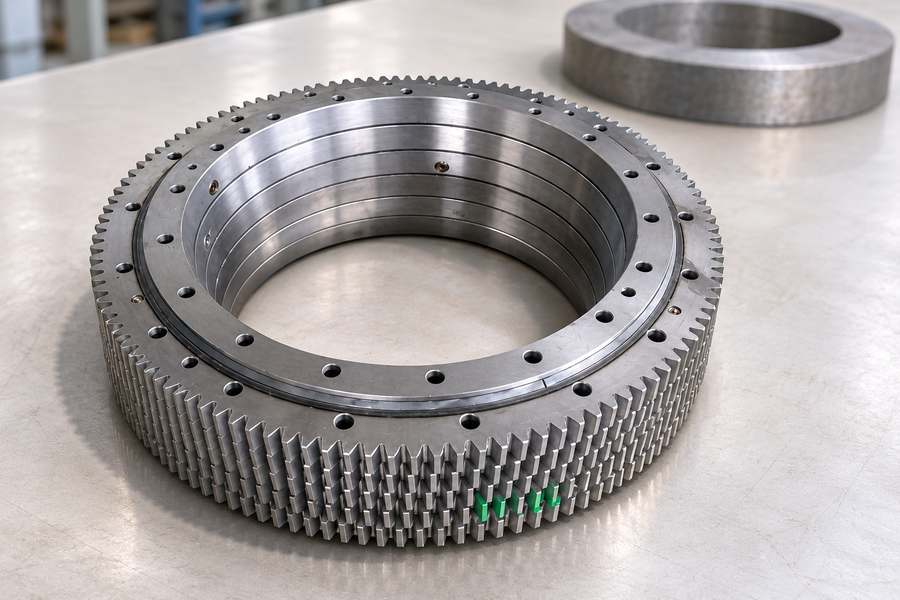
Several steps or recesses may require additional operations when machined from a flat blank.
A profiled blank may reduce removal if its contour approximates the required shape without restricting access to surfaces that still need machining.
- Tool access: Check whether cutting tools can reach shoulders, recesses, and internal features without interference.
- Workholding: Determine whether the blank provides stable surfaces for locating and securing the ring during machining.
- Finishing allowance: Leave adequate stock for final dimensional adjustments and the required surface quality.
Irregular contours can complicate workholding and tool access, so near-net shape is useful only when finishing remains practical.
Dimensional Accuracy and Inspection Requirements
Both types require dimensional control. Flat rings are checked mainly through principal dimensions and relationships between cylindrical and planar surfaces.
Profiled rings also require checks of local heights, recess depths, shoulders, and transitions that may affect fit.
- Diameter: Verify inside and outside diameters at the locations and stages specified by the drawing.
- Section dimensions: Check radial thickness and axial height, including local variations where applicable.
- Profile: Measure contour features, recesses, shoulders, and transition locations that control function or machining.
- Inspection stage: Distinguish checks required on the rolled blank from those required after machining.
Measurement methods should suit the geometry and tolerances; complex profiles may need additional locations or suitable inspection equipment.
Inspection can be staged: verify overall dimensions after rolling, then recheck functional contours after machining. This helps distinguish forming variation from finishing results.
Mechanical Performance and Functional Suitability
Cross-sectional geometry affects material distribution, stiffness, load transfer, and local deformation under operating forces.
A flat section provides consistent material distribution and can suit components without local section changes.
A profiled section can place material in selected regions or provide interfaces that would otherwise require machining from a uniform blank.
Geometry alone does not determine performance; material properties, heat treatment, manufacturing quality, loading, and service conditions also matter.
- Load distribution: Assess how forces pass through the ring and its different cross-sectional regions.
- Local stiffness: Consider whether changes in section dimensions influence deformation under the intended loads.
- Stress concentrations: Review shoulders, sharp transitions, and geometric discontinuities that may create localized stress.
A profiled design may improve functional integration, but poorly considered transitions can introduce local stress concentrations. Neither cross-section universally provides greater strength or fatigue resistance.
| Evaluation Factor | Flat Uniform-Section Rings | Profiled Rolled Rings |
| Cross-sectional geometry | Consistent section | Contoured or variable section |
| Material utilization | Depends on machining requirements | May improve when near-net-shape geometry reduces excess stock |
| Rolling complexity | Generally more consistent forming geometry | Requires evaluation of local features and transitions |
| Machining | May need more removal for complex finished shapes | May reduce removal when the rolled profile matches the final design |
| Inspection | Focuses on primary ring dimensions | Also covers local profile measurements |
| Functional considerations | Provides relatively uniform section distribution | Can incorporate specific section features, subject to load evaluation |
Choosing the Right Cross-Section for Different Applications
Choose geometry from the finished component’s function and production needs. Flat, profiled, and tapered rings are not interchangeable.
When Flat Uniform-Section Rings Are More Suitable
Flat rings suit components needing a consistent annular section without substantial rolled contours. Their regular geometry supports conventional machining and direct checks.
They are suitable when the finished part mainly needs cylindrical surfaces and parallel faces, with additional features machined afterward.
- Uniform body: The finished component retains similar radial thickness and axial height around its circumference.
- Accessible machining: Required turning and facing operations can be completed without difficult access to recessed areas.
- Simple inspection: Critical dimensions are concentrated in the principal ring geometry.
For a simple annular body, a profiled blank may add forming work without reducing much machining.
When Profiled Rolled Rings Are More Efficient
Profiled rings suit components whose section changes can be incorporated into the blank, bringing the starting geometry closer to the final shape.
Stepped components, contoured races, and some gear blanks may benefit when local material placement reduces stock removal.
- Stepped components: Different section heights or thicknesses are required in selected regions.
- Contoured components: The finished part includes shaped features that can be formed as part of the ring profile.
- Integrated geometry: Several cross-sectional features can be incorporated without making finishing operations impractical.
The benefit is limited when critical surfaces still need extensive machining or the profile restricts tool access.
When Tapered Rolled Rings Are Preferable
Tapered rings suit conical interfaces, inclined contact surfaces, or gradual section changes, providing a closer starting shape than a rectangular section.
Consider taper direction, adjoining features, finishing stock, material, and ring dimensions. A taper should serve a functional interface or defined transition, not simply appear to reduce stock.
How Material and Delivery Condition Influence Selection
Material and delivery condition affect forming behavior and the work remaining after rolling.
- Steel and aluminum: These material categories have different mechanical and deformation characteristics. Material grade, ring dimensions, and application requirements should guide the process assessment rather than assuming one cross-section suits either material universally.
- As-forged: The ring retains its forged condition; starting geometry and surface condition influence machining allowance and subsequent processing.
- As-rolled: The ring is supplied after rolling, with dimensions and surface condition suited to the next manufacturing stage.
- Rough-machined: Preliminary machining establishes defined surfaces while retaining sufficient stock for final finishing.
- Precision-machined: Further machining achieves drawing-defined dimensions and surface requirements; the finishing level should reflect component function.
Heat treatment can affect dimensions or create a need for additional finishing. Its position in the production route should therefore be considered when establishing the blank and machining allowances.
How to Select and Specify the Most Efficient Rolled Ring Design
Select the cross-section by connecting the finished component, proposed blank, and manufacturing route.
Start with the Finished Component Drawing
Use the finished drawing to establish principal ring dimensions and identify features that distinguish flat, profiled, and tapered sections.
Review inside diameter, outside diameter, wall thickness, and axial height, together with shoulders, recesses, angles, and transitions.
Distinguish functional surfaces from non-critical areas to establish dimensional control and machining allowance.
- Section geometry: Identify uniform, tapered, stepped, or contoured regions.
- Functional features: Mark surfaces that control assembly, contact, location, or component operation.
- Critical tolerances: Identify dimensions and geometric relationships requiring particular control.
Compare the Rolled Blank with the Finished Geometry
Compare each blank profile with the finished cross-section to locate excess stock and areas needing additional material.
The rolled contour should not duplicate final dimensions where stock is needed for finishing or dimensional correction.
Review shoulders, recesses, and thickness changes for forming feasibility and tool access.
- Excess stock: Identify regions where the blank contains more material than the finished component requires.
- Finishing allowance: Confirm that sufficient material remains for final machining and surface preparation.
- Local transitions: Review whether changes in section can be formed and machined reliably.
A component with stepped surfaces may benefit from a profiled blank, but extensive precision machining can limit the stock-removal benefit.
Evaluate the Complete Manufacturing Route
Assess rolling, required heat treatment, machining, and inspection together; reduced material removal may require additional forming controls.
Check whether workholding, datum selection, tool access, and finishing stock support the proposed machining sequence.
- Ring rolling: Evaluate whether the cross-section can be formed under suitable process conditions.
- Machining: Assess material removal, locating surfaces, tool access, and finishing operations.
- Inspection: Define checks for the rolled blank and finished component at the relevant stages.
The preferred route balances material use, achievable dimensions, and practical processing. Tight allowances can leave insufficient stock; excess stock increases machining.
Define Technical Requirements for Production
Production information should distinguish material, geometry, delivery condition, and inspection expectations for the rolled blank and finished part.
- Material: State the required steel or aluminum grade and applicable material requirements.
- Tolerances: Identify critical dimensions and required geometric controls.
- Delivery condition: Select as-forged, as-rolled, rough-machined, or precision-machined condition.
- Inspection: Identify measurement locations, applicable acceptance criteria, and the stage at which checks are required.
Drawing-Based Rolled Ring Production with Boberry Machining
Boberry Machining produces steel and aluminum rolled rings in flat uniform-section, tapered, and profiled or contour configurations, based on component drawings.
Delivery conditions include as-forged, as-rolled, rough-machined, and precision-machined forms.
A manufacturing review uses the finished cross-section, dimensions, material, machining allowance, and delivery condition to assess forming and finishing needs.
| Selection Factor | Key Considerations |
| Finished geometry | Uniform, tapered, stepped, or profiled cross-section |
| Material | Specified steel or aluminum grade and relevant requirements |
| Material utilization | Starting stock, retained material, and expected machining removal |
| Rolling feasibility | Section geometry, material flow, and transition design |
| Machining | Stock allowance, tool access, workholding, and finishing sequence |
| Delivery condition | As-forged, as-rolled, rough-machined, or precision-machined |
| Inspection | Critical dimensions, profile measurements, and acceptance criteria |