
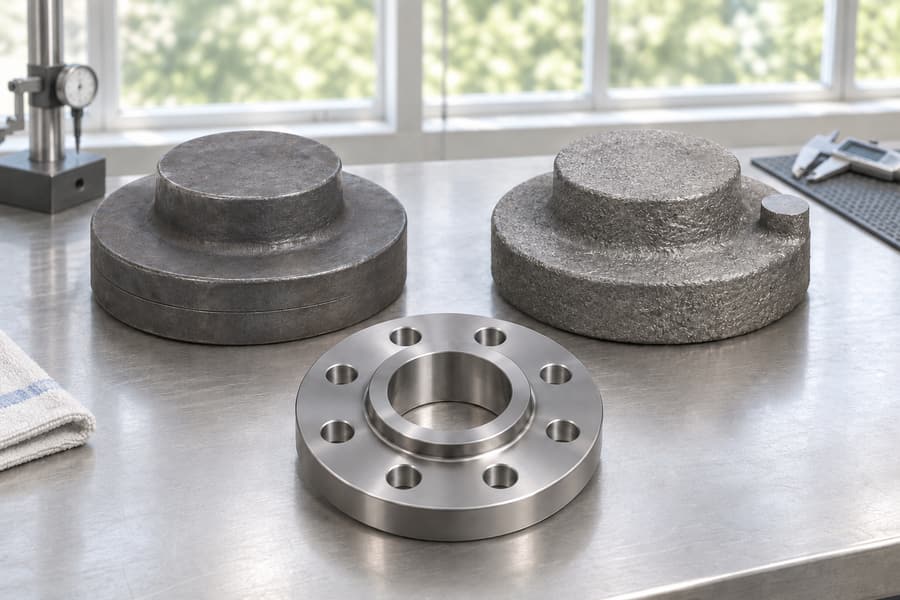
Drop forging shapes solid metal through hammer impacts, while casting forms components as molten metal solidifies. Forging may improve strength and fatigue behavior for certain parts; casting often accommodates more intricate geometry. Neither process is inherently superior.
The appropriate choice depends on matching alloy, heat treatment, service conditions, finished acceptance criteria, manufacturing quantity, and total cost per accepted component.
Two Routes from Raw Metal to a Finished Component
How Drop Forging Works
Drop forging deforms a solid billet with successive hammer blows, usually after heating it to a temperature appropriate for the alloy and forming operation. Unlike casting, the workpiece is not melted.
The term drop can describe a gravity-driven hammer or a power-assisted drop hammer. Both apply impact energy; press forging instead applies force through a press-controlled stroke.
Force application and tooling are separate classifications. Open dies allow relatively unrestricted lateral flow, while impression dies contain shaped cavities that guide metal toward the required geometry.
“Closed-die forging” often means impression-die forging in ordinary industrial usage. Strictly flashless closed-die forging is narrower: the cavity is filled without intentionally producing peripheral flash, demanding close volume control.
A typical production route includes billet preparation, heating, forming, flash trimming where applicable, and cleaning. Alloy-appropriate heat treatment and CNC finishing may follow according to the drawing.
For components with geometry suited to impact forming, drop forging services can be evaluated alongside downstream finishing requirements rather than as an isolated blank-making step.
How Casting Works
Casting begins with molten metal poured or otherwise introduced into a mold. The metal fills available space, solidifies, cools, and is removed for cleaning and further processing.
Sand casting offers flexible mold configurations; investment casting uses expendable patterns for detailed features; permanent-mold processes reuse durable molds where materials and geometry permit.
Gates and risers may be needed to fill and feed the mold. Their removal, together with cleaning, appropriate heat treatment, machining, and inspection, contributes to the finished route.
When a part contains passages, internal pockets, or extensive shape changes, metal casting services may offer a practical route that would be difficult to reproduce through hammer deformation.
Solid Deformation vs. Solidification
Forging changes a solid material’s geometry through plastic deformation. Depending on processing conditions, deformation and subsequent thermal history can develop grain structures and flow patterns relevant to component loading.
Casting develops its initial structure during solidification. Cooling rate, feeding, mold conditions, and alloy behavior affect grain structure, segregation, and the risk of internal discontinuities.
Neither description establishes a finished property’s value. A fair comparison starts with equivalent alloy chemistry, specified condition, component geometry, and the tests required for acceptance.
Drop Forging vs Casting: Which Provides Better Strength and Performance?
Reading Tensile-Test Results
A tensile test reports the peak engineering stress and a defined point at which permanent strain becomes significant; these are the tensile and yield values. Both depend strongly on alloy and condition.
Deformation and thermal processing can refine or redirect microstructural features in a forging. This may support favorable mechanical properties, provided the forming and heat-treatment route is appropriate.
A sound casting made from a suitable alloy may also meet demanding strength requirements. Comparing a heat-treated forging with an untreated casting, however, says little about the processes themselves.
Engineers should specify test location, orientation where relevant, specimen condition, and acceptance limits. Material certificates alone may not characterize critical properties throughout a complex finished section.
Fatigue Resistance and Durability
Fatigue cracks can initiate under repeated loads well below a component’s static tensile strength. Their behavior depends on stress range, surface quality, geometry, and local material condition.
In a well-designed forging, grain-flow orientation may follow important load paths. That potential benefit is reduced if machining removes favorable regions or the part contains folds and cracks.
Cast components require attention to shrinkage, porosity, inclusions, and surface-connected discontinuities, particularly near highly stressed features. Sound castings can still provide satisfactory fatigue performance when appropriately designed.
A fillet radius, machined finish, or contact condition may control failure more strongly than the shaping label. Compare fatigue data at equivalent loading and inspection conditions, not broad process claims.
Toughness, Ductility, and Impact Resistance
Toughness concerns resistance to fracture, while ductility describes the amount of plastic deformation a material can sustain. Neither should be treated as interchangeable with hardness or tensile strength.
Forging may achieve useful toughness through suitable deformation and heat treatment. Casting performance depends on the selected alloy, solidification quality, defect distribution, and subsequent thermal processing.
Impact tests, when applicable, must reflect the specified temperature and test method. In service, section thickness and constraint also influence fracture behavior beyond a single laboratory result.
| Performance factor | Drop forging | Casting |
| Tensile and yield strength | Influenced by deformation, alloy, and thermal processing | Influenced by alloy, solidification, and thermal processing |
| Fatigue resistance | May benefit from favorable grain flow; folds and surface damage remain risks | Sensitive to porosity, inclusions, surface condition, and design |
| Toughness | Depends on alloy, forging quality, and heat treatment | Depends on alloy, casting soundness, and heat treatment |
| Microstructure | Solid-state deformation modifies existing structure | Initial structure develops during solidification |
| Overall suitability | Must meet finished-part loads and acceptance criteria | Must meet the same finished-part loads and acceptance criteria |
How Do Drop Forging and Casting Compare in Design Flexibility and Quality?
Geometric Complexity and Design Limitations
Casting can create intricate external profiles and internal cavities using mold features or cores. This makes it attractive for housings, fluid passages, and components integrating several functions.
Drop forging is generally better suited to shapes that allow the heated metal to flow under hammer impacts. Deep recesses, inaccessible pockets, and thin, complex walls present challenges.
Die parting, draft, corner radii, and material distribution must be considered early. A shape feasible as a casting may require redesign, several forging operations, or extensive machining.
Conversely, a compact, solid load-bearing part may be simpler to forge than a casting with added feeding structures. The drawing, not the process name, determines practicality.
Planning Final Dimensions and Material Yield
The process name alone cannot tell a buyer what dimensional variation or surface texture to expect. Results vary among forging tooling arrangements, casting methods, alloy characteristics, and the size and intricacy of the part.
Critical bearing seats, threads, or sealing faces often need machining regardless of the blank-making process. Compare how much stock must be removed and whether tools can reach those features.
Forging may generate flash, scale, trimming losses, and machining chips. Casting may require gates, risers, cleanup, and machining stock; some process metal can potentially be remelted.
Blank weight and finished weight are therefore different measures. Material efficiency should reflect actual routing, usable yield, and scrap recovery rather than an assumed advantage for either method.
Common Manufacturing Defects and Inspection Requirements
- Forging risks: Laps, folds, underfill, cracks, and dimensional mismatch can arise from unsuitable billet condition, temperature, die design, or metal flow during forming.
- Casting risks: Shrinkage cavities, gas porosity, inclusions, hot tears, and incomplete filling may arise from filling behavior, feeding, cooling, or mold-related conditions.
- Inspection strategy: Dimensional and visual checks establish basic conformity. Mechanical tests and suitable nondestructive methods address specified material properties and relevant internal or surface discontinuities.
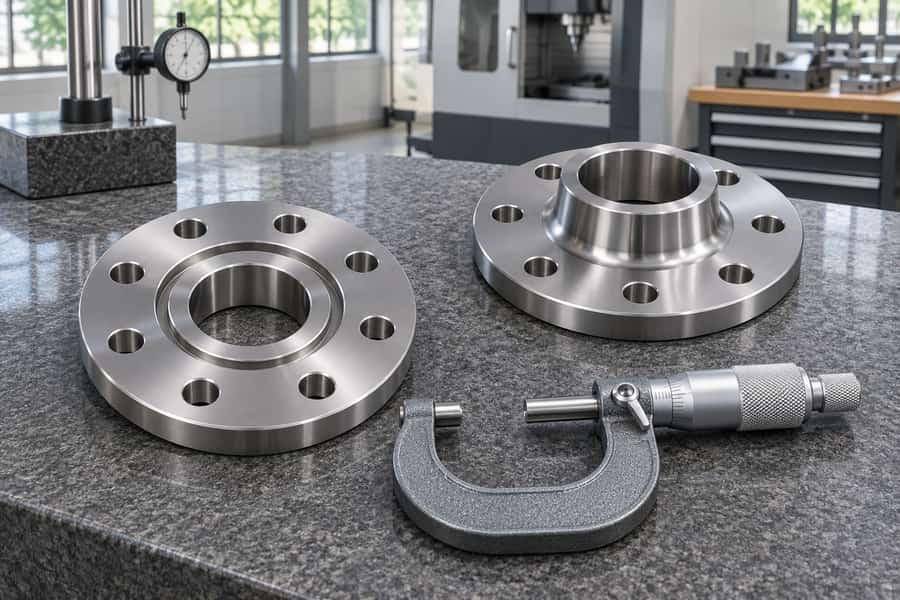
An inspector must choose methods that can find the relevant flaw in the specified alloy and section; no single nondestructive examination covers every defect. Inspection plans should name applicable methods, coverage, and acceptance levels.
A defect type is not automatically a rejection without reference to the component specification. For critical service, location, size, orientation, and potential crack growth matter.
Comparing the Cost of Accepted Components
Tooling and Initial Setup Costs
Forging economics include die design, manufacture, setup, and possible tool maintenance. Casting costs may include patterns, molds, cores, setup, and related process equipment.
The relative investment changes with shape, tooling life, casting method, and anticipated quantity. A simple shape can have very different tooling needs from an intricate one.
Tooling allocated to a small run increases cost per part. At higher quantities, that fixed amount is spread more widely, although variable production and quality costs remain.
Material, Processing, and Finishing Costs
A forging route commonly includes billet cutting, heating, hammer forming, trimming, and cleaning. The cost of flash and scale losses must be considered alongside the starting material.
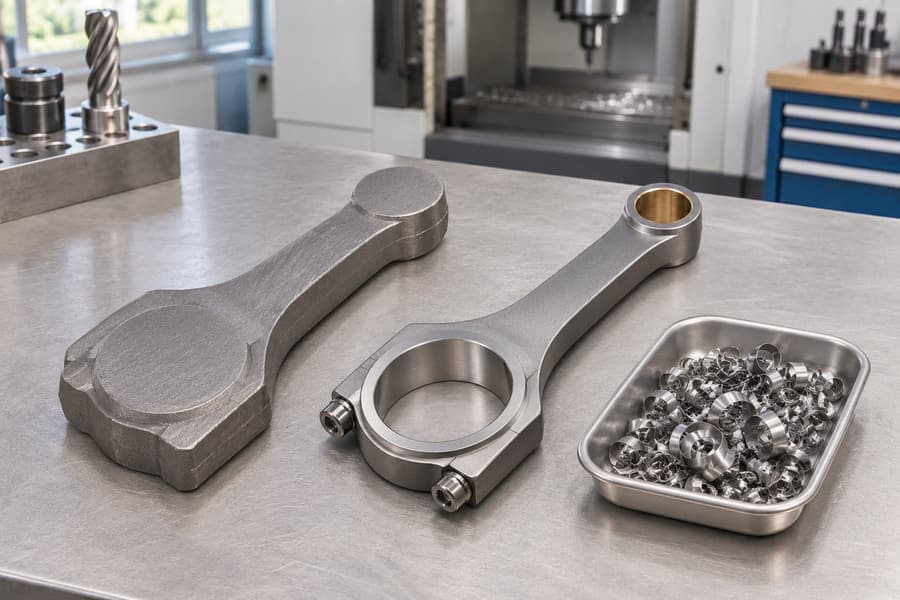
Casting includes metal preparation and melting, mold filling, cooling, removal, and cleanup. Feeders, gates, cores, and the handling of scrap affect its actual material economics.
For either blank, the drawing may call for a thermal cycle, machined features, a protective finish, and documented acceptance checks. The less expensive unmachined blank can require more work before acceptance.
Machining estimates should consider stock allowance, tool access, setup changes, cutting time, and achievable surface finish. Comparing blank prices while omitting these operations distorts the decision.
Production Quantity and Total Accepted-Part Cost
The useful purchasing measure is cost per conforming finished part, not simply cost per attempted blank. Rejection and rework increase expenditure without increasing accepted output.
Hypothetical teaching calculation, November 2026: Assume both routes must deliver 900 accepted components to the same drawing, alloy, heat-treatment condition, and finished inspection criteria.
For illustration only, assume forging requires 1,000 attempts to yield 900 accepted parts. Casting requires 1,200 attempts for the same 900 accepted parts.
Assume forging tooling costs USD 12,000 and variable preparation, forming, heat treatment, machining, and inspection total USD 54 per attempt.
Its modeled cost is:
USD 12,000 + (1,000 × USD 54) = USD 66,000
That equals USD 73.33 per accepted part.
Assume casting tooling costs USD 6,000 and its equivalent variable operations total USD 52 per attempt.
Its modeled cost is:
USD 6,000 + (1,200 × USD 52) = USD 68,400
That equals USD 76.00 per accepted part.
These figures, including assumed yields, are fictional teaching inputs, not market rates, Boberry quotations, or a regional survey. Freight, taxes, installation, and profit margin are excluded from both routes.
The example shows how lower tooling and per-attempt costs can still produce a higher accepted-part cost when assumed yield differs. Reversing the inputs could reverse the result.
| Cost driver | Drop forging considerations | Casting considerations |
| One-time tooling | Dies and forming setup | Patterns, molds, cores, and setup |
| Starting material | Billet size, flash, scale, and trimming | Melt charge, gates, risers, and recovery |
| Primary operation | Heating and hammer forming | Melting, filling, and solidification |
| Secondary work | Heat treatment, cleaning, machining | Heat treatment, cleanup, machining |
| Quality losses | Forging defects, rework, rejected blanks | Casting defects, rework, rejected blanks |
| Buyer comparison | Total cost ÷ conforming finished parts | Same calculation and acceptance standard |
A serious quotation comparison should therefore use consistent production quantity, drawing revision, acceptance conditions, and included operations. Tooling ownership and replacement responsibilities also need explicit definition.
When Should You Choose Drop Forging Instead of Casting?
Applications Where Drop Forging May Be Preferred
Drop forging is worth evaluating for solid components that carry substantial loads, experience cyclic stress, or may benefit from favorable metal-flow orientation along critical sections.
Selected shafts, connecting members, and machinery parts can fit this profile. Not every shaft or load-bearing part is drop forged, and process suitability depends on geometry and material.
For example, forged shafts may require attention to grain flow, machining allowance, heat-treatment distortion, and inspection of critical journals or transitions.
An advantage exists only when the chosen forging route can produce the required shape, properties, and quality at an acceptable total cost.
Applications Where Casting May Be Preferred
Casting often deserves priority for complex internal passages, broad changes in wall thickness, or external details that would demand extensive removal of forged stock.
Selected equipment housings, pump casings, and structural bodies illustrate these design conditions. Their suitability depends on alloy selection, casting soundness, and verified service requirements.
Integrating several features in one casting can reduce subsequent assembly or machining, but difficult feeding arrangements or high rejection risk may offset those savings.
When Both Processes Are Suitable
Some components can be redesigned for either route. Compare the geometry actually achievable, the required mechanical properties, and machining access before estimating production economics.
For equivalent finished conditions, neither grain flow alone nor geometric freedom should settle the decision. Load direction, inspection capability, supply reliability, and accepted-part cost all matter.
How Should Engineers and Buyers Select Between Drop Forging and Casting?
Review Material, Design, and Service Requirements
Begin with the finished drawing and the service loads. Specify the alloy grade, allowable material condition, heat treatment, and required mechanical properties rather than assuming process labels define them.
Identify stress concentrations, required fatigue performance, operating temperatures, and any passages or features that limit manufacturing options. Highlight critical sections needing additional verification.
Evaluate Manufacturing and Quality Requirements
Set achievable dimensional tolerances, surface finish, and machining requirements. Identify where stock allowance is acceptable and where shape complexity makes additional operations impractical.
Specify inspection methods and their coverage, permitted discontinuities, and material testing requirements. Equal acceptance rules are essential when evaluating costs or claimed property differences.
Include order size, expected repeat production, and delivery requirements. A route suited to a development batch may differ from one justified by recurring demand.
Prepare a Clear RFQ for Manufacturing Evaluation
- Drawing package: Provide the finished drawing, revision, critical dimensions, service information, and applicable material and inspection standards so manufacturing assumptions are visible.
- Manufacturing scope: State which operations must be included, such as heat treatment, machining, surface finishing, cleaning, and documentation, avoiding inconsistent blank-only quotations.
- Commercial basis: Specify quantity, anticipated repeats, tooling terms, inspection scope, and delivery condition. A quotation should show what is paid once for setup and what will recur each time conforming parts are delivered.
Boberry Machining can discuss the applicability of its forging, casting, and CNC finishing routes against the stated specification. The final choice should follow feasibility review, acceptance evidence, and a like-for-like cost comparison.