
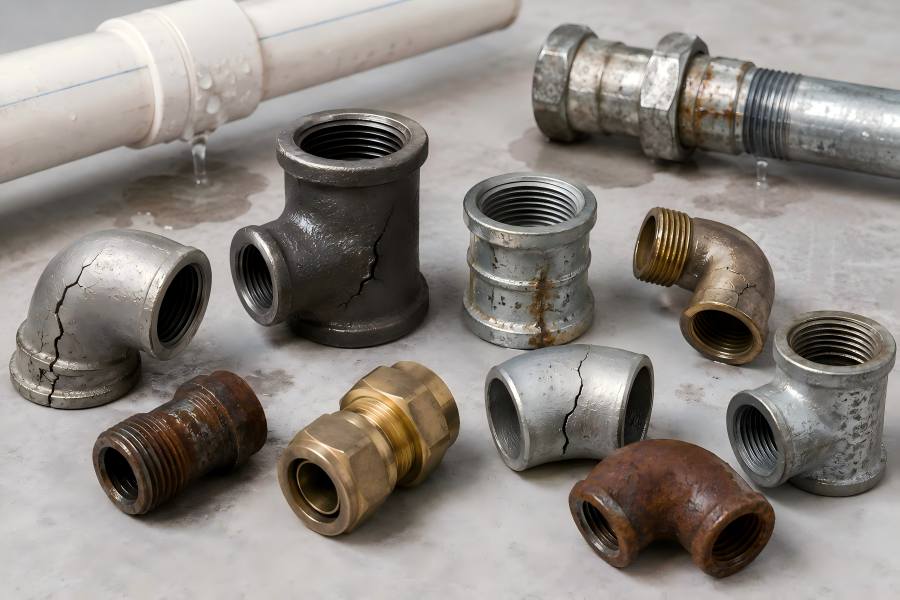
Pipe fittings connect, redirect, branch, and regulate flow in industrial piping systems. Although small in cost, they face high stress and can fail through leakage, corrosion, cracking, or pressure damage. Understanding these failures helps improve safety, reduce downtime, and extend piping system service life.
1. Leakage at Threaded Connections
Threaded pipe fittings remain widely used because they provide a simple and economical means of joining pipe sections. They are especially common in utility services, compressed air systems, instrumentation lines, fire protection networks, and low-pressure piping applications.
Despite their convenience, threaded fittings are one of the most common sources of leakage in industrial systems. Since sealing depends on proper thread engagement and sealant application, even minor installation errors can compromise joint integrity.
Leaks may initially appear insignificant, but over time they can lead to product loss, pressure reduction, corrosion, contamination, and increased maintenance requirements.
Common Causes
Several factors contribute to threaded fitting leakage:
- Cross-threading during assembly
- Damaged or worn threads
- Improper thread machining
- Excessive tightening
- Insufficient tightening
- Inadequate sealant application
- Thermal expansion and contraction
- Continuous vibration
- Mechanical movement of connected piping
Over-tightening is particularly problematic because it can distort threads and create stress concentrations that eventually lead to cracking.
Prevention Methods
Preventing threaded connection failures begins with proper installation procedures.
Recommended practices include:
- Using fittings manufactured to recognized industry standards.
- Inspecting all threads before assembly.
- Cleaning threads thoroughly.
- Applying approved thread sealants.
- Following torque recommendations.
- Supporting piping properly to minimize stress.
- Replacing damaged fittings rather than attempting repairs.
Periodic leak inspections should be incorporated into routine maintenance programs to identify developing problems before they worsen.
2. Corrosion-Induced Failure
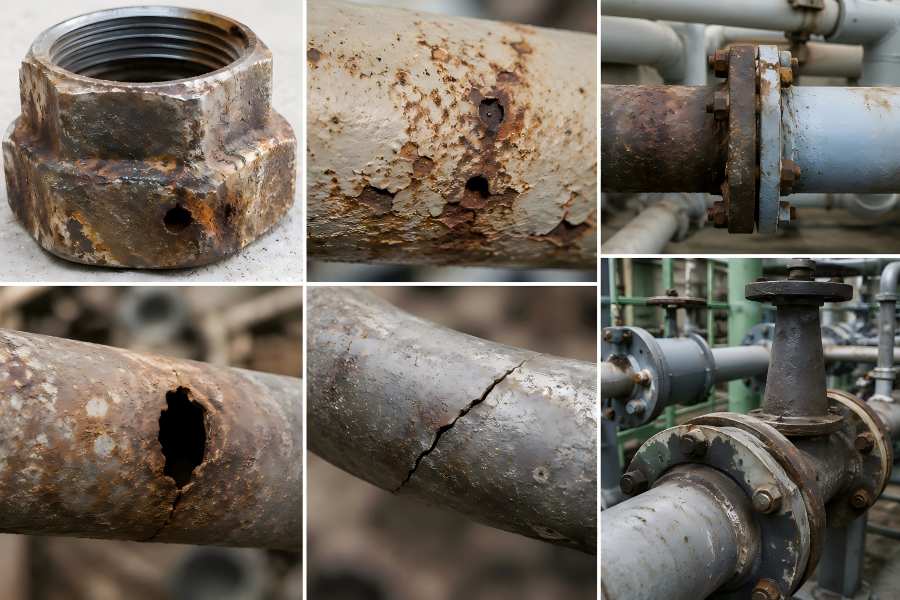
Corrosion remains one of the most destructive and expensive causes of pipe fitting failure across virtually every industry. It gradually degrades metal surfaces, reduces wall thickness, and weakens structural integrity until leaks or ruptures occur.
Fittings are particularly vulnerable because their geometry often creates areas where fluids stagnate, deposits accumulate, or protective coatings become damaged.
Types of Corrosion
Uniform Corrosion
Uniform corrosion affects large surface areas evenly. Although relatively predictable, it steadily reduces material thickness and eventually compromises strength.
Pitting Corrosion
Pitting corrosion creates highly localized holes that can penetrate through a fitting wall while leaving surrounding areas relatively unaffected.
Because pits are often small and difficult to detect, they frequently cause unexpected failures.
Galvanic Corrosion
When dissimilar metals are electrically coupled in a conductive environment, galvanic corrosion takes place. The less noble metal corrodes preferentially.
Crevice Corrosion
Crevice corrosion develops in narrow spaces where stagnant fluid creates localized chemical conditions that accelerate attack.
Stress Corrosion Cracking
Certain combinations of tensile stress and corrosive environments can produce cracking that spreads rapidly through a component.
Prevention Methods
Corrosion control requires a comprehensive strategy that may include:
- Proper material selection
- Protective coatings
- Corrosion inhibitors
- Cathodic protection systems
- Environmental monitoring
- Regular inspections
- Control of fluid chemistry
- Isolation of dissimilar metals
Selecting materials based on actual operating conditions rather than initial cost alone often results in lower long-term ownership costs.
3. Erosion and Wear Damage
Erosion occurs when flowing fluids remove material from internal fitting surfaces through mechanical action. Unlike corrosion, which is primarily chemical, erosion is caused by particle impact, turbulence, and high-velocity flow.
Elbows, tees, reducers, and branch connections are especially vulnerable because fluid direction changes create localized areas of high turbulence.
Common Causes
Common contributors to erosion include:
- High fluid velocity
- Abrasive solids
- Slurry transport
- Sand production
- Cavitation
- Poor flow distribution
- Inadequate fitting design
Signs of Erosion
Early indicators may include:
- Surface roughness
- Grooving
- Metal thinning
- Increased vibration
- Reduced efficiency
- Unexpected leakage
Prevention Methods
Effective erosion prevention measures include:
- Limiting flow velocity.
- Selecting long-radius fittings.
- Using wear-resistant alloys.
- Installing ceramic or rubber liners.
- Optimizing piping layouts.
- Conducting ultrasonic thickness surveys.
Regular monitoring is particularly important in systems handling abrasive materials.
4. Cracking Due to Thermal Stress
Changes in temperature cause piping materials to undergo expansion and contraction. When thermal movement is restricted, stresses develop within fittings and adjacent piping.
Over time, repeated thermal cycling can initiate cracks that grow progressively larger.
Common Causes
Sources of thermal stress include:
- Rapid startup and shutdown cycles
- Steam service
- Batch processing operations
- Uneven heating
- Inadequate expansion allowances
- Improper support placement
Consequences
Thermal stress can result in:
- Cracked fittings
- Distorted flanges
- Leaking joints
- Reduced fatigue life
- Structural failure
Prevention Methods
Proper thermal stress management includes:
- Expansion joints
- Expansion loops
- Flexible couplings
- Thermal analysis during design
- Strategic support placement
- Gradual temperature changes where possible
5. Fatigue Failure from Vibration
Vibration-induced fatigue is a common but often underestimated cause of fitting failure. Cracks may develop over time due to cyclic loading, despite stress levels remaining below the material’s yield strength.
Because industrial facilities contain numerous vibration sources, fittings may experience millions of stress cycles during normal operation.
Sources of Vibration
Common sources include:
- Pumps
- Compressors
- Turbines
- Fans
- Reciprocating machinery
- Flow turbulence
- Water hammer events
Vulnerable Components
Particularly susceptible areas include:
- Threaded fittings
- Instrument connections
- Small-bore piping
- Branch connections
- Welded joints
Prevention Methods
Reducing vibration-related failures requires:
- Proper pipe support design.
- Flexible connectors.
- Vibration isolation equipment.
- Equipment balancing.
- Regular vibration monitoring.
- Structural analysis to avoid resonance.
Predictive maintenance programs frequently use vibration monitoring to detect developing issues before visible damage occurs.
6. Improper Welding Defects
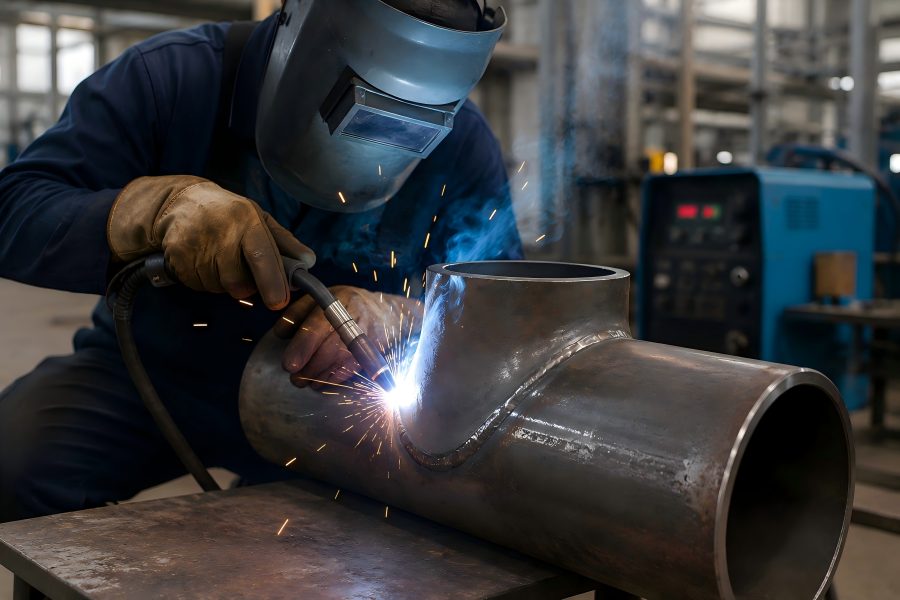
Welded fittings are widely used in high-pressure and high-temperature systems because they provide strong, leak-resistant connections. Poor welding techniques, however, might result in flaws that drastically lower dependability.
Common Welding Defects
Typical defects include:
- Lack of fusion
- Incomplete penetration
- Porosity
- Slag inclusions
- Undercutting
- Cracking
- Distortion
Consequences
Weld defects may lead to:
- Reduced strength
- Increased corrosion susceptibility
- Premature fatigue failure
- Leakage
- Catastrophic rupture
Prevention Methods
Effective welding quality control includes:
- Qualified welding personnel.
- Approved welding procedures.
- Proper joint preparation.
- Material traceability.
- Non-destructive testing.
- Post-weld heat treatment when required.
Investing in welding quality during fabrication can prevent expensive repairs later.
7. Overpressure Failure
Every fitting is designed to operate within specified pressure limits. Exceeding these limits can cause deformation, leakage, or rupture.
Overpressure incidents often occur suddenly and can have severe consequences.
Common Causes
Typical causes include:
- Water hammer
- Blocked pipelines
- Control system failures
- Pump malfunctions
- Valve failures
- Incorrect component selection
Consequences
Overpressure events may result in:
- Burst fittings
- Equipment damage
- Product release
- Safety incidents
- Production interruptions
Prevention Methods
Recommended protection measures include:
- Pressure relief valves.
- Rupture discs.
- Surge suppression systems.
- Continuous pressure monitoring.
- Correct pressure-rated fittings.
- Preventive maintenance of pressure-control equipment.
Safety margins should always be incorporated into system design.
8. Incorrect Material Selection
Choosing suitable materials is essential for ensuring piping system reliability, as a fitting that performs satisfactorily in one environment may fail prematurely in another.
Increased maintenance and replacement expenses are frequently the result of choosing materials only based on purchase price.
Common mistakes include:
- Carbon steel in highly corrosive services
- Brass fittings exposed to aggressive chemicals
- Plastic fittings subjected to excessive temperatures
- Inappropriate stainless steel grades in chloride environments
Prevention Methods
Material selection should consider:
- Fluid chemistry
- Operating pressure
- Temperature range
- Corrosion resistance
- Mechanical properties
- Regulatory requirements
9. Gasket and Flange Connection Failures
Flanged connections provide convenient access for maintenance and equipment replacement. However, gasket and flange failures remain a frequent source of leakage.
Common Causes
Factors contributing to flange leakage include:
- Uneven bolt tightening
- Improper gasket selection
- Damaged flange surfaces
- Excessive vibration
- Thermal cycling
- Incorrect bolt lubrication
Consequences
Flange failures may cause:
- Product loss
- Environmental releases
- Safety hazards
- Increased downtime
- Higher maintenance costs
Prevention Methods
Reliable flange performance requires:
- Proper gasket materials.
- Clean sealing surfaces.
- Controlled bolt tightening procedures.
- Torque verification.
- Periodic inspections.
Many facilities now use controlled bolting programs to improve flange reliability.
10. Water Hammer Damage
Water hammer occurs when fluid flow changes suddenly, creating pressure waves that travel through the piping system at high speed.
These transient pressures may greatly exceed normal operating conditions and place enormous stress on fittings.
Effects on Pipe Fittings
Potential consequences include:
- Cracked elbows
- Leaking joints
- Damaged valves
- Pipe movement
- Support failures
Common Triggers
Typical triggers include:
- Rapid valve closure
- Sudden pump shutdown
- Quick directional changes
- Air pocket collapse
Prevention Methods
Water hammer prevention strategies include:
- Surge suppressors.
- Air chambers.
- Slow-closing valves.
- Pressure relief devices.
- Controlled pump operation.
Proper hydraulic analysis during system design can greatly reduce water hammer risks.
The Importance of Preventive Maintenance
Even the highest-quality fittings require routine maintenance to achieve their expected service life. A well-structured preventive maintenance program helps identify developing issues before they result in costly failures, production downtime, safety risks, or emergency repairs.
Visual Inspections
Routine inspections should check for:
- Leaks
- Corrosion
- Cracking
- Coating damage
- Mechanical deformation
Visual inspections are the first line of defense. Maintenance teams should pay close attention to joints, elbows, tees, flanges, and areas exposed to moisture, vibration, or chemical contact.
Non-Destructive Testing
Useful inspection techniques include:
- Ultrasonic testing
- Radiographic testing
- Magnetic particle inspection
- Dye penetrant examination
Non-destructive testing helps detect internal defects, hidden cracks, weld problems, and wall-thickness loss without damaging the fitting or interrupting system integrity.
Thickness Monitoring
Regular wall-thickness measurements help detect corrosion and erosion trends before structural integrity is compromised. This is especially important for elbows, reducers, and fittings used in abrasive, corrosive, or high-velocity fluid systems.
Vibration Analysis
Monitoring vibration levels allows maintenance teams to identify equipment and piping issues early. Excessive vibration from pumps, compressors, or flow turbulence can gradually loosen connections, damage supports, and cause fatigue cracks.
Documentation
Accurate records support trend analysis, reliability improvements, and future maintenance planning. Inspection reports, repair history, material data, and failure records help teams predict risks and make better replacement decisions.
Best Practices for Preventing Pipe Fitting Failures
Organizations can significantly improve piping reliability by following several fundamental principles.
Choose High-Quality Components
Purchase fittings from reputable manufacturers with certified quality systems, reliable material traceability, dimensional accuracy, and proven performance in demanding industrial applications.
Match Materials to Service Conditions
Evaluate fluid chemistry, pressure, temperature, corrosion risk, and mechanical load to ensure every fitting material suits the actual operating environment.
Follow Proper Installation Procedures
Use trained technicians, correct tools, approved torque values, proper alignment, and standardized assembly methods to prevent leakage, stress, and premature damage.
Monitor Operating Conditions
Track pressure, temperature, flow rate, vibration, and abnormal fluctuations continuously to identify early warning signs before fitting failures develop.
Implement Preventive Maintenance
Schedule routine inspections, cleaning, testing, and replacement plans to detect corrosion, wear, leakage, or cracking before serious system failures occur.
Conduct Root Cause Analysis
Investigate each significant failure carefully to identify design, material, installation, or operating problems and prevent similar failures from happening again.
Invest in Personnel Training
Provide regular training for engineers, welders, installers, and maintenance teams so they understand standards, failure risks, and proper handling procedures.
Establish Reliability Programs
Build a structured reliability program using inspection records, operating data, risk ranking, and maintenance planning to improve long-term piping system performance.