
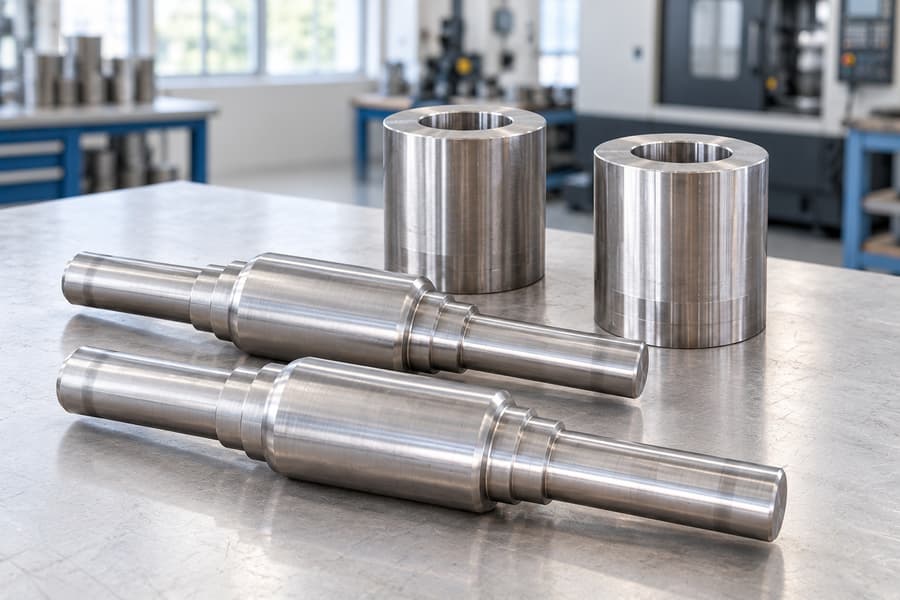
Carbon steel suits many general-duty forgings, alloy steel offers greater hardenability for demanding sections, and stainless steel addresses corrosion exposure. The finished component’s service conditions ultimately determine which material is suitable for use.
For shafts, sleeves, flanges, and gear blanks, compare the grade, section size, heat treatment, and inspection requirements together before committing to a material specification.
Key Factors in Selecting Open Die Forging Materials
Material selection for open die forging begins with the component’s operating requirements rather than a general preference for a particular steel family. A grade suitable for a moderate-load shaft may not meet the requirements of a heavily loaded gear blank.
The open die forging process can produce large and relatively simple forged shapes through repeated compression and controlled workpiece movement. However, the resulting properties depend on the material, forging practice, subsequent heat treatment, and component dimensions.
Operating Environment and Mechanical Requirements
Engineers should identify the forces, temperatures, surrounding media, and expected operating cycles before selecting a material. These conditions determine which properties deserve priority during procurement.
Important service requirements include:
- Tensile strength: Determines the material’s resistance to pulling forces and helps establish its suitability for load-bearing components.
- Yield strength: Indicates when permanent deformation begins under applied loading.
- Impact toughness: Matters when components experience sudden loading, vibration, or potential shock.
- Fatigue resistance: Influences performance under repeated loading and unloading.
- Wear resistance: Becomes important for contact surfaces, rotating parts, and components exposed to friction.
- Corrosion resistance: Determines suitability for moisture, chemicals, industrial atmospheres, and other corrosive environments.
These properties must be evaluated together. Increasing hardness through heat treatment, for example, does not automatically improve impact toughness or fatigue performance.
Component Geometry and Manufacturing Considerations
Cross-sectional dimensions influence how a forging cools during heat treatment. A thick shaft or heavy block may develop different surface and core properties because heat extraction and transformation rates vary across its section.
Geometry also affects material consumption, forging operations, machining allowances, and inspection access. Deep shoulders, large diameter changes, and hollow sections deserve particular attention during manufacturing planning.
Machinability is another purchasing consideration. A material delivered in a suitable annealed or normalized condition may simplify rough machining before final heat treatment, depending on the component’s manufacturing sequence.
Buyers should therefore evaluate the complete route from forging through heat treatment, machining, and inspection rather than comparing material prices or nominal strength values independently.
Carbon Steel Options for Open Die Forging
Carbon steel is commonly considered when components require dependable mechanical properties, practical machinability, and relatively straightforward material selection. Its performance depends primarily on carbon content, other alloying elements, processing history, and heat treatment.
Different carbon steel grades serve different purposes. Lower-carbon grades generally offer greater ductility and weldability, while medium-carbon grades can provide higher strength and hardness after appropriate processing.
Common Grades and Mechanical Properties
Two representative options are 1020 and 1045 carbon steel. Their different carbon contents create meaningful differences in strength potential, hardenability, machinability, and heat-treatment response.
1020 carbon steel is a low-carbon option used where ductility, machinability, and moderate mechanical requirements are important. It can be suitable for less heavily loaded forged components and applications where extensive through-hardening is unnecessary.
Its relatively low carbon content limits the hardness achievable through conventional quenching and tempering. Where a harder surface is required, a suitable surface-hardening route may be considered if the component design and specification permit it.
1045 carbon steel is a medium-carbon grade that can achieve higher strength and hardness through suitable heat treatment. It is often considered for shafts, gear blanks, and other components exposed to moderate or substantial mechanical loading.
Compared with 1020, 1045 offers greater potential hardness and strength but generally requires more attention to heat-treatment conditions. Compared with many alloy steels, 1045 has lower hardenability, which becomes a greater concern in large cross-sections.
For larger components, buyers should not assume that a satisfactory surface hardness indicates uniform properties throughout the section. Core mechanical properties must be evaluated against the specified dimensions and heat-treatment route.
Typical Heat Treatment and Applications
Carbon steel forgings may be supplied in as-forged, normalized, annealed, or other specified conditions. The appropriate delivery condition depends on machining requirements and the mechanical properties required for service.
Normalization can refine the microstructure and provide a more consistent starting condition for subsequent operations. Annealing may improve machinability, while quenching and tempering can increase strength and hardness in suitable medium-carbon grades.
The selection must account for section thickness because thick components may not respond uniformly to rapid cooling. A heat-treatment specification should therefore identify the required condition and applicable mechanical testing locations.
Common applications include:
- Shafts: Medium-carbon grades such as 1045 may suit shafts with moderate strength requirements and appropriate dimensions.
- Flanges: Carbon steel can provide a practical balance of mechanical performance and machinability for general industrial connections.
- Gear blanks: Suitable carbon steel grades can be considered when the required core properties and subsequent tooth-hardening process are compatible.
- Heavy blocks: Lower-carbon grades may be appropriate where ductility, machinability, and structural requirements take priority over high hardness.
Selection Limitations
Carbon steel is not the preferred choice for every operating environment. Its corrosion resistance is limited, so components exposed to moisture, chemicals, or corrosive process media may require protective measures or another material family.
Weldability also varies with carbon content, thickness, and manufacturing condition. Buyers planning repairs or welded connections should establish appropriate material and welding requirements before production.
Alloy Steel Options for Open Die Forging
Alloy steel is often selected when carbon steel cannot provide the required combination of strength, toughness, hardenability, and wear resistance. Chromium, molybdenum, nickel, and manganese modify the steel’s response to heat treatment and mechanical loading.
These elements do not automatically make every alloy steel stronger or more durable. Their effects depend on concentration, interactions between alloying elements, microstructure, forging practice, and the final heat-treatment condition.
Common Grades and Their Mechanical Characteristics
Several alloy steel grades are widely considered for custom forged components. Among them, 4140, 4340, 42CrMo, and 42CrMo4 are relevant options, but their designations must be checked against the governing material standards.
4140 alloy steel contains chromium and molybdenum as important alloying elements. It offers useful hardenability and can achieve a combination of strength, hardness, and toughness through suitable quenching and tempering.
It is commonly considered for forged shafts, gear blanks, heavy-duty machinery components, and other parts requiring substantial mechanical strength. Its suitability depends on the actual section size and specified properties.
4340 alloy steel contains nickel in addition to chromium and molybdenum. This alloying system provides higher hardenability than many lower-alloy alternatives, making it worth evaluating for heavily loaded components and larger sections.
However, its higher hardenability does not guarantee identical properties throughout every forging. Heat-treatment design, component geometry, cooling conditions, and testing requirements remain important.
42CrMo and 42CrMo4 are chromium-molybdenum alloy steel designations associated with different material standards. Although they may have similar chemical compositions and intended applications, buyers must not treat their designations as automatically interchangeable.
The governing standard, chemical composition limits, mechanical property requirements, delivery condition, and inspection criteria must be reviewed before substitution. Before considering 4140 as an alternative to 42CrMo or 42CrMo4, the requirements of their respective standards must also be compared.
Carbon and Alloy Steel Grade Comparison
| Material Grade | Main Characteristics | Typical Selection Considerations |
| 1020 Carbon Steel | Low carbon content and good ductility; machining depends on condition | Components with moderate mechanical requirements |
| 1045 Carbon Steel | Medium carbon content, higher potential hardness | Shafts, gear blanks, and general machinery parts |
| 4140 Alloy Steel | Chromium-molybdenum alloy, good hardenability | Forged shafts and heavily loaded components |
| 4340 Alloy Steel | Nickel-chromium-molybdenum alloy, high hardenability | Large or highly stressed components requiring careful property control |
| 42CrMo | Chromium-molybdenum alloy steel | Applications specified under the applicable material standard |
| 42CrMo4 | Chromium-molybdenum alloy steel under a different designation system | Applications requiring compliance with the specified European material standard |
This comparison provides an initial selection reference rather than a substitute for grade-specific material verification. Actual properties must come from the agreed standard, delivery condition, and test results.
Quenching and Tempering Requirements
Quenching and tempering are common heat-treatment routes for alloy steel forgings. Quenching transforms the steel into a harder microstructure, while subsequent tempering adjusts the balance between strength, hardness, and toughness.
The treatment must be developed for the actual grade and component dimensions. A process suitable for a relatively small shaft may not produce equivalent core properties in a much larger forged section.
Buyers should clarify several details before placing an order:
- Required heat-treatment condition and applicable material standard.
- Target tensile strength, yield strength, hardness, and impact toughness where specified.
- Component dimensions and the section locations used for mechanical testing.
- Whether testing applies to the surface, core, or specified sampling locations.
- Whether heat-treatment records and mechanical test results are required.
For larger forgings, hardenability deserves particular attention. Alloying elements can improve the depth at which useful hardened structures develop, but actual results still depend on section dimensions and cooling conditions.
Typical Applications for Heavy-Duty Forged Components
Alloy steel is frequently considered for components carrying high mechanical loads or operating under repeated stress. The appropriate grade depends on the combination of load, geometry, manufacturing condition, and maintenance requirements.
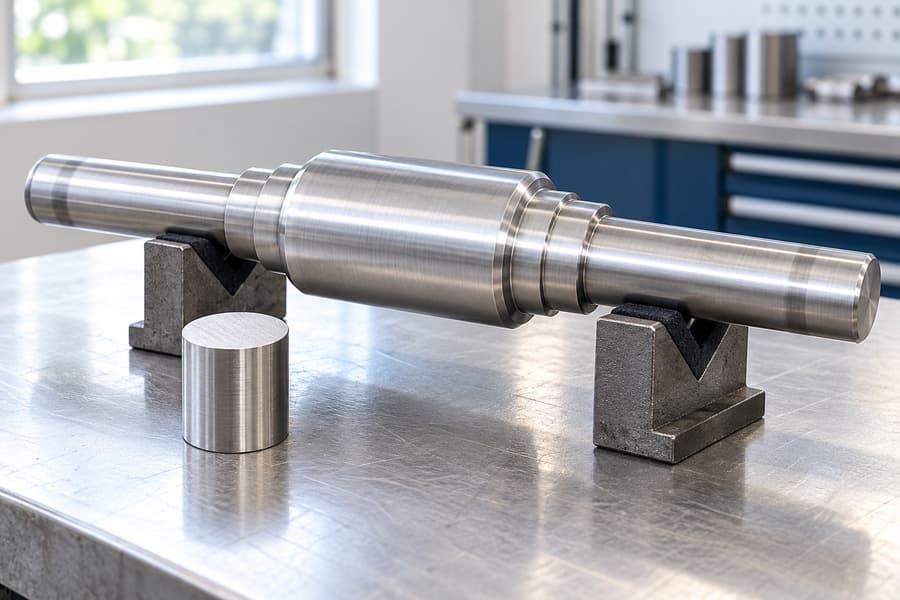
Forged shafts are a representative application because their diameter, length, shoulders, and operating loads influence both material selection and heat-treatment planning. Buyers can review Boberry Machining’s forged shafts for relevant custom component requirements.
Alloy steel may also be suitable for:
- Heavy-duty flanges: Where specified strength and toughness are important under mechanical loading.
- Gear blanks: Where core strength and the requirements of subsequent tooth machining or surface hardening must be coordinated.
- Large machinery blocks: Where section size and through-section mechanical properties require careful evaluation.
- Hollow forged components: Where wall thickness, internal geometry, and heat-treatment response influence material selection.
For these applications, the material grade should be selected together with the forging dimensions, heat-treatment condition, machining sequence, and required inspection records.
Stainless Steel Options for Open Die Forging
Stainless steel is selected when forged components require corrosion resistance alongside specified mechanical properties. Different stainless families offer substantially different combinations of strength, toughness, hardness, and heat-treatment response.
Material selection must account for the actual corrosive environment, operating temperature, mechanical loading, and section dimensions. Whether a stainless steel grade is suitable depends on the specific operating environment and service requirements.
Austenitic Stainless Steel – 304 and 316
304 stainless steel offers useful corrosion resistance, ductility, and toughness for general industrial applications. It is commonly considered for forged flanges, rings, and components exposed to atmospheric moisture or compatible process fluids.
316 stainless steel contains molybdenum, which improves resistance to certain forms of localized corrosion compared with 304 under appropriate conditions. However, 316 is not seawater-proof and remains vulnerable to chloride-induced pitting and crevice corrosion.
Neither 304 nor 316 is hardened by conventional quenching. Their properties depend on composition, processing history, and delivery condition, while solution annealing may be specified to restore an appropriate corrosion-resistant microstructure.
Martensitic Stainless Steel – 410 and 420
410 stainless steel can be hardened through suitable heat treatment and is considered where mechanical strength, moderate corrosion resistance, and wear performance are important.
420 stainless steel generally offers greater attainable hardness than 410 because of its carbon content, although properties depend on the specific grade. Both require appropriate hardening and tempering procedures.
Compared with austenitic grades, martensitic stainless steels generally provide less corrosion resistance. Selection must balance hardness, toughness, corrosion exposure, and the risks associated with heat-treatment distortion.
2205 Duplex Stainless Steel: Microstructure and Properties
The microstructure of 2205 duplex stainless steel contains both austenitic and ferritic phases. It offers relatively high strength and useful resistance to certain chloride-related corrosion mechanisms, making it relevant to selected chemical-processing and marine applications.
Duplex properties depend on maintaining an appropriate phase balance. Grade-specific solution treatment and cooling practices are important because unsuitable thermal exposure can produce detrimental phases that reduce toughness and corrosion resistance.
Precipitation-Hardening Stainless Steel – 17-4PH
17-4PH stainless steel develops strength through precipitation-hardening heat treatment. Forged shafts and other mechanical components may use 17-4PH when the application demands both strength and corrosion resistance.
For 17-4PH, specify the required aging condition in the purchase order to establish the intended mechanical property targets. Buyers must identify the required heat-treatment designation and mechanical acceptance criteria rather than ordering solely by the 17-4PH grade name.
Comparison of Stainless Steel Families
| Stainless Family | Representative Grades | Heat Treatment | Main Selection Considerations |
| Austenitic | 304, 316 | Solution annealing; not quench-hardenable | Corrosion resistance, ductility, toughness |
| Martensitic | 410, 420 | Hardening and tempering | Hardness, wear resistance, moderate corrosion resistance |
| Duplex | 2205 | Grade-specific solution treatment | Strength, chloride resistance, phase balance |
| Precipitation-Hardening | 17-4PH | Solution treatment and controlled aging | High strength, aging condition, corrosion resistance |
The table supports preliminary selection only. Final material acceptance depends on the governing standard, specified heat-treatment condition, service environment, and required mechanical properties.
Alternative Materials for Specialized Forging Requirements
Although steel dominates many industrial forging applications, certain service conditions justify evaluating nonferrous alloys. These alternatives require separate assessment of forgeability, section size, heat treatment, and manufacturing feasibility.
Nickel-Based Alloys
Nickel-based alloys may be appropriate for components exposed to demanding temperatures, corrosive chemicals, or conditions requiring specific oxidation or creep resistance.
Their forging-temperature windows, deformation behavior, and heat-treatment requirements vary significantly by grade. Buyers should establish whether the selected alloy and component dimensions are compatible with the proposed manufacturing route.
Titanium Alloys
Titanium alloys offer attractive strength-to-weight ratios and corrosion resistance in selected environments. They may be considered when reducing component mass is important without sacrificing specified mechanical performance.
However, titanium forging requires careful control of temperature, surface contamination, deformation, and subsequent processing. Material grade and manufacturing feasibility must be verified before specifying a large custom component.
Aluminum Alloys
Aluminum alloys are relevant where low component weight, machinability, and suitable mechanical properties are priorities. Their strength and heat-treatment response vary substantially between alloy families.
Not every aluminum alloy is appropriate for the same forging process. Buyers must verify forging suitability, achievable section properties, heat-treatment compatibility, and the component’s intended operating conditions.
How Section Size and Heat Treatment Affect Forged Properties
Even when the correct grade is selected, forging dimensions can significantly influence final mechanical properties. Large sections create particular challenges because temperature distribution and cooling rates vary throughout the workpiece.
Temperature and Property Variations Between the Surface and Core
When a thick forging undergoes heat treatment, its outer regions generally lose heat faster than its center. This difference influences microstructural transformation and can produce variations in hardness, strength, and toughness.
Hardenability determines how readily a steel develops hardened microstructures through its section under particular cooling conditions. Higher hardenability improves the potential for through-section response but does not guarantee uniform properties.
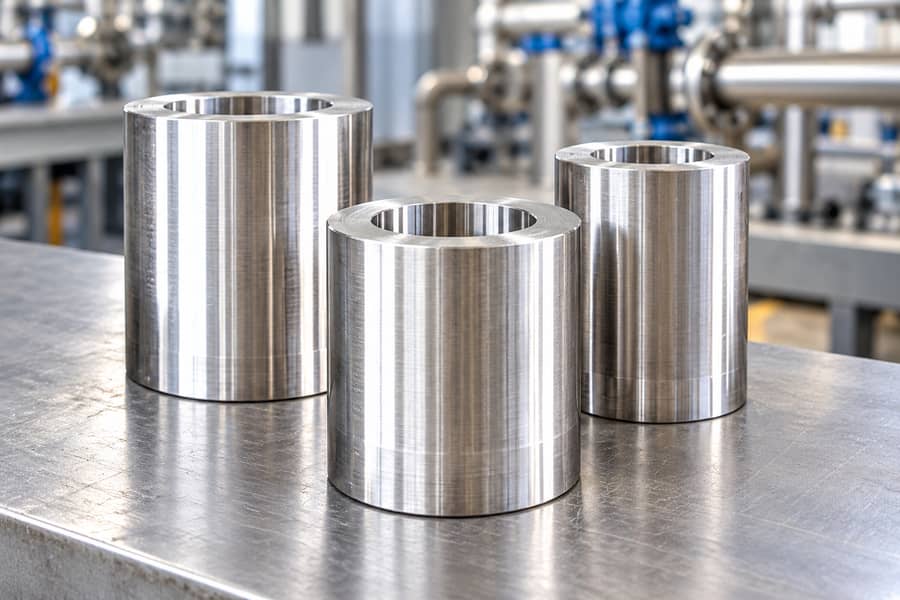
For hollow components, both wall thickness and overall geometry matter. Buyers sourcing forged cylinder sleeves should specify internal dimensions, external dimensions, wall requirements, and relevant inspection locations.
Heat Treatment Selection by Material Grade
Heat treatment must match the material family and governing specification. Depending on the specified property targets, carbon and low-alloy steels may undergo normalizing or quenching and tempering.
Austenitic stainless steels require different treatment objectives from martensitic grades. Duplex steels require appropriate phase control, while precipitation-hardening stainless steels depend on specified aging treatments.
For large forgings, buyers should establish how mechanical test results represent the finished section. Test coupon location, orientation, thermal history, and acceptance requirements need agreement before production.
Distortion, Residual Stress, and Machining Allowances
Heating and cooling can introduce residual stresses or dimensional changes, particularly in forgings with uneven sections, shoulders, bores, or substantial differences in wall thickness.
Manufacturing plans should coordinate rough machining, heat treatment, final machining, and inspection. The required machining allowances depend on geometry, material behavior, processing sequence, and agreed drawing requirements.
The purchase specification needs to identify final dimensions, delivery condition, mechanical testing requirements, and inspection acceptance criteria. These details help establish whether the finished forging meets its intended service requirements.
Matching Materials to Common Open Die Forged Components
Material selection becomes more practical when connected to component geometry, loading conditions, and manufacturing requirements. Shafts, flanges, rings, gear blanks, heavy blocks, and hollow cylinders present different engineering challenges.
Forged Shafts and Heavy-Duty Flanges
Forged shafts commonly require a suitable combination of strength, toughness, fatigue resistance, and machinability. Carbon steel may suit moderate loads, while alloy steel becomes relevant when higher hardenability is necessary.
For flanges, material selection depends on operating pressure, temperature, connected equipment, and exposure conditions. Where the service environment demands greater corrosion resistance, stainless steel may be worth considering.
Rings and Gear Blanks
Forged rings may require dimensional stability, toughness, and resistance to operational stresses. Material selection depends on whether the ring serves a structural, rotating, or corrosion-exposed function.
Gear blanks often require core toughness alongside appropriate surface properties. Alloy steel may be selected when subsequent tooth hardening is planned, provided the grade supports the specified treatment.
Heavy Blocks and Hollow Cylinders
Heavy forged blocks require particular attention to section size, internal soundness, heat-treatment response, and mechanical test locations. Specified properties must be achievable at representative locations within the forging.
Hollow cylinders introduce additional considerations involving wall thickness, bore geometry, and machining access. Material selection must account for internal pressure, wear, corrosion, and dimensional requirements where applicable.
Hypothetical purchasing example: An equipment manufacturer requires a large forged transmission shaft exposed to repeated torsional loading. Initial material candidates include 1045 and 4140 steel.
The engineer would compare required strength, fatigue considerations, shaft diameter, and achievable core properties. If 1045 cannot satisfy the specified through-section requirements, appropriately heat-treated 4140 may warrant further evaluation.
The final purchase decision would depend on verified mechanical requirements, an agreed material standard, heat-treatment feasibility, and inspection criteria rather than grade designation alone.
How to Specify Materials When Ordering Custom Forgings
A complete request for quotation (RFQ) allows the forging supplier to evaluate material suitability, manufacturing requirements, and inspection expectations before confirming an order.
Material Grade, Standards, and Mechanical Requirements
Specify the material designation together with its governing standard and applicable edition. Similar grade names from different designation systems must not be substituted without reviewing their requirements.
Mechanical requirements should identify the specified properties, test conditions, and acceptance criteria. Where relevant, clarify whether properties apply to the finished component or representative test specimens.
Dimensions, Heat Treatment, and Inspection
Provide drawings showing finished dimensions, forging stock allowances, critical surfaces, and relevant geometric features. Identify the required delivery condition and any machining operations included in the supply scope.
Heat-treatment requirements should identify the specified condition and applicable acceptance criteria. Inspection requirements must distinguish mandatory examinations from optional testing or documentation.
RFQ Checklist for Custom Open Die Forgings
Include the following information when requesting a quotation:
- Component details: Part name, intended application, and required quantity.
- Material specification: Grade, governing standard, and applicable edition.
- Engineering drawings: Dimensions, geometry, and machining allowances.
- Mechanical requirements: Strength, hardness, toughness, and testing locations where applicable.
- Heat-treatment condition: Required treatment and final delivery condition.
- Inspection requirements: Dimensional checks, mechanical testing, and specified nondestructive examinations.
- Documentation: Required material records, inspection reports, and test results.
- Delivery scope: Forged blank, semi-finished component, or finished machined part.
Clear documentation helps distinguish essential engineering requirements from preferences that can be evaluated during quotation.
Material Selection and Custom Forging Support from Boberry Machining
Boberry Machining supplies custom open-die-forged blanks, semi-finished components, and finished parts, including shafts, flanges, rings, gear blanks, heavy blocks, and hollow cylinders.
Depending on the agreed order scope, Boberry Machining may supply components with heat treatment, machining, and inspection included. The requested scope must identify the relevant material specification, component dimensions, delivery condition, and acceptance criteria.
For material selection inquiries, supplying complete engineering drawings and service requirements helps establish an appropriate quotation basis. Final grade selection and manufacturing requirements should be confirmed against the component’s actual engineering specification.