
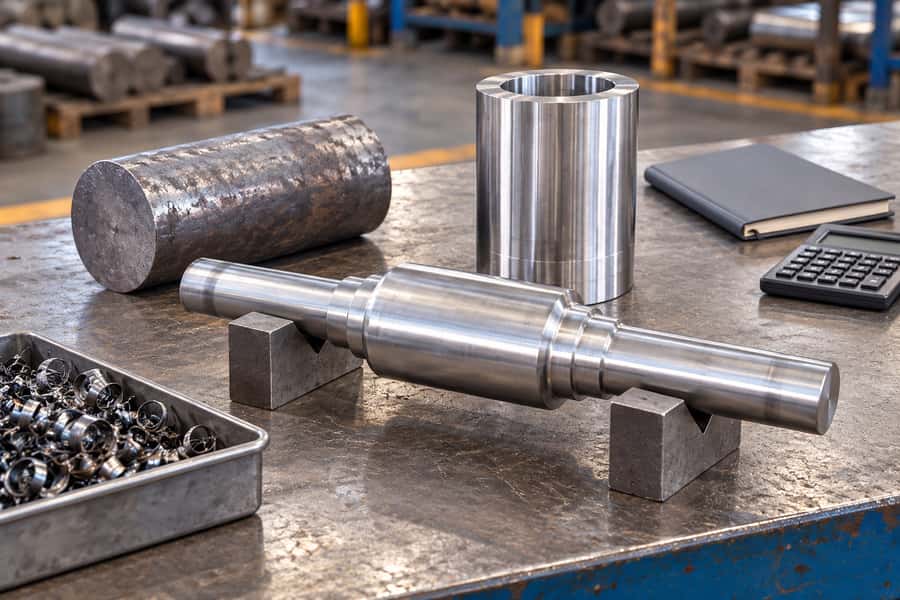
Open die forging prices depend on more than the weight of the finished component. Material purchased, metal removed, deformation effort, and required downstream operations can change manufacturing cost substantially.
Procurement teams can compare quotations more reliably when drawings, acceptance criteria, quantities, and delivery boundaries match. The following cost factors explain where differences arise and what information suppliers need.
From Raw Stock to Delivery: What Buyers Pay For in Open Die Forging
The cost of open die forging includes material procurement, stock preparation, heating, deformation, and any subsequent processing needed to meet the specified delivery condition.
Raw material often represents a substantial expense, especially for large forgings. However, heat treatment, machining, testing, and documentation can also influence the final quoted price.
Production expenses include both component-specific operations and order-level activities. Setup, process planning, and certain inspection preparations may be distributed across several acceptable components.
| Cost Factor | Main Pricing Considerations | Purchasing Information Needed |
| Raw material | Grade, availability, purchased weight | Material specification |
| Material utilization | Cropping, scale loss, machining stock | Blank and finished dimensions |
| Forging operations | Geometry, deformation, reheating | Component drawings |
| Order quantity | Setup and batch allocation | Quantity and repeat demand |
| Heat treatment | Required condition and properties | Heat-treatment specification |
| Machining | Material removal, tolerances | Finished drawings |
| Inspection | Testing coverage and documentation | Acceptance criteria |
These factors interact. A relatively simple carbon steel forging may require extensive machining, while a more complex preform may involve additional deformation but less downstream material removal.
The quoted selling price also reflects commercial considerations beyond direct manufacturing expenses. Comparing individual cost categories is useful, but it does not establish the supplier’s complete pricing calculation.
How Do Material Grade, Input Weight, and Yield Affect Forging Cost?
Material Grade and Raw Material Procurement
Material selection influences the cost of purchased stock and the operations required to transform it into an acceptable forging.
Carbon steel, alloy steel, and stainless steel differ in composition, procurement requirements, forging behavior, and possible heat-treatment routes. Their relative costs depend on the actual grades and purchasing conditions.
Special chemistry limits, restricted impurities, or additional certification requirements may increase procurement complexity. Less readily available stock dimensions can also affect preparation and delivery planning.
For alloy steel forgings, specified strength and toughness requirements may influence both the starting material and subsequent heat treatment. Material designation alone cannot establish the complete processing cost.
Stainless steel can introduce different heating, deformation, and machining considerations. These depend on the specific grade and should not be applied uniformly across all stainless families.
Changing to a less expensive grade is not automatically acceptable. Material substitutions require engineering approval based on service conditions, mechanical properties, corrosion requirements, and applicable specifications.
Input Weight Versus Finished Component Weight
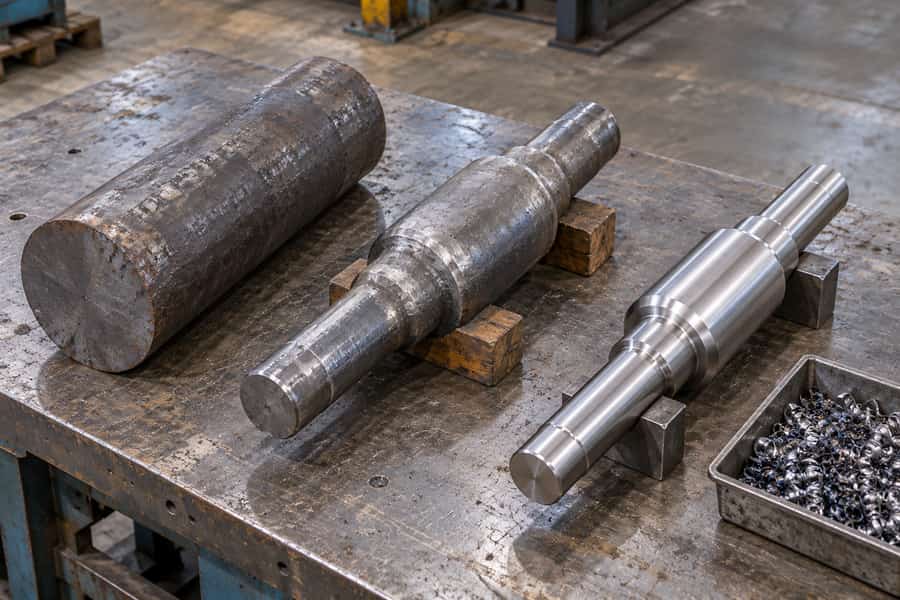
The purchased material weight is often greater than the finished component weight. This difference affects raw material consumption and the quantity of metal processed.
Three weight measurements help explain material utilization:
- Purchased input weight: Material allocated to the component before forging-related losses.
- Rough forged weight: Weight after forging and associated material removal.
- Finished component weight: Weight remaining after the specified machining operations.
Overall finished-part material yield can be expressed as:
Material yield (%) = finished weight ÷ purchased input weight × 100.
Consider a hypothetical component requiring 100 kg of purchased material and weighing 70 kg after machining. Its overall finished-part material yield would be 70%.
This percentage describes material utilization across the defined production scope. It should not be confused with yield measured only between the initial billet and rough forging.
Material Loss and Scrap Recovery
Material losses can arise from billet cropping, oxidation scale, process-related removal, and machining. The proportions depend on stock preparation, geometry, and manufacturing methods.
Some offcuts and machining chips may have recoverable scrap value. Oxidation losses and certain contaminated residues may not provide equivalent recovery opportunities.
A quotation may account for scrap recovery through internal material costing or an agreed commercial credit. Buyers should not assume every kilogram removed reduces the invoice.
How Does Forging Geometry and Section Size Influence Cost?
Simple Shafts and Heavy Forged Blocks
Straight shafts and rectangular blocks often require relatively straightforward forming sequences. Their costs still depend on dimensions, starting stock, reduction requirements, and material specifications.
For forged shafts, length, diameter, straightness requirements, and machining allowances influence the amount of material and the selected manufacturing route.
Long components can introduce handling and alignment considerations. Large cross-sections may require additional attention to heating uniformity, deformation distribution, and subsequent heat treatment.
Heavy forged blocks can also require substantial material removal when finished features are machined from relatively simple preforms. A straightforward forging shape does not guarantee inexpensive completion.
Stepped Shafts, Flanges, and Gear Blanks
Stepped shafts contain diameter transitions and shoulders that may require repeated drawing, upsetting, and local shaping operations.
Flanges and gear blanks can require concentrated material in selected regions. Producing suitable preforms may involve additional deformation, repositioning, and intermediate dimensional checks.
The complexity of the forging process depends on the starting stock and the required distribution of material, not simply the number of features shown on the finished drawing.
Where practical, allowing suitable machining stock around functional features may simplify forging. Excessively generous stock, however, increases material purchases and subsequent machining effort.
Thick-Walled Cylinder Sleeves and Forged Rings
Thick-walled hollow components introduce additional questions concerning bore formation, wall thickness, length, and material distribution.
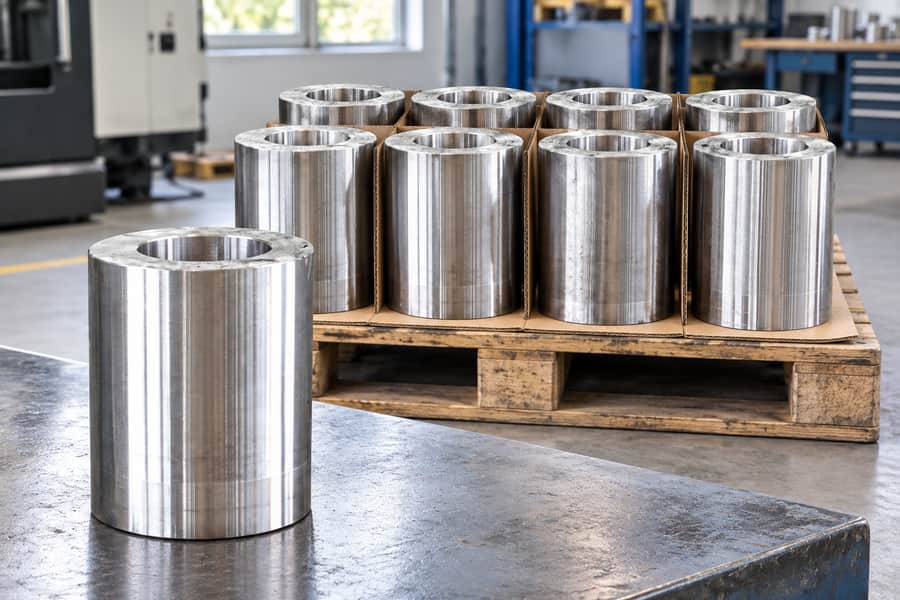
For forged cylinder sleeves, production planning may consider hollow-forging methods or machining a bore from solid stock, depending on feasibility and specifications.
Piercing and mandrel-based operations are not automatically suitable for every material, dimension, or manufacturing arrangement. The chosen route affects forging effort and subsequent machining.
Ring-shaped components require similar evaluation. Conventional open die forging and ring rolling are distinct operations, so their processing assumptions should not be treated as interchangeable.
How Do Heating and Forging Operations Affect Production Cost?
Billet Preparation and Heating
Forging normally begins with preparing suitable stock dimensions and heating the material to an appropriate working temperature.
Stock preparation may involve cutting, surface checks, and handling. The starting dimensions influence furnace loading arrangements and the amount of material requiring heating.
Different materials have different permissible working temperatures and temperature sensitivities. Heating procedures must follow the actual grade and intended deformation requirements.
Section thickness also matters. Large sections may require attention to temperature distribution before deformation begins, influencing the planned heating sequence.
Working Passes and Return Trips to the Furnace
During production, the dies compress selected sections of the workpiece while leaving other surfaces unconfined, allowing the operator to progressively shape the material.
Operations may include upsetting to increase cross-section, drawing to extend the workpiece, and cogging with rotation or repositioning between successive reductions.
Complex shapes can require additional operations and handling. The required deformation, workpiece temperature, die contact, and production sequence influence manufacturing effort.
As forging progresses, the workpiece loses heat. Reheating may be necessary when further deformation cannot be completed within the suitable working temperature range.
Additional heating cycles increase processing requirements, but their number cannot be established from finished weight alone.
Equipment Selection and Manufacturing Requirements
Equipment selection depends on workpiece dimensions, material behavior, required force or impact energy, deformation sequence, and handling requirements.
Hydraulic presses and forging hammers apply deformation differently. Neither method guarantees superior internal soundness without an appropriate process design, reduction history, and material condition.
A quotation therefore requires an assessment of the actual forming route rather than applying a universal processing cost per kilogram.
How Does Order Quantity Affect Open Die Forging Pricing?
Setup and Production Preparation Costs
Manufacturing an order requires activities that may not increase proportionally with the number of components. These can include engineering review, production planning, handling preparation, setup, and certain quality-control arrangements.
When applicable, fixed order-level expenses are allocated across the planned quantity. Their contribution per piece generally decreases when more acceptable components share those costs.
Single Pieces, Small Batches, and Repeat Orders
A single custom forging may carry a larger share of preparation expenses than components produced in a repeat batch. Repeat orders can sometimes reuse established process information, approved drawings, and inspection arrangements, reducing duplicated preparation work.
However, raw material, forging, heat treatment, machining, and testing must still be completed according to the required scope.
A larger quantity can improve cost allocation without guaranteeing a particular discount. Material availability, production scheduling, and individual component requirements remain relevant.
Why Quantity Savings May Be Limited
When raw material or extensive machining dominates the manufacturing cost, distributing setup expenses across more pieces may produce relatively modest savings.
Likewise, individual mechanical tests or specified inspection operations may remain necessary regardless of batch size.
Purchasers comparing quantities should request consistent technical specifications and identify which charges are fixed, quantity-dependent, or separately quoted.
How Do Heat Treatment Requirements Influence Forging Cost?
Common Heat Treatment Requirements
Heat treatment can influence mechanical properties, microstructure, dimensional stability, and the specified delivery condition of a forging. Depending on material and requirements, operations may include annealing, normalizing, quenching and tempering, or other appropriate thermal processes.
Not every forging requires the same treatment. A specification calling for particular mechanical properties may require a different route from one requesting a simpler delivery condition.
Section Thickness and Mechanical Properties
Large sections can develop different cooling conditions across their thickness. Achievable properties depend on material hardenability, thermal processing, and component geometry.
Strength, toughness, and hardness requirements therefore need to be considered alongside the actual section dimensions.
Specified test locations and orientations also matter. Mechanical properties measured in one region should not automatically be assumed identical throughout a large forging.
Additional Heat Treatment Operations
Thermal processing may require dedicated preparation, controlled cooling, straightening, or further examination when specified.
Corrective processing can introduce additional work if the initial condition does not meet agreed requirements, subject to the applicable specification and acceptance procedure.
Clear heat-treatment requirements help suppliers select an appropriate route and identify associated testing before preparing the quotation.
How Do Machining Allowances and Dimensional Requirements Affect Cost?
Machining Allowance and Forged Stock Dimensions
Open die forging produces a shaped workpiece rather than automatically achieving finished machining tolerances. Machining allowance provides material for removing scale, correcting appropriate surface irregularities, and producing specified finished dimensions.
Forging dimensional tolerance describes allowable variation in the forged blank. Machining allowance describes stock intentionally reserved for subsequent removal. These are different requirements.
Insufficient stock can prevent a finished surface from cleaning up, particularly when centerline displacement, straightness variation, or surface conditions affect material availability.
Excessive allowances increase purchased material weight and machining effort. Suitable allowances must consider geometry, process capability, and the finished drawing.
Rough Machining Versus Finish Machining
An as-forged component may require cleaning and basic dimensional verification without extensive machining. Rough machining removes substantial stock and prepares the part for later operations. It may also expose surfaces needed for further inspection.
Finish machining produces specified dimensions, geometric relationships, and surface conditions through operations such as turning, boring, facing, and drilling. The cost difference depends on stock removal, accessibility, part rigidity, required accuracy, and the manufacturing sequence.
Tolerances, Surface Finish, and Geometric Accuracy
Tight dimensional tolerances and demanding surface finishes can require additional machining passes, measurement, and process control. Straightness, concentricity, runout, and other geometric requirements must be related to appropriate drawing datums and functional needs.
A forging’s dimensional capability should not be described using accuracy achieved later through CNC or other finish machining. Applying unnecessarily restrictive requirements to nonfunctional surfaces can increase processing cost without improving the component’s intended performance.
How Do Inspection, Testing, and Traceability Requirements Affect Price?
Material Verification and Mechanical Testing
Inspection requirements vary according to material specifications, service conditions, and contractual acceptance criteria. Depending on the specified acceptance requirements, an order may involve chemical composition checks, tensile tests, impact tests, hardness measurements, or a combination of these examinations.
Costs depend on sample quantity, test locations, preparation, and reporting. Additional tests should not be assumed included unless the quotation identifies them.
Nondestructive Testing Requirements
Ultrasonic testing may be specified to examine internal discontinuities where the material, geometry, and procedure support meaningful examination. Magnetic particle testing applies to suitable ferromagnetic materials. When surface-breaking defects are a concern, penetrant inspection can reveal relevant indications after the examination surfaces have been properly cleaned and prepared.
Examination coverage, sensitivity, acceptance criteria, and inspection stage affect the required work. For example, inspecting a rough-machined surface can involve different preparation from examining an as-forged surface with residual scale.
Traceability and Quality Documentation
Traceability requirements may include heat identification, material certificates, heat-treatment records, dimensional reports, and documented inspection results. Additional witnessing or project-specific documentation may increase administrative and inspection effort.
Purchasers should specify required records before ordering. A material certificate alone does not establish that every requested examination or acceptance requirement has been satisfied.
How Much Does Open Die Forging Cost? A Hypothetical Calculation
Establishing the Hypothetical Example
Consider a hypothetical machined shaft produced from purchased forging stock. The following figures demonstrate how selected cost components can be combined.
Assume each component requires 100 kg of purchased material and has a finished machined weight of 70 kg.
The resulting overall finished-part material yield is 70%. The hypothetical order contains ten acceptable finished components. Assume an invented material cost of $4 per input kilogram, solely to demonstrate the arithmetic.
Calculating the Illustrative Cost Per Component
The hypothetical costs are:
- Raw material: 100 kg × $4/kg = $400.
- Heating and forging: $180 per piece.
- Heat treatment: $90 per piece.
- Machining: $220 per piece.
- Inspection: $65 per piece.
- Allocated setup: $500 total ÷ 10 pieces = $50 per piece.
- Packaging: $15 per piece.
The combined hypothetical amount is:
$400 + $180 + $90 + $220 + $65 + $50 + $15 = $1,020 per finished component.
The result is $1,020 per finished component, based exclusively on these invented assumptions. No scrap recovery credit is included. Setup allocation assumes all ten finished components are acceptable, without additional replacement production.
The calculation covers only the listed cost elements. It does not quantify unlisted overhead, contingency, profit margin, or other commercial adjustments that may affect a selling price.
Limitations of the Cost Illustration
Important: This hypothetical calculation was prepared for November 2, 2026. All USD amounts are invented demonstration inputs, not market prices, supplier quotations, or geographically based cost benchmarks.
Every amount is expressed in US dollars per finished component, except the explicitly identified total order setup charge. The calculation excludes taxes, freight, and installation.
Changing purchased material weight, utilization, manufacturing scope, or order quantity would alter the result. Buyers should treat this figure solely as an arithmetic illustration rather than a reference price for actual forging purchases.
How Should Buyers Compare Open Die Forging Quotations?
Confirming the Scope of Supply
Quotations cannot be compared reliably unless they describe equivalent deliverables. One quotation may cover an as-forged blank, while another includes heat treatment, rough machining, and nondestructive testing.
The quoted delivery condition should identify completed manufacturing operations and any work remaining for the purchaser. Packaging, component identification, surface protection, freight responsibility, and delivery terms should also be confirmed.
Comparing Quotations on an Equivalent Basis
The following checklist helps identify differences that may otherwise be hidden within unit prices.
| Comparison Item | What to Confirm | Potential Difference |
| Material | Grade and certification | Different stock requirements |
| Weight basis | Input, forged, finished weight | Inconsistent pricing basis |
| Quantity | Lot size and setup charges | Different cost allocation |
| Heat treatment | Required condition and properties | Missing operations |
| Machining | As-forged, rough, finished | Additional processing |
| Inspection | Methods and acceptance criteria | Unequal testing scope |
| Documentation | Certificates and records | Missing deliverables |
| Delivery | Packaging, freight, terms | Excluded expenses |
| Schedule | Required delivery date | Different planning assumptions |
Evaluating Total Procurement Cost
A lower forging unit price does not necessarily mean a lower total procurement cost. Additional machining, testing, certification, or transportation may increase expenditure after the initial forging purchase.
For example, a hypothetical rough-machined blank might have a lower purchase price than a finished component, but require separately contracted finishing and inspection.
The economically preferable option depends on the total cost of obtaining an acceptable component at the required delivery stage.
Quotation comparisons should also identify one-time setup charges, quantity assumptions, drawing revisions, and exclusions before commercial evaluation.
Delivery schedules deserve attention because a lower price may be unsuitable if it does not meet the project’s required manufacturing timeline.
How to Get an Accurate Custom Open Die Forging Quote from Boberry Machining
Technical Information Required for Quotation
A useful request for quotation includes the drawing, material specification, quantity, and required delivery condition. For custom shafts, cylinder sleeves, rotors, flanges, rings, gear blanks, and heavy blocks, purchasers should provide the following information:
- Component type: Intended part and application.
- Engineering drawings: Dimensions, datums, tolerances, and revision.
- Material: Grade, specification, and required condition.
- Weight and dimensions: Finished weight, blank dimensions, or available estimates.
- Heat treatment: Required properties and processing conditions.
- Machining: Allowances, finished features, and surface requirements.
- Inspection: Methods, test coverage, and acceptance criteria.
- Documentation: Material certificates and traceability records.
- Order requirements: Quantity, repeat demand, schedule, and delivery terms.
Where dimensions or manufacturing details remain unresolved, drawings should distinguish fixed functional requirements from features that can be reviewed during process planning.
Drawing-Based Custom Forging and Quotation Support
Boberry Machining can evaluate drawing-based custom forging requirements, including material selection, geometry, manufacturing scope, machining, heat treatment, and inspection according to confirmed project arrangements.
The appropriate manufacturing route and delivery scope must be established for the particular component rather than assumed from its product category.
Industrial buyers can submit technical drawings, material specifications, required quantities, inspection requirements, and delivery expectations to Boberry Machining for a project-specific quotation.