
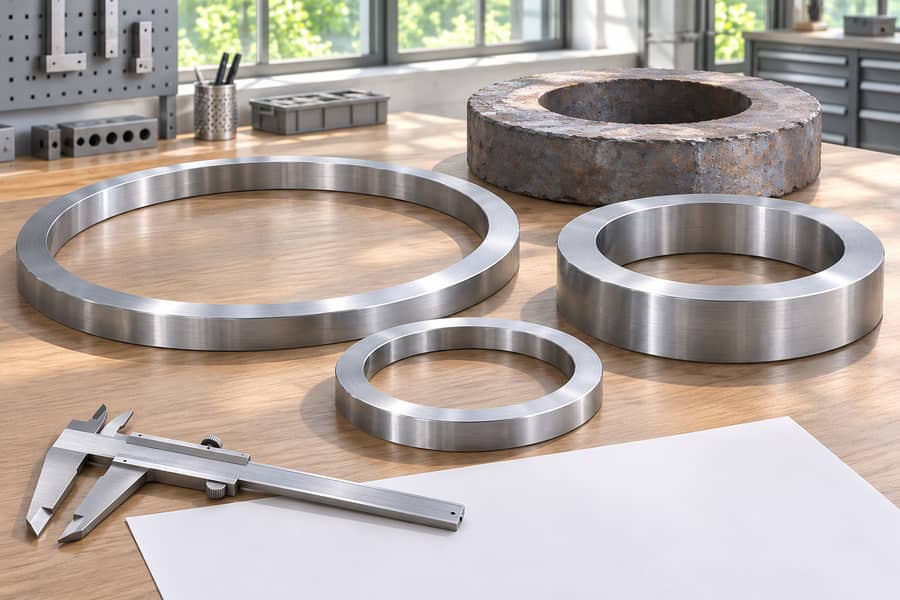
Seamless rolled ring manufacturing cost depends on more than finished ring weight. Quotes reflect stock consumed, the forming sequence, finishing work, acceptance checks, and the number of rings ordered.
Understanding how these items are allocated helps engineers compare prices on the same delivery and acceptance basis, rather than treating the lowest unit figure as the lowest total cost.
Where the Ring Manufacturing Budget Goes
A seamless rolled ring is formed from an annular preform that expands through radial and axial rolling. Manufacturing cost therefore covers material preparation, forming, specified thermal processing, finishing, inspection, and delivery preparation.
A typical route starts with billet cutting and heating, followed by upsetting and piercing to produce the preform. Ring rolling expands that preform; heat treatment and machining bring the component to its specified condition.
The ring forging services offered by Boberry provide a reference for this production sequence. Actual cost depends on the drawing, material, process plan, acceptance requirements, and delivery condition.
The main cost drivers can be grouped as follows:
| Cost driver | Variables to check | Why it affects cost |
| Material | Grade, billet weight, availability | Determines stock quantity and material rate |
| Geometry and yield | OD, ID, height, section, machining stock | Determines finished volume and gross stock |
| Forming | Heating, upsetting, piercing, rolling | Influences operation time and preparation |
| Tooling and setup | Plain or profiled section, equipment preparation | Adds fixed or project-specific charges |
| Finishing | Heat treatment and machining scope | Adds thermal processing and material removal |
| Quality | Dimensional checks, NDT, testing, records | Determines inspection effort |
| Quantity | Batch size and repeat orders | Spreads fixed costs over accepted parts |
How Ring Dimensions, Material, and Billet Yield Affect Material Cost
Ring Dimensions and Finished Weight
The drawing establishes the finished ring’s outside diameter (OD), inside diameter (ID), height, and cross-sectional profile, which determine the material volume remaining after forming and machining.
Subtract the bore diameter from the outside diameter and divide by two to obtain the radial thickness of a plain, concentric ring. Finished volume is the area of the outer circle minus the area of the inner circle, multiplied by height.
OD alone does not determine material consumption. A large-diameter ring with a narrow wall may weigh less than a smaller ring with a thicker section or greater height.
Profiled rings need a more detailed volume calculation because their cross-section varies. A drawing or three-dimensional model provides a better basis than a simple cylindrical approximation.
The custom forged rolled rings page describes plain and profile ring forms. Costing starts with finished geometry and the surfaces requiring machining.
Material Grade and Raw Stock
Material grade affects purchased-stock cost and the operations needed to form and finish the ring. A quotation for a plain-carbon grade cannot serve as a cost baseline for an alloyed or corrosion-resistant grade without reviewing the entire process.
Density changes the mass required for a given volume, so identical ring dimensions can produce different finished weights in different materials. Stock availability, billet dimensions, certification, and procurement quantity also affect purchasing costs.
Processing characteristics matter as well. Some alloys require closer control during heating and deformation, while their specified heat-treatment routes can add time, energy, handling, or testing.
Material substitution can change mechanical properties, corrosion performance, heat treatment, and acceptance requirements, not just billet cost.
Gross Billet Weight and Material Yield
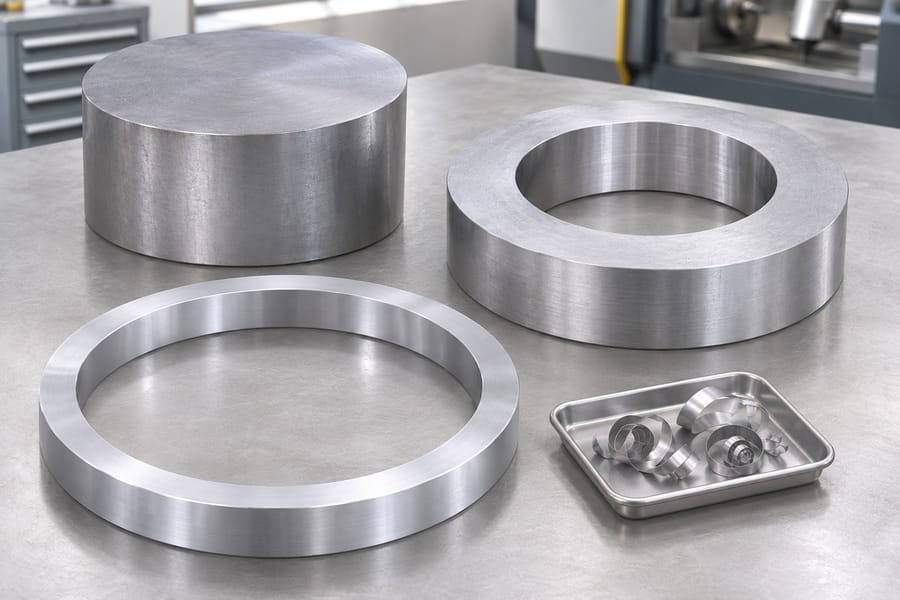
Finished ring mass is not the same as gross billet weight charged to the job. Material is removed or lost during cutting, heating, piercing, and machining, so starting stock must account for those stages.
A simple material-yield calculation compares finished component mass with gross billet mass consumed. If an 18 kg finished ring starts from a 30 kg billet, the illustrative yield is 60%.
The 12 kg difference may include the pierced centre, scale, cutting losses, and machining stock, not one recoverable scrap stream.
Distinguish three quantities when estimating material:
- Finished mass: Weight of the accepted ring at the agreed delivery condition.
- Gross stock consumption: Billet weight assigned to producing the ring before process losses and material removal.
- Recoverable scrap: Material that may receive a credit when the costing arrangement explicitly includes it.
Machining allowance increases gross stock requirements because material must remain for final dimensions. Excessive allowance also increases machining time; insufficient allowance may prevent cleanup of required surfaces.
Normal piercing losses, scale, and machining removal should be reflected in gross-stock or yield assumptions. Do not add them again as separate scrap charges unless a distinct additional expense is identified.
How Preform Preparation and Ring Rolling Affect Processing Cost
Billet Cutting and Heating
The billet is cut to a starting size that provides sufficient material for the annular preform and finishing. Cutting contributes equipment time, handling, and potentially material loss at the cut ends.
Heating cost depends on material grade, billet section, heating procedure, and production schedule. Temperature control supports the planned deformation; uneven heating can complicate material flow and dimensional control.
Heating expenses also include loading, movement, temperature monitoring, and coordination with forming equipment.
Upsetting and Piercing the Preform
Upsetting redistributes billet material and establishes a shape suitable for an annular blank. Piercing creates the central opening, leaving a preform with the basic geometry needed for rolling.
Preform OD, ID, height, and section proportions influence the reduction required during rolling. Starting dimensions poorly matched to the finished ring can make deformation and dimensional control more difficult.
Where substantial initial redistribution is required, open die forging may prepare the stock before piercing and ring rolling. This is a possible stage in a combined route, not automatically an alternative to ring rolling.
Identify whether cutting, heating, upsetting, piercing, and additional preform work are included, avoiding duplicate charges for the same preparation stage.
Radial and Axial Ring Rolling
Ring rolling expands an annular preform through incremental deformation between rolls. Radial rolling generally reduces radial cross-section while increasing diameter; axial rolling helps control ring height and section development.
Processing cost depends on the preform-to-finished geometry, reduction, section proportions, rolling sequence, handling, and adjustments.
Plain rectangular-section rings and profiled rings may require different roll arrangements and forming considerations. A changing cross-section can increase setup demands and make material-flow control more involved.
Ring rolling is distinct from longitudinal roll forging. Ring rolling enlarges an annular workpiece, whereas longitudinal roll forging changes the cross-section of an elongated component along its length.
How Tooling, Setup, and Order Quantity Affect Unit Price
Tooling for Plain and Profiled Rings
Tooling depends on the ring section and equipment arrangement. Plain rectangular-section rings may use a more straightforward roll configuration, while contoured or specially profiled rings can require additional forming considerations.
Mandrels, radial rolls, axial rolls, and supporting or guide components must suit the preform and intended deformation. Their selection is process-dependent; the drawing alone does not establish that every arrangement can produce the ring.
Show dedicated roll or mandrel preparation as its own quoted item, with a clear basis for recovering that expense. The quotation should state whether tooling is newly prepared, reused, or allocated across a defined order quantity.
Setup and Production Preparation
Setup may include preparing equipment, installing or adjusting tooling, positioning the workpiece, and establishing the forming sequence. A new design can require more preparation than a repeat order using an established process.
Trial forming or first-piece checks may confirm the preform and rolling sequence; include them only when required by the project.
Quantity and Tooling Allocation
Setup and tooling are often fixed or lot-level expenses. Dividing them by the number of accepted rings shows their contribution to unit cost.
For example, allocating $1,200 of tooling across 100 accepted rings contributes $12 per ring. Across 300 accepted rings, the same charge contributes $4 per ring.
Larger orders can reduce the fixed-cost share per component, but do not guarantee a lower total price. Material purchasing, scheduling, inspection, and finishing requirements may also change with quantity.
Repeat orders may reuse suitable existing tooling if the drawing remains compatible; confirm this assumption in the quotation.
How Heat Treatment, Machining, and Delivery Condition Affect Cost
Heat Treatment Requirements
Heat treatment depends on material grade, section thickness, and required mechanical properties. Normalizing, annealing, quenching and tempering, or other treatments may be appropriate according to the alloy and component specification.
These routes are not interchangeable. Austenitic stainless steels, for example, are not hardened by conventional quenching and tempering like many carbon and alloy steels. The quotation must follow the specified grade and condition.
Thermal processing cost can include furnace time, heating and cooling control, loading, unloading, handling, and verification. Ring section thickness and geometry influence the treatment plan and assessment of property uniformity.
Specified hardness or mechanical testing adds costs beyond treatment; identify the method, sampling location, and acceptance criteria.
Machining Allowances and Finishing
Rolled rings may require machining to achieve final OD, ID, height, profile, and surface condition. Compare the rolled envelope with the finished drawing to establish the volume that subsequent cuts must remove.
Typical operations include OD turning, ID boring or turning, face machining, and profile machining. Complex profiles or tighter dimensional requirements can increase machining time, measurement frequency, and setup needs.
Machining allowance has two cost effects: it increases gross material required before forming and increases material removal during finishing. Both effects should be reflected without charging the same loss twice.
The delivery condition must be stated precisely. An as-rolled ring, heat-treated ring, rough-machined ring, and precision-machined ring represent different scopes and are not directly comparable.
Delivery Scope
Identify whether heat treatment, machining, NDT, documentation, and packaging are included before dispatch.
This distinction matters when one supplier quotes a formed ring and another quotes a finished component. Before accepting a price advantage, check whether any required work has been left for the purchaser to arrange.
How Inspection, NDT, and Documentation Affect Forged Ring Cost
Dimensional and Surface Inspection
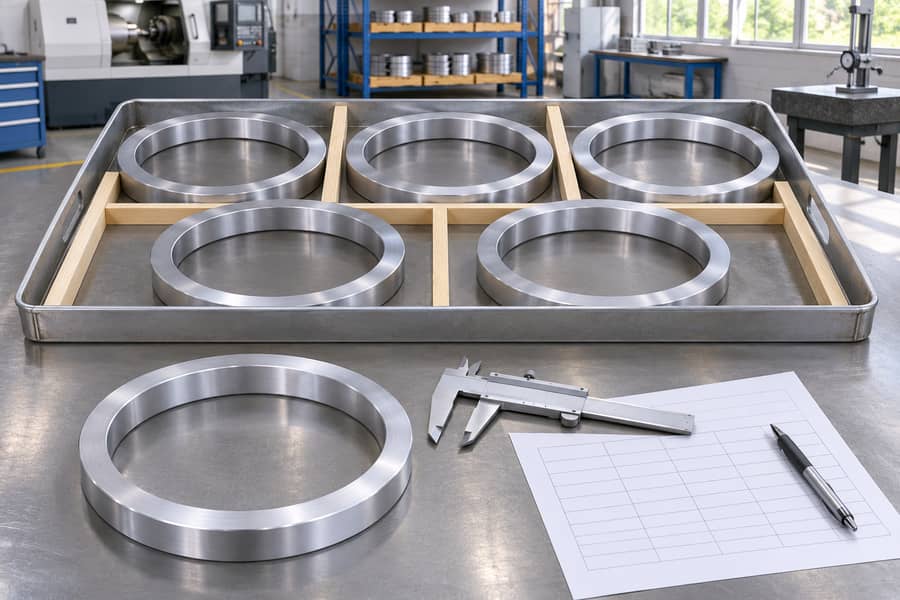
Inspection cost depends on the characteristics measured, required accuracy, and acceptance criteria. Basic OD, ID, and height checks differ from a report covering profile and geometric features.
On a large ring, a single diameter reading can miss variation around the circumference or between the upper and lower sections. Roundness, concentricity, flatness, and other characteristics should be checked when relevant to the drawing and agreed specification.
Visual inspection checks surface condition and visible discontinuities. Additional inspection should be linked to a defined requirement rather than included as an unspecified allowance.
Nondestructive Testing and Material Verification
Nondestructive testing adds preparation, inspection time, equipment, personnel, and reporting costs. The method and coverage depend on material, component geometry, and the discontinuities to be evaluated.
Ultrasonic testing may be specified for internal examination. Magnetic particle or liquid penetrant testing may be used for suitable surface or near-surface examination, subject to material and specification requirements.
These methods have different capabilities and are not interchangeable. The purchase specification should identify method, coverage, acceptance level, and reporting expectations.
Mechanical testing and material verification may also be required. Specimen quantity, sampling locations, and required properties influence the inspection scope.
Documentation and Traceability
Documentation may include material certificates, heat-treatment records, dimensional reports, NDT reports, and traceability records. Cost depends on the number of records, required format, and component-level identification.
Identify mandatory documents in the purchase specification; adding reports after production starts can require further verification.
Hypothetical USD Cost Calculation for 100 Accepted Forged Rings
The following example uses fictional USD assumptions to demonstrate one order’s cost allocation. It is not a Boberry quotation, market average, or price for any real date or region.
Assumptions and Cost Breakdown
Assume an order for 100 seamless rolled rings, all accepted, with no rejected components and no rework. Each ring uses a 30 kg billet and has an 18 kg finished mass.
The assumed material rate is $5 per kilogram. Material yield is 18 kg divided by 30 kg, or 60%. The cost categories below are illustrative and held constant for the calculation.
| Cost component | Assumed cost | Total for 100 rings |
| Billet material | $150/ring | $15,000 |
| Preform preparation and ring rolling | $90/ring | $9,000 |
| Heat treatment | $35/ring | $3,500 |
| Machining | $100/ring | $10,000 |
| Inspection and NDT | $25/ring | $2,500 |
| Documentation | $10/ring | $1,000 |
| Production setup | $800/lot | $800 |
| Tooling allocation | $1,200/lot | $1,200 |
| Total manufacturing cost | $430/ring | $43,000 |
Checking the Arithmetic and Boundaries
Billet material cost per ring is 30 kg multiplied by $5/kg, giving $150. For 100 rings, gross billet consumption is 3,000 kg and the assumed material charge is $15,000.
Finished mass is 18 kg multiplied by 100, or 1,800 kg. Dividing 1,800 kg by 3,000 kg gives a 60% material yield.
Recurring per-ring charges total $410: $150 material, $90 forming, $35 heat treatment, $100 machining, $25 inspection, and $10 documentation. Setup and tooling add $800 plus $1,200, or $2,000 per lot.
The total is $41,000 in recurring charges plus $2,000 in lot-level charges, equaling $43,000. Dividing by 100 accepted rings gives $430 per accepted ring.
The gross billet charge already reflects assumed normal material losses, including piercing and machining removal. No second scrap charge is added, and routine maintenance is included in the processing rate rather than charged again.
The example assumes no rejects or rework, and tooling is separately allocated. Freight, tax, installation, and profit margin are excluded; every amount is fictional and used only to explain the calculation.
How to Compare Forged Ring Manufacturing Quotes on an Accepted-Part Basis
Compare quotations against the same drawing, material, delivery condition, and acceptance requirements; otherwise, price differences may reflect different scopes.
Check whether each quotation identifies billet grade and gross-stock assumptions, preform preparation, ring rolling, heat treatment, machining, inspection, and documentation. Confirm which operations are included in the unit price and which are charged separately.
Tooling and setup should be identified with the quantity over which each charge is allocated. Confirm whether material cost uses gross billet consumption and whether normal process losses are already included.
Accepted-part cost is the applicable total order expenditure divided by the number of components accepted under the agreed criteria. If rejects or rework are possible, clarify their cost and replacement treatment before comparing offers.
For a clear RFQ, provide the information that determines the manufacturing route and delivery scope:
- Drawing: OD, ID, height, radial thickness, profile, and critical tolerances.
- Material: Grade, applicable standard, and required condition.
- Quantity: Initial batch size and expected repeat-order volume.
- Delivery condition: As-rolled, heat-treated, rough-machined, or precision-machined.
- Machining: Stock allowances, finished dimensions, and surface requirements.
- Quality: Dimensional inspection, NDT method and coverage, and mechanical testing.
- Records: Required evidence of stock identity, thermal processing, and completed acceptance checks.
- Commercial scope: Tooling allocation, setup charges, packaging, and delivery responsibilities.
These details allow Boberry to review the drawing and account for its material, forming, finishing, and inspection requirements.