
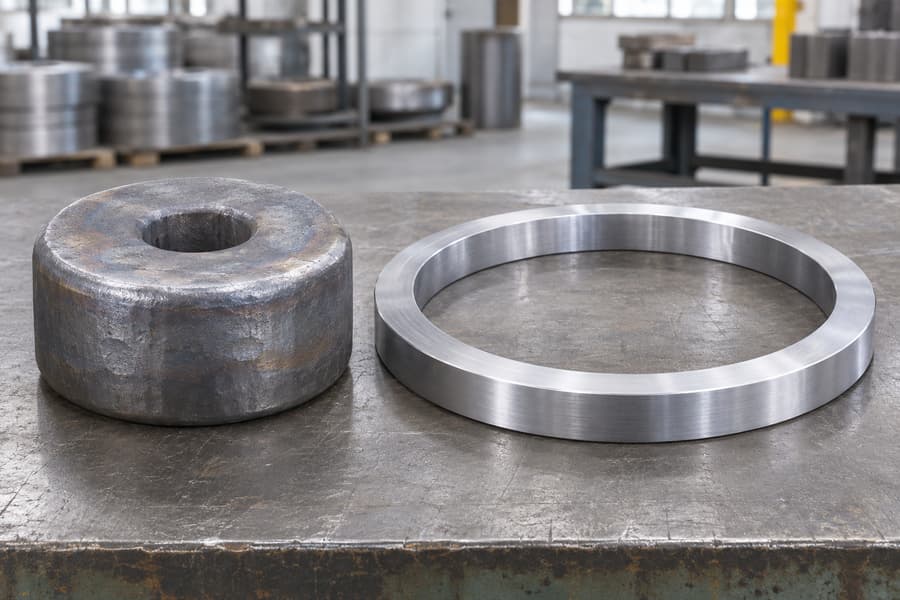
Open die forging shapes metal through repeated compression between open dies; ring rolling expands an annular preform through controlled radial and axial deformation.
The routes can overlap: open die forging may prepare a pierced preform for rolling, while mandrel forging can form a ring without rolling. Process selection depends on geometry, material condition, machining, and inspection requirements.
How Do Open Die Forging and Ring Rolling Work?
Both processes use compression, but their tooling and deformation sequences differ, affecting starting geometry, material movement, and downstream operations.
Working Between Open Dies
During open die work, each press stroke or hammer blow compresses part of the hot stock while surrounding surfaces remain free to move. A hammer or press applies successive blows or strokes while the workpiece is repositioned.
Unlike impression-die forging, the process does not use a closed cavity to establish the entire component shape. Die contact, workpiece manipulation, and forming sequence determine the developing geometry.
Common operations include:
- Upsetting:
Increasing cross-sectional area while reducing workpiece length. - Drawing out:
Reducing cross-sectional dimensions while extending the workpiece. - Piercing:
Creating an opening through solid stock to prepare a hollow or annular preform. - Mandrel forging:
Expanding and shaping a pierced opening through successive compression around a mandrel. - Repositioning:
Rotating or moving the workpiece to distribute deformation across required regions.
These operations support shafts, blocks, sleeves, and ring preforms. The achievable geometry depends on starting stock, tooling, and the selected deformation sequence.
Operators control reduction through the number and placement of strokes, workpiece rotation, and temperature management. These choices influence section uniformity and the amount of stock available for later machining.
For projects involving these components, Boberry’s open die forging services provide a reference for evaluating this route.
Ring Rolling Process
Ring rolling starts with a pierced annular preform positioned between a driven roll and mandrel, which progressively reduce its radial cross-section.
As the ring rotates under pressure, its diameter expands while radial wall thickness decreases.
Axial rolls may also control ring height and cross-sectional development, depending on equipment configuration and component geometry. Coordinating radial and axial reduction helps maintain the intended section as the ring grows. The required sequence depends on ring proportions and whether the profile is plain or shaped.
The main actions are radial rolling, which expands diameter while reducing wall thickness, and optional axial rolling, which controls height and section development.
Ring rolling suits annular components that can be developed through radial and optional axial deformation; machining may still be required.
Do not confuse ring rolling with longitudinal roll forging. Longitudinal roll forging forms elongated stock, whereas ring rolling expands an annular workpiece around its circumference.
How Open Die Forging Can Prepare a Ring-Rolling Preform
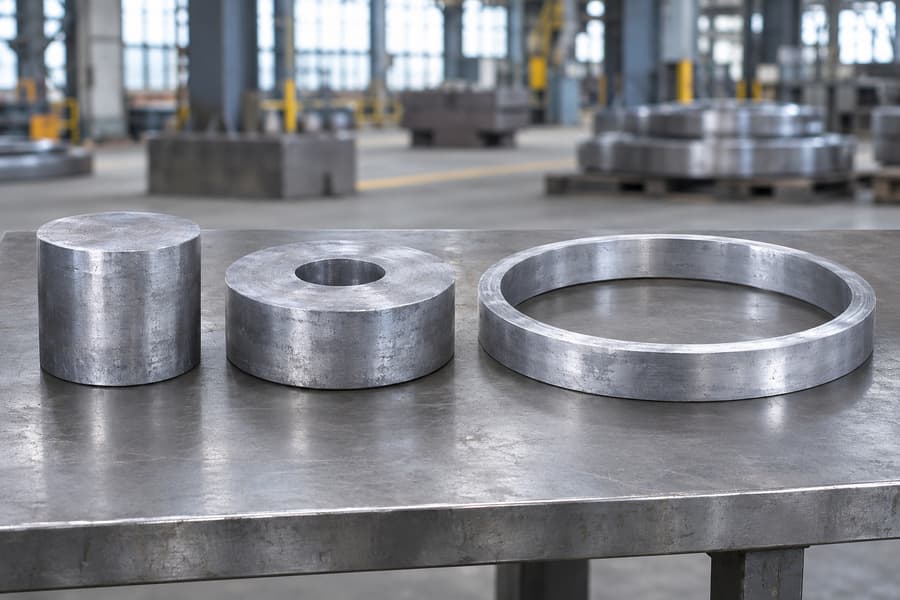
Open die forging and ring rolling are not always alternative routes. Open die operations can prepare the annular preform that is subsequently expanded and shaped by rolling.
A typical sequence is billet preparation, upsetting to establish the preform section, piercing to create the opening, preform conditioning, ring rolling, and specified downstream heat treatment, machining, and inspection.
Forging establishes the annular preform; rolling then develops its diameter and cross-section. The operations perform different functions within one route.
This sequence is not mandatory; starting stock, alloy, dimensions, and available equipment determine preform preparation. Some rings may instead be made by mandrel forging, while other projects may begin with a preform produced through a different suitable operation.
Mandrel forging is another way to produce rings, but it is not ring rolling. It shapes a pierced workpiece through successive localized compression around a mandrel rather than rolling contact between a driven roll and mandrel.
What Are the Main Engineering Differences?
Key differences include deformation, material movement, geometry, and tooling, which determine whether forging, rolling, or a combined sequence is appropriate.
Deformation Mechanism and Material Flow
Open die forging compresses selected regions of a workpiece. Repositioning between operations directs deformation toward the required shape.
Ring rolling applies incremental pressure as the annular preform rotates. Radial reduction expands the diameter, while axial rolls can influence height and cross-sectional development.
Material movement also differs: open die forging directs flow through upsetting, drawing, and piercing, while ring rolling redistributes material around the circumference as diameter expands.
Grain flow reflects starting material and deformation history; neither process guarantees isotropic properties or defect-free material.
Geometry and Component Suitability
Open die forging accommodates solid, stepped, hollow, and annular preforms. Ring rolling specializes in annular components formed through radial and optional axial deformation.
Typical open die forging applications
- Solid components:
Shafts, blocks, and sections that are not annular. - Variable cross-sections:
Components with diameter changes or transitions along their length. - Hollow components:
Sleeves and shapes requiring upsetting and piercing. - Ring preforms:
Annular starting shapes prepared for subsequent rolling. - Mandrel-forged rings:
Rings developed through successive forging operations.
Typical ring rolling applications
- Plain rings: Seamless annular components with relatively simple sections.
- Rectangular sections: Rings with defined radial wall thickness and axial height.
- Profiled rings: Components requiring a shaped cross-section.
- Dimensionally controlled rings: Components requiring coordinated control of diameter, height, and section.
Profiled rings may need specialized tooling; feasibility depends on profile complexity, material movement, and finishing. Deep grooves, shoulders, or changing section thicknesses can complicate roll contact and stock distribution, so the drawing must be assessed as a complete cross-section.
For annular projects involving preform preparation and subsequent rolling, Boberry’s ring forging services provide a relevant manufacturing reference.
Equipment, Tooling, and Process Control
Open die forging generally uses presses or hammers with open tooling. Workpiece handling and repositioning control where deformation occurs.
Ring rolling requires equipment that maintains the working relationship between the driven roll, mandrel, and optional axial rolls. Tooling must suit the preform and intended ring profile.
| Comparison factor | Open die forging | Ring rolling |
| Deformation method | Repeated compression | Incremental rolling |
| Starting workpiece | Billet, ingot, or forged preform | Pierced annular preform |
| Material movement | Localized upsetting and drawing | Radial and axial redistribution |
| Main geometry | Solid, hollow, and varied sections | Annular sections |
| Diameter development | Depends on forging sequence | Usually increases during rolling |
| Cross-section control | Successive forging operations | Radial and axial roll settings |
| Tooling | Open dies and handling equipment | Mandrel and rolling tools |
| Typical applications | Shafts, blocks, sleeves, and preforms | Plain and profiled rings |
Feasibility depends on press capacity, hammer energy, handling, roll geometry, heating, and tooling; nominal machine capacity alone is insufficient.
How Do Material Flow and Heat Treatment Affect Ring Quality?
Forming influences material distribution, while finished properties also depend on alloy, section thickness, cooling, and heat treatment.
Material Deformation and Grain Flow
Open die forging changes workpiece geometry through compression, influencing grain orientation according to the deformation sequence. Upsetting, drawing, and piercing create different local flow patterns.
Ring rolling develops circumferential deformation as the preform rotates. Radial reduction and axial compression influence material distribution across the ring section.
Grain-flow orientation alone does not establish finished properties; inclusions, segregation, and internal discontinuities also affect quality.
Review starting material condition, reduction distribution, temperature, and preform geometry.
Material Selection and Deformation Requirements
Carbon, alloy, and stainless steels may suit either route, depending on grade, forming behavior, and service conditions.
Alloy composition affects hot-working, hardenability, and heat-treatment response; section thickness influences heating and cooling.
Material evaluation should address:
- Hot-working characteristics: Deformation behavior within the selected processing temperature range.
- Hardenability: Response to hardening through different section thicknesses.
- Corrosion requirements: Environmental exposure and required corrosion resistance.
- Mechanical properties: Specified strength, toughness, hardness, and other acceptance criteria.
The same alloy can produce different material conditions under different deformation and cooling histories.
Heat Treatment and Mechanical Properties
Heat treatment follows forming when required by the material specification and application. The selected thermal cycle targets the microstructure and property range specified for the component.
Common treatments include normalizing, annealing, and quenching and tempering for suitable steel grades. The appropriate route depends on composition, section size, and required properties.
Heat treatment can influence hardness, tensile strength, toughness, and residual stress. It cannot automatically correct every variation or discontinuity introduced during forming.
Rings of the same alloy may respond differently when section thickness, deformation history, or cooling conditions differ. Mechanical testing should follow the agreed specification, including sampling location and orientation where relevant.
Heat-treatment planning must account for the thickest and thinnest sections because temperature equalization and cooling rates may vary across the component.
Dimensional Accuracy, Machining Allowances, and Inspection
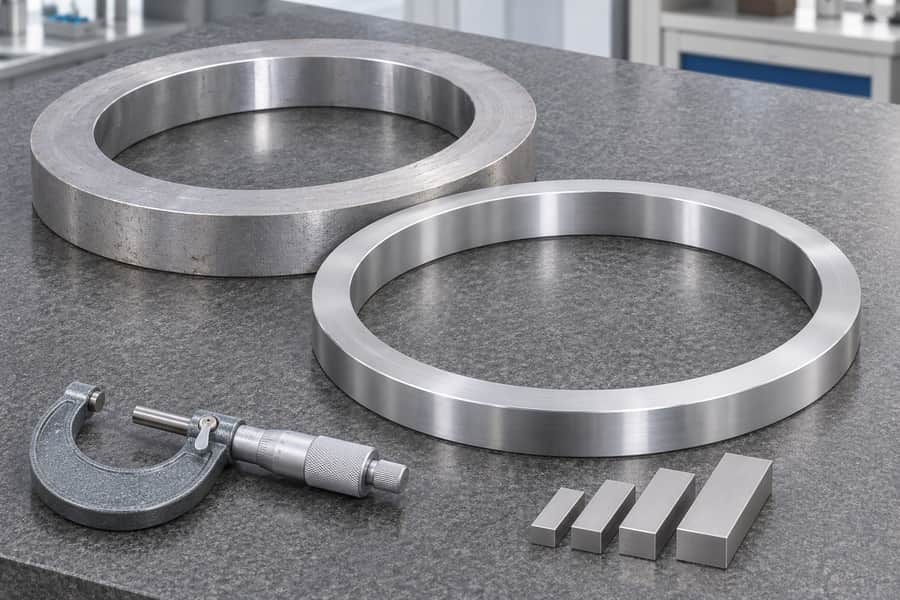
Forged and rolled dimensions are not necessarily finished dimensions; machining allowances and inspection belong in manufacturing planning.
Dimensional Control of Forged and Rolled Rings
Open die dimensions depend on compression, workpiece manipulation, die contact, and operation sequence.
Ring dimensions depend on roll positioning and radial or axial reduction.
Critical dimensions include outer and inner diameter, ring height, radial wall thickness, cross-sectional profile, roundness, and concentricity.
Achievable tolerances depend on component size, material, equipment, tooling, and process control; no single range applies to every ring.
Machining Requirements and Finished Dimensions
Forged and rolled components commonly require machining to reach drawing dimensions and surface requirements.
Forming must leave enough finishing stock without creating unnecessary material removal.
A closely controlled bore may need stock for boring, while machined faces need sufficient axial allowance.
Define datums, stock distribution, profile requirements, and measurement methods so forming supports the finishing plan.
Inspection and Quality Acceptance
Inspection verifies material, dimensional, and quality requirements using methods suited to the geometry and application.
Typical inspection activities include:
- Visual inspection: Checking accessible surfaces for visible cracks, laps, and other irregularities.
- Dimensional inspection: Measuring diameter, height, wall thickness, roundness, and relevant profiles.
- Ultrasonic testing: Evaluating internal material conditions where specified.
- Mechanical testing: Verifying tensile properties, hardness, or impact performance as required.
- Material verification: Confirming grade identification and traceability.
Testing coverage and acceptance criteria follow project specifications; dimensional checks do not replace required internal testing.
How Should Engineers Select the Manufacturing Route?
Select the route by geometry and manufacturing sequence, distinguishing solid forgings, forged rings, and rolled annular components.
When Open Die Forging Is Suitable
Consider open die forging when flexible deformation is needed rather than dedicated annular rolling.
Typical situations include:
- Solid components: Shafts, blocks, and sections that ring rolling cannot produce.
- Variable cross-sections: Components with diameter changes or transitions along their length.
- Hollow components: Sleeves and shapes requiring upsetting and piercing.
- Ring preforms: Annular starting shapes prepared for subsequent rolling.
- Mandrel-forged rings: Components developed through localized forging operations.
Select the sequence to suit material and dimensional requirements.
When Ring Rolling Is Suitable
Ring rolling suits annular components benefiting from radial and axial deformation, including plain, rectangular-section, and selected profiled rings.
Boberry’s custom forged rolled rings provide a reference for evaluating plain and profile ring requirements against component drawings.
Evaluate annular geometry, preform, diameter, profile, machining allowance, and roll access.
A circular shape alone does not establish suitability; the preform and deformation path must work.
When a Combined Manufacturing Route Is More Appropriate
Some components require open die forging followed by ring rolling because the operations address different forming stages.
Open die forging establishes the initial annular shape through upsetting and piercing. Ring rolling then expands the preform and develops its cross-sectional geometry.
This route may suit starting stock that requires preform preparation before rolling.
Mandrel forging provides another route. It produces an annular component through localized compression without requiring subsequent ring rolling.
Compare preform preparation, forming, machining, and quality requirements across the complete route.
Production Quantity and Total Manufacturing Cost
Total cost includes preform preparation, setup, material utilization, heat treatment, machining, and inspection.
Open die forging may require repeated handling; ring rolling needs suitable equipment and a prepared preform.
Order quantity changes the effect of setup and tooling costs; material use and downstream processing also matter.
A practical cost review should include:
- Material utilization: Starting stock, machining allowance, and process losses.
- Equipment requirements: Press or hammer operations compared with ring rolling equipment.
- Preform preparation: Upsetting, piercing, and intermediate handling.
- Secondary processing: Heat treatment, machining, and surface finishing.
- Inspection: Testing methods, documentation, and acceptance requirements.
- Production planning: Setup, processing sequence, and scheduling.
| Component requirement | Potential manufacturing route | Main evaluation factors |
| Solid shaft or block | Open die forging | Section geometry and deformation sequence |
| Plain seamless ring | Ring rolling | Preform preparation and diameter requirements |
| Profiled annular component | Ring rolling | Cross-sectional profile and machining |
| Ring requiring substantial preform deformation | Open die forging followed by ring rolling | Preform geometry and material distribution |
| Ring suitable for direct mandrel forming | Mandrel forging | Geometry and dimensional requirements |
Compare total finished-component cost rather than assuming either forming operation is universally cheaper. A route with an additional preform operation may still be practical if it supports the required geometry or reduces difficult downstream work; the comparison must use the same finished scope.
What Should Engineers Specify in an RFQ?
An RFQ should provide the drawing, material specification, and acceptance requirements needed to evaluate the route.
Drawing and Material Requirements
Drawings should identify finished dimensions, including ring diameters, height, wall thickness, and cross-sectional profile.
Specify material grade, applicable standard, delivery condition, and required heat treatment.
Include critical tolerances, machining allowances, material grade, heat-treatment condition, and relevant service requirements.
Manufacturing Route and Quality Requirements
Identify whether the route uses open die forging, mandrel forging, ring rolling, or a combination; confirm preform compatibility.
Specify dimensional inspection, mechanical testing, NDT, traceability, documentation, and acceptance criteria. Identify any required inspection hold points and whether testing applies before or after heat treatment and machining.
Manufacturing Feasibility Review
The supplier should review the drawing for conflicts between preform geometry, machining, and inspection.
Review equipment suitability, deformation sequence, machining stock, and finished-dimension feasibility.
Compare proposed routes against the same technical and acceptance requirements.
Boberry Machining can review the drawing, material specification, forming sequence, and finished inspection requirements when evaluating a suitable manufacturing route.