
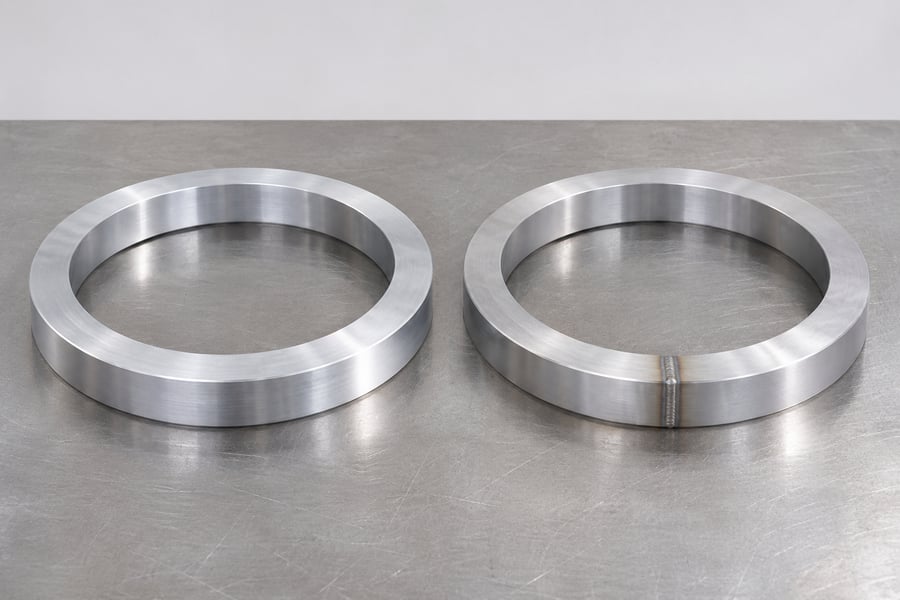
Seamless rolled ring forging forms an annular component through upsetting, piercing, and ring rolling. A welded ring bends suitable stock into a circle and joins its ends with a closure weld.
Selection depends on geometry, material condition, loading, fatigue, inspection, production volume, and applicable codes. Neither route is universally superior.
What Are Seamless Rolled Rings and Welded Rings?
What Is Seamless Rolled Ring Forging?
Seamless rolled ring forging produces an annular component without a welded joint. It starts with a heated billet that undergoes controlled plastic deformation through three main operations:
- Upsetting: Compressing the billet to increase its cross-sectional area and establish suitable proportions.
- Piercing: Creating a central opening to form an annular preform.
- Ring rolling: Compressing the preform between dies, increasing its diameter while controlling the cross-section.
As the ring expands, material flows around the circumference. The forming sequence influences grain orientation, microstructure, and the final dimensions.
Rings may have plain rectangular or profiled sections, depending on material, forming sequence, tooling, and machining allowance.
Heat treatment, machining, and inspection establish the required material condition and finished geometry.
For an overview of the process and related manufacturing options, see Boberry’s ring forging services.
What Is a Welded Ring?
A welded ring is produced by bending suitable metal stock into an annular shape and joining its ends. Depending on the design, the stock may be plate, flat bar, or another form that can be shaped and welded.
The typical sequence includes:
- Stock preparation: Cutting material to size and preparing the joint edges.
- Bending: Forming the stock into a circular or specified annular shape.
- Fit-up: Aligning the bent ends and establishing the required joint preparation.
- Welding: Joining the ends with a qualified procedure and compatible filler metal where required.
- Finishing: Removing excess weld reinforcement where specified and correcting dimensions through machining.
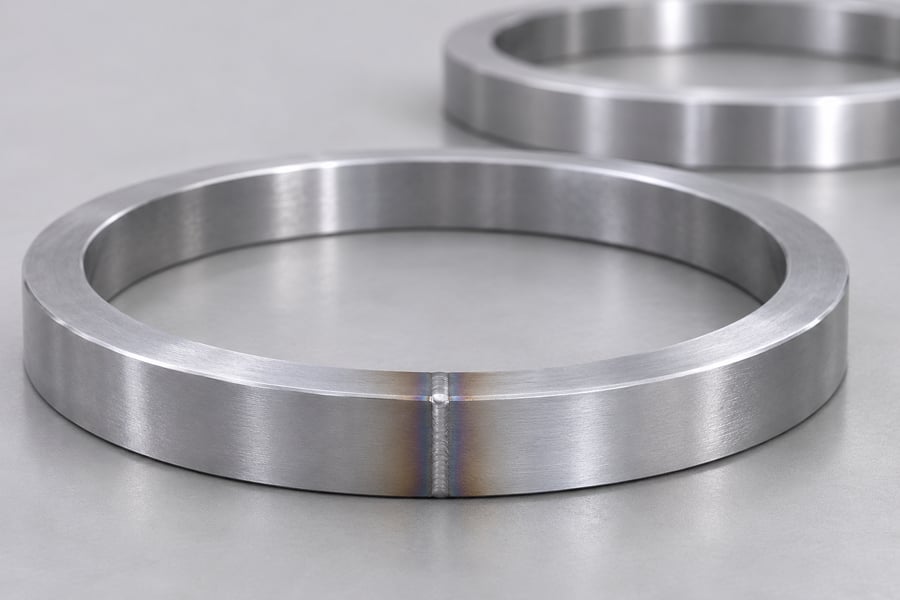
The closure weld joins the bent stock ends and normally crosses the ring section. It creates a local welded joint, not a weld running around the ring’s circumference.
Welded-ring feasibility depends on stock availability, equipment, joint design, welding procedure, and any post-weld treatment.
The Fundamental Manufacturing Difference
Seamless ring forging shapes a continuous billet through plastic deformation. Welded-ring manufacturing bends stock and joins its ends, creating a distinct weld region.
That difference affects material structure, defect locations, inspection methods, and production planning. A seamless ring can contain forging defects, while a properly designed and qualified welded ring can meet demanding requirements.
Material Continuity, Weld Zones, and Residual Stress
Material Flow in Seamless Rolled Rings
During ring rolling, the billet undergoes plastic deformation as the annular preform expands. The resulting structure reflects billet quality, deformation, temperature history, and subsequent processing.
Grain flow generally follows the deformation pattern rather than being interrupted by a welded joint. This can benefit components whose geometry and loading are compatible with the resulting material orientation.
Initial material cleanliness, deformation, temperature control, and heat treatment influence quality. Potential imperfections include laps, folds, cracks, and internal discontinuities.
Weld Metal and the Heat-Affected Zone
Welding creates distinct metallurgical regions that engineers must consider:
- Base metal: Original stock outside the weld’s thermal influence.
- Weld metal: Deposited material forming the joint, potentially combined with melted base metal.
- Heat-affected zone (HAZ): Adjacent base metal whose microstructure or properties change during the welding thermal cycle.
Although the HAZ does not melt, its thermal exposure can alter grain structure, hardness, and toughness. Effects depend on grade, thickness, heat input, and cooling.
Possible weld imperfections include porosity, incomplete fusion, lack of penetration, cracking, and slag inclusions where applicable. Procedure controls help reduce these risks; examination verifies the completed joint against specified acceptance criteria.
Residual Stress and Distortion
Both routes can leave residual stresses, but their origins and distributions differ. Welding produces localized heating and cooling, which can cause uneven expansion, contraction, and weld shrinkage.
Distortion can affect diameter, circularity, face alignment, and local geometry. Fit-up and welding sequence influence its direction and extent.
Seamless rings can also retain stresses from forming, cooling, heat treatment, and machining. Stress relief may suit either route, depending on material and service requirements, but treatment can also change dimensions and properties.
| Comparison factor | Seamless rolled ring | Welded ring |
| Manufacturing method | Upsetting, piercing, and ring rolling | Bending and welding |
| Material structure | Deformed continuous billet | Base metal, weld metal, and HAZ |
| Weld region | No welded joint | Closure weld joining bent stock ends |
| Residual stress | Influenced by forming and heat treatment | Influenced by welding and subsequent treatment |
| Main quality concerns | Forging discontinuities and material integrity | Weld imperfections and joint integrity |
| Dimensional control | Rolling, heat treatment, and machining | Bending, fit-up, weld distortion, and machining |
Mechanical Performance and Fatigue Qualification
Mechanical Properties and Load Distribution
Mechanical performance depends on material grade, heat treatment, section dimensions, manufacturing quality, and operating conditions. Joint construction belongs in the assessment alongside the alloy, section size, and intended service.
Tensile and yield strength do not independently establish fatigue resistance. In seamless rings, deformation history and grain orientation can influence directional properties.
In welded rings, base metal, weld metal, and HAZ may differ in hardness, toughness, and strength. Geometry, support conditions, and joint location also affect load distribution and stress concentrations.
Fatigue Under Cyclic Loading
Fatigue matters when a ring experiences repeated loading, vibration, rotation, or fluctuating operating forces. In welded rings, weld toes, roots, and changes in joint geometry can create local stress concentrations and potential fatigue initiation sites.
Weld imperfections, residual stresses, surface condition, and alignment influence fatigue according to stress range, joint detail, loading direction, and service environment.
Seamless rolled rings eliminate the closure weld and its associated weld-toe and HAZ considerations. However, fatigue performance still depends on material quality, surface finish, internal integrity, geometry, and loading. Forging laps, inclusions, and machining marks can also initiate fatigue cracks.
Why Tensile Strength Is Not a Fatigue Ranking
A fair comparison requires equivalent material grades or justified equivalents, delivery conditions, geometries, and loading. Comparing nominal tensile strength alone can conceal important differences.
For welded construction, fatigue assessment may require joint-detail classification, welding procedure qualification, inspection results, and design-code provisions. Procedure qualification establishes controlled production parameters; it does not prove fatigue performance for every joint detail.
For forged rings, assess material condition, forging quality, and surface condition. Fatigue-critical service may require design calculations and qualification evidence for the actual loading.
Material Selection and Process Compatibility
Materials for Seamless Rolled Ring Forging
Seamless rolled rings can use different material families when the grade and section geometry suit the forming route:
- Carbon steel:
Used where specified strength, toughness, and other mechanical requirements can be achieved. - Alloy steel:
Selected when hardenability, strength, or other specified properties are required. - Stainless steel:
A candidate where the actual operating medium or temperature calls for a suitable stainless grade. - Other alloys:
Evaluated according to hot workability, availability, and process qualification.
Hot workability governs deformation without unacceptable cracking. Hardenability matters when heat treatment must achieve required properties through the section thickness.
Final properties depend on chemistry, deformation, cooling, heat treatment, and dimensions. Not every grade suits every ring size or route.
Materials for Welded Rings
Welded rings use carbon steels, alloy steels, stainless steels, and other weldable materials. Weldability varies with grade, thickness, and joint design.
Important considerations include:
- Filler-metal selection: Match deposited metal to required joint properties and service conditions.
- Preheating: Certain materials and thicknesses require controlled preheating to reduce cracking risks.
- Heat input: Welding parameters influence the thermal cycle and HAZ properties.
- Post-weld treatment: Some applications require stress relief or another specified treatment.
Nominal strength does not establish weldability. High-strength alloy steels may require carefully controlled procedures, while stainless grades differ in welding behavior and corrosion performance.
Making a Fair Material Comparison
Compare specified grades and standards, not broad labels. Similar compositions may have different mechanical requirements and processing conditions.
Review chemistry, mechanical properties, heat-treatment condition, corrosion requirements, and traceability. Then evaluate whether the material is suitable for forging or welding in the required section size.
Dimensional Control, Heat Treatment, and Machining
Dimensional Accuracy and Geometry
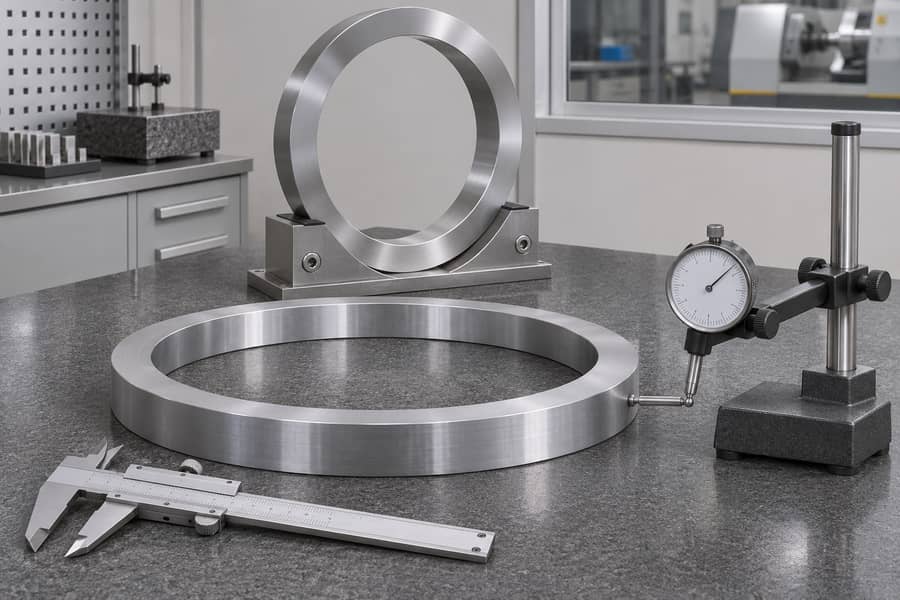
Both routes must meet drawing dimensions. Key characteristics include diameters, height, wall thickness, roundness, concentricity, flatness, and cross-sectional profile.
Ring-rolling control depends on billet preparation, die alignment, temperature, and deformation. Welded rings add springback, end alignment, and weld shrinkage.
Machining allowance must cover variation after forming and heat treatment. Insufficient stock can prevent surface cleanup or leave dimensions outside tolerance.
Heat Treatment Requirements
Heat treatment establishes or modifies properties according to the selected grade and required delivery condition. Forged rings may require normalizing, annealing, quenching and tempering, or another grade-specific treatment.
Welded rings may require stress relief or post-weld heat treatment when specified by material requirements, design code, or project specification. Such treatment can reduce residual stresses or achieve a required metallurgical condition.
Not every welded ring requires post-weld heat treatment, and not every forged ring requires quenching and tempering. The specification should identify the final condition and records.
Establishing the Finished Ring Interfaces
Either starting form can pass through an initial stock-removal stage before the critical interfaces receive their final cuts. Typical operations include turning inner and outer diameters, facing axial surfaces, and producing specified grooves or profiles.
For seamless rings, machining removes scale and excess stock while establishing final dimensions. For welded rings, it may also remove weld reinforcement where required and create consistent finished surfaces across the joint area.
Key requirements include:
- Datums: Identify reference surfaces for machining and measurement.
- Stock allowance: Provide enough material to clean up surfaces and correct expected variation.
- Surface finish: Specify the finish required for contact, sealing, or assembly.
- Final dimensions: Verify drawing-critical dimensions after finishing.
Machining cannot correct internal defects or an unacceptable material condition; these require manufacturing controls and inspection.
Inspection, Testing, and Quality Acceptance
Inspection of Seamless Rolled Rings
Inspection focuses on material identity, forging integrity, dimensions, and specified mechanical properties. The plan depends on component size, grade, geometry, and applicable standards.
Methods include visual examination, specified ultrasonic testing, and suitable magnetic particle or penetrant testing.
Mechanical testing may verify tensile, impact, or other specified properties. Heat-treatment records and material certificates provide evidence of material identity and processing condition.
Examination coverage and methods should suit critical areas, material, geometry, and likely discontinuities.
Inspection of Welded Rings
Welded rings require examination of parent material and completed joint. Visual inspection checks weld appearance, dimensions, surface condition, and visible imperfections.
Radiographic or ultrasonic testing may examine suitable internal discontinuities; magnetic particle or penetrant testing may identify surface defects. Selection depends on material, thickness, geometry, and code.
Welding procedure and personnel qualification records support process control but do not replace examination results.
Standards and Acceptance Documentation
Forged-product inspection and weld-joint examination address different manufacturing risks. Acceptance criteria should follow the governing design code, material standard, purchase specification, and project requirements.
Quality records may include material certificates, heat-treatment records, mechanical tests, welding documents, dimensional reports, and NDT results.
Agree inspection extent, sampling, and acceptance criteria before production.
Production Economics and Total Manufacturing Costs
Material and Initial Manufacturing Costs
Initial cost depends on material, dimensions, quantity, equipment, and process complexity. Seamless ring forging requires suitable billet stock, heating, forming operations, and potentially dedicated tooling.
Welded-ring production may require plate or bar cutting, edge preparation, bending, fit-up, welding consumables, and fabrication labor.
Material utilization varies: forging may involve billet and machining losses, while welding may involve cutting waste and joint preparation.
Other cost drivers include setup, tooling, material availability, and quantity. Large or unusual profiles can constrain either route.
Secondary Processing and Quality Costs
Both routes may require heat treatment, machining, finishing, dimensional verification, and mechanical testing. Welded rings may add joint preparation, weld examination, stress relief, or distortion correction.
Seamless rings may require substantial machining depending on the starting profile and finished geometry. Inspection costs depend on methods, coverage, acceptance criteria, and documentation.
Rework, weld repair, or rejection can affect cost and delivery.
Comparing Cost per Accepted Ring
Compare complete manufacturing routes rather than individual operation prices. Include material, forming or fabrication, heat treatment, machining, inspection, and rework.
Production yield matters because the lowest initial processing cost does not necessarily produce the lowest cost per accepted component. Setup and tooling costs may also be distributed differently across order quantities.
A useful quotation comparison holds finished dimensions, material requirements, testing scope, and documentation constant. Otherwise, price differences may reflect different manufacturing scopes rather than process savings.
Applications, Process Selection, and Drawing Review
When to Consider Seamless Rolled Rings
Seamless rolled rings are worth evaluating when material continuity is a design priority or a closure weld is undesirable. Typical applications include rotating equipment, bearing-related components, heavy industrial machinery, gear-related blanks, and annular parts with plain or profiled cross-sections.
For fatigue-sensitive components, eliminating the closure weld removes one potential fatigue-sensitive detail, but material quality, geometry, and qualification still matter.
When to Consider Welded Rings
Welded rings are candidates when the design permits a qualified joint and fabrication can meet required standards. They may suit fabricated structures, large annular assemblies, and projects using available plate or bar stock.
Fabrication flexibility can suit the geometry and production plan. Consider joint location, inspection access, service loading, and post-weld treatment.
Selecting the Manufacturing Route
Start with functional requirements rather than a general preference for forging or welding. Determine whether the design permits a welded joint and whether applicable codes restrict the manufacturing route.
Compare dimensions, profile, stock availability, and forming feasibility alongside loading, service conditions, fatigue, and inspection access.
| Project requirement | Route to evaluate | Key considerations |
| Material continuity is specified | Seamless rolled ring | Forging quality and material qualification |
| Welded construction is permitted | Both routes | Code requirements and joint acceptance |
| Fatigue-critical service | Both routes | Fatigue data, loading, and manufacturing quality |
| Large diameter or heavy section | Both routes | Stock availability and manufacturing feasibility |
| Complex annular profile | Seamless rolled ring | Rolling feasibility and machining requirements |
| Suitable plate or bar stock is available | Welded ring | Formability, weldability, and joint design |
| High production volume | Both routes | Setup, tooling, yield, and production efficiency |
Drawing and Purchase Requirements
A manufacturing review begins with a drawing identifying finished dimensions, material grade, applicable standard, delivery condition, tolerances, datums, and surface requirements.
Specify operating loads, temperature, pressure, mechanical properties, and applicable codes to establish manufacturing and inspection requirements.
For quotation, identify machining allowances, heat-treatment condition, NDT methods and coverage, mechanical testing, acceptance criteria, traceability, and required documentation. Separating final tolerances from machining stock prevents ambiguity.
Boberry can review supplied drawings and material requirements to assess seamless rolled ring forging feasibility. The review should connect stock, forming geometry, heat treatment, machining, and inspection.
For project-specific annular components, see Boberry’s custom forged rolled rings. A clear technical specification gives engineering and purchasing teams a consistent basis for evaluating the proposed route, quotation scope, and final component acceptance.