
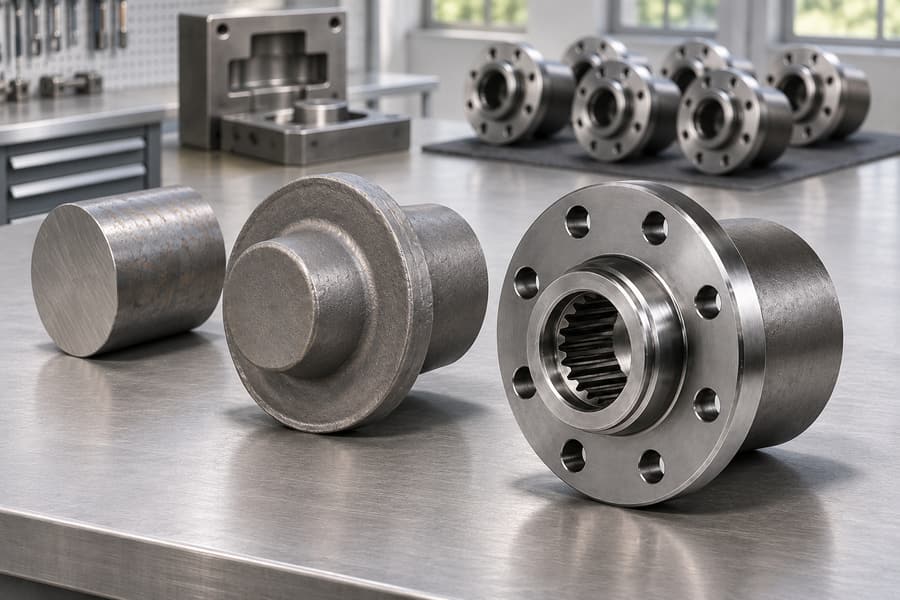
Closed die forging cost depends on material, geometry, die development, production quantity, and required finishing. A low unit price may exclude tooling, machining, testing, or other necessary work.
Engineers and buyers should compare complete manufacturing routes, distinguish recurring costs from upfront charges, and confirm exactly what condition each quoted component will reach before delivery.
What Are the Main Cost Components of Closed Die Forging?
Closed die forging involves several manufacturing stages, each contributing to the final component cost. Understanding fixed, variable, and order-specific expenses helps buyers assess quotations accurately.
Fixed and Upfront Costs
Fixed costs arise before or during production preparation. They generally include die development, tooling manufacture, engineering work, and production setup.
These expenses do not increase directly with every additional component. However, their allocation significantly affects unit prices, particularly when order quantities are relatively small.
Typical upfront expenses include:
- Die engineering: Designing cavities, parting surfaces, and forming sequences.
- Tooling manufacture: Producing and preparing dies for the specified geometry.
- Process development: Establishing suitable forming conditions and manufacturing procedures.
- Production setup: Installing tooling, adjusting equipment, and verifying initial production conditions.
Complex components may require additional engineering or multiple forming stages, increasing preparation expenses before regular production begins.
Variable Manufacturing Costs
Variable costs generally increase with production quantity because each component consumes material, processing time, energy, and manufacturing resources.
Material purchase, billet cutting, heating, deformation, trimming, and handling contribute directly to production expenses. Additional operations depend on the specified delivery condition.
Common variable costs include:
- Raw material and billet preparation
- Heating and forging operations
- Flash trimming and cleaning
- Heat treatment when required
- Machining and finishing
- Inspection and testing
Actual variable cost also depends on process yield. Rejected components consume resources without contributing to the accepted production quantity.
Order-Specific and Additional Costs
Some expenses depend on purchasing requirements rather than the basic forging process. Special inspection, packaging, documentation, and delivery arrangements may generate additional charges.
Engineering modifications after tooling approval can also change the quotation. Buyers should distinguish these charges from the original manufacturing scope.
| Cost category | Typical expenses | Main pricing influence |
| Material | Stock purchase, cutting, preparation | Material grade and billet weight |
| Tooling | Die design, manufacture, maintenance | Complexity and production volume |
| Forging | Heating, forming, trimming | Processing time and difficulty |
| Secondary processing | Heat treatment, cleaning, machining | Finished-part requirements |
| Quality control | Inspection, testing, documentation | Acceptance specifications |
| Order-specific costs | Setup, packaging, delivery | Order terms and scope |
How Do Material Selection and Billet Requirements Affect Cost?
Material selection influences more than the purchase price of metal. It also affects heating conditions, deformation behavior, processing efficiency, and the manufacturing route.
Material Grade and Purchase Price
Carbon steel, alloy steel, and stainless steel can have different procurement costs and forging requirements. However, individual grades must be evaluated against their specifications.
Alloy chemistry influences hot workability, temperature control, and potential post-forging treatment. The stock premium may be only part of the difference: extra temperature control, slower forming, or difficult cutting can add further expense.
Buyers should assess:
- Required mechanical properties
- Corrosion and temperature resistance
- Material availability and stock dimensions
- Forging temperature requirements
- Subsequent heat treatment and machinability
The material specification should match the intended service environment rather than introduce unnecessary processing complexity or excessive performance requirements.
Billet Size, Weight, and Material Utilization
Closed die forging begins with prepared material stock. The starting billet must provide sufficient volume for cavity filling, flash formation where applicable, and subsequent machining allowances.
A forged component’s starting weight may exceed its finished weight substantially, depending on geometry and the selected manufacturing route.
For example, a gear blank requiring extensive machining may consume more starting material than a design that retains more as-forged surfaces.
Material utilization can be improved through appropriate billet sizing, die design, and manufacturing planning. However, reducing starting material excessively can create incomplete filling or other defects.
Material Waste and Scrap Costs
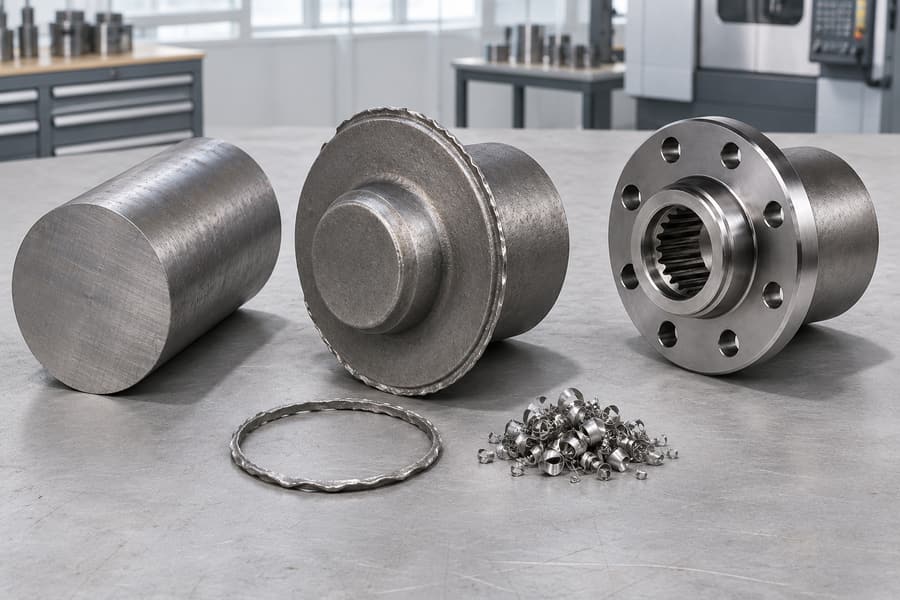
Material losses occur during cutting, flash trimming, and machining. Rejected forgings can increase consumption further because the original billet and processing resources have already been used.
Some manufacturing scrap may have recoverable value, but this depends on material segregation, collection arrangements, and applicable recycling conditions.
An accurate material estimate should consider starting stock consumption, expected waste, recovery credits where relevant, and the number of accepted components.
How Do Part Geometry and Forging Complexity Influence Pricing?
Part geometry determines the difficulty of forming metal inside shaped dies. Two components with similar finished weights can have very different manufacturing costs.
Part Size, Shape, and Section Changes
Component dimensions influence required billet volume, die size, handling arrangements, and forming demands. Complex geometries can also increase tooling development work.
Features that may increase manufacturing difficulty include:
- Deep recesses or narrow cavities
- Thin sections requiring reliable filling
- Abrupt changes in cross-sectional area
- Asymmetric shapes
- Complex parting-line arrangements
Custom shafts, flanges, couplings, gear blanks, and connecting rods illustrate different geometry requirements. Their costs cannot be compared reliably using finished weight alone.
A relatively simple flange may require fewer forming features than an intricate connecting rod, although actual manufacturing difficulty depends on the complete specification.
Forging Sequence and Manufacturing Difficulty
Some components can be formed through a relatively straightforward sequence. Others require intermediate preforming to distribute material before final cavity filling.
Additional forming stages increase handling and processing demands. They may also require dedicated tooling features or separate die operations.
Manufacturing engineers must consider material flow, cavity filling, die loading, and achievable geometry. The selected process should balance technical feasibility with production efficiency.
Design for Manufacturability
Design decisions made before die manufacture can significantly influence costs. Appropriate draft angles, fillet radii, and section transitions support more practical forging operations.
An unnecessarily complicated forged feature may be cheaper to produce through machining, provided the alternative satisfies functional and material requirements.
Design reviews should focus on:
- Draft angles: Supporting component release from suitable die configurations.
- Fillet radii: Reducing unnecessarily sharp transitions and supporting material flow.
- Parting lines: Considering die construction, flash formation, and component removal.
- Machining allowances: Providing sufficient stock without excessive removal.
- Critical features: Preserving dimensions and geometry essential to component performance.
Design simplification must not compromise load paths, required properties, or the finished component’s intended function.
How Do Forging Dies and Tooling Affect Overall Cost?
Dies represent a major upfront investment in many closed die forging projects. The tooling budget must cover the work needed to make the dies, keep their cavities usable, and replace them as production continues.
Initial Die Design and Manufacturing
Die development translates the component drawing into a manufacturing arrangement capable of producing the required forged shape.
Engineering work may include determining cavity geometry, material distribution, parting surfaces, and forming stages. Complex components can require additional development effort.
Initial tooling costs should be evaluated separately from recurring part costs because the same dies may support multiple production orders.
Tooling Maintenance and Replacement
Forging dies experience repeated mechanical loading and thermal exposure. Wear, surface damage, and dimensional changes can eventually require maintenance or replacement.
Die life depends on factors such as workpiece material, operating conditions, cavity geometry, lubrication practices, and maintenance procedures.
Buyers should clarify whether quotation assumptions include routine maintenance, major refurbishment, replacement tooling, or a defined production quantity.
An unusually low tooling charge may not represent the lowest long-term cost if substantial replacement expenses arise during continuing production.
Tooling Reuse for Repeat Orders
Reusable tooling can improve repeat-order economics when the component design remains unchanged and the dies remain suitable for production.
The initial investment may be allocated across the expected production program rather than charged entirely against the first batch.
Important commercial questions include:
- Who owns the forging dies?
- How will tooling be stored and maintained?
- Are future replacement expenses included?
- What happens when component drawings change?
- Can existing tooling support anticipated repeat quantities?
These arrangements should be documented before production because they influence future sourcing flexibility and total purchasing expenditure.
How Do Production Volume and Manufacturing Efficiency Affect Unit Price?
Production quantity influences the allocation of fixed expenses and the efficiency of recurring manufacturing operations. Larger orders can reduce unit costs under suitable conditions.
Order Quantity and Setup Cost Allocation
Small orders generally distribute tooling and setup charges across fewer accepted components. This increases the fixed-cost contribution to each part.
Larger quantities may improve purchasing and production efficiency, particularly when the same tooling supports repeatable operations without frequent adjustments.
However, purchasing more components increases inventory commitments and total expenditure. Unit-price savings should be evaluated against storage, financing, and demand uncertainty.
For recurring requirements, buyers can consider annual demand forecasts or scheduled releases instead of evaluating every order independently.
Heating, Forming, and Cycle Time
Forging production includes billet preparation, heating, transfer, deformation, and component removal. Time spent at these stations accumulates in the cost of every accepted forging.
Components requiring multiple forming stages or complicated handling may consume more production resources than simpler designs of comparable weight.
Heating efficiency also matters. Excessive delays or unnecessary reheating can increase energy consumption and disrupt production flow.
Cycle-time estimates should reflect the actual component geometry, material specification, forming sequence, and production arrangements rather than a generic rate.
Production Yield and Rejection Risk
Not every produced component necessarily meets acceptance requirements. Rejections can result from incomplete filling, laps, dimensional problems, or other manufacturing defects.
The cost of rejected pieces is ultimately carried by the accepted production output unless the commercial agreement allocates those losses differently.
For cost analysis, buyers should distinguish between:
- Billet yield: Usable forging output relative to starting material consumption.
- Production yield: Accepted components relative to the number produced.
- Rework: Additional processing needed to recover acceptable components.
- Scrap: Components that cannot be economically or technically recovered.
A manufacturing process with reliable yield may provide better purchasing economics than a cheaper nominal process with substantial rejection losses.
How Do Heat Treatment, Machining, and Inspection Affect Cost?
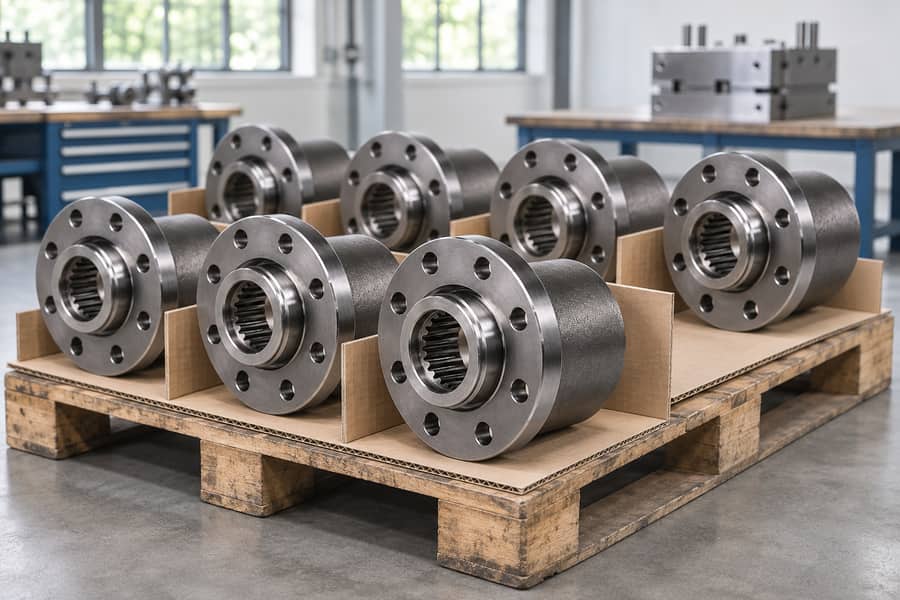
The quoted delivery condition strongly influences the price of a forged component. An as-forged part and a fully machined, inspected component represent different manufacturing scopes.
Heat Treatment and Surface Cleaning
Heat treatment may be required to achieve specified mechanical properties or establish a suitable microstructure for further processing.
The appropriate treatment depends on alloy chemistry, section size, the required final condition, and the applicable material specification.
Carbon and certain alloy steels may use suitable hardening and tempering routes. Austenitic and duplex stainless steels do not quench-harden like carbon steel, while precipitation-hardening stainless grades use controlled aging.
For duplex stainless steels, appropriate thermal processing must also preserve the specified microstructure and avoid harmful phase formation.
Properties measured in the as-forged condition should not be assumed to represent the final heat-treated condition.
Heat treatment expenses depend on the required cycle, handling arrangements, component dimensions, and verification requirements.
Cleaning operations, including appropriate mechanical surface treatments where specified, can add further processing costs before machining or inspection.
Machining and Dimensional Accuracy
Closed die forging can produce shapes relatively close to finished component geometry, but critical features often require subsequent machining.
Shaft journals, flange faces, bores, and gear-related features may need turning, milling, drilling, boring, or grinding according to drawing requirements.
Machining cost depends on:
- Material removal volume
- Component geometry and accessibility
- Workholding and datum requirements
- Tool wear and machining time
- Specified dimensional and surface requirements
Excessive machining allowances increase material consumption and processing time. Insufficient allowances risk leaving surfaces or dimensions that cannot meet final specifications.
Buyers should identify which surfaces require precision machining and which may remain as-forged.
Inspection, Testing, and Documentation
Quality requirements influence the inspection equipment, testing procedures, labor, and documentation needed for each production order.
Dimensional inspection may be sufficient for some features, while other components require mechanical testing, material verification, or nondestructive examination.
Additional requirements can include:
- Chemical composition verification
- Tensile, impact, or hardness testing where specified
- Surface or volumetric nondestructive examination
- Dimensional inspection reports
- Material identification and traceability records
Testing requirements must correspond to the component specification, material condition, and applicable acceptance criteria.
An inspection-intensive component may have a substantially different total cost from an otherwise similar forging with simpler acceptance requirements.
Illustrative Closed Die Forging Cost Calculation
The following example uses hypothetical arithmetic created in November 2026. All amounts are assumed USD values, not a Boberry Machining quotation, market rate, or benchmark for any geographic market.
Taxes, freight, and installation are excluded. The model also assumes no additional scrap, rework, die replacement, or other unlisted expenses.
Assumed Manufacturing Costs
Suppose a hypothetical forged component has a recurring manufacturing cost of $58 per accepted part, an initial tooling investment of $10,000, and a $2,000 setup charge per order.
The two columns represent alternative order sizes, not successive orders. All produced parts are assumed accepted, and every variable expense is expressed per accepted part.
| Cost component | Assumed cost | 500 parts: USD/accepted part | 2,000 parts: USD/accepted part |
| Material and billet preparation | $20/part | $20 | $20 |
| Heating, forging, and trimming | $17/part | $17 | $17 |
| Heat treatment and cleaning | $6/part | $6 | $6 |
| Machining | $10/part | $10 | $10 |
| Inspection | $5/part | $5 | $5 |
| Initial tooling | $10,000 total | $20 | $5 |
| Production setup | $2,000/order | $4 | $1 |
| Total unit cost | $82 | $64 | |
| Total order cost | $41,000 | $128,000 |
Calculate Unit Cost With Tooling Amortization
Tooling amortization distributes the initial investment across the quantity selected for costing. The example also allocates the assumed setup charge to each accepted component.
Unit cost = Variable cost per accepted part + (Tooling cost + Setup cost) / Accepted quantity
The recurring manufacturing cost is calculated by adding the material, forging, heat treatment, machining, and inspection expenses.
Variable cost = $20 + $17 + $6 + $10 + $5 = $58 per accepted part
For an order of 500 accepted components:
Unit cost = $58 + ($10,000 + $2,000) / 500 = $82 per accepted part
For an order of 2,000 accepted components:
Unit cost = $58 + ($10,000 + $2,000) / 2,000 = $64 per accepted part
Compare Small and Large Production Orders
The assumed unit cost decreases because the fixed tooling and setup expenses are distributed across more accepted components.
However, the larger order requires greater total expenditure. Paying less for each piece can still tie up more cash when the extra stock will not be used soon.
Repeat orders may avoid a new initial tooling charge when existing dies remain suitable. Nevertheless, maintenance and future replacement costs still require consideration.
Actual quotations can change with material prices, processing times, production yield, tooling life, and required finishing operations.
What Other Factors Can Change a Closed Die Forging Quotation?
Even when component geometry and material remain unchanged, purchasing conditions can influence the final quoted price.
Delivery Schedule and Production Lead Time
Requested delivery dates influence production planning, material procurement, tooling preparation, and scheduling.
A compressed schedule may require additional arrangements, especially when material availability, tooling development, or external processing creates constraints.
Buyers should distinguish between normal manufacturing lead time and expedited delivery requirements before comparing supplier prices.
Material Price Changes and Commercial Terms
Material prices can change between quotation preparation and purchase order confirmation. Quotation validity periods therefore deserve attention.
Commercial terms may also influence payment schedules, delivery responsibilities, and the allocation of certain purchasing risks.
Relevant items include:
- Quotation validity period
- Material pricing assumptions
- Currency and payment terms
- Packaging requirements
- Freight and delivery scope
- Responsibility for tooling-related expenses
A comparison based solely on stated component prices can overlook meaningful differences in these commercial arrangements.
Engineering Changes and Additional Requirements
Drawing revisions after tooling approval can require die modifications, process adjustments, or additional validation.
Changes to material specifications, tolerances, inspection criteria, or delivery condition may also increase manufacturing costs.
Buyers should establish a formal revision process and confirm the cost implications of proposed changes before authorizing further production.
Where a Forging Cost Review Can Produce Useful Savings
Cost reduction should begin with component requirements and manufacturing feasibility. Removing necessary performance or inspection controls simply to reduce quoted prices can create greater downstream risks.
Simplify Part Design Where Practical
Engineers can examine whether difficult geometric features are essential or whether alternative shapes could simplify the forging sequence.
Potential improvements include adjusting noncritical radii, reviewing parting-line arrangements, and reducing unnecessary machining stock.
These changes require supplier review because geometry modifications may affect material flow, die performance, component function, or downstream operations.
Avoid Over-Specification
Specifications should distinguish functional requirements from preferences that do not influence component performance.
A clearance surface rarely needs the same dimensional control as a bearing seat. Making both equally demanding can add cutting and measurement work with little functional benefit.
Cost reviews should examine:
- Material: Whether the specified grade and condition match the duty.
- Dimensions: Which tolerances are functionally critical.
- Surface finish: Which surfaces require additional processing.
- Heat treatment: Which final properties must be achieved and verified.
- Inspection: Which examinations are required for acceptance.
Any relaxation of requirements must receive appropriate engineering approval rather than being treated as an automatic cost-saving measure.
Plan Production Quantities and Repeat Orders
Buyers with recurring demand can assess whether larger production batches reduce setup and tooling allocation costs.
Scheduled purchases may provide a workable balance between manufacturing efficiency and inventory commitments.
Tooling reuse also deserves early consideration, particularly for components with stable drawings and predictable long-term demand.
A purchasing decision should account for unit cost, total expenditure, stockholding, tooling condition, and the likelihood of future design changes.
How Should Buyers Compare Closed Die Forging Quotations?
A useful quotation comparison begins with equivalent technical requirements. Different manufacturing scopes can produce different prices even when suppliers receive the same component drawing.
Prepare a Complete RFQ Package
An incomplete request for quotation can produce assumptions that later become expensive engineering changes.
A practical RFQ should provide:
- Drawings: Current revisions, dimensions, and functional features.
- Material specifications: Required grade, product requirements, and delivery condition.
- Quantities: Initial order volume and expected annual demand.
- Machining scope: Mark the surfaces to be cut, their dimensional limits, and the finish needed at each interface.
- Heat treatment: Required final condition and applicable verification.
- Inspection: Testing methods, acceptance criteria, and documentation.
- Delivery: Packaging requirements and requested schedule.
Providing consistent information allows manufacturers to assess the same scope and reduces uncertainty during quotation development.
Confirm What the Quoted Price Includes
A quotation should clearly distinguish tooling charges, recurring manufacturing expenses, and optional services.
Buyers should verify whether the price covers flash trimming, heat treatment, machining, inspection, and the specified component condition.
They should also clarify whether tooling maintenance, repeat-order setup, replacement dies, and engineering changes involve separate charges.
These details become particularly important when evaluating recurring purchases rather than a single production batch.
Evaluate Total Cost Rather Than Unit Price Alone
The lowest initial unit price does not necessarily represent the lowest total purchasing cost.
A realistic comparison considers tooling investment, accepted-part yield, secondary operations, inspection requirements, delivery costs, and the financial implications of rejected components.
When discussing custom closed-die forged shafts, flanges, couplings, gear blanks, connecting rods, or other industrial components with Boberry Machining, buyers should request a defined manufacturing and delivery scope.
Before approving a purchase order, confirm the following decisions:
- Material selection: Is the grade appropriate for the required application and final condition?
- Design: Have avoidable forging and machining difficulties been reviewed?
- Tooling: Are initial charges, reuse rights, maintenance, and replacement responsibilities clear?
- Quantity: Does the order size balance unit cost against inventory commitments?
- Processing: Are heat treatment, cleaning, and machining included where required?
- Quality: Are acceptance criteria, inspection methods, and documentation agreed?
- Commercial scope: Are delivery terms, exclusions, quotation validity, and revision procedures documented?
These purchasing decisions provide a consistent basis for comparing closed die forging quotations while preserving the component’s specified technical requirements.