
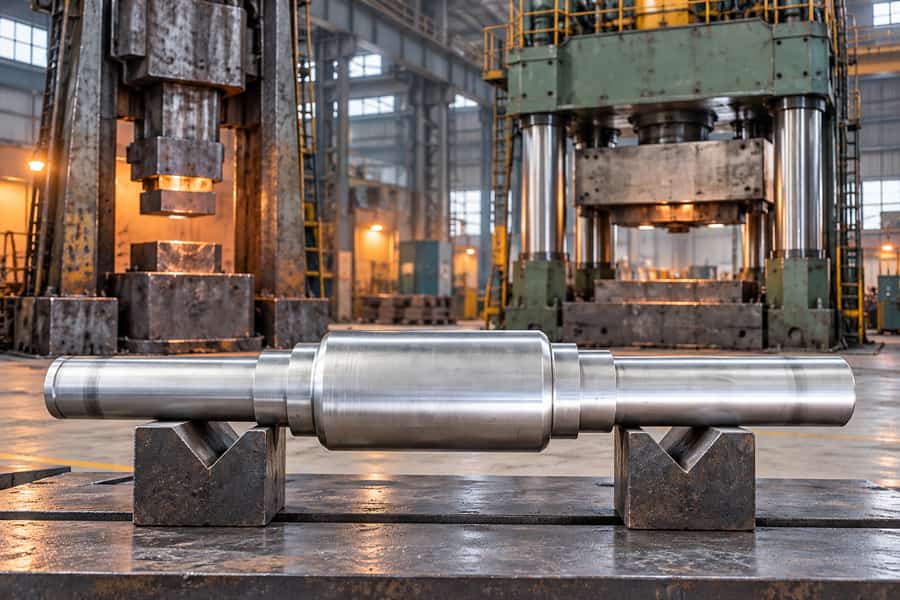
In both hammer and hydraulic press open-die forging, heated metal is compressed by dies without fully enclosing the workpiece. A hammer delivers repeated impacts, while a hydraulic press applies force through a controlled stroke.
Neither route is inherently better. Selection depends on machine capability, reduction schedules, geometry, alloy behavior, temperature management, machining, inspection, batch size, and total delivered cost.
How Do Open-Die Hammer and Hydraulic Press Forging Differ?
Both processes belong to open die forging, but their loading characteristics differ. Material characteristics, component dimensions, and production requirements determine which equipment features matter most when selecting a forging process.
The comparison concerns open-die hammer forging and hydraulic press forging. It does not compare hydraulic presses with closed-die drop forging, where shaped dies substantially enclose the workpiece.
Impact Loading vs Hydraulic Pressing
Open-die hammer forging uses repeated impacts to deform heated metal. The hammer transfers energy through moving equipment components, creating short-duration loads at the die-workpiece interface.
Deformation depends on delivered impact energy, die geometry, workpiece temperature, contact conditions, and successive reductions. The intended geometry develops as the workpiece is repositioned and successive hammer impacts are directed toward selected areas.
Hydraulic press forging applies force through a hydraulically driven ram. Its movement allows controlled strokes, although actual force, speed, positioning accuracy, and feedback capabilities depend on equipment design.
Unlike a hammer, which delivers energy through impacts, a hydraulic press maintains loading during a comparatively slower deformation stroke. This difference affects strain rate, friction, and temperature evolution.
Hammer forging can support incremental shaping through repeated blows and frequent repositioning. However, producing consistent reductions requires suitable equipment settings, tooling, operating practices, and process supervision.
Hydraulic presses can provide controlled reductions during drawing or upsetting operations. Nevertheless, stroke control alone does not establish uniform deformation or guarantee the required internal structure.
For either route, the manufacturing plan must establish reduction sequences, contact conditions, workpiece orientation, and temperature limits. Equipment characteristics influence control but cannot replace process engineering.
Workpiece Size and Shape
Workpiece dimensions strongly influence equipment selection. Relevant factors include starting stock size, section thickness, component length, handling weight, and access to the required forging surfaces.
Hydraulic presses are frequently considered for substantial cross-sections because suitable equipment can apply sustained compressive loading during planned reductions. Actual suitability remains dependent on available force and tooling.
Hammers may offer practical flexibility for incremental shaping, especially where repeated repositioning and localized reductions are useful. Their effectiveness depends on delivered energy and workpiece response.
Neither machine category establishes a universal size limit. Ram capacity, working clearance, die dimensions, manipulator capability, and foundation arrangements vary between individual installations.
Long shafts introduce additional considerations. The equipment must accommodate workpiece rotation, progressive drawing, handling between reductions, and control of straightness throughout the forging sequence.
For hollow cylinders and rings, engineers must also consider wall development, internal geometry, tooling access, and subsequent bore machining. Open-die forging should not be confused with ring rolling.
A hypothetical large shaft order might favor hydraulic pressing if the available press offers appropriate loading and handling arrangements. A smaller shaft might suit hammer forging under different production conditions.
These examples illustrate conditional equipment selection, not fixed rules based on component size.
Metal Flow and Internal Quality
Both processes deform metal plastically, changing its dimensions and internal structure. The resulting metal flow depends on reduction direction, die contact, temperature, friction, and material behavior.
Hammer forging does not necessarily deform only the workpiece surface. Suitable impact energy, reductions, and contact conditions can produce deformation extending into the section.
Similarly, hydraulic pressing does not automatically produce complete through-section deformation. Insufficient reduction, unfavorable die geometry, or excessive section thickness can leave inadequately worked regions.
During drawing, successive reductions extend the workpiece while reducing its cross-section. Upsetting increases the cross-section by compressing material along its longitudinal direction.
Forging schedules may combine drawing, upsetting, rotation, and reheating. The chosen sequence affects dimensional development, accumulated strain, and the distribution of deformation throughout the workpiece.
Forging can modify grain structure and influence the orientation of material flow. However, favorable grain flow cannot be assumed from the machine type alone.
Neither hammer nor press forging guarantees elimination of porosity, segregation, or internal discontinuities. The starting material, reduction history, and applicable acceptance requirements remain important.
| Engineering Factor | Hammer Forging | Hydraulic Press Forging |
| Loading mechanism | Repeated energy-driven impacts | Force applied through hydraulic strokes |
| Deformation rate | Generally higher during impacts | Generally lower and more controllable |
| Reduction control | Depends on blow energy, tooling, and operation | Depends on stroke, force control, and equipment feedback |
| Deformation distribution | Depends on impact conditions, die contact, and reductions | Depends on loading, die contact, and reductions |
| Workpiece handling | Repeated repositioning between impacts | Repositioning between pressing strokes |
| Large sections | Requires sufficient impact energy and suitable handling | Requires sufficient force, clearance, and handling |
| Temperature behavior | Short contacts with repeated working intervals | Longer contacts may increase localized heat transfer |
| Internal quality | Requires suitable forging practice and verification | Requires suitable forging practice and verification |
| Best-fit applications | Incremental operations where equipment capability matches requirements | Controlled reduction sequences where equipment capability matches requirements |
The table describes general process characteristics rather than equipment guarantees. Final selection requires evaluating the actual machine, tooling configuration, material, and forging schedule.
How Do Downstream Operations Affect Selection?
Forging equipment represents only one part of the manufacturing route. Heating, heat treatment, machining, and inspection can influence final quality and cost as much as the initial deformation method.
Heating and Reheating
Both methods generally require heating workpieces to a temperature range appropriate for their material grade. Forging temperature influences flow stress, ductility, deformation behavior, and defect risk.
Some alloys offer relatively broad workable temperature ranges. Others require tighter temperature management because of sensitivity to cracking, grain growth, or undesirable microstructural changes.
Hammer forging involves repeated short contacts, but the workpiece continues losing heat through its surfaces and handling intervals. Multiple passes may therefore require additional heating.
Hydraulic pressing involves longer contact during individual strokes, potentially increasing heat transfer into the dies. However, total heat loss depends on processing time and equipment conditions.
Large workpieces may also develop significant differences between surface and core temperatures. These gradients can influence deformation resistance and the consistency of the forging operation.
Reheating requirements depend on the material, initial temperature, processing sequence, and remaining deformation. Neither method can be declared universally more energy-efficient without examining the complete operation.
Engineers must also consider scale formation, decarburization where applicable, and surface damage. Heating and handling practices affect the amount of material subsequently removed during machining.
Temperature records, where required, help demonstrate that the approved forging procedure was followed. Measurements should correspond to defined locations and appropriate measurement methods.
Heat Treatment, Machining, and Allowances
Open-die forging typically produces an intermediate shape rather than a precision-finished component. Both hammer-forged and press-forged products may require substantial downstream processing.
Heat treatment may be specified to develop required mechanical properties, control hardness, or prepare the material for machining. The appropriate cycle depends on material grade and section dimensions.
Normalizing, annealing, quenching, and tempering serve different metallurgical purposes. A heat-treatment cycle appropriate for one material grade may be unsuitable for another, making grade-specific evaluation necessary.
Heating and cooling can also introduce distortion. Long shafts may experience bending, while cylindrical components can develop dimensional changes affecting subsequent machining allowances.
As-forged dimensions should therefore be distinguished from rough-machined and finish-machined dimensions. Each stage has different measurement conditions, tolerances, and acceptance requirements.
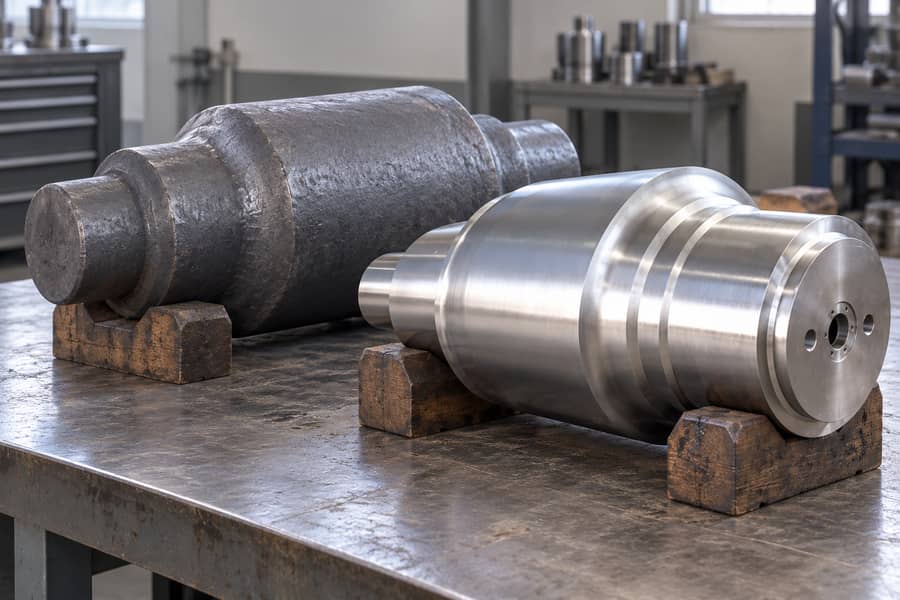
On a hollow component, the forging drawing reserves stock for turning and boring; those cuts bring the outside and inside diameters to their finished sizes. It is not the same as dimensional tolerance, which defines the permitted variation around a specified dimension.
For example, a hypothetical forged shaft may require additional stock around its outside diameter to accommodate scale removal, straightening effects, and final turning.
The allowance must reflect the actual forging route and specified finished geometry. It should not be selected from an assumed universal value for hammer or press forging.
For hollow components, forged cylinder sleeves illustrate why outside diameter, bore geometry, wall thickness, and concentricity must be evaluated together.
Rough machining can remove irregular surfaces and establish reference features before final inspection. Finish machining subsequently produces the specified dimensions, surface finish, and geometric relationships.
Common requirements include straightness, roundness, cylindricity, perpendicularity, and concentric relationships. These characteristics require appropriate datums and measurement methods rather than relying on forging accuracy alone.
The selected forging method may influence machining stock and distortion behavior, but finished accuracy primarily depends on the complete manufacturing and inspection sequence.
Inspection and Acceptance
Inspection requirements should be defined before manufacturing. Both forging methods require verification against agreed drawings, material specifications, and applicable acceptance criteria.
Material verification may include chemical analysis, traceability records, and mechanical testing. Test specimen location, orientation, heat-treatment condition, and acceptance requirements must be specified when relevant.
Dimensional inspection confirms conformity at designated manufacturing stages. Rough-forged measurements and finished dimensions should not be evaluated against identical criteria unless explicitly required.
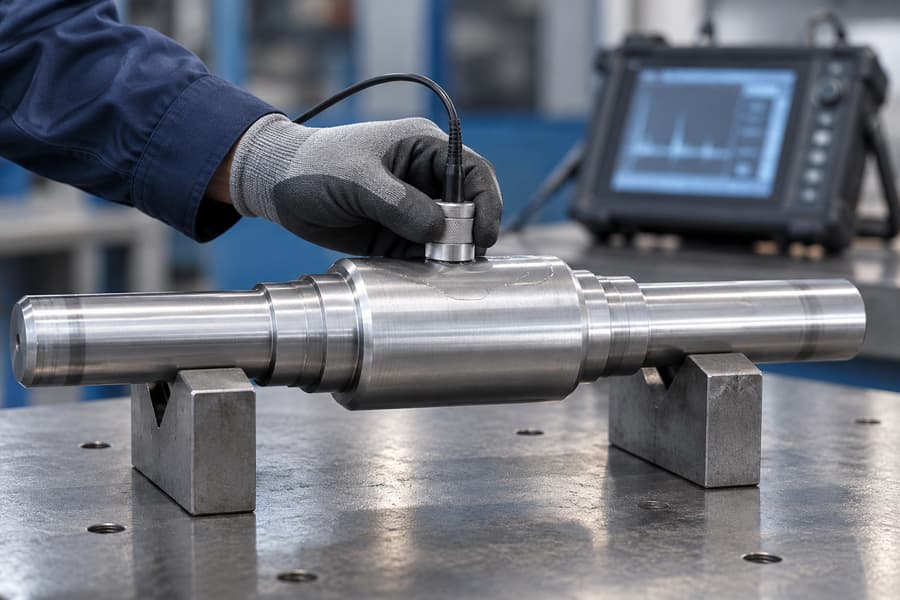
Ultrasonic testing may detect certain internal discontinuities when material condition, geometry, and examination parameters permit effective coverage. Its effectiveness is not independent of inspection conditions.
On suitable ferromagnetic components, magnetic particle examination can reveal indications associated with surface defects or discontinuities just beneath the surface. Liquid penetrant testing examines surface-breaking indications on accessible prepared surfaces.
These methods serve different purposes and have limitations. Examination procedures must define coverage, sensitivity, timing, and acceptance requirements rather than simply requesting an unspecified quality inspection.
For critical components, inspection after rough machining may improve access to surfaces and internal regions. The chosen inspection stage should be coordinated with heat treatment and subsequent machining.
Neither forging route eliminates the need for acceptance testing. Equipment selection, process records, and inspection results together establish whether the delivered component meets the order requirements.
Which Process Offers Better Total Cost?
The lower-cost forging method cannot be determined from equipment type alone. Cost depends on the manufacturing sequence, material utilization, production quantity, and required delivery condition.
Batch Size and Production Planning
Order quantity influences the economics of forging equipment, tooling preparation, handling, and process setup. A route suitable for a single component may differ from one used repeatedly.
For small batches, flexible tooling and efficient setup can be particularly valuable. However, equipment availability and the complexity of individual operations may outweigh nominal setup advantages.
Hammer forging may support economical incremental shaping where suitable equipment and tooling already exist. Nevertheless, repeated impacts and repositioning can increase processing time for some geometries.
Hydraulic presses can offer advantages when controlled reduction sequences are needed. Their operating economics depend on loading requirements, stroke cycles, tooling, and material handling.
For recurring orders, repeatable manufacturing plans may reduce preparation effort and simplify production scheduling. Consistency still requires documented settings, trained operation, and appropriate inspection.
A hypothetical order of several similar gear blanks might justify additional process preparation if the schedule supports repeat production. A single replacement block may favor a different arrangement.
Neither hypothetical project proves that one machine type has lower unit cost. The comparison must include the actual equipment configuration and complete production route.
Total Manufacturing Cost
Forging cost should be evaluated through delivery of the specified component, not merely through the time spent deforming heated material.
A faster forging operation may produce no overall saving if additional machining, reheating, handling, or inspection is needed to meet final requirements.
Similarly, greater stroke control does not necessarily produce lower total cost. Excessive setup requirements or underutilized equipment can offset potential process advantages.
Material yield is another consideration. Starting stock dimensions, end cropping, surface removal, machining allowances, and rejected material all influence overall material consumption.
Table 2. Purchasing and Total-Cost Decision Factors
| Cost or Decision Factor | What Buyers Should Compare |
| Starting material | Grade, stock dimensions, availability, and usable yield |
| Equipment suitability | Actual energy or force capability, tooling, and clearance |
| Setup requirements | Die preparation, handling arrangements, and process planning |
| Forging operations | Reduction schedule, repositioning, and operating time |
| Heating | Initial heating, reheating frequency, and temperature management |
| Machining | Stock removal, setup requirements, and finished geometry |
| Heat treatment | Required cycles, section considerations, and distortion |
| Inspection | Testing methods, examination stages, and documentation |
| Production quantity | Setup allocation, repeatability, and scheduling |
| Rework and rejection | Potential correction work, scrap exposure, and delivery risk |
The most useful purchasing comparison is based on quotations covering equivalent material specifications, final dimensions, processing conditions, inspection requirements, and delivery responsibilities.
An apparently cheaper forging may become more expensive if heat treatment, machining, or testing must be purchased separately. Quotations should identify these scope differences clearly.
Delivery schedules also matter. Equipment availability, heating arrangements, outsourced operations, and inspection hold points can affect lead time independently of the forging method.
How Should Buyers Choose a Forging Route?
The appropriate selection begins with component requirements rather than a preference for impact or hydraulic equipment. Buyers need enough technical information to evaluate feasible manufacturing sequences.
RFQ and Decision Checklist
A complete request for quotation should describe the final component and its operating requirements. The supplier can then evaluate material condition, deformation needs, and available manufacturing routes.
Important RFQ information includes:
- Material specification: Grade, applicable standard, required properties, and delivery condition.
- Component geometry: Overall dimensions, section changes, bore requirements, and drawing revisions.
- Order quantity: Initial quantity, anticipated repeat orders, and delivery schedule.
- Forging requirements: Relevant reduction requirements, process restrictions, or specified deformation controls.
- Heat treatment: Required condition, testing requirements, and applicable material specifications.
- Machining scope: As-forged, rough-machined, or finished delivery, including dimensional and geometric tolerances.
- Inspection: Required test methods, examination coverage, acceptance criteria, and records.
- Traceability: Material identification, batch records, certificates, and documentation requirements.
Buyers should distinguish mandatory design requirements from manufacturing preferences. Requiring a specific machine without a technical justification can unnecessarily restrict feasible production routes.
For a hypothetical high-load shaft, engineers might prioritize material properties, section reduction, straightness, and ultrasonic examination before selecting the forging equipment.
If available hydraulic press equipment supports the required reduction schedule and handling arrangement, pressing may be appropriate. Hammer forging remains an option if its verified capabilities satisfy the requirements.
For a hypothetical hollow cylinder, bore condition, wall allowance, heat-treatment response, and final concentricity may deserve greater attention than the initial forging equipment category.
A useful supplier discussion therefore examines the planned forging sequence, temperature controls, starting stock, machining stages, and acceptance testing as one connected manufacturing process.
Where equipment characteristics materially affect part quality, purchasers can request process documentation or technical clarification. However, disclosure requirements should be agreed before placing the order.
Final acceptance should rely on the contracted specifications and inspection results, not an assumption that hammer or hydraulic press forging automatically produces better components.
Custom Open-Die Forging at Boberry Machining
Boberry Machining supplies custom open-die components, including shafts, hollow cylinders, flanges, rings, gear blanks, and blocks. Manufacturing requirements are established according to component specifications.
For applications involving forged shafts, important purchasing details include material grade, shaft dimensions, section transitions, required mechanical properties, and machining condition.
Hollow components require additional attention to bore dimensions, wall thickness, available machining stock, and inspection access. These requirements should be reflected in drawings and purchasing documentation.
Boberry Machining also provides order-specific heat treatment, machining, and inspection. The applicable operations and acceptance requirements depend on the individual component and agreed supply scope.
Hammer forging versus hydraulic press forging should ultimately be decided through technical evaluation of the proposed manufacturing route. Before specifying a forging method, purchasers need verification that the proposed equipment is available and capable of meeting their requirements.
Providing complete drawings, material specifications, delivery conditions, and inspection requirements allows the feasibility of the proposed forging route to be assessed against the finished component’s needs.