
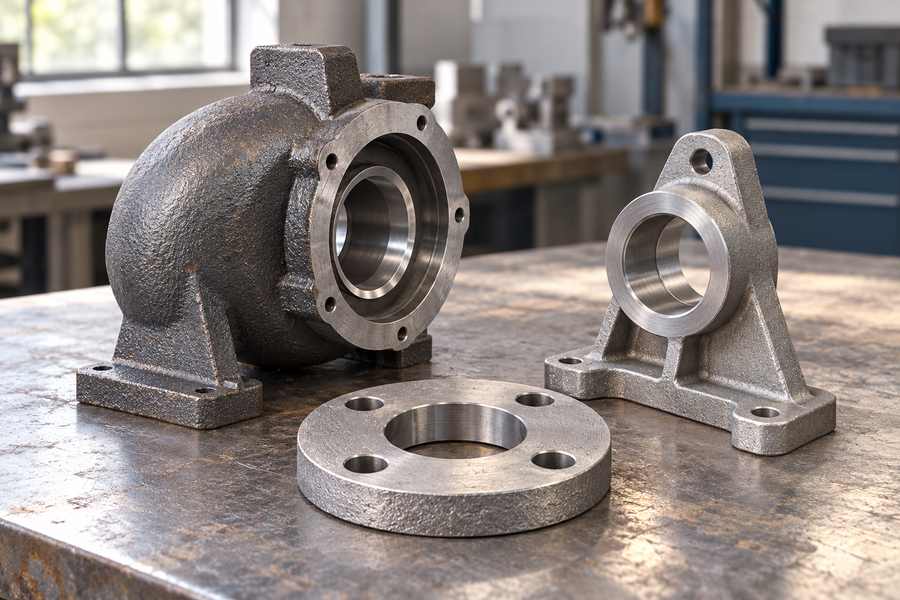
Neither cast iron nor cast steel is universally better. Gray iron often suits vibration-damping bases, ductile iron serves many loaded housings, and cast steel can suit demanding impact or welding requirements.
The choice depends on grade, heat treatment, service loads, temperature, geometry, and finished-part cost. Compare real casting conditions, not broad material labels.
How Do Gray Iron, Ductile Iron, and Cast Steel Differ?
Cast iron and cast steel are iron-based materials, but differences in carbon content, graphite formation, and microstructure influence their mechanical properties and manufacturing behavior.
For engineering buyers, the distinction is more specific than iron versus steel. Gray iron, ductile iron, and cast steel represent different material families with different design opportunities.
Gray Iron: Graphite Structure and Material Characteristics
In gray iron, carbon forms thin graphite flakes distributed throughout the metallic matrix. These flakes influence how stresses develop within the material, particularly when the component experiences tensile or bending loads.
The graphite structure contributes to vibration damping and can improve machinability. These characteristics make gray iron attractive for machine bases, equipment housings, and certain stationary components.
However, graphite flakes also create local stress concentrations. Gray iron generally has limited tensile ductility, making it less suitable for applications involving significant impact or deformation.
Its properties also depend on the metallic matrix surrounding the graphite. Ferritic and pearlitic structures, casting thickness, and cooling conditions can produce different mechanical and machining characteristics.
For example, a stationary gearbox housing may benefit from gray iron’s damping and machinability, provided its calculated stresses and mounting loads remain within the specified grade’s limits.
Ductile Iron: Nodular Graphite and Mechanical Behavior
Unlike gray iron, ductile iron has graphite particles shaped mainly as rounded nodules, which reduce localized stress concentrations. This shape reduces the severity of graphite-related stress concentrations.
Consequently, suitable ductile iron grades can provide greater tensile ductility and toughness than conventional gray iron, while retaining useful casting characteristics.
The metallic matrix strongly influences performance. Ferritic grades generally emphasize ductility, while pearlitic grades can provide greater strength and hardness with different elongation characteristics.
Heat-treated ductile iron introduces further possibilities, but these grades require their own specifications. Their properties should not be assumed equivalent to those of conventional as-cast ductile iron.
Ductile iron is commonly considered for brackets, pump housings, valve bodies, and mechanically loaded components. It can compete with certain cast steel grades, depending on the actual requirements.
Cast Steel
Cast steel is produced by pouring molten steel into molds to create the required component geometry. Its properties depend on composition, solidification, heat treatment, and section thickness.
Carbon cast steel provides a range of mechanical properties suitable for structural and mechanical applications. Buyers can evaluate carbon steel castings when toughness, ductility, or joining requirements influence material selection.
Alloying elements and heat treatment can extend the available performance range. Alloy steel castings may be considered when particular strength, wear, or temperature requirements justify a suitable alloy grade.
Cast steel often offers advantages where tensile ductility, impact resistance, or welding are important. However, those advantages must be established for the specified material condition.
A high-strength ductile iron grade may exceed the tensile strength of some cast steel grades. Material names alone therefore cannot establish which component will carry more load.
Cast Iron vs Cast Steel: Which Performs Better Under Different Conditions?
Mechanical performance must be evaluated against the actual operating conditions. A material that works well under steady compression may behave differently during repeated bending or impact.
Likewise, better performance in one characteristic does not establish overall superiority. Damping, toughness, wear resistance, thermal behavior, and corrosion exposure can lead to different selections.
Tensile Strength, Compressive Strength, and Structural Loading
Gray iron generally performs well in appropriately designed compression-loaded components. Its limited tensile ductility becomes more important when bending generates tensile stress at critical surfaces.
Ductile iron provides a broader range of tensile strength and elongation characteristics. Different grades allow designers to balance load capacity, deformation behavior, and manufacturing requirements.
Cast steel also offers a wide range of strength and ductility combinations. The appropriate grade and heat-treatment condition must match the component’s loading conditions.
Importantly, a component rarely experiences pure compression or tension. Mounting forces, bolt preload, pressure, bending moments, and thermal stresses often act together.
For example, a support bracket may experience steady compression during operation but substantial tensile stress around its mounting holes during an overload.
Selecting gray iron solely because the main operating load is compressive would overlook those critical regions. Ductile iron and cast steel deserve evaluation against the complete stress distribution.
Impact Toughness and Fatigue Resistance
Impact toughness describes the ability to absorb energy under specified impact-test conditions. It differs from tensile strength, which measures resistance during a different loading process.
Gray iron is generally less suitable for severe impact because its graphite flakes can promote crack initiation. The limitation becomes important under shock or low-temperature conditions.
Ductile iron offers improved toughness possibilities, particularly in grades designed for adequate elongation and impact performance. Nevertheless, not every ductile iron grade satisfies demanding impact requirements.
Cast steel can provide favorable impact toughness when its composition and heat treatment are appropriate. Buyers must still verify the relevant test temperature and acceptance criteria.
Fatigue introduces another consideration. Repeated stresses can initiate cracks at surfaces, casting discontinuities, sharp transitions, or other locally stressed regions.
A hypothetical rotating machinery component experiencing repeated bending may require fatigue-oriented design verification, regardless of whether its starting material is ductile iron or cast steel.
Vibration Damping and Dimensional Stability
Gray iron is widely used in machinery structures because its graphite-containing microstructure provides useful vibration damping. This can help limit unwanted vibration during operation.
Machine beds, equipment supports, and housings may benefit from this behavior, particularly where vibration influences noise, machining quality, or mechanical stability.
Ductile iron and cast steel generally provide less inherent damping than gray iron. However, structural design, connections, and additional damping measures also influence system behavior.
Damping should not be confused with stiffness or dimensional stability. Wall thickness, rib placement, residual stress, heat treatment, and machining sequence can affect component accuracy.
A rigid cast steel structure may satisfy a particular vibration requirement through its geometry, while a poorly designed gray iron casting may still deform excessively.
Material Behavior Under Wear and Elevated Temperatures
A casting’s resistance to wear changes with the type of contact, applied load, lubrication conditions, and abrasive exposure. Sliding contact, abrasive particles, repeated impact, and inadequate lubrication create different material requirements.
Graphite in gray iron can contribute to favorable sliding behavior under suitable conditions. However, graphite does not guarantee resistance to abrasive or impact-related wear.
Ductile iron wear behavior depends on matrix structure, hardness, graphite distribution, and surface condition. Some heat-treated grades provide useful options for demanding contact conditions.
Cast steel can also be selected for wear applications, particularly when appropriate alloy composition, heat treatment, or surface hardening supports the required performance.
Temperature adds separate requirements. Thermal conductivity, expansion, oxidation, thermal fatigue, and high-temperature strength must be evaluated according to the actual operating environment.
Gray iron may be attractive for certain heat-transfer applications, while specialized iron or steel grades may be required for more severe thermal exposure.
Corrosion Resistance and Weldability
Neither conventional gray iron, ductile iron, nor ordinary carbon cast steel is inherently suitable for every corrosive environment. Moisture, chemicals, temperature, and surface protection influence durability.
Alloy composition can improve resistance to particular environments, but an alloy steel designation does not automatically indicate meaningful corrosion resistance.
Weldability also differs. Suitable cast steel grades are often more practical to weld, although carbon content, alloying, section thickness, and welding procedures remain important.
Gray iron presents welding challenges associated with its carbon-rich microstructure and crack sensitivity. Ductile iron also requires careful procedure selection to preserve satisfactory joint performance.
For components requiring welded attachments or future repair, the joining method should be considered during material selection rather than after the casting design is finalized.
Table 1: Cast Iron vs Cast Steel — Service-Performance Decision Matrix
| Service Requirement | Gray Cast Iron | Ductile Cast Iron | Cast Steel |
| Vibration damping | Often preferred | Lower inherent damping | Generally lower inherent damping |
| Tensile and bending loads | Limited ductility | Broad grade-dependent capability | Broad grade-dependent capability |
| Compressive loading | Often suitable | Suitable with proper design | Suitable with proper design |
| Impact resistance | Generally less favorable | Suitable grades may qualify | Tough grades often favored |
| Fatigue loading | Sensitive to tensile stress concentrations | Grade and geometry dependent | Grade and geometry dependent |
| Wear resistance | Useful for selected sliding conditions | Depends on hardness and matrix | Depends on alloy and treatment |
| High-temperature service | Requires grade-specific evaluation | Requires grade-specific evaluation | Specialized grades may qualify |
| Welding requirements | Often challenging | Requires qualified procedures | Often more practical with suitable grades |
This comparison identifies general tendencies rather than guaranteed performance. Final decisions require representative grade properties, component geometry, manufacturing conditions, and relevant testing.
Is Cast Iron or Cast Steel More Cost-Effective?
Material cost matters, but engineering buyers ultimately pay for an acceptable finished component. Casting production, machining, treatment, inspection, and rejection risk all influence expenditure.
Casting Production and Material Costs
Gray iron can offer manufacturing advantages for suitable complex castings because of its casting characteristics and established production methods.
Ductile iron requires controlled graphite formation and appropriate process management. Its cost depends on grade requirements, section thickness, production quantity, and inspection scope.
Cast steel often involves demanding melting, feeding, and solidification control. Shrinkage-related concerns can affect casting design, production yield, and manufacturing effort.
However, these tendencies do not establish a universal cost ranking. A complicated ductile iron component may cost more than a relatively simple steel casting.
Patterns, cores, feeding systems, finishing allowances, and expected casting yield all affect quotation accuracy. Comparing raw material prices alone misses these production differences.
Machining, Heat Treatment, and Finishing Costs
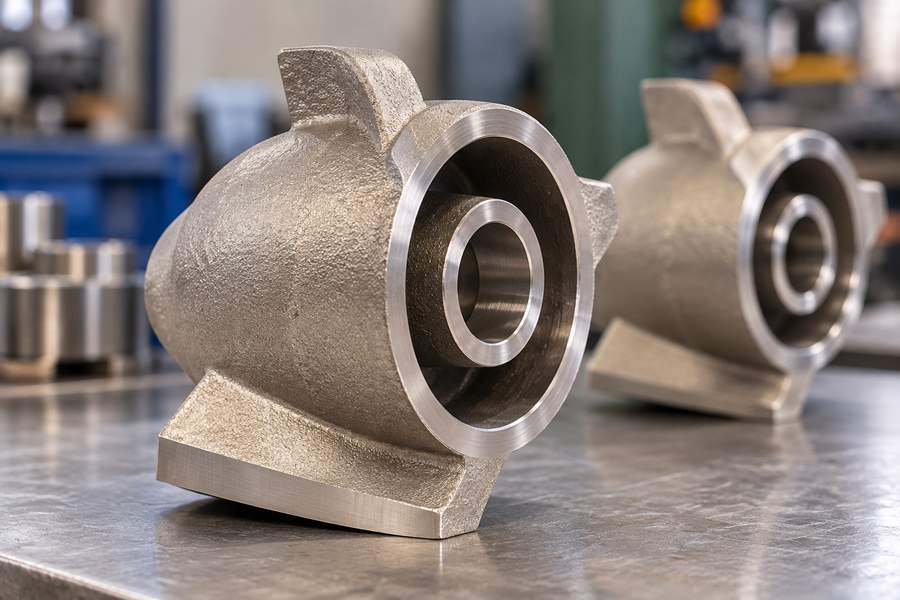
Gray iron is often machinable with relatively short-breaking chips. Its actual machining behavior still depends on hardness, microstructure, inclusions, and local casting conditions.
Ductile iron machining varies considerably between ferritic, pearlitic, and heat-treated grades. Tool selection and cutting conditions must reflect the specified material.
Cast steel machining depends on alloy composition, hardness, heat-treatment condition, and required metal removal. Some grades present greater cutting challenges than others.
The geometry of the casting also matters. Interrupted cuts, deep cavities, difficult access, and tight tolerances can dominate machining time regardless of material.
Heat treatment and finishing add further cost. These operations may be necessary to achieve specified properties, dimensional stability, surface condition, or environmental protection.
Finished-Part Cost vs Initial Casting Price
A meaningful quotation comparison includes the complete manufacturing scope. Buyers should separate casting price from machining, testing, heat treatment, coating, and transportation requirements.
For example, a ductile iron bracket could have a lower initial casting quotation but require design changes or additional machining to satisfy its duty.
A cast steel alternative might carry higher initial production costs yet simplify a required welded assembly. The total comparison would depend on verified manufacturing arrangements.
The reverse situation is equally possible. Replacing an unnecessarily demanding steel grade with suitable ductile iron may reduce costs without compromising required performance.
Material substitution can change wall thickness, weight, feeding requirements, and machining allowances. Therefore, identical drawings do not always produce equally optimized alternatives.
When evaluating metal casting services, buyers should request comparable quotations based on defined material conditions, accepted inspection standards, and finished dimensions.
The relevant measure is the cost of obtaining an accepted component that meets its service requirements, not simply the cheapest unmachined casting.
Which Material Is Better for Different Casting Applications?
Applications provide a useful starting point for comparison, but they do not determine the final material automatically. Similar-looking components may experience very different stresses and temperatures.
Machine Bases and Industrial Equipment Housings
Gray iron is frequently selected for machine bases because damping, machinability, and complex cast geometry can be valuable in stationary equipment.
For a precision machinery base, vibration behavior and dimensional accuracy may influence the design more strongly than maximum tensile strength.
Ductile iron becomes worth evaluating where the housing includes heavily loaded mounting features. Cast steel may be considered when specified structural or joining requirements justify it.
Geometry remains critical. Rib arrangement, support points, wall thickness, and machining sequence can influence performance more than a simple comparison of material datasheets.
Pump Bodies, Valve Bodies, and Pressure Components
Pressure-containing castings require particular attention to internal stresses, pressure cycling, fluid compatibility, temperature, and relevant design requirements.
Gray iron can be used in qualifying applications, but its limited tensile ductility restricts suitability under some pressure, temperature, or shock conditions.
Ductile iron is commonly considered where useful strength and ductility are required. Actual suitability depends on the specified grade and applicable design standards.
Cast steel may be selected for particular pressure, temperature, impact, or fabrication requirements. Its suitability must still be verified against the design and inspection criteria.
For example, a valve body operating under repeated pressure changes may need fatigue-related assessment around flange transitions and internal geometry.
Material selection must account for those local stresses, casting soundness, corrosion exposure, and required pressure testing rather than relying on nominal strength alone.
Brackets, Gears, and Heavy Machinery Components
Structural brackets commonly experience combinations of bending, tension, compression, and repeated loading. Their material requirements depend heavily on mounting geometry and stress distribution.
Ductile iron may provide an effective option for specified brackets requiring mechanical strength and castability without particularly demanding welding or impact conditions.
Cast steel becomes attractive where toughness, substantial impact exposure, or welded connections form important parts of the design specification.
Gray iron can remain appropriate for stationary supports with controlled loading, although its tensile behavior must be considered near holes, corners, and mounting surfaces.
For gears, tooth loading, contact fatigue, wear, and lubrication may govern selection. General material-family comparisons cannot replace gear-specific calculations and material requirements.
Wear-Exposed and Heat-Exposed Components
Wear-exposed castings require a clear description of contact conditions. Abrasive particles, sliding surfaces, and repeated mechanical impacts do not produce identical damage mechanisms.
Certain iron grades may perform well under sliding conditions, while specialized ductile iron or cast steel grades may suit different combinations of wear and loading.
Heat-exposed components require assessment of operating temperature, thermal cycling, oxidation, and temperature-dependent mechanical properties. Room-temperature tensile strength is not sufficient evidence.
For example, a heated equipment housing may need dimensional stability during repeated thermal cycles, making expansion behavior and temperature distribution important selection criteria.
Table 2: Material Selection by Component Application
| Component Application | Candidate Materials | Critical Selection Factors | Useful Verification |
| Machine base | Gray iron; ductile iron; cast steel | Damping, stiffness, mounting loads | Structural assessment, dimensional inspection |
| Equipment housing | Gray iron; ductile iron; cast steel | Wall thickness, loading, machining | Dimensional and material verification |
| Pump housing | Ductile iron; cast steel; qualifying gray iron | Pressure, corrosion, temperature | Applicable pressure and material tests |
| Valve body | Ductile iron; cast steel; qualifying gray iron | Pressure integrity, fluid compatibility | Pressure testing, defect inspection |
| Structural bracket | Ductile iron; cast steel | Bending, fatigue, impact | Mechanical properties, critical-region inspection |
| Heavy machinery component | Ductile iron; cast steel | Shock loads, toughness, fatigue | Relevant mechanical and nondestructive tests |
| Wear component | Selected iron or steel grades | Contact type, hardness, lubrication | Hardness and representative wear evaluation |
| Heat-exposed component | Suitable heat-resistant iron or steel grades | Temperature, oxidation, thermal cycling | Temperature-specific material verification |
The table provides candidate materials, not approved substitutions. Final selection requires grade-specific properties and verification against the component’s actual operating conditions.
How Should Buyers Select and Verify the Right Casting Material?
A practical purchasing specification connects material requirements with component geometry, manufacturing processes, and acceptance criteria. This helps avoid disagreements based on incomplete material descriptions.
Define Material and Component Requirements
Begin with the component’s operating duty. Identify tensile, compressive, bending, impact, and repeated loads, including unusual conditions during startup, shutdown, and handling.
Record the operating temperature range, fluid or atmospheric exposure, contact conditions, and intended service life. These factors can change which material characteristics matter most.
Next, establish the material standard, grade, heat-treatment condition, and required mechanical properties. Avoid treating similar grade names from different standards as interchangeable.
Casting geometry deserves equal attention. Wall thickness, section transitions, internal passages, mounting holes, and machining allowances influence both manufacturability and mechanical performance.
A hypothetical material change from gray iron to ductile iron may require recalculating dimensions rather than simply replacing the material designation on the drawing.
Similarly, replacing ductile iron with cast steel does not automatically improve performance if casting defects, dimensional constraints, or unsuitable heat treatment undermine the design.
Compare Manufacturing Feasibility and Quotations
Request quotations using consistent production quantities, drawings, machining requirements, inspection criteria, and delivery scope. This makes material alternatives easier to compare fairly.
Discuss casting feasibility before approving a material substitution. Feeding arrangements, section transitions, core requirements, and machining allowances may differ between iron and steel production.
The supplier should identify important manufacturing limitations and proposed drawing changes. Any changes affecting structural performance require appropriate engineering review before acceptance.
For example, a steel casting may need a modified feeding arrangement that affects machining stock around a critical mounting surface.
The purchasing comparison should therefore include the final achievable geometry, mechanical requirements, and inspection obligations rather than only the quoted raw casting price.
Boberry Machining can be approached with the component drawings and defined material requirements for technical review, without assuming that every requested grade or process is available.
Verify Material Quality and Finished Casting Performance
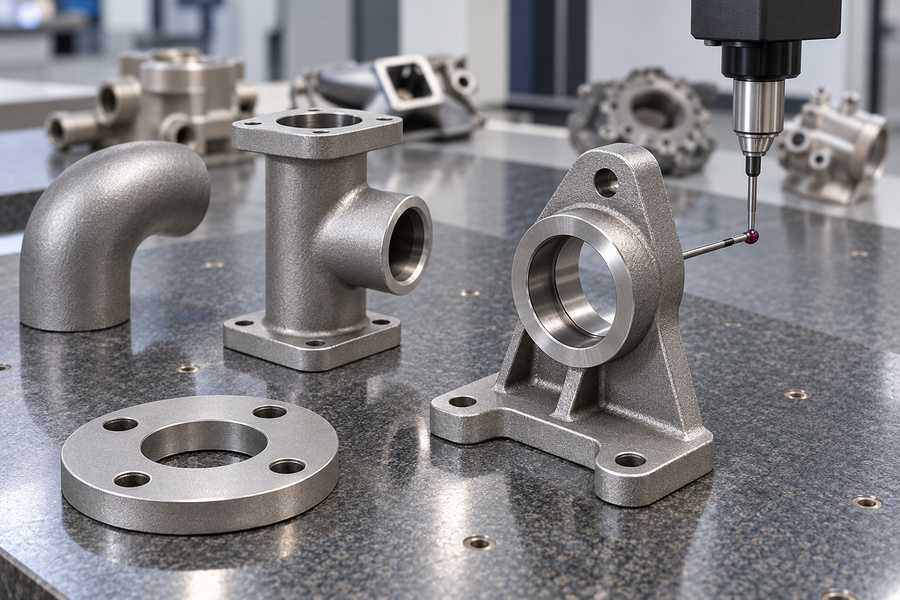
Material certification should identify the specified grade and relevant manufacturing condition. Chemical composition and mechanical test results must correspond to the agreed requirements.
Tensile testing, hardness measurements, impact testing, or microstructure examination may be appropriate, depending on the material specification and component duty.
For gray iron, graphite structure and matrix characteristics can be important. Ductile iron verification may additionally consider graphite nodularity and grade-specific mechanical properties.
For cast steel, heat-treatment records and specified mechanical tests can help establish that the delivered casting meets the required material condition.
Nondestructive examination may be necessary around critical regions. The selected method, inspection extent, and acceptance criteria should reflect the relevant defect risks.
Pressure-containing components may require pressure testing under an applicable specification. The agreed test conditions and acceptance requirements must be documented before production approval.
Inspection records should also cover critical dimensions, machined surfaces, repaired areas, and any deviations from the approved drawing or material specification.
Final material approval should be based on the combined evidence of design suitability, manufacturing feasibility, material properties, and inspection results—not the assumption that one casting material is inherently better.