
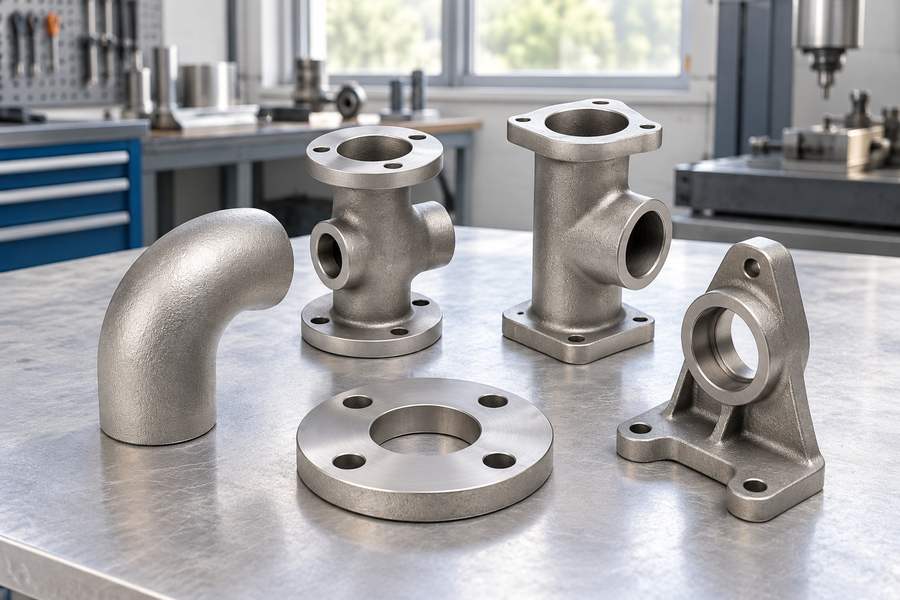
Selecting steel for a custom casting requires more than comparing nominal strength or corrosion resistance. Service conditions, section thickness, and required inspection determine which cast grade is suitable.
Carbon steel, low-alloy steel, and stainless steel have distinct compositions and respond differently to casting processes. This guide explains cast-grade designations, practical material tradeoffs, and the records buyers need to confirm compliance.
Understanding Steel Casting Materials
What Are Steel Castings?
Steel castings are components manufactured by pouring molten steel into prepared molds. Once the metal solidifies, each casting proceeds through the cleaning, thermal processing, examination, and machining operations specified for the component.
Casting allows manufacturers to produce complex external shapes, internal passages, and integrated structural features. These characteristics make steel casting suitable for valve bodies, pump housings, machinery components, and industrial brackets.
Unlike cast iron, cast steel generally contains less carbon and develops different microstructures and mechanical characteristics. However, actual properties depend on material composition, processing, and heat treatment.
Casting also introduces manufacturing considerations. Shrinkage, porosity, inclusions, and section-thickness variations must be controlled through mold design, feeding arrangements, processing parameters, and appropriate inspection.
Cast Steel vs. Wrought Steel Grades
Cast and wrought steels can have similar chemical compositions, but their manufacturing processes produce different structures. Wrought products undergo deformation processes such as rolling or forging after initial solidification.
Steel castings retain solidification-related features that influence mechanical behavior. Local cooling rates, casting geometry, and subsequent heat treatment can affect the properties obtained in different regions.
Material designations must therefore distinguish between cast and wrought products. For example, CF8 is commonly compared with wrought 304 stainless steel, while CF8M is associated with wrought 316.
These comparisons are useful for understanding alloy families, but they do not establish identical properties. Cast grades require their own specifications, acceptance criteria, and service evaluations.
Carbon Steel Casting Materials
Characteristics of Carbon Steel Castings
Carbon steel is commonly selected for industrial components requiring specified strength, toughness, and reasonable manufacturing cost. Its properties depend on carbon content, other controlled elements, and processing conditions.
Carbon contributes to hardness and strength, particularly after appropriate heat treatment. Manganese influences hardenability and other material characteristics, while sulfur and phosphorus require composition control.
Increasing carbon content can improve attainable hardness but may reduce weldability and toughness. Engineers must balance these characteristics against component loading, section thickness, and manufacturing requirements.
For custom carbon steel castings, material selection also involves casting geometry, machining allowances, and surface protection. Carbon steel generally requires protective measures in corrosive environments.
Common Carbon Steel Casting Grades
Several ASTM casting specifications cover carbon steel grades intended for different operating conditions. Choosing an appropriate grade requires matching the casting’s intended service conditions with the governing engineering and material requirements.
ASTM A216 WCA, WCB, and WCC
These grades cover carbon steel castings for applicable pressure-containing service. They have distinct specified mechanical requirements and must be evaluated in their required material conditions.
WCB is frequently considered for valve bodies, fittings, and pressure-containing components. WCA and WCC provide alternative specified property requirements within the same material standard.
A grade name cannot, by itself, confirm that a casting will perform acceptably at the specified pressure and temperature. Component design, material certification, and applicable service requirements remain essential.
ASTM A352 LCB and LCC
LCB and LCC are carbon steel casting grades associated with low-temperature pressure service. Their specifications include requirements relevant to toughness at designated testing temperatures.
These materials are considered where resistance to brittle fracture is important. Buyers need to establish the required impact-test temperature and acceptance criteria.
Typical Applications and Selection Limitations
Carbon steel castings are used for machinery housings, structural supports, brackets, valve bodies, and other industrial components where their specified properties meet design requirements.
Their relatively straightforward alloying approach can offer cost advantages over more highly alloyed materials. However, machining complexity, inspection requirements, and heat treatment affect finished-component cost.
Corrosion exposure is a major limitation. Outdoor components, wet environments, and chemically aggressive conditions may require coatings, suitable corrosion allowances, or alternative materials.
Low-temperature performance also needs attention. A carbon steel grade suitable for ordinary industrial service may not provide the impact toughness required for colder conditions.
Low-Alloy Steel Casting Materials
Characteristics of Low-Alloy Steel Castings
Low-alloy steel castings contain selected alloying additions intended to achieve particular mechanical or temperature-related properties. Chromium and molybdenum are frequently added, while nickel and manganese may be used to achieve particular property targets.
Chromium and molybdenum can influence hardenability and elevated-temperature behavior. Nickel can contribute to toughness, although the effect depends on composition, microstructure, and heat treatment.
Alloy additions do not automatically produce higher strength or better wear resistance. The finished properties depend on the grade, heat-treatment condition, and cooling behavior throughout the casting.
For alloy steel castings, engineers must consider component geometry alongside material chemistry. Heavy sections can respond differently to heat treatment than thinner regions.
Common Low-Alloy Steel Casting Grades
ASTM A217 WC6
WC6 is a chromium-molybdenum cast steel grade specified for applicable elevated-temperature pressure service. It is associated with components such as pressure-containing valve and equipment parts.
Its selection requires verification of service temperature, applicable mechanical requirements, and processing condition. The allowable operating temperature must be determined from the material’s specified properties and the applicable service requirements, not its grade name alone.
ASTM A217 WC9
WC9 is another chromium-molybdenum casting grade within ASTM A217. Its different alloy composition influences material behavior and the conditions for which it may be specified.
Selection between WC6 and WC9 requires reference to the applicable material specification, design code, operating temperature, and required properties.
Selected ASTM A487 Grades
ASTM A487 covers steel castings suitable for pressure service under specified requirements. Each specified grade-and-class combination defines the required composition, thermal processing condition, and mechanical properties for material acceptance.
Buyers need to identify the complete grade and class rather than specifying only the standard number. Additional testing may be necessary for particular operating conditions.
Wrought grades such as 4130 and 4140 are sometimes used as familiar alloy references. However, those designations alone do not define an acceptable cast steel specification.
Typical Applications and Selection Limitations
Low-alloy steel castings may be used in pressure-containing equipment, industrial machinery, and components exposed to demanding mechanical or thermal operating conditions.
They are particularly relevant when the specified properties cannot be achieved economically with an appropriate carbon steel grade. Nevertheless, greater alloy content does not always justify a material change.
Heat-treatment sensitivity is an important limitation. Different wall thicknesses can develop different microstructures, affecting the consistency of mechanical properties across a component.
Welding and repair procedures may also require additional controls. These processing requirements, together with material availability and testing, can increase manufacturing cost.
Stainless Steel Casting Materials
Characteristics of Stainless Steel Castings
Stainless steel contains sufficient chromium to develop a protective passive surface film under suitable environmental conditions. This film contributes to corrosion resistance.
Nickel, molybdenum, carbon, and other elements influence microstructure, mechanical behavior, and resistance to different corrosion mechanisms. Their effects vary considerably between stainless steel families.
Even stainless steel can deteriorate when exposed to chemicals or environmental conditions beyond its corrosion-resistance capabilities. Chlorides, acids, high temperatures, deposits, and restricted-flow regions can create conditions for localized material attack.
Custom stainless steel castings must therefore be selected according to the actual operating environment, required mechanical properties, and applicable casting specifications.
Austenitic Stainless Steel Casting Grades
Austenitic stainless steel castings are widely used for pumps, valves, fluid-handling equipment, and industrial components requiring a combination of corrosion resistance and toughness.
CF8 is a cast stainless steel grade commonly associated with the wrought 304 family. It is considered for applications where its corrosion behavior meets the specified environment.
CF8M contains molybdenum and is commonly associated with wrought 316. Adding molybdenum can make certain stainless steels less susceptible to localized attack, provided the alloy and exposure conditions are appropriate.
CF3 and CF3M are lower-carbon cast grades related to the CF8 and CF8M families. They may be selected where their specified chemistry and service characteristics are advantageous.
Cast austenitic stainless steels can contain ferrite as part of their microstructure. Consequently, their magnetic behavior, weldability, and mechanical characteristics may differ from wrought counterparts.
Martensitic and Duplex Stainless Steel Castings
Martensitic stainless steel castings are used where particular strength, toughness, and corrosion-resistance combinations are required. Their properties can depend strongly on heat treatment.
CA6NM is an example used in selected pump, turbine, and other machinery applications. Its specified heat-treatment condition is important to achieving the required mechanical performance.
Duplex stainless steel castings contain both austenitic and ferritic phases. Combining austenitic and ferritic phases can deliver a favorable balance of mechanical strength and corrosion performance in properly selected service environments.
CD3MN is one example of a duplex stainless casting grade. Its selection involves verifying the relevant casting specification, processing condition, and corrosion requirements.
Duplex grades also require appropriate microstructural control. Improper thermal processing can produce unfavorable phases that affect toughness or corrosion resistance.
Typical Applications and Selection Limitations
Stainless steel castings are used in chemical-processing equipment, pump housings, valve bodies, and components exposed to moisture or corrosive process fluids.
Food-processing applications may also require stainless steel castings, although material suitability must be considered together with surface finish, cleanability, and applicable hygiene requirements.
For chloride-containing environments, the specific stainless grade matters more than the general material family. CF8M, for example, is not automatically suitable for every seawater application.
The performance advantages of a selected material must justify any additional expense associated with its production and processing. Complex machining, specialized heat treatment, and corrosion testing can influence the final quotation.
Carbon Steel vs. Alloy Steel vs. Stainless Steel Castings
Carbon steel, low-alloy steel, and stainless steel serve different engineering priorities. The comparison below summarizes their general characteristics rather than establishing interchangeable performance ratings.
| Comparison Factor | Carbon Steel | Low-Alloy Steel | Stainless Steel |
| Main composition feature | Carbon with controlled additional elements | Selected alloying additions | Chromium-based alloying |
| Selection priority | Strength, toughness, and cost | Specific mechanical or temperature requirements | Corrosion compatibility and required properties |
| Corrosion considerations | Often requires protection | Depends on grade and environment | Grade-specific corrosion resistance |
| Heat-treatment requirements | Depend on grade | Often critical to required properties | Depend on stainless family |
| Relative material cost | Often lower | Depends on alloy content | Often higher |
| Example cast grades | WCB, WCC, LCB | WC6, WC9 | CF8, CF8M, CA6NM |
| Typical applications | Machinery housings and valve bodies | Pressure equipment and loaded machinery | Pumps, valves, and chemical equipment |
How to Interpret the Material Comparison
A material family provides an initial screening category. Final selection requires a specific casting grade, heat-treatment condition, and verified performance requirements.
For illustration, a coated carbon steel casting may be suitable for an outdoor machinery bracket. A component continuously exposed to aggressive chemicals may require another material.
A higher alloy content does not necessarily produce a better component. The chosen material must satisfy the actual service conditions without introducing unnecessary manufacturing complexity.
How to Choose the Right Steel Casting Material
Evaluate Mechanical Loads and Service Temperature
Begin with the component’s loading conditions. Static forces, repeated loading, impact, vibration, and stress concentrations can create different material requirements.
Tensile strength and yield strength are useful, but they do not fully describe fatigue resistance or impact toughness. Specify additional properties where component performance depends on them.
Service temperature must also be defined. Low temperatures can increase brittle-fracture concerns, while elevated temperatures may introduce creep, oxidation, or other degradation mechanisms.
Section thickness deserves particular attention. Thick casting regions can cool differently from separately prepared test coupons, affecting microstructure and local mechanical characteristics.
Assess Corrosion and Environmental Conditions
Identify all materials and fluids contacting the component during operation. Include cleaning chemicals, humidity, process contaminants, and intermittent exposure conditions.
Corrosion behavior depends on concentration, temperature, oxygen availability, and fluid movement. A material suitable for one chemical concentration may behave differently under another condition.
Localized corrosion can be particularly important in stainless steel. Crevices, deposits, stagnant fluids, and chloride exposure may create unfavorable conditions despite acceptable general corrosion resistance.
For carbon steel, protective coatings may offer an economical solution. Their suitability depends on surface preparation, operating conditions, inspection access, and expected maintenance.
Review Casting Geometry and Manufacturing Feasibility
Casting geometry affects material processing as well as manufacturing cost. Thick-to-thin transitions, isolated heavy sections, and narrow passages can complicate solidification.
Sand casting is commonly considered for larger components and suitable complex geometries. Investment casting can accommodate detailed shapes where its size and process limitations permit.
Neither process is universally better. Component dimensions, alloy characteristics, required surface quality, quantities, and inspection requirements influence the appropriate manufacturing route.
Machining requirements must also be considered early. Critical bores, sealing surfaces, and mounting interfaces often require finished-machining allowances and accessible reference features.
Compare Total Finished Component Cost
Material price represents only one part of a steel casting quotation. Tooling, melting, casting yield, heat treatment, machining, and inspection contribute to finished-part cost.
Highly alloyed materials can increase raw material and processing expenses. However, a lower-cost material may require additional coatings, maintenance, or replacement during service.
Production quantity also affects the comparison. Tooling investment, setup effort, and machining strategy may be distributed differently between prototypes and repeat production orders.
Buyers should compare quotations against the same drawing revision, material specification, inspection scope, and delivery condition. Otherwise, apparent price differences may reflect unequal requirements.
Heat Treatment and Quality Control for Steel Castings
Heat Treatment Requirements
Heat treatment modifies steel microstructure and helps achieve specified mechanical properties. The appropriate process depends on grade, section thickness, and applicable manufacturing requirements.
Carbon steel castings may undergo annealing, normalizing, or normalizing and tempering. These processes can influence microstructure, residual stresses, and mechanical behavior.
Low-alloy steel castings may require controlled normalizing, quenching, or tempering. Cooling behavior and treatment parameters affect the properties developed in different component regions.
Austenitic stainless steel castings may require solution treatment under their applicable specifications. Martensitic stainless castings commonly depend on controlled hardening and tempering conditions.
Duplex stainless steel requires particular attention to phase balance and thermal exposure. Unfavorable processing can affect toughness and corrosion resistance.
The specified heat-treatment condition must be documented. A nominal material designation without the required processing information may not establish complete manufacturing requirements.
Material Testing and Inspection Methods
Inspection establishes whether the produced casting meets defined requirements. Different methods evaluate different characteristics, and no single examination establishes complete component quality.
| Inspection or Test | Main Purpose | Buyer Verification |
| Chemical analysis | Verify material composition | Heat analysis or product analysis records |
| Tensile testing | Confirm specified mechanical properties | Results, specimen details, and test condition |
| Impact testing | Evaluate toughness at a specified temperature | Test temperature, results, and acceptance criteria |
| Nondestructive examination | Identify relevant surface or internal discontinuities | Method, coverage, and acceptance standard |
| Heat-treatment verification | Confirm required processing | Recorded treatment cycle and traceability |
| Dimensional inspection | Verify component geometry | Inspection report and drawing revision |
Acceptance Criteria and Documentation
Visual inspection identifies accessible surface conditions, while magnetic particle or liquid penetrant examination can reveal relevant surface discontinuities under suitable testing conditions.
Ultrasonic and radiographic examinations can assess certain internal discontinuities. Their effectiveness depends on casting geometry, material characteristics, inspection procedure, and defect orientation.
Test-coupon results provide evidence of material compliance under the specified testing arrangement. They do not automatically establish identical properties throughout every casting section.
Buyers should also define weld-repair approval requirements. Repair procedures, subsequent heat treatment, and reinspection can be important for pressure-containing or highly loaded components.
Material traceability connects inspection results and processing records to the delivered casting. The required documentation should be established before production begins.
What to Specify When Ordering Custom Steel Castings
Define Material and Manufacturing Requirements
A complete purchasing specification identifies the applicable material standard, edition, cast grade, and required heat-treatment condition. Unspecified alternatives can create manufacturing and acceptance disagreements.
Component drawings should identify critical dimensions, tolerances, machining allowances, and required surface conditions. Particular attention belongs on sealing surfaces, bearing locations, and mounting interfaces.
Operating conditions must also be communicated. Include relevant loading, service temperature, chemical exposure, pressure requirements, and applicable design rules.
If the casting process has not been selected, request a manufacturing feasibility review. The supplier can then evaluate the geometry against proposed material and process requirements.
Confirm Testing and Acceptance Requirements
Define the necessary chemical analysis, mechanical testing, nondestructive examination, and dimensional inspection before requesting production approval.
Inspection requirements should identify examination locations, methods, coverage, and acceptance criteria. Additional testing may be needed for critical regions or specialized service conditions.
Specify whether weld repairs are permitted and what approval, treatment, and reinspection requirements apply. These details influence manufacturing planning and quotation scope.
Documentation requirements should include the material certificates, heat-treatment records, inspection reports, and traceability information needed for final acceptance.
Prepare a Complete Request for Quotation
For a custom steel casting quotation, provide Boberry Machining with the component drawings, required material grade, estimated quantity, and intended delivery condition.
Include a clear distinction between as-cast features and surfaces requiring machining. Identify dimensional requirements that are essential to assembly or function.
Request clarification when an alternative material, casting method, or heat-treatment condition is proposed. Any substitution should be evaluated against the original technical requirements.
The quotation should identify the agreed material specification, manufacturing scope, inspection requirements, documentation, quantity, and delivery expectations. With these requirements clearly documented, buyers can assess quotations consistently and establish agreed conditions before authorizing production.