
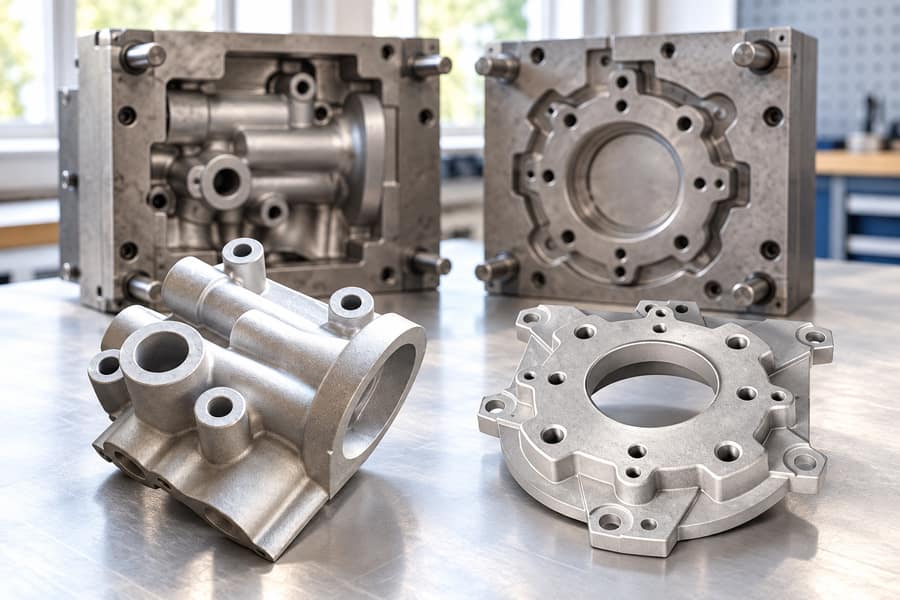
Gravity permanent-mold casting and pressure casting fill metal molds differently, but filling pressure alone does not determine part quality. Geometry, alloy behavior, internal soundness, and machining requirements matter.
Low-pressure and high-pressure die casting differ enough in operation and application to warrant individual assessment. Their equipment, production economics, and processing constraints can lead to different choices for the same component.
Gravity Casting vs Pressure Casting: What Are the Main Differences?
Gravity Permanent-Mold Casting
In gravity casting, molten metal enters a reusable metal mold mainly under its own weight. The mold is prepared, filled, allowed to solidify, and opened for casting removal.
Gates direct the incoming metal, while risers or other feeding provisions compensate for solidification shrinkage where appropriate. Cooling conditions and section geometry influence how effectively those provisions work.
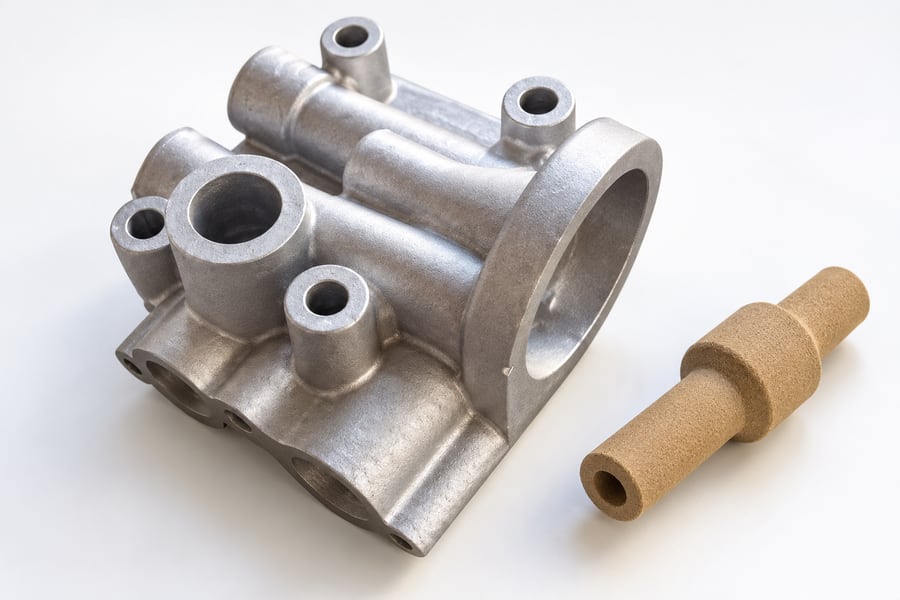
Metal cores can form accessible internal features, and suitable expendable cores may create more involved passages. Core removal, positioning, and compatibility with the mold cycle must be considered early.
Gravity permanent-mold casting should not be confused with sand casting. Both can use gravity filling, but reusable metal molds and expendable sand molds impose different tooling, cooling, and geometry constraints.
Low-Pressure Die Casting (LPDC)
Low-pressure die casting typically uses controlled gas pressure above a molten-metal bath to push metal upward through a fill tube into the mold. Filling is relatively controlled rather than driven by rapid injection.
Maintained pressure can also assist feeding during solidification, depending on the gating and thermal design. Pressure-assisted feeding can help, but engineers must still check for shrinkage defects and areas that solidify last.
LPDC is not simply a slower version of high-pressure die casting. Its metal-delivery arrangement, pressure regime, filling behavior, and production equipment differ substantially.
High-Pressure Die Casting (HPDC)
In the high-pressure form of pressure die casting, a powered shot system injects molten metal into a metal die. Rapid filling can support intricate geometry and short production cycles.
Gates, runners, overflows, vents, die temperature, and ejection features all influence the result. A properly engineered and controlled vacuum system can limit air entrapment during cavity filling.
Injection pressure alone cannot establish strength, density, or leak tightness. Those outcomes depend on alloy selection, metal cleanliness, flow conditions, solidification, and the defects remaining in critical locations.
| Comparison factor | Gravity permanent-mold | Low-pressure die casting | High-pressure die casting |
| Primary filling force | Gravity | Controlled gas pressure | Powered high-pressure injection |
| Filling characteristic | Pouring and gravity flow | Controlled upward filling, commonly through a tube | Rapid cavity filling |
| Feeding approach | Risers and designed feeding paths | Pressure can assist feeding | Feeding options depend on rapid solidification and die design |
| Internal-feature strategy | Metal or suitable expendable cores | Core arrangements depend on equipment and part design | Slides and removable cores common; enclosed passages need special review |
| Main integrity concerns | Shrinkage, inclusions, gas and filling defects | Shrinkage, gas and filling defects | Entrapped gas, shrinkage and other localized defects |
| Production considerations | Mold cycle and feeding requirements | Pressure-control and solidification cycle | Potential for fast repeated cycles with substantial tooling |
| Thermal processing | Alloy and soundness dependent | Alloy and soundness dependent | Conventional gas entrapment may constrain solution treatment; qualified variants differ |
How Do Part Geometry and Material Requirements Affect Casting Selection?
Wall Thickness and Geometric Complexity
Thin walls require metal to reach remote features before freezing. HPDC’s rapid filling can help, but trapped air, erosion, and premature solidification remain design concerns.
Gravity filling may suit less demanding flow paths or geometries that permit effective feeding. LPDC offers another filling strategy where controlled metal entry and section transitions are important.
Thicker junctions can form hot spots that solidify later than adjacent walls. Local feeding, cooling control, and geometry changes may matter more than the nominal filling method.
No universal wall-thickness threshold separates these processes. Alloy fluidity, flow length, local geometry, die temperature, and acceptable defect levels must be assessed together.
Internal Cavities, Cores, and Undercuts
Valve bodies may contain turning passages, while housings may need pockets, bearing openings, and recessed mounting features. These details often determine practical tooling options before cycle time does.
Gravity molds can incorporate retractable metal cores or suitable expendable cores. LPDC tooling may also accommodate designed core systems, subject to process access and thermal conditions.
Conventional HPDC commonly relies on moving slides and removable metal cores. Complex enclosed passages can demand specialized methods or subsequent drilling rather than standard die movement.
Parting lines, core joints, and ejector locations should avoid sealing interfaces when feasible. Designers must also consider extraction directions, draft, core support, and access for cleaning.
Alloy Compatibility and Mechanical Properties
Aluminum casting alloys are widely considered across these processes, but identical alloy designations or tempers should not be assumed available in every route. Chemistry and solidification behavior affect feasibility.
Specify properties that matter in service: yield strength for permanent deformation, tensile strength for ultimate loading, elongation for ductility, and fatigue resistance for repeated stressing.
A comparison based on one test bar cannot establish the behavior of a differently sized casting. Section thickness, cooling rate, defects, and local heat-treatment response can change results.
Qualification should use appropriate specimen locations, orientations, material conditions, and test methods. An as-cast gravity component should not be compared casually with a heat-treated pressure casting.
Draft, Parting Lines, and Mold Release
A shape that looks straightforward in CAD may require added draft, a revised parting line, or multiple moving tool elements. Those changes affect tooling cost and dimensional control.
As-cast tolerances must be agreed for the actual geometry and process. Critical bores, sealing faces, or mating interfaces may be more reliably established during machining.
How Do Internal Casting Quality, Heat Treatment, and Welding Requirements Compare?
Shrinkage Porosity and Gas Entrapment
As molten metal freezes, contraction can leave voids in regions without sufficient feeding. Gravity molds often use risers and directed solidification; LPDC may retain pressure during feeding.
Gas porosity has different origins, including dissolved gas and air trapped during filling. Melt preparation, gate design, venting, and operating stability influence its severity in all three processes.
Rapid HPDC filling can entrain air, especially with unsuitable flow or venting. Vacuum assistance may reduce this risk, but equipment capability and actual operating conditions require verification.
Neither a smooth exterior nor a dense-looking sample proves acceptable internal soundness. Defect size, position, connectivity, and exposure during machining determine whether porosity affects function.
Internal Soundness and Pressure-Tight Components
A valve body must meet its specified pressure and leakage requirements after all relevant operations. Internal pores may connect drilled passages to external surfaces or sealing regions.
Inspection should follow the failure mode. Radiography or computed tomography may reveal selected internal defects; leak testing checks containment under defined test conditions.
Test pressure, medium, duration, measurement sensitivity, and acceptance criteria must be documented. Passing one inspection method does not automatically satisfy every structural or service requirement.
Heat Treatment of Gravity and Low-Pressure Castings
Compatible alloys produced with suitable soundness may undergo solution treatment, quenching, and aging to develop required properties. Results depend on composition, section geometry, and the actual casting condition.
Thermal cycles may cause distortion, residual stress, or dimensional movement. Machining sequence and inspection plans should account for components that need accurate sealing faces or aligned bores.
A process being generally compatible with heat treatment does not mean every alloy or part should receive the same schedule. The specified temper requires its own qualification.
Heat Treatment and Welding Considerations for HPDC
Entrapped gas in conventional HPDC may expand during high-temperature solution treatment, creating blisters or other damage. This can limit available thermal cycles for certain conventional castings.
Lower-temperature aging and other treatments are different operations; their feasibility cannot be inferred from solution-treatment restrictions. Some components may require no post-casting thermal treatment at all.
Specialized vacuum-assisted HPDC, appropriate alloy selection, and qualified processing can improve suitability for certain solution-treated or welded parts. Such capability must be demonstrated, not assumed.
Welding also depends on local porosity, oxide films, composition, joint design, and thermal response. Representative weld trials and inspection should precede any production commitment requiring welded castings.
How Do Tooling Costs and Production Volumes Influence the Choice?
Initial Tooling and Equipment Requirements
Permanent molds require durable cavities, gating, thermal management, and reliable opening arrangements. Internal cores, multiple parting directions, and replaceable wear elements can increase complexity.
LPDC introduces pressure-controlled metal delivery and associated mold interfaces. HPDC adds shot-system requirements, die locking, ejection arrangements, and potentially extensive slides and cooling provisions.
The lowest tooling quotation may not deliver the lowest finished-part cost. Maintenance frequency, tool life, yield, changeover needs, and inspection should influence comparisons.
Cycle Time and Production Efficiency
HPDC can offer rapid repetitive production for suitable designs, but complex ejection, thick sections, or demanding quality controls may extend actual cycles.
Gravity and low-pressure cycles depend on filling, cooling, mold handling, and feeding requirements. Neither process should be assigned a fixed productivity level without evaluating a specific tool.
Capacity calculations should reflect operating availability and acceptable output, not merely theoretical shots per hour. Trimming, inspection, and material handling may create additional constraints.
Total Manufacturing Cost
A useful estimate includes tooling amortization, melt handling, casting labor, consumables, maintenance, trimming, heat treatment where needed, inspection, machining, and rejected components.
Order volume matters because upfront tooling is distributed across acceptable parts. Yet there is no universal annual quantity at which HPDC becomes the cheaper choice.
Give each supplier identical drawings, inspection requirements, delivery specifications, and projected order volumes for a meaningful cost comparison. Otherwise, apparent process savings may simply reflect different included operations.
Evaluating Machining Needs and Finished-Part Inspection
Machining Allowances and Critical Dimensions
Casting should leave enough material for critical finished dimensions without creating unnecessary stock removal. Allowances depend on process capability, geometry, datum stability, and defect exposure risks.
Choose locating features that remain repeatable after trimming or heat treatment. Poorly placed datums can create unnecessary setup variation even when the casting itself is acceptable.
Bores, threads, gasket faces, and precision mounting interfaces commonly need machining. A promising as-cast surface finish does not substitute for verifying functionally specified dimensions.
Machining Valve Bodies and Housings
Valve bodies often need accurately aligned ports, sealing seats, and threaded connections. Their internal passages also require attention to trapped debris, intersecting holes, and leak paths.
Housings may require controlled bearing seats, mating faces, shaft alignment, and bolt patterns. Tool access and clamping surfaces should be considered before committing to mold geometry.
Machining can open subsurface pores that were harmless or invisible in the as-cast condition. Critical finished faces and drilled intersections may therefore need targeted inspection.
Surface Finish and Final Quality Verification
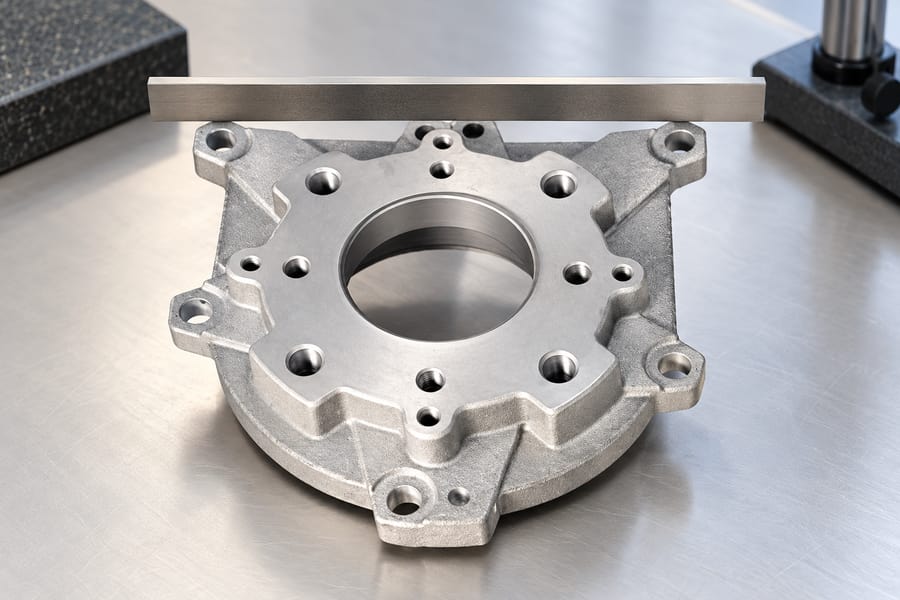
Surface requirements should distinguish cosmetic appearance from functional roughness and sealing performance. Depending on the part’s operating environment, specific surfaces may need machining, abrasive blasting, burr removal, or protective coating.
A finished-part inspection plan might combine dimensional measurements, roughness checks, defect assessment, and leakage tests. Each result must be judged against documented drawing requirements.
For cast parts, comparing processes at the delivered condition avoids overlooking machining effort, rework, or inspection needed to meet the same functional specification.
How Should Engineers Select the Right Casting Method?
Match the Process to the Governing Requirement
Begin with the features that cannot be compromised: internal passages, minimum viable walls, material properties, service loads, sealing performance, and finishing requirements.
A thin-walled housing may prompt an HPDC review, while a core-dependent passage may favor evaluation of gravity or LPDC tooling. Neither observation is a final process recommendation.
If a specification calls for solution treatment or welding, ask for evidence from the intended alloy and process variant. Do not reject all HPDC options without examining qualification.
Likewise, pressure-tight service calls for tested integrity rather than assumptions about gravity filling or pressure-assisted feeding. Manufacturing route and acceptance standard must be evaluated together.
| Project requirement | Gravity permanent-mold considerations | LPDC considerations | HPDC considerations | Verification priority |
| Thin walls and complex ribs | Check flow distance and freeze-off | Check fill control and geometry | Rapid filling may help | Filling analysis and representative samples |
| Core-dependent passages | Evaluate core design and removal | Evaluate compatible core arrangement | Review slides or specialized core methods | Tooling and passage accessibility |
| Strength and ductility | Assess alloy, condition and soundness | Assess alloy, condition and soundness | Assess qualified alloy and process variant | Relevant material tests |
| Leak-tight features | Check shrinkage and machined exposure | Check feeding and local defects | Check gas entrapment and critical surfaces | Defined leak test and defect limits |
| Solution treatment or welding | Review alloy and casting integrity | Review alloy and casting integrity | Conventional constraints; specialized routes may qualify | Representative thermal or weld trials |
| Production economics | Evaluate mold cycle and tooling | Evaluate equipment and solidification cycle | Evaluate die investment and output | Cost per accepted finished part |
| Precision interfaces | Plan machining datums and stock | Plan machining datums and stock | Plan machining datums and stock | Finished-part dimensional inspection |
Validate the Proposed Process Before Production
A drawing review should establish alloy, material condition, service environment, critical dimensions, inspection methods, and delivery state. Tooling feasibility should be checked before production assumptions become contractual obligations.
Where justified, filling or solidification analysis can identify likely risks. Representative castings then provide evidence from the actual process rather than general comparisons between casting families.
Measure critical finished dimensions and evaluate internal soundness at relevant locations. Include leak, strength, thermal-processing, or weld tests only where they correspond to project requirements.
Acceptance limits need to be agreed before interpreting results. A component that passes a cosmetic check may still fail a machined-surface or pressure-integrity criterion.
Prepare a Useful Supplier Review Package
Provide 2D drawings and 3D models, identified material specifications, required condition, and expected quantities. Mark sealing faces, precision bores, internal passages, and surfaces requiring machining.
State whether the supplier is quoting an as-cast blank or a completed machined component. Include expected inspection records, packaging requirements, and any post-casting processing responsibilities.
Boberry Machining offers gravity casting and die casting services; its published component range includes valve bodies and housings. Those product categories do not establish which casting process suits every design.
For an informed manufacturing review, request a proposed route, identified technical risks, and the tests needed to approve the finished part. Let documented requirements decide the method.