
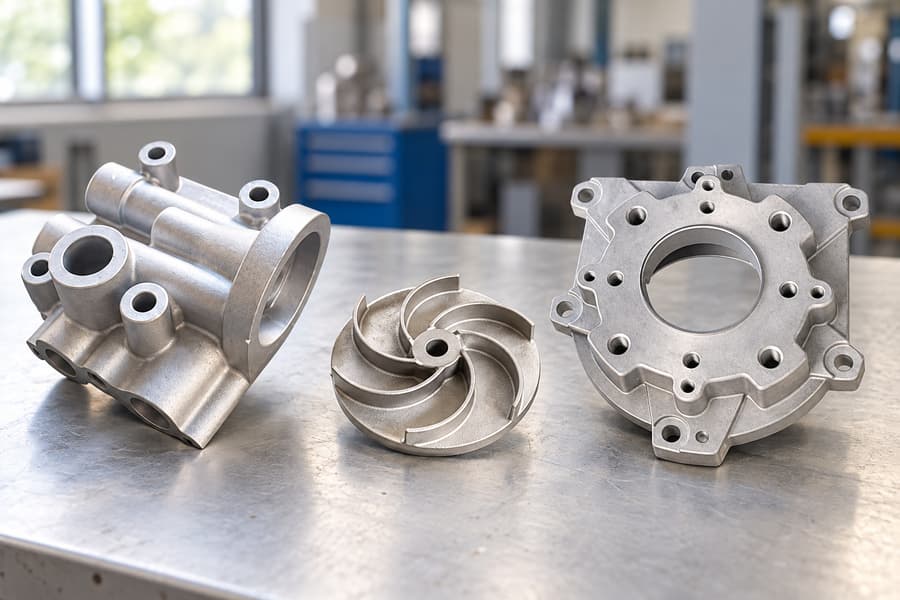
Industrial cast components form the housings, flow passages, and supports used in pumps, valves, motors, and machinery. Their shapes often combine structural features with surfaces requiring later machining.
Selection requires separate decisions about component function, alloy, casting process, and final inspection. Each choice must reflect service loads, operating conditions, and production needs.
Understanding Industrial Cast Components and Their Classification
What Makes a Component an Industrial Casting?
A cast part is made by filling a prepared mold with molten metal, letting the metal solidify, and extracting the part for subsequent operations.
The process can produce curved passages, enclosed cavities, mounting features, and complex external shapes. These characteristics make casting useful when machining an entire component from solid stock would require extensive material removal.
Buyers examining industrial cast components should distinguish between three delivery conditions:
- Rough Castings: Components supplied after casting and agreed basic cleaning or removal operations, with further processing potentially required.
- Machined Castings: Cast components with precision features produced through operations such as milling, drilling, boring, and turning.
- Finished Components: Parts supplied in an agreed condition that may include machining, surface treatment, inspection, and other specified operations.
A casting is not necessarily ready for assembly when it leaves the mold. Its required delivery condition depends on the drawing and purchase specification.
Three Ways to Classify Industrial Cast Components
Industrial cast components can be classified by function, material, or manufacturing process. Each classification answers a different engineering question.
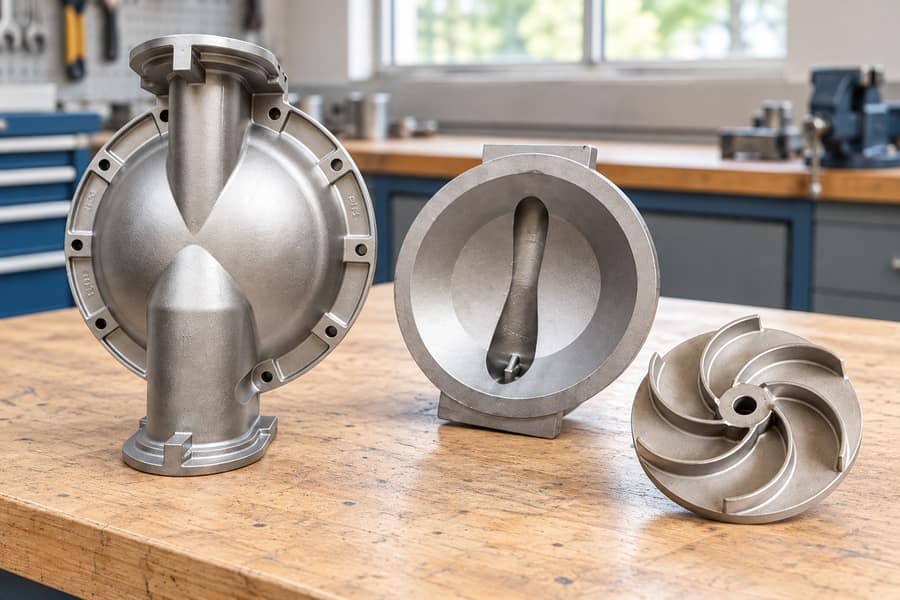
Functional classification identifies the component’s purpose. Valve bodies control fluid passages, impellers transfer energy to fluids, and motor end covers support mechanical interfaces.
Material classification identifies the alloy family and required properties. Each alloy family presents different tradeoffs in mechanical properties, weight, corrosion resistance, and ease of manufacture.
Process classification describes how the casting is produced. Investment casting, gravity casting, and die casting use different tooling arrangements and filling methods.
These classifications overlap. An aluminum motor cover describes a function and material, but neither description alone establishes the manufacturing process.
Types of Industrial Cast Components and Their Applications
Valve Bodies for Fluid Control Systems
Cast valve bodies provide internal passages and connection surfaces for controlling fluid flow. They are used in industrial valves, pipelines, pumping systems, and process equipment.
Their geometry may contain intersecting passages, curved chambers, and reinforced connection points. These passages and connection features can be formed within one cast body instead of being manufactured as separate pieces.
Engineers must account for fluid characteristics, expected pressure and temperature, and the configuration of adjoining connections. Material selection must also account for corrosion and other relevant degradation mechanisms.
Valve seats, flange faces, threaded ports, and sealing interfaces frequently require machining. Pressure-containing applications may also require specified inspection and pressure testing before acceptance.
Cast Impellers for Pumps and Fluid-Handling Equipment
Impellers are rotating components that transfer mechanical energy to fluids. Cast impellers are found in centrifugal pumps and other equipment requiring controlled fluid movement.
Their blade profiles and internal passages influence hydraulic performance. Forming curved blades and passages directly in a mold can be more practical than machining the entire geometry from solid stock.
Material selection depends on operating speed, fluid chemistry, temperature, and potential erosion or cavitation exposure. Different environments can require substantially different alloys.
The shaft connection, hub bore, and selected reference surfaces may require precision machining. Rotational balance and dimensional verification should follow the equipment’s operating requirements.
Aluminum Motor End Covers for Electric Motors
Motor end covers close the ends of motor housings while providing mechanical support for bearings, fasteners, and other assembly interfaces.
Aluminum alloys are commonly considered where reduced weight and thermal behavior are important. However, actual mechanical performance depends on alloy selection, casting quality, and geometry.
A motor end cover must maintain the intended relationship between bearing supports and other motor components. Poor alignment can affect assembly fit and operating behavior.
Bearing bores, locating diameters, and mounting faces often require machining. Designers should also consider thermal expansion differences between aluminum castings and adjoining components.
Machinery Housings and Structural Cast Components
Cast housings are used in industrial machinery, mechanical drives, and equipment enclosures. They provide structural support while accommodating shafts, bearings, fasteners, and internal mechanisms.
Casting allows designers to integrate mounting bosses, reinforcing ribs, and internal cavities. This can reduce the number of separate structural pieces required.
Housing geometry must accommodate mechanical loads, vibration, thermal movement, and installation constraints. Greater wall thickness does not automatically improve performance or casting quality.
Machined bearing seats, mounting planes, and locating features establish critical assembly relationships. Their tolerances should be specified according to the equipment’s functional requirements.
Cast Brackets and Mechanical Support Components
Cast brackets connect machinery components, support mounted equipment, and transfer mechanical loads between structures. Their shapes often include mounting holes, ribs, and reinforcing transitions.
Integrated casting geometry can be useful where several connected features would otherwise require fabrication and assembly. Its suitability depends on loading, quantity, material, and manufacturing requirements.
Designers must consider load direction, fastener placement, and local stresses. Sharp geometric transitions or unsupported projections may require additional structural review.
Machining may be necessary for mounting faces and precision holes. Inspection should concentrate on dimensions and features that directly affect load transfer and installation.
Common Casting Alloys and Their Industrial Uses
Carbon Steel Castings
Carbon steel castings are used for mechanical components requiring selected combinations of strength, ductility, and toughness. Their properties depend on composition, processing, and heat treatment.
Typical applications include structural machinery parts, valve components, and other load-bearing equipment features. Carbon steel is also used for components manufactured through investment casting.
The specified grade should reflect service loads, temperature, and environmental exposure. Carbon steel generally requires additional consideration where corrosion resistance is important.
Aluminum Castings for Lightweight Equipment
Aluminum alloys can reduce component mass while providing effective heat conduction in suitable equipment designs. These characteristics make them suitable candidates for motor covers, machinery housings, and selected equipment components.
Their casting behavior varies significantly by alloy and process. Strength, elongation, dimensional stability, and machinability should be evaluated for the selected material condition.
For precision assemblies, thermal expansion can influence bearing fits and alignment. Designers must consider the temperatures experienced during machining, assembly, and operation.
Stainless Steel Castings for Corrosive Environments
Cast stainless steel is considered for components exposed to conditions that demand grade-specific corrosion protection. Typical uses include valve internals, pump components, and other parts in direct contact with process fluids.
Stainless steel grades vary in their ability to withstand corrosive exposure, mechanical loads, and elevated operating temperatures. The selected grade should match the fluids, temperatures, and exposure conditions encountered during service.
A stainless steel designation alone does not guarantee suitability for every chemical exposure. Surface condition, fluid concentration, temperature, and operating conditions can influence corrosion behavior.
Cast Iron and Other Engineering Casting Alloys
Cast iron remains useful for selected machinery housings, support structures, and equipment components. Its suitability depends on iron type, geometry, and mechanical loading.
Gray cast iron provides useful vibration-damping characteristics, while ductile iron can offer greater ductility and different strength characteristics. Neither should be treated as interchangeable with cast steel.
Other casting alloys may be considered for specialized thermal, wear, or corrosion requirements. Their availability and process compatibility require confirmation during manufacturing review.
Matching Casting Materials to Operating Conditions
Material selection should begin with the component’s service requirements rather than a preference for a familiar alloy family.
| Material Family | Key Selection Factors | Typical Applications | Points to Verify |
| Carbon steel | Strength, toughness, heat treatment | Valve components, structural parts | Grade, loading, corrosion protection |
| Aluminum alloys | Weight, thermal properties, castability | Motor covers, equipment housings | Alloy grade, strength, dimensional stability |
| Stainless steel | Corrosion behavior, temperature compatibility | Pump and valve components | Fluid compatibility, grade, operating temperature |
| Cast iron | Stiffness, damping, mechanical loading | Machinery housings, support components | Iron type, impact resistance, tensile properties |
Material selection also affects casting feasibility. An alloy that meets the mechanical requirements may still require a particular manufacturing route or geometry adjustment.
Engineering drawings should identify the required grade and material condition. Where equivalent materials are permitted, acceptance criteria should be defined before substitution.
Industrial Casting Processes: Investment, Gravity, and Die Casting
Investment Casting for Complex Industrial Components
Investment casting uses expendable patterns and ceramic molds to produce metal components with detailed external and internal features.
It is applicable to selected steel and other compatible alloy castings, including components with intricate geometry or features that would otherwise require substantial machining.
The process can provide useful dimensional capability and surface finish, but achievable results depend on component size, alloy, geometry, and process control.
Tooling requirements, ceramic shell preparation, solidification behavior, and machining allowances should be evaluated before selecting investment casting for a particular component.
Gravity Casting for Industrial Metal Parts
Gravity casting introduces molten metal into a mold primarily through gravitational force rather than high-pressure injection.
It is commonly considered for suitable aluminum alloy components, including selected housings and mechanical parts. Mold type and alloy selection affect achievable features.
Wall thickness, feeding arrangements, and solidification behavior influence casting soundness. Complex cavities may require cores or additional manufacturing provisions.
Buyers should review tooling requirements, dimensional allowances, surface condition, and production quantity before choosing gravity casting over alternative manufacturing methods.
Die Casting for Metal Housings and Covers
Die casting commonly uses pressure to introduce molten metal into reusable metal dies. It is widely associated with suitable nonferrous alloys and repeatable component geometries.
Potential applications include motor covers, equipment housings, and enclosures. The process can support relatively thin sections, subject to alloy and tooling constraints.
Tooling complexity and production quantity strongly influence manufacturing suitability. High-pressure die casting may also introduce porosity requiring attention in critical applications.
Pressure integrity, heat treatment suitability, and machining behavior should therefore be evaluated rather than assumed from the manufacturing process alone.
Comparing Casting Processes for Component Selection
The main differences between casting processes involve compatible alloys, geometry, tooling, production requirements, and achievable casting characteristics.
| Casting Process | Typical Compatible Alloys | Geometry and Dimensional Considerations | Production Considerations | Common Applications |
| Investment casting | Carbon steel, stainless steel, other suitable alloys | Detailed shapes, complex features, process-dependent tolerances | Pattern tooling, shell preparation, production planning | Valve parts, impellers, mechanical components |
| Gravity casting | Suitable aluminum and other nonferrous alloys | Mold filling, wall thickness, solidification control | Mold tooling, cycle requirements, quantity | Housings, covers, machinery components |
| Die casting | Suitable aluminum, zinc, and other nonferrous alloys | Thin sections, detailed die geometry, porosity considerations | Metal dies, production quantity, tooling complexity | Motor covers, enclosures, equipment housings |
No process is automatically superior for every industrial component. A technically suitable comparison must use the same required function, material properties, and acceptance conditions.
Machining and inspection requirements also affect the decision. A process that produces satisfactory rough geometry may still require extensive finishing to meet functional tolerances.
Design Considerations for Custom Industrial Cast Components
Wall Thickness and Structural Geometry
Wall thickness influences molten metal flow, cooling behavior, and structural performance. Abrupt section changes may create localized solidification difficulties or stress concentrations.
Designers should examine transitions between thick and thin sections, particularly around bosses, ribs, and reinforced mounting features. Smooth transitions may improve manufacturability.
Uniform thickness is often desirable but cannot always be maintained in functional components. Where heavy sections are necessary, feeding and solidification requirements need specific review.
Dimensional Tolerances and Machining Allowances
Casting tolerances differ from final machining tolerances. A component may meet its as-cast requirements while still needing machining at important assembly interfaces.
Engineering drawings should distinguish critical dimensions from noncritical geometry. Applying precision-machining tolerances throughout an entire rough casting can introduce unnecessary manufacturing constraints.
Machining allowances must provide sufficient material for finishing while accounting for casting variation. Excessive allowances can increase material removal and machining effort.
Mechanical Loads and Operating Conditions
Industrial cast components may experience static loading, repeated stress cycles, vibration, thermal changes, or fluid pressure. Each condition influences material and geometric requirements.
A component carrying cyclic loads requires attention to fatigue-sensitive features. Pressure-containing castings need suitable integrity requirements, while rotating components may demand balance verification.
Material properties should be evaluated in the specified condition, including any relevant heat treatment. General alloy descriptions are insufficient for critical structural assessments.
Designing for Casting and Assembly
A castable design must account for mold access, parting arrangements, draft where required, and methods for producing internal passages.
Features that appear simple in a finished drawing may create substantial tooling difficulties. Deep cavities, enclosed passages, and inaccessible surfaces deserve early manufacturing review.
Assembly requirements are equally important. Bearing locations, mounting surfaces, and fastener access should be considered before finalizing the casting geometry.
Early coordination between design, casting, and machining can identify conflicts between tool access, machining allowances, and finished assembly requirements.
Post-Casting Machining and Finishing Requirements
CNC Machining of Functional Surfaces
Casting creates the primary component shape, while CNC machining produces selected dimensions and surfaces requiring tighter control.
Typical operations include milling mounting faces, boring bearing seats, drilling connection holes, turning cylindrical interfaces, and machining valve sealing surfaces.
Not every surface needs machining. Functional requirements should determine where additional precision is necessary and where the original cast surface remains acceptable.
Machining Datum Selection and Dimensional Control
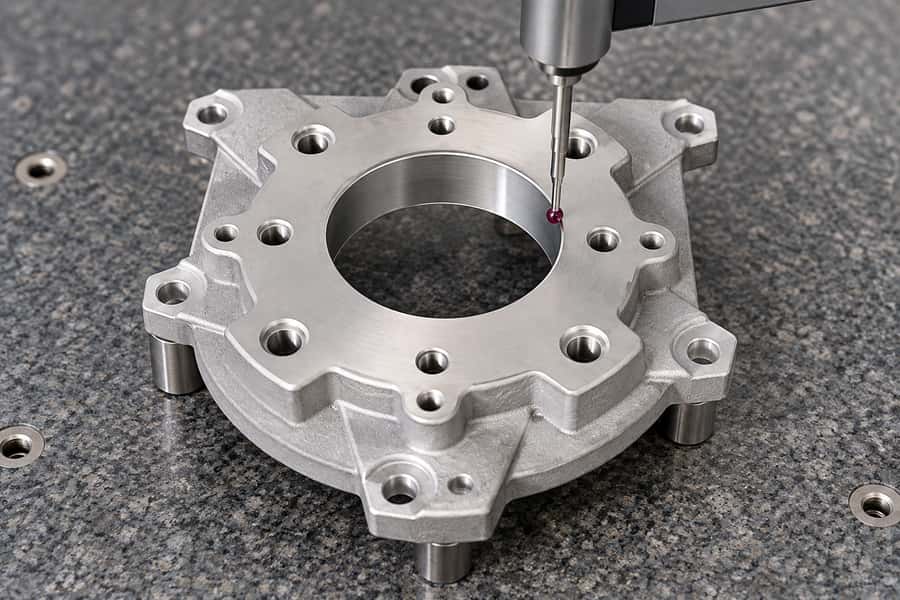
Machining datum selection establishes how a component is positioned during processing. Poor datum planning can create alignment problems between critical features.
For example, bearing bores and mounting surfaces may need controlled relationships to achieve proper assembly. These relationships should appear explicitly in the engineering drawing.
Workholding must accommodate casting variation without introducing unacceptable distortion. Inspection should verify finished dimensions using the specified reference system.
Surface Finishing and Secondary Operations
Cast components may require cleaning, deburring, surface preparation, or protective finishing before assembly. The necessary operations depend on material and service conditions.
Coatings may be specified for corrosion protection, while selected components may require heat treatment to achieve their intended material properties.
Surface treatments should be evaluated for compatibility with dimensional requirements. Coating thickness or processing distortion can affect precision fits and sealing interfaces.
Coordinating Casting and Machining
Casting and machining should be planned as connected manufacturing stages rather than unrelated purchasing activities.
Machining requirements influence initial casting geometry, stock allowances, fixture access, and feature placement. These decisions can affect tooling design and processing sequence.
A coordinated manufacturing plan should identify critical surfaces, inspection points, and required delivery condition before production commitments are finalized.
Quality Inspection and Acceptance Requirements
Common Casting Defects and Their Significance
Casting defects can include porosity, shrinkage cavities, inclusions, cracks, and surface discontinuities. Their occurrence and significance depend on the alloy, process, geometry, and application.
A discontinuity near a highly stressed feature may be more serious than a comparable indication in a noncritical region.
Acceptance requirements should therefore consider defect type, location, size, and service conditions. Not every visible surface imperfection indicates functional failure.
Dimensional and Material Verification
Dimensional inspection confirms whether the casting and its machined features meet the approved drawing. Measurement methods should match the tolerance and accessibility of each feature.
Material verification may include grade identification, chemical composition records, and applicable mechanical property documentation, depending on contractual requirements.
Traceability becomes particularly important when components have specified heat treatment, material conditions, or application-related inspection obligations.
Functional Testing and Quality Documentation
Functional testing depends on component duty. Valve bodies may require pressure or leak testing, while selected impellers may require rotational balance verification.
Other applications may call for nondestructive examination or additional material testing. The selected methods should follow agreed engineering requirements.
Inspection plans must define acceptance criteria, documentation, and responsibility for resolving nonconformities. These details should be established before manufacturing rather than after delivery.
How to Specify and Source Custom Industrial Cast Components
Define Technical and Application Requirements
An effective casting inquiry begins with a technical drawing and a description of the intended service environment.
Buyers should identify operating loads, temperature, fluid exposure, assembly interfaces, and dimensional requirements. These details establish the basis for material and manufacturing decisions.
Critical requirements must be clearly separated from preferences. Manufacturing flexibility is useful, but essential functional and safety requirements should not become negotiable through unclear specifications.
Evaluate Casting and Machining Requirements Together
Supplier evaluation should cover the complete manufacturing route, including alloy selection, mold preparation, casting, machining, finishing, and inspection.
Boberry Machining offers custom cast parts such as valve bodies, impellers, aluminum motor end covers, and carbon steel investment castings, alongside investment casting, gravity casting, die casting, and post-machining services.
The appropriate process still depends on the individual component. Alloy compatibility, geometry, quantity, and required quality should be reviewed before choosing a manufacturing route.
Prepare a Complete Technical Inquiry
Industrial buyers can reduce specification ambiguity by organizing the inquiry around five practical categories:
- Engineering Drawings: Provide component geometry, dimensional tolerances, reference datums, surface requirements, and critical interfaces.
- Material Requirements: Specify the required alloy grade, relevant material condition, and any applicable heat treatment.
- Production Requirements: State estimated quantities, expected order patterns, and the requested supply condition.
- Quality Requirements: Identify inspection methods, functional tests, documentation, and agreed acceptance criteria.
- Manufacturing Flexibility: Explain which features or process choices may be adjusted without compromising the intended application.
Incomplete specifications can lead to different interpretations of what the supplier must deliver. Clearly identify surfaces requiring machining and establish responsibility for dimensional and quality inspections.
Assess Manufacturing Proposals Against Engineering Requirements
Casting proposals should be assessed against engineering suitability, not merely the stated manufacturing process or apparent simplicity of the component.
Confirm the proposed material grade, tooling approach, machining scope, required finishing, and acceptance documentation. Any proposed design modifications should receive engineering approval.
Responsibility for tooling, material records, dimensional verification, and nonconformance resolution should be clear before an order proceeds.
For industrial cast components, a well-defined manufacturing scope helps ensure that the delivered part matches the intended function, assembly requirements, and documented quality expectations.