
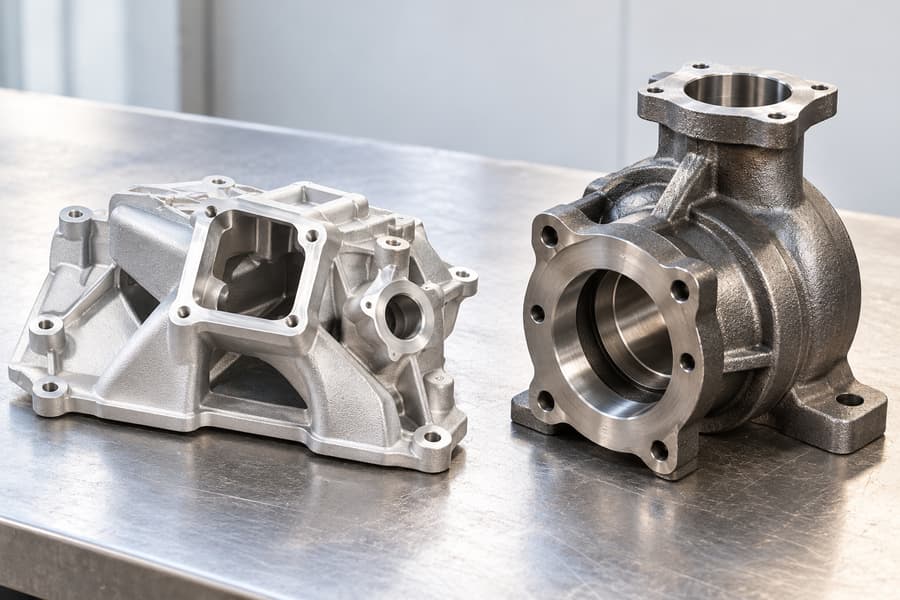
Aluminum casting is often chosen for lightweight components and heat-transfer applications, while steel casting can better suit designs requiring high stiffness, heavy loading, or elevated-temperature capability.
Selecting between them requires more than comparing material names: engineers must evaluate alloy specifications, geometry, service conditions, manufacturing requirements, inspection criteria, and total lifecycle cost.
Define the Application Requirements Before Selecting a Material
Identify the Component’s Function and Load Requirements
Material selection should begin with the component’s function and the demands placed on it during operation. Equipment housings, structural supports, pump components, machine frames, and heat-transfer parts require different combinations of mechanical and physical properties.
For weight-sensitive assemblies, aluminum casting can reduce component mass and simplify handling, installation, or movement.
Components supporting substantial loads may instead benefit from steel’s higher stiffness, provided the selected grade meets the required strength and toughness criteria.
Engineers should also examine how the component connects to surrounding structures. Mounting points, bearing seats, bolted joints, and load-transfer surfaces can create local stresses that influence both material selection and casting geometry.
Establish Operating Conditions and Potential Failure Risks
A material that performs adequately under static loading may be unsuitable when exposed to repeated stress, impact, vibration, or substantial temperature changes.
Operating conditions therefore need to be documented before candidate materials can be compared meaningfully.
Environmental exposure is equally important. Moisture, chlorides, industrial chemicals, abrasive particles, and contact with dissimilar metals can affect corrosion behavior, maintenance requirements, and expected component performance.
- Mechanical loading: Identify static and peak loads, cyclic stresses, impact forces, vibration, and the expected loading pattern throughout operation.
- Temperature conditions: Record normal operating temperatures, thermal cycling, and possible excursions that could affect strength, dimensions, or material stability.
- Environmental exposure: Assess moisture, chemicals, corrosive substances, abrasion, and galvanic contact with adjacent components.
- Failure consequences: Determine whether excessive deformation, cracking, leakage, or fracture could interrupt operations or create safety risks.
Define Mandatory Engineering Acceptance Criteria
Translate operating requirements into measurable specifications before requesting quotations. Depending on the application, these may include mechanical properties, maximum permissible deflection, dimensional tolerances, corrosion resistance, surface finish, and inspection requirements.
Separate mandatory criteria from preferences such as lower weight or reduced machining. A candidate material must satisfy the essential engineering requirements before procurement cost and manufacturing convenience become deciding factors.
Compare the Physical and Mechanical Properties of Aluminum and Steel Castings
Density and Component Weight
Aluminum alloys have substantially lower density than steel, making them attractive when reducing component mass is a primary design objective. Lower weight can simplify handling, reduce moving mass, and ease transportation or installation.
However, comparing equal volumes of aluminum and steel does not establish the weight difference between finished components.
An aluminum design may require thicker walls, deeper sections, or additional ribs to achieve the required stiffness and load-bearing performance.
The correct comparison evaluates complete designs under equivalent loading conditions, functional requirements, and allowable deformation. Engineers should assess whether the weight reduction remains worthwhile after necessary geometry changes are incorporated.
Strength, Stiffness, and Load-Bearing Performance
Strength describes resistance to yielding or fracture under specified conditions, whereas stiffness describes resistance to elastic deformation.
These properties must be assessed separately because a strong material does not necessarily provide the stiffness required by a particular design.
Steel has a substantially higher elastic modulus than aluminum. With identical geometry and elastic loading, a steel component generally deflects less; changing section depth or rib layout can alter that comparison.
Aluminum can still serve effectively in structural applications when the component geometry is designed appropriately.
Increasing section depth, adjusting rib placement, or modifying wall thickness may improve stiffness, although these changes must also preserve casting feasibility and weight objectives.
Mechanical comparisons must use data applicable to the actual casting grade, heat-treatment condition, and operating temperature. Properties reported for wrought products should not automatically be assigned to cast components made from a related alloy family.
Thermal Conductivity, Expansion, and Temperature Resistance
Aluminum alloys generally offer higher thermal conductivity than steel, which can benefit housings and components designed to transfer or dissipate heat. This advantage must be balanced against dimensional changes caused by temperature fluctuations.
Aluminum generally expands more than steel for an equivalent temperature change and component length. Assemblies with close clearances, seals, or alignment-sensitive interfaces therefore require careful consideration of thermal expansion and operating tolerances.
For a hot-running steel component, review the grade data for retained load capacity and dimensional change, then assess the repeated heating and cooling expected in service. Neither material family should be approved for hot service without checking properties at the actual operating temperature.
Key Property Differences Between Aluminum and Steel Castings
The following table summarizes general tendencies for initial screening. Actual performance depends on the specified alloy, casting quality, heat treatment, geometry, and service environment.
| Property | Aluminum casting | Steel casting |
| Density | Lower; beneficial for weight-sensitive designs | Higher; increases mass for comparable volume |
| Stiffness | Lower elastic modulus; geometry may need adjustment | Higher elastic modulus; often useful for deflection control |
| Strength | Depends on alloy, casting quality, and heat treatment | Depends on grade, casting quality, and heat treatment |
| Thermal conductivity | Generally higher | Generally lower, depending on grade |
| Thermal expansion | Generally higher | Generally lower than aluminum |
| Corrosion behavior | Protective oxide layer, but susceptible to certain chemical and galvanic conditions | Varies by grade; some steels require protective coatings |
| Typical selection priority | Low weight and heat transfer | Stiffness, heavy loading, and suitable high-temperature performance |
Choose the Right Casting Alloy and Material Specification
Select an Aluminum Casting Alloy Based on Application Requirements
Aluminum casting alloys differ in strength, fluidity, corrosion resistance, thermal conductivity, and heat-treatment response. A grade suitable for a housing with complex geometry may not provide the properties required for a heavily loaded structural component.
Selection should consider the specified mechanical properties, wall thickness, casting method, environmental exposure, and finishing requirements.
Heat treatment may improve particular properties, but it can also cause dimensional changes that affect subsequent machining and tolerance control.
For custom aluminum castings, begin with the housing or support drawing. Confirm the alloy, heat-treatment condition, and functional surfaces before comparing production proposals.
Evaluate Carbon Steel and Alloy Steel Casting Grades
Carbon steel and alloy steel castings offer different combinations of strength, toughness, hardenability, and temperature performance.
Carbon steel may suit general structural applications, while an alloy steel grade may be considered when particular mechanical properties are required.
The highest available strength is not necessarily the best selection criterion. Impact toughness, fatigue resistance, corrosion exposure, section dimensions, heat treatment, and manufacturing feasibility must be evaluated together.
Engineers should identify the applicable casting specification and required material condition in the drawing or purchase specification. A generic reference to steel does not provide enough information to verify composition, mechanical properties, or acceptance requirements.
Distinguish Cast Stainless Steel Grades from Wrought Grades
Cast stainless steel grades must be specified using the applicable casting designation and standard. A casting purchase order may specify CF8 or CF8M. A drawing calling for wrought 304 or 316 requires a separate review before either cast grade is substituted.
These designations may represent related alloy families, but they are not automatic equivalents. Casting and wrought manufacturing routes can produce differences in microstructure, permitted composition, mechanical properties, and applicable acceptance requirements.
For corrosive service, verify the exact cast grade against the chemical environment, temperature, concentration, and exposure duration. The general description stainless steel is insufficient to establish resistance to a specific chemical or chloride-containing environment.
Verify Heat Treatment and Material Documentation
Material documentation should identify the specified grade, applicable standard, required condition, and relevant test results.
Depending on the application, procurement may require chemical composition records, mechanical test reports, and evidence of conformity with the purchase specification.
Any proposed material substitution should receive engineering approval before production. A substitute must meet the original functional requirements, including strength, toughness, corrosion resistance, temperature limits, and applicable regulatory obligations.
Evaluate Casting Design, Geometry, and Manufacturability
Optimize Wall Thickness and Section Transitions
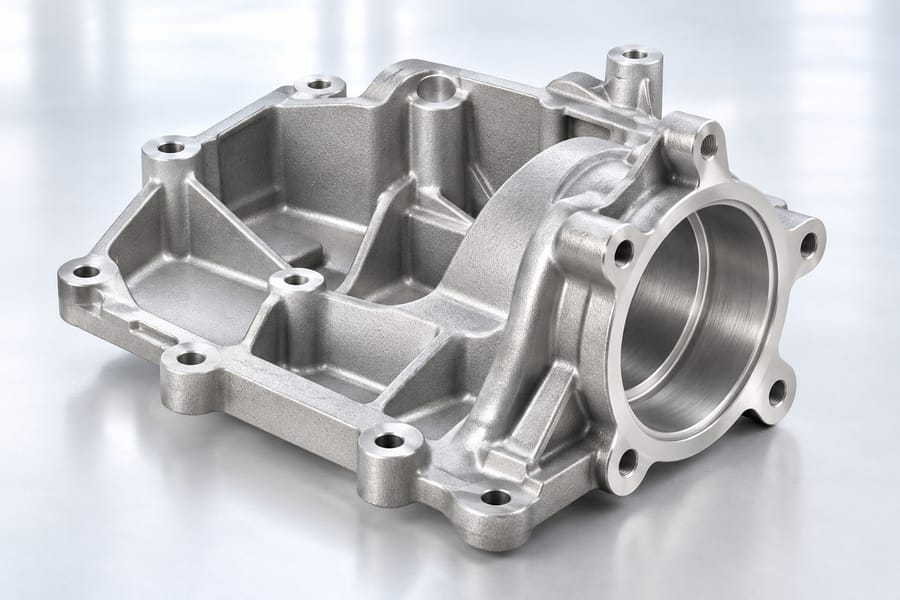
Component geometry affects both structural behavior and casting quality. A heavy boss beside a thin wall cools differently from its surroundings. That thermal imbalance can produce stressed regions or shrinkage-related flaws unless the feeding and geometry are addressed.
Engineers should review wall thickness, fillets, ribs, section transitions, and the location of potential shrinkage or porosity. Uniform sections can simplify solidification control, although the appropriate geometry must ultimately satisfy functional loads and manufacturing constraints.
Aluminum and steel have different melting and solidification characteristics, so designs cannot always be transferred directly between materials.
A change in alloy or casting route may require revisions to section dimensions, feeding arrangements, or other process-related features.
Assess Geometric Complexity, Dimensional Accuracy, and Machining
Both aluminum and steel can be cast into complex shapes, but achievable geometry and dimensional accuracy depend on the alloy, process, component size, tooling, and production controls.
Not every casting method is suitable for both materials.
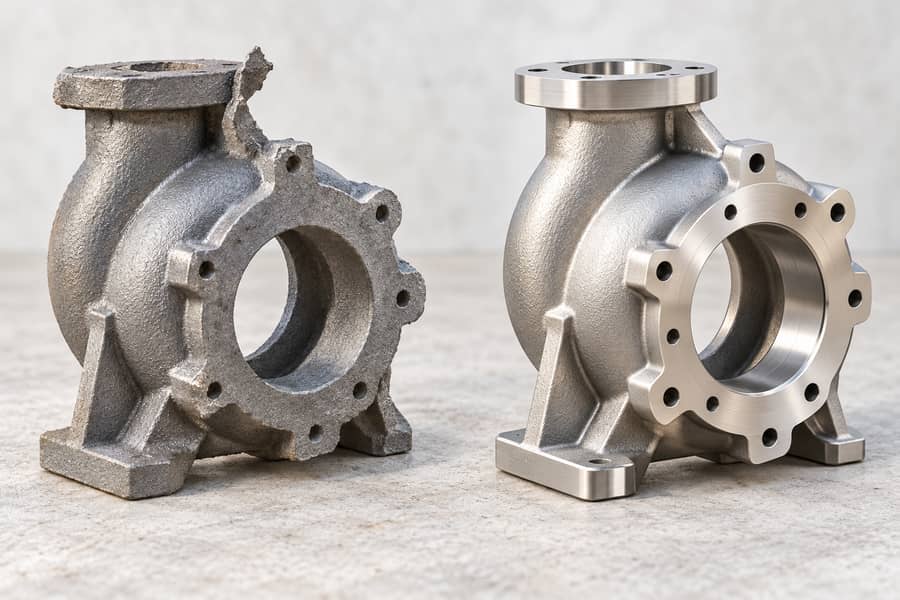
Identify critical features before finalizing the design, particularly bearing seats, mounting interfaces, threaded holes, sealing surfaces, and alignment references. These features may require machining even when other surfaces can remain in their as-cast condition.
Machining allowances should reflect the expected casting condition and the material required for removal.
Potential distortion during cooling or heat treatment should also be considered when establishing datum references, machining sequences, and final dimensional acceptance criteria.
Match the Material to a Suitable Casting Process
Process selection depends on material compatibility, production volume, component geometry, required quality, and tooling considerations. The higher melting temperature of steel imposes different mold and process requirements from those associated with aluminum casting.
Aluminum can use sand, permanent-mold, or pressure die casting, depending on the alloy and part. Steel commonly uses sand or investment casting; a conventional aluminum die-casting tool is not transferable.
Identify Machining Allowances and Critical Dimensions
Before releasing a drawing for quotation, distinguish dimensions that can remain as cast from those requiring machining. Specify the relevant tolerances, surface finishes, and inspection methods for features that determine assembly fit or component performance.
Do not assume that every casting can achieve the same dimensional accuracy regardless of size or process.
Confirm achievable tolerances and inspection arrangements with the supplier for the specific component, and resolve any limitations before production approval.
Assess Service Performance and Potential Failure Risks
Corrosion Resistance and Environmental Compatibility
Corrosion resistance must be evaluated against the actual service environment rather than the broad material category. Moisture, chlorides, cleaning chemicals, process fluids, and dissimilar-metal contact can affect component durability differently.
For example, an aluminum housing mounted against steel hardware may require attention to galvanic corrosion if moisture can reach the interface. Appropriate isolation, coatings, drainage, or material combinations should be considered during assembly design.
Carbon steel castings may require protective coatings in exposed environments, while suitable stainless steel grades can provide better resistance under specified conditions.
Use the specified process fluid and cleaning cycle to assess the grade; a material name alone cannot establish corrosion performance under those conditions.
Fatigue Strength, Impact Loads, and Cyclic Loading
Components subjected to repeated loads require fatigue evaluation in addition to static strength checks. Rotating equipment housings, machine supports, and pump components may experience vibration or fluctuating stresses that gradually initiate cracks.
A mounting hole or a sudden change in section can concentrate the applied load into a small region, making that location a priority for fatigue assessment.
Generous transitions and carefully positioned ribs can help manage these concentrations, provided the geometry remains compatible with casting and machining requirements.
Impact-loaded components also require suitable toughness at the expected operating temperature. Where failure could interrupt production or create safety risks, specify relevant impact testing, fatigue assessment, and inspection criteria before approving the material.
Wear Resistance, Elevated Temperatures, and Pressure Containment
Wear behavior depends on contact pressure, relative movement, lubrication, abrasive particles, and surface hardness. Steel may be appropriate for demanding contact conditions, but the selected grade and heat-treatment condition must match the actual wear mechanism.
Elevated-temperature service requires checking strength retention, thermal expansion, oxidation behavior, and dimensional stability. Aluminum alloys can lose strength as temperature increases, so their suitability should be established using grade-specific properties at the intended operating conditions.
Pressure-containing castings need particular attention to wall thickness, internal discontinuities, leakage paths, and the consequences of failure. Material selection should be coordinated with the applicable pressure requirements, casting quality criteria, and inspection plan.
Determine Appropriate Testing and Inspection Requirements
Inspection methods should target the defects and failure modes relevant to the component. Visual and dimensional inspections may identify surface or geometry issues, while additional methods may be needed to evaluate internal integrity.
Radiography and suitable ultrasonic methods assess internal discontinuities. Liquid penetrant testing reveals surface-breaking flaws; magnetic particle testing requires a ferromagnetic material and cannot be used on aluminum.
Mechanical testing, chemical composition analysis, and pressure testing may also be required. Define test locations, sampling frequency, acceptance limits, and documentation before production begins, especially when the component has critical structural or sealing functions.
Compare Manufacturing Cost and Total Lifecycle Cost
Evaluate Material, Casting, and Tooling Costs
The cost comparison should cover the complete manufacturing route rather than raw material alone. Material consumption, mold design, tooling, casting complexity, expected yield, heat treatment, and finishing can influence the cost of a completed component.
Aluminum’s lower density may reduce material mass, but the finished part could require thicker sections or additional features to meet stiffness requirements.
Steel may offer a more direct structural solution in some applications, although its casting and processing requirements also affect total cost.
Production volume influences tooling decisions.
A process suitable for repeated production may not be economical for a small batch, while a flexible route may be preferable for prototypes or specialized components.
Give every bidder one controlled drawing and an identical purchasing brief. Resolve differences in quantities, material condition, and acceptance testing before comparing quoted totals.
An Illustrative Quote Comparison
Consider a hypothetical 500-piece order in US dollars, with identical technical requirements. These figures are calculation assumptions, not BOBERRY prices or a market quotation for any region.
Offer A charges USD 100 per finished casting plus USD 3,000 for tooling: USD 53,000 total, or USD 106 per accepted part if all 500 pass inspection.
Offer B charges USD 108 per finished casting with tooling included: USD 54,000 total. The comparison excludes tax, freight, installation, and financing; it assumes identical inspection and finishing scope.
Under these assumptions, Offer A saves USD 1,000 on this order. Different acceptance yields, tooling ownership, repeat quantities, or maintenance needs can change the decision.
Compare Machining, Inspection, and Quality-Related Costs
Machining costs depend on the material to be removed, feature accessibility, surface finish, tolerance requirements, and operation sequence.
Near-net-shape casting can reduce machining demand, but critical bores, sealing faces, and mounting interfaces may still require finishing.
Quality-related costs include inspection, additional testing, rework where permitted, and replacement of nonconforming castings.
A meaningful comparison should consider the required quality level and the consequences of defects rather than assuming either material inherently produces fewer problems.
Suppliers should identify which dimensions remain as cast and which receive post-machining. This distinction helps procurement teams compare quotations accurately and prevents differences in finishing scope from being mistaken for differences in material cost.
Assess Installation, Maintenance, and Replacement Considerations
Lifecycle cost includes installation effort, operating conditions, protective treatments, maintenance access, inspection intervals, and potential replacement downtime.
Weight reduction may be particularly valuable for moving equipment, whereas stiffness or corrosion resistance may matter more in stationary machinery.
For components exposed to corrosive fluids, evaluate the expected maintenance requirements alongside the initial material and coating costs. For fatigue-sensitive parts, consider inspection accessibility and the consequences of unexpected shutdowns.
The following matrix helps procurement teams organize the comparison before requesting final quotations.
| Evaluation factor | Questions to resolve | Cost or sourcing implication |
| Material and casting | Which grade, process, geometry, and production volume are required? | Influences material use, tooling, casting yield, and production planning. |
| Machining | Which interfaces require finished dimensions or specific surface conditions? | Determines machining scope, setup requirements, and inspection needs. |
| Quality verification | Which material tests, dimensional checks, and defect inspections apply? | Affects testing scope, documentation, and nonconformance management. |
| Service and maintenance | What environmental exposure, wear, and loading conditions are expected? | Influences protection, maintenance planning, and replacement risk. |
| Procurement comparison | Do quotations cover identical specifications and acceptance requirements? | Improves cost comparability and reduces scope-related misunderstandings. |
Validate the Material Choice and Evaluate Supplier Requirements
Prepare a Material and Drawing Specification Checklist
Before requesting production approval, ensure the drawing and purchase specification describe the intended component clearly. The documentation should identify the material grade, applicable standard, heat-treatment condition, critical dimensions, and required surface finish.
Include operating loads, temperature conditions, environmental exposure, and pressure requirements where relevant. These details allow the supplier to assess manufacturing feasibility against the actual application rather than relying on incomplete dimensional information.
For complex components, provide three-dimensional models alongside dimensioned drawings when available. Identify functional interfaces, machining allowances, datum references, and features that require special inspection so manufacturing and quality teams work from the same requirements.
Confirm Mechanical Testing, Nondestructive Examination, and Traceability
Specify the evidence needed to demonstrate material and casting conformity. Depending on the application, this may include chemical composition results, mechanical test reports, heat-treatment records, dimensional inspection reports, and relevant nondestructive examination results.
Traceability requirements should connect the supplied parts with their applicable material and production records. For safety-critical components, establish the required documentation and inspection hold points before manufacturing starts rather than requesting them after delivery.
Verify Dimensional Tolerances and Quality Acceptance Criteria
Not every casting surface requires the same dimensional accuracy. Separate functional dimensions from noncritical as-cast features, and specify tighter tolerances only where assembly fit or component performance requires them.
Discuss achievable tolerances with the supplier for the selected alloy, casting process, part size, and geometry. Confirm measurement methods, inspection frequency, surface acceptance criteria, and the treatment of nonconforming parts before approving the production drawing.
Evaluate Supplier Process Compatibility and Technical Documentation
Supplier evaluation should establish whether the proposed casting route, material, machining scope, and inspection plan align with the component’s requirements. Review the available BOBERRY casting solutions when assessing potential manufacturing approaches for custom mechanical parts.
Technical discussions should address mold suitability, expected section geometry, material availability, heat treatment where required, and finishing operations. Request clarification whenever the proposed process differs from the drawing assumptions or specified acceptance criteria.
Confirm Project-Specific Capabilities Before Finalizing Procurement
Before placing an order, confirm the approved material specification, production route, delivery scope, inspection documentation, and handling of design changes.
Any proposed substitution should undergo engineering review to ensure that the original performance requirements remain satisfied.
A well-prepared sourcing package gives suppliers a consistent basis for evaluating manufacturability and preparing quotations. It also helps engineers distinguish genuine material trade-offs from differences in production scope, inspection requirements, or finishing assumptions.
Send BOBERRY your component drawings and operating requirements to discuss suitable casting materials, manufacturing options, and the technical details needed for your project quotation.