
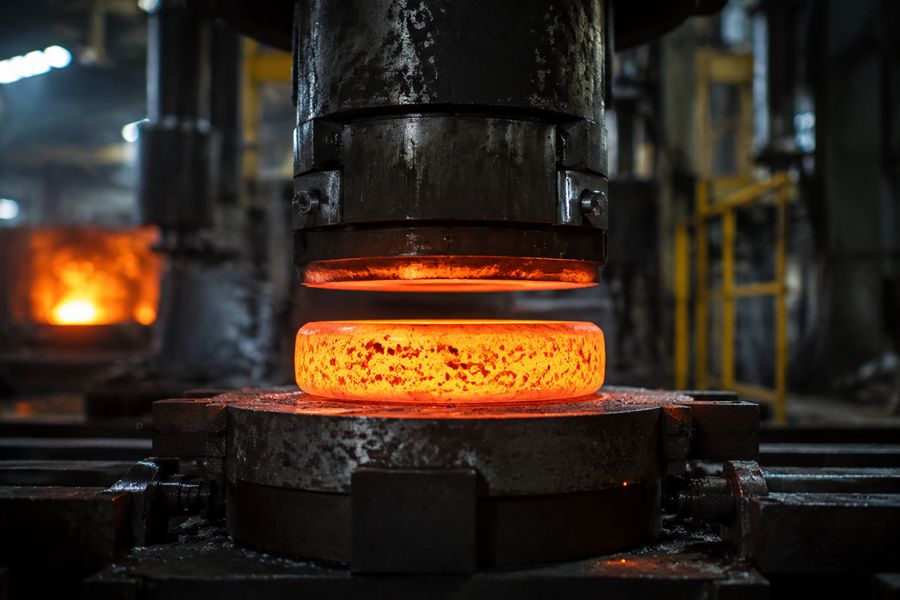
Forging quality depends on more than final dimensions. Six key process checks, from material preparation to inspection, help optimize grain flow, improve strength, and ensure reliable performance in demanding industrial applications.
| Process Check | Key Focus | Result |
| Material Quality | Grade, billet, defects | Stable grain structure |
| Temperature Control | Heating, holding time | Reduced defects |
| Die Design | Metal flow, cavity | Improved strength |
| Deformation Control | Sequence, reduction | Consistent performance |
| Heat Treatment | Cooling, hardness | Enhanced properties |
| Final Inspection | Size, surface, quality | Reliable components |
Material Selection and Billet Quality Check
Material preparation underpins forging performance. Appropriate billet quality, chemical composition control and material selection facilitate stable grain structures, enhanced mechanical properties and dependable performance for high-strength industrial parts.
Why Billet Preparation Influences Grain Flow
A properly prepared billet ensures controlled grain flow, balanced material distribution, and improved fatigue resistance for reliable forged components.
Key Material and Billet Checks
Before forging production begins, manufacturers typically verify several important factors:
- Material grade and chemical composition consistency
- Billet dimensions and weight accuracy
- Surface condition and visible defects
- Internal quality requirements
- Cutting quality and material preparation method
Accurate billet volume control is especially important for closed-die forging. An oversized billet may increase forging load and create excessive material flow, while an undersized billet may cause incomplete filling.
Heating Temperature and Thermal Control Check
Controlled forging temperature enables proper deformation, balanced grain structure, reduced defects, and improved mechanical performance in forged components.
Temperature Control for Stable Forging
A stable heating process allows the material to respond consistently during deformation. In industrial forging production, temperature control usually involves monitoring:
- Initial billet temperature
- Heating uniformity throughout the material
- Holding time
- Transfer time between heating and forging
- Temperature loss during forming
Carbon steel, alloy steel, stainless steel, and special alloys each have different forming characteristics.
Avoiding Overheating and Uneven Heating
When different areas of the billet have significant temperature differences, the deformation resistance becomes uneven. This can influence metal flow and create inconsistent grain distribution.
A stable heating process helps ensure:
- Better material flow
- More uniform deformation
- Reduced defect probability
- More consistent mechanical properties
From our perspective, temperature control is often underestimated, as many forging defects originate from improper thermal management.
Die Design and Metal Flow Verification
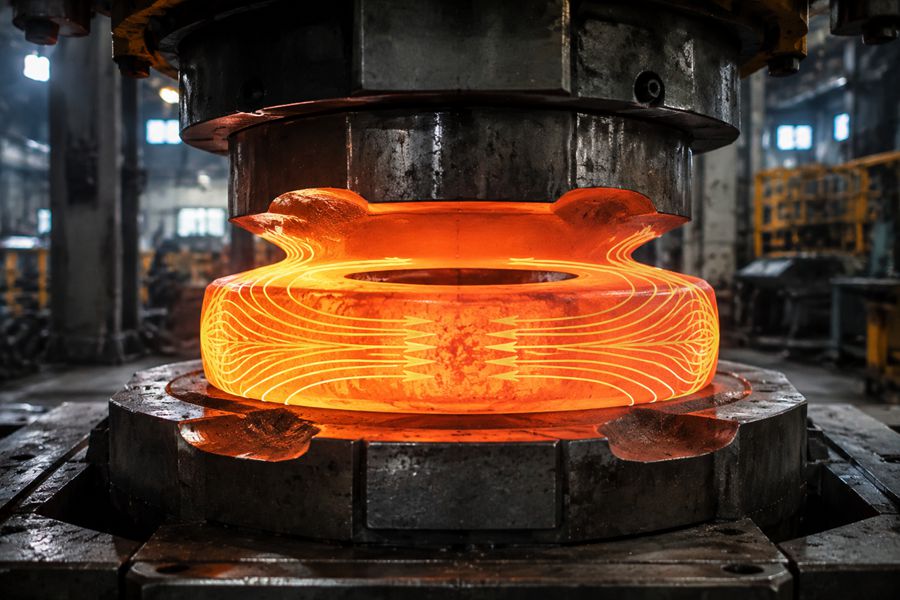
Die design controls material flow during forging, ensuring proper grain structure, reducing defects, and improving component strength and reliability.
Grain Flow and Regulated Metal Deformation
During forging, the metal follows the resistance path created by the die cavity. The shape of the cavity, transition areas, fillets, and forging allowance all influence how the material distributes.
For example, components with complex geometries require careful consideration of:
- Material movement direction
- Forging draft angles
- Corner radii
- Excess material allowance
- Die filling sequence
Engineering Evaluation Before Production
Evaluation may include:
- Forging simulation analysis
- Material flow prediction
- Die stress assessment
- Process sequence review
- Machining allowance evaluation
For customers looking for Custom Metal Forging, the best forging suppliers act as engineering partners who help customers optimize component design, material utilization, and manufacturing reliability.
Forming Sequence and Reduction Control
The deformation sequence controls grain flow, material distribution, and strength, ensuring consistent performance in complex forged components.
Controlling Forging Reduction
Forging reduction refers to the amount of thickness or cross-section change achieved during deformation.
Excessive deformation in unsuitable conditions may introduce new problems, including:
- Uneven grain distribution
- Localized stress concentration
- Surface cracking risks
- Dimensional instability after heat treatment
The objective is to achieve balanced deformation throughout the component.
Adjusting Forging Sequences
Basic shaft parts only need simple upsetting and stretching, whereas large industrial rings demand several forming passes to obtain uniform circumferential grain flow.
The forging sequence should be developed according to:
- Component geometry
- Material characteristics
- Final mechanical requirements
- Machining allowance
- Service loading conditions
Avoiding Uncontrolled Metal Flow
During forging production, several issues may indicate problems with deformation control:
- Uneven filling in die cavities
- Excessive flash formation
- Inconsistent dimensions between batches
- Unexpected mechanical property variation
For customers requiring customized forged parts, selecting a supplier with strong process development capability can reduce these risks.
Heat Treatment and Cooling Process Verification
Forging creates the basic material flow, but the final mechanical performance is usually determined after heat treatment.
The heat treatment stage modifies the internal structure created during forging and helps achieve the required balance between strength, hardness, toughness, and wear resistance.
Strength Development
After deformation, the metal structure is affected by temperature history, cooling speed, and subsequent thermal cycles.
Important control factors include:
- Heating temperature
- Holding time
- Cooling method
- Temperature uniformity
- Batch consistency
Cooling Control
Uneven cooling can create differences in internal structure between different areas of the same component. Large forgings are particularly sensitive because thicker sections retain heat longer than thinner sections.
Proper cooling management helps reduce:
- Internal stress
- Distortion
- Unexpected hardness variation
- Dimensional changes
Verification Through Mechanical Testing
After heat treatment, manufacturers may perform different inspections according to customer requirements, including:
- Hardness testing
- Tensile testing
- Impact testing
- Metallographic analysis
Dimensional Accuracy and Final Quality Inspection
Although grain flow and mechanical strength are closely related to internal structure, dimensional accuracy remains a critical part of forging quality.
A forged component must not only be strong but also fit correctly into the final assembly.
Poor dimensional control may increase machining requirements, create assembly difficulties, and affect the overall production efficiency of customers.
Connecting Forging Quality with Machining Performance
A well-controlled forging process can provide:
- More consistent machining allowance
- Reduced material removal
- Lower machining time
- Improved production efficiency
Key Final Inspection Items
| Inspection Stage | Key Checks |
| Dimensional Inspection | Dimensions, tolerances, geometry, machining allowance |
| Surface Inspection | Cracks, folding defects, oxidation, forging marks |
| Internal Quality Inspection | Ultrasonic testing, magnetic particle testing, NDT methods |
| Documentation Review | Material traceability, heat treatment records, inspection data, process records |
Process Control Matters More Than Single Parameters
In practical manufacturing, experienced engineers usually pay attention to small details:
- Whether billet weight is consistent between batches
- Whether heating conditions remain stable during production
- Whether metal flow matches the component requirements
- Whether process adjustments are recorded and repeatable
- Whether inspection data can support long-term production consistency
This is why we believe that forging quality should be evaluated as a complete process system rather than a collection of isolated production steps.
Though unseen on component surfaces, these factors decide the forgings’ dependable performance over long service life.
Six forging process checks help optimize grain flow, improve strength, and ensure reliable performance through controlled manufacturing and quality management.