
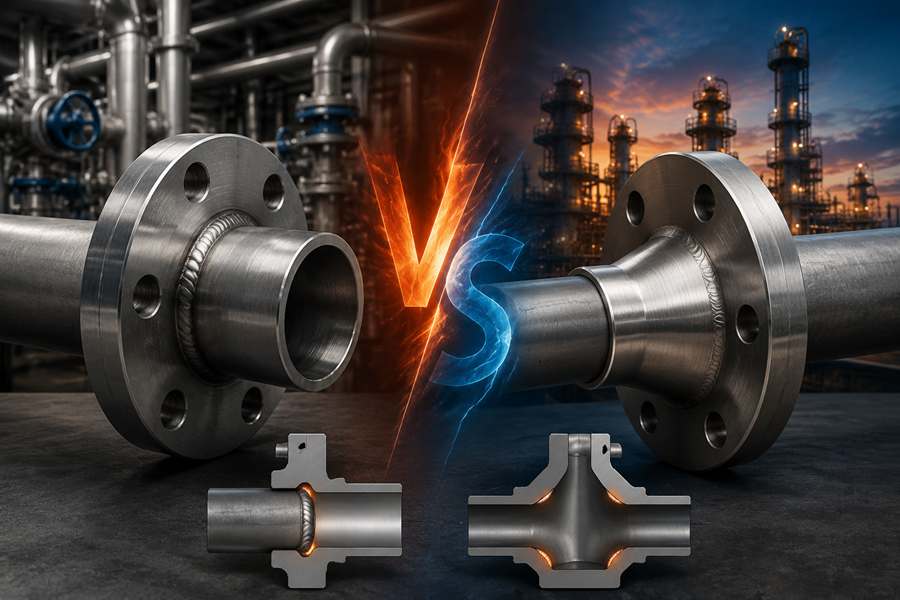
Socket Weld Flange favors installation efficiency in stable small-bore systems, while Weld Neck Flange prioritizes stress control and failure prevention in critical pipelines. Selection should follow risk level, not price alone.
Introduction to Forging Techniques
Forging is a metal manufacturing method where heated steel is shaped through controlled pressure to achieve the desired structure and strength. For flange production, it helps create a denser structure, better strength, and more stable pressure resistance.
In pressure piping systems, forged flanges are commonly used because the connection must handle load, temperature, fluid pressure, and long-term operation. Material quality, heat treatment, and machining accuracy are just as important as the flange type itself.
Among forged flange products, socket weld flanges and weld neck flanges are two common solutions used for pipe connection applications. Both flange types are installed through welding, but they are designed to meet different requirements in terms of pressure, environment, and service conditions.
What Is Socket Weld Flange?
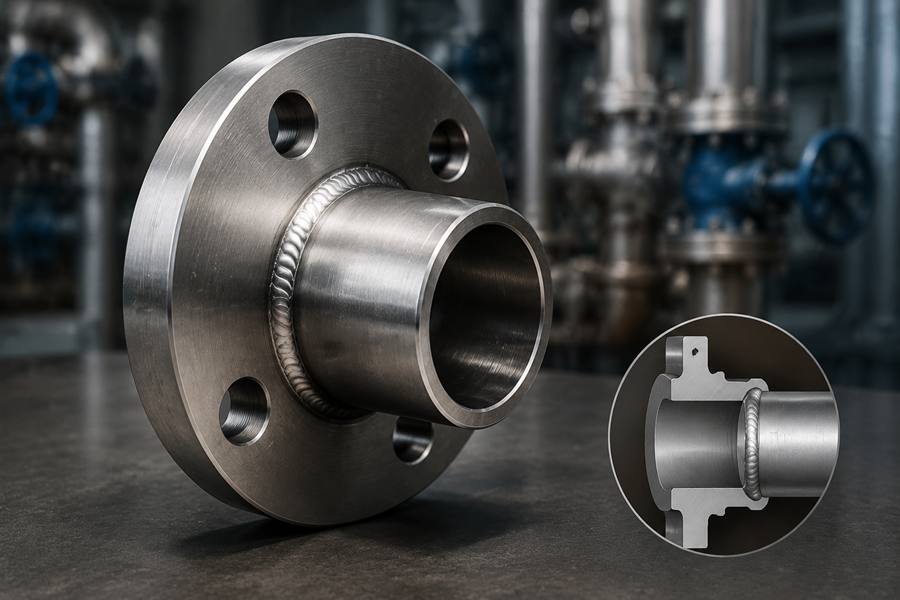
A socket weld flange has a recessed socket inside the flange bore. The pipe is placed into the recessed section of the flange before an external fillet weld is applied to secure the connection.
With its compact configuration, this flange design allows easier positioning and helps improve installation accuracy. It is often used for small-bore piping where space is limited and the pressure is relatively high but stable.
Key Features
- Recessed socket structure
- Pipe inserted into the flange
- Outside fillet weld
- Compact body design
- Easier pipe alignment
- Common for small-size piping
Socket weld flange is practical when buyers need fast installation and a clean piping layout. It works best in small and stable pressure systems, not in harsh or high-risk conditions.
What Is Weld Neck Flange?
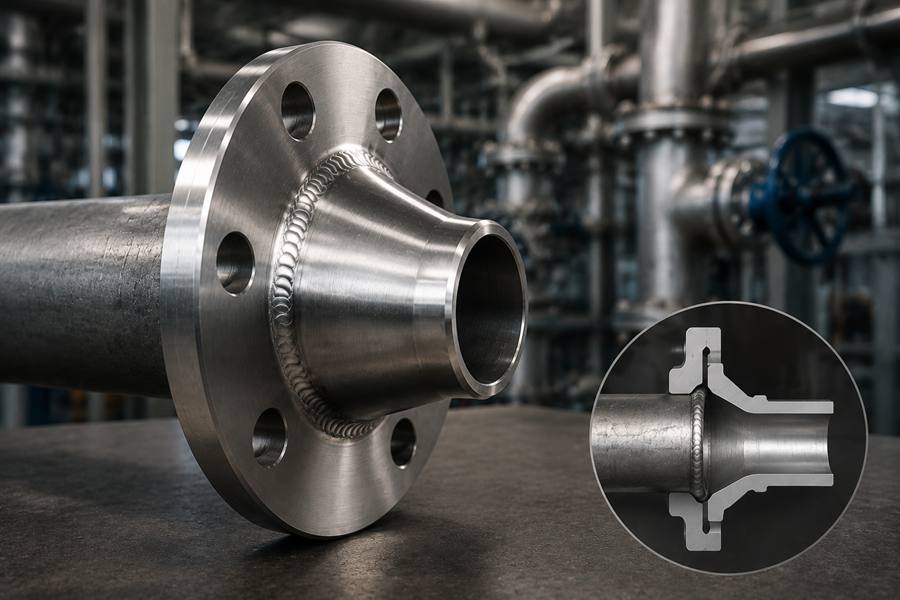
A weld neck flange uses a tapered neck extension that is welded directly to the pipe end by a butt welding process.This extended neck design creates a smoother load transfer path between the pipe and the flange connection.
By improving stress distribution at the joint area, the structure helps minimize localized stress during operation. It is commonly selected for demanding pipeline conditions, including high pressure, elevated temperatures, vibration environments, and critical service applications.
Main Characteristics
- Long tapered neck
- Butt welded connection
- Smooth bore transition
- Better stress distribution
- Stronger pressure resistance
- Suitable for critical pipelines
Weld neck flange usually needs more welding work and higher installation control. The higher initial cost is often reasonable when leakage, shutdown, or repair would create greater loss.
Key Comparison
| Comparison Section | Socket Weld Flange | Weld Neck Flange | Buyer Focus |
| Pressure Resistance | Works well in small-bore high-pressure piping with stable pressure | Better for high-pressure, high-temperature, and critical pipelines | Pressure level and safety margin |
| Part Design and Geometry | Short body with an internal socket for compact installation | Long tapered neck with smoother pipe transition | Space layout and connection structure |
| Stress and Service Stability | More suitable for stable systems with lower vibration risk | More reliable under vibration, thermal expansion, and pressure cycling | Long-term operating stability |
| Cost and Installation | Easier alignment, simpler welding, and lower installation cost | More complex welding but stronger connection reliability | Initial cost vs future risk |
| Maintenance and Inspection | Suitable for clean media and moderate inspection needs | Better for strict inspection and critical maintenance planning | Maintenance access and failure cost |
Pressure Resistance
- Socket Weld Flange
Performs well in small-bore high-pressure piping, especially when pressure is stable and installation space is limited. Welding quality, pipe insertion depth, and socket gap control should be checked carefully. - Weld Neck Flange
Offers stronger pressure resistance for high-pressure, high-temperature, or critical pipelines. Its tapered neck helps transfer pressure load more smoothly and reduces stress around the flange joint.
Pressure Selection Guide
| Working Condition | Better Choice | Reason |
| Small pipe with stable pressure | Socket Weld Flange | Compact and efficient |
| High-pressure main pipeline | Weld Neck Flange | Stronger stress transfer |
| High-temperature steam line | Weld Neck Flange | Better thermal expansion control |
| Hydraulic small-bore line | Socket Weld Flange | Practical for compact pressure systems |
| Pipeline with vibration | Weld Neck Flange | Lower fatigue risk |
| Safety-critical system | Weld Neck Flange | Higher long-term reliability |
Pressure rating is only a basic reference. Real working pressure, medium type, welding control, and repair difficulty often decide whether the flange is truly suitable.
Part Design and Geometry
- Socket Weld Flange
Has a short body with an internal socket, making it compact and easy to install in narrow spaces. The socket design is convenient, but buyers should be cautious when the fluid is dirty, corrosive, or easy to crystallize. - Weld Neck Flange
Uses a tapered neck structure that provides a continuous transition between the flange and the connected pipe.This structure helps reduce stress concentration and supports better flow stability in demanding pipelines.
The geometry difference is one reason weld neck flange performs better in severe service. Its shape is not only for connection, but also for stress control.
Stress and Service Stability
- Socket Weld Flange
The socket structure is compact, but stress may gather around the socket and fillet weld area. It works better in small pipelines with stable operation and lower vibration risk. - Weld Neck Flange
The tapered neck helps spread stress from the flange to the pipe more smoothly. It is more stable in systems with vibration, thermal expansion, pressure cycling, or long operating hours.
Socket weld flange is suitable for stable small-bore systems. Weld neck flange is more reliable when the pipeline must handle repeated stress, temperature changes, or higher shutdown risk.
Cost and Installation
- Socket Weld Flange
Usually has lower installation cost because pipe end preparation is simpler and alignment is easier. It is useful for projects with many small-size connection points and limited installation time. - Weld Neck Flange
Usually costs more because it requires beveling, butt welding, skilled workers, and stricter inspection. However, the higher initial cost can reduce future leakage risk in critical pipelines.
| Flange Size | Socket Weld Flange (Approx.) | Weld Neck Flange (Approx.) | Price Difference |
| 1/2 inch | $15–$35 / piece | $25–$60 / piece | About 30%–70% higher |
| 1 inch | $25–$60 / piece | $40–$90 / piece | About 30%–60% higher |
| 2 inch | $45–$100 / piece | $70–$160 / piece | About 40%–70% higher |
| 3 inch | $80–$180 / piece | $130–$280 / piece | About 40%–60% higher |
| 4 inch | $120–$260 / piece | $200–$450 / piece | About 50%–80% higher |
| 6 inch | $250–$600 / piece | $400–$900 / piece | About 40%–70% higher |
A lower flange price only makes sense when the working condition is suitable. For high-risk pipelines, long-term reliability is often more important than saving on the first purchase.
Maintenance and Inspection
- Socket Weld Flange
Suitable for normal systems with clean media, stable pressure, and moderate inspection needs. The socket area may be less convenient to inspect, especially when the medium causes corrosion, residue, or buildup. - Weld Neck Flange
Easier to justify in strict inspection projects because the butt weld area is more direct. The smoother transition also helps reduce deposit buildup and stress problems.
For long-term maintenance planning, weld neck flange is usually the safer choice in critical piping systems.
Application Cases by Industry
Case Study 1: Small Hydraulic Pipeline
- Chosen Flange:
Socket Weld Flange - Reason:
Small hydraulic lines need compact installation and stable pressure resistance. Socket weld flange supports easy alignment and saves space around equipment.
Case Study 2: High-Pressure Steam Line
- Chosen Flange:
Weld Neck Flange - Reason:
Steam pipelines face high temperature and pressure changes. Weld neck flange offers better stress distribution and reduces leakage risk.
Case Study 3: Chemical Dosing System
- Chosen Flange:
Socket Weld Flange - Reason:
Small dosing pipelines often need neat installation and lower welding workload. Socket weld flange fits clean and stable chemical transfer lines.
Choosing Based on Product Lifecycle
Socket weld flange is suitable when the project needs quick installation, compact structure, and reasonable cost. It works best in small-bore piping where pressure is stable and service conditions are not extreme.
Choose socket weld flange when:
- Pipe size is small
- Space is limited
- Pressure is stable
- Installation speed matters
- Budget control is important
- Inspection demand is moderate
Weld neck flange is better when the pipeline carries higher risk. It is preferred when the system faces high pressure, high temperature, vibration, thermal expansion, or expensive shutdown risk.
Choose weld neck flange when:
- Pipeline is critical
- Pressure is high
- Temperature changes often
- Vibration exists
- Medium is dangerous or valuable
- Long service life matters
Socket weld flange saves installation effort. Weld neck flange reduces long-term uncertainty.
Summary Table
| Criteria | Socket Weld Flange | Weld Neck Flange |
| Structure | Socket connection | Tapered neck connection |
| Welding Method | Fillet weld | Butt weld |
| Installation | Easier and faster | More complex |
| Pressure Resistance | Good for small-bore lines | Better for critical systems |
| Stress Control | Moderate | Strong |
| Inspection | Less direct in socket area | Easier for critical inspection |
| Cost | Lower initial cost | Higher initial cost |
| Best Use | Small stable pipelines | Main and high-risk pipelines |