
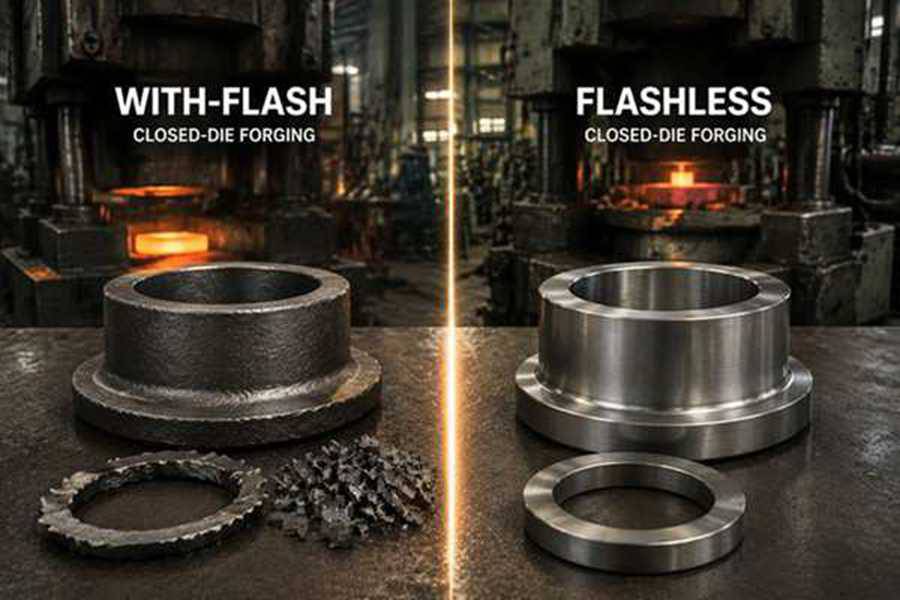
With-flash and flashless closed-die forging differ in material efficiency, accuracy, and production cost. Based on our forging experience, the right choice depends on part design, material, volume, and overall manufacturing requirements.
Tips at a Glance
| Comparison | With-Flash Forging | Flashless Forging |
| Material Waste | Higher due to flash removal | Lower, higher utilization |
| Accuracy | Stable for complex parts | Higher precision with strict control |
| Machining | More trimming required | Less machining allowance |
| Cost | Lower tooling cost, flexible production | Higher initial cost, suitable for mass production |
| Application | Complex shapes, general components | Precision parts, high-volume production |
Closed-Die Forging with Flash
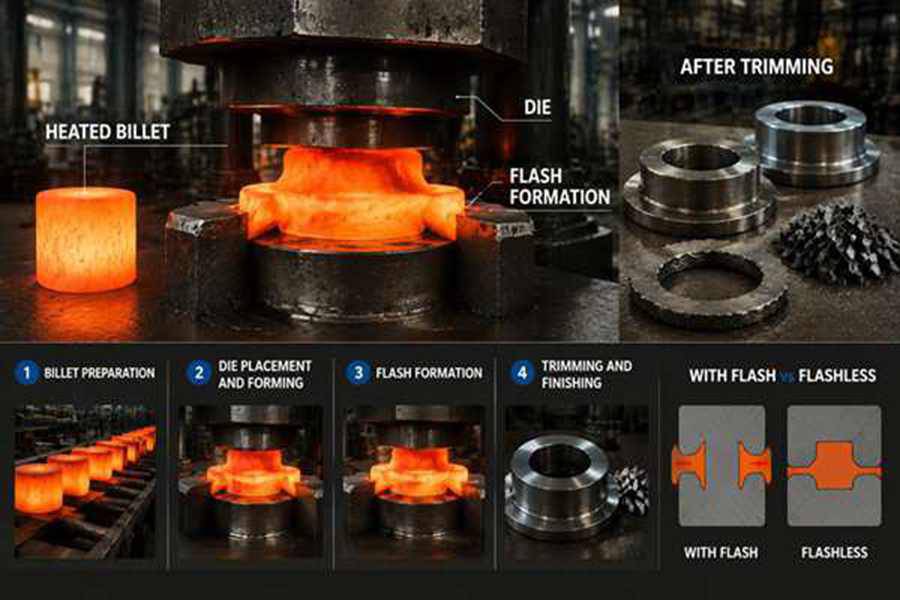
In with-flash closed-die forging, heated billets are compressed in dies, allowing excess metal to flow into the flash area. This controlled overflow improves material flow, die filling, and part accuracy.
The core workflow covers the following segments:
- Billet preparation
- Die placement and forming
- Flash formation
- Trimming and finishing
After forging, the flash is removed through trimming. Subsequent manufacturing steps like cutting, heat treatment, surface modification and testing can be carried out in accordance with the component’s final service demands.
A comparison diagram of flash-containing closed-die forging visually illustrates the above principle. Extra metal forms a regulated overflow zone surrounding the formed part, which facilitates more uniform material flow in the deformation process.
Advantages of Closed-Die Forging with Flash
Better Material Flow Control for Complex Shapes
With-flash forging handles complex geometries by using flash to regulate material flow, improve die filling, and enhance production reliability.
Higher Forging Process Stability
Manufacturing stability can be achieved via flash forging technology. This method tolerates inconsistent material properties, delivers superior die cavity filling effect, simplifies process monitoring and maintains stable batch delivery quality.
Suitable for a Wide Range of Materials
Flash-type closed-die forging suits most frequently used forging raw materials, which mainly consist of:
- Carbon steel
- Alloy steel
- Stainless steel
- Aluminum alloys
- Titanium alloys
- Copper alloys
Different metals have different forming characteristics. Some materials have limited flowability and require additional space during deformation.
The flash area provides flexibility when working with materials that are more difficult to forge.
Limitations of With-Flash Forging
Higher Material Consumption
The removal of flash leads to greater material consumption in flash forging processes. However, the enhanced operational stability offsets additional expenditures, especially in mass production of sophisticated forgings.
Additional Trimming Process
Flash removal requires additional trimming, equipment, and processing time, but its impact depends on machining needs and part design.
Possible Additional Machining Allowance
Residual metal distributed on parting lines brings extra machining workload to flash forging products. Optimized die structures can effectively shrink redundant processing allowance without sacrificing the stability of forming production.
Flashless Closed-Die Forging Process
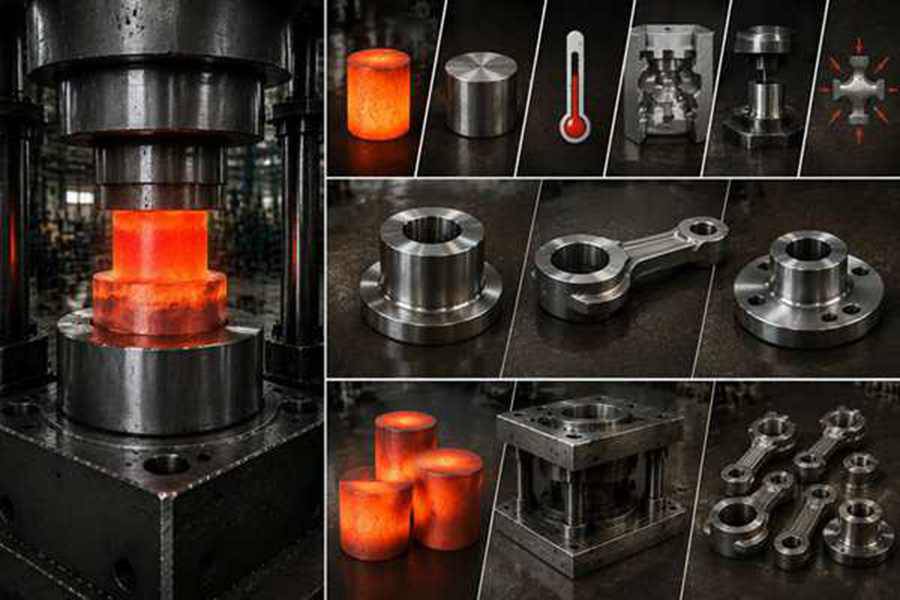
Flashless closed-die forging fully contains billets inside the die cavity, requiring precise volume control for accurate forming.
The forming principle is based on precise control of:
- Billet weight
- Billet dimensions
- Heating temperature
- Die cavity design
- Forging pressure
- Material distribution
Benefits Brought by the Flashless Closed-Die Forging Process
Maximum Material Utilization
Since there is no excess metal flowing outside the die cavity, almost the entire billet becomes part of the final component.
Reduced Secondary Processing
The forged component is already closer to the final geometry, machining requirements may be reduced.
For precision components, reducing machining allowance can also help maintain better material properties because more of the original forged structure is preserved.
Cleaner Part Appearance
Without flash around the parting line, flashless forged components often have a cleaner surface appearance.
Challenges of Flashless Forging
Strict Billet Volume Accuracy
Strict control of billet capacity is essential to flashless closed-die forging. If the blank size fails to meet standards, defects including incomplete die filling, high die load and out-of-tolerance dimensions will emerge.
Higher Tooling Requirements
The die must withstand higher pressure because there is no flash area to absorb excess material.
As a result:
- Die strength requirements increase
- Tooling design becomes more complex
- Initial investment may be higher
For low-volume projects, the additional tooling cost may not always be justified.
Limited Application Range
Workpieces with standardized geometric structures can be produced via flashless forging. By contrast, flash-assisted forging is preferred for complicated parts to mitigate potential forming failures.
Material Waste Comparison
Flashless forging has a clear advantage because the billet is designed to match the final part volume more closely. However, material waste should not be evaluated separately from production reliability.
A practical evaluation should include:
- Raw material consumption
- Scrap recovery value
- Tool life
- Production stability
- Machining requirements
- Inspection requirements
- Production yield
For example, a flashless forging process may save material but require more expensive tooling and stricter production control. For a small production batch, those additional costs may outweigh material savings.
Dimensional Precision Contrast
Dimensional Accuracy of With-Flash Closed-Die Forging
The flash area controls material flow, maintains pressure, and improves die filling for consistent dimensions in complex parts.
In practical production, with-flash forging can achieve reliable repeatability when the following factors are properly controlled:
- Die machining accuracy
- Forging temperature consistency
- Material preparation
- Press parameters
- Trimming accuracy
- Heat treatment control
Dimensional Accuracy of Flashless Closed-Die Forging
There is no flash formation, the final forged shape is closer to the die geometry. This reduces material movement outside the intended forming area and can decrease machining allowance.
Achieving this accuracy requires much tighter process management:
- Billet Weight Accuracy
- Temperature Control
- Die Manufacturing Precision
Manufacturing Cost Evaluation
| Cost Factor | With-Flash Forging | Flashless Forging |
| Tooling Cost | Lower: $5,000–50,000 (20–50% lower die cost) | Higher: $10,000–100,000+ (30–80% higher investment) |
| Material Cost | Higher waste: 10–30% material loss | Lower waste: 2–10% material loss |
| Production Risk | Lower: 90–98% yield rate | Higher: 85–95% yield rate during optimization |
| Machining Cost | Higher: $0.5–10+/part due to trimming & extra machining | Lower: 20–50% machining reduction |
| Best Cost Range | Best for 100–50,000 pcs/year | Best for 50,000+ pcs/year |
Overall costs are determined by materials, molds, machining, output and process reliability, not merely material savings.
Choose With-Flash Forging When:
The Part Geometry Is Complex
Components with irregular shapes, deep cavities, or difficult material flow conditions usually benefit from the additional flexibility provided by flash.
Production Volume Is Moderate
For smaller or medium production quantities, lower tooling complexity can make with-flash forging more economical.
Material Formability Is Limited
Materials that are difficult to shape may require additional forming space to achieve complete filling.
Process Reliability Is the Priority
When delivery consistency and production stability are more important than maximum material savings, with-flash forging is often the practical choice.
Time to Choose Flashless Forging:
Material Cost Is a Major Concern
For expensive metals or large production volumes, improved material utilization can provide significant benefits.
Near-Net Shape Production Is Required
When reducing machining operations is a priority, flashless forging can help achieve closer final dimensions.
Component Geometry Is Suitable
Parts with controlled shapes and predictable material flow are better candidates for flashless production.
Long-Term Production Is Planned
The higher initial investment can be justified when the same component is produced continuously over many years.
Application Scenarios
| Industry | With-Flash Forging | Flashless Forging |
| Automotive | Connecting rods, steering parts, suspension components | Precision drivetrain and lightweight alloy parts |
| Heavy Equipment | Hydraulic parts, gears, shafts, structural components | Precision components requiring less machining |
| Energy Equipment | High-strength components for demanding environments | Expensive alloy parts with high material efficiency |
| Industrial Machinery | Custom parts with complex shapes and requirements | Precision parts requiring tighter dimensional control |
Both forging methods feature distinct strengths. Optimal selection balances component needs against material efficiency, precision, expense, production steadiness and long-run performance.