
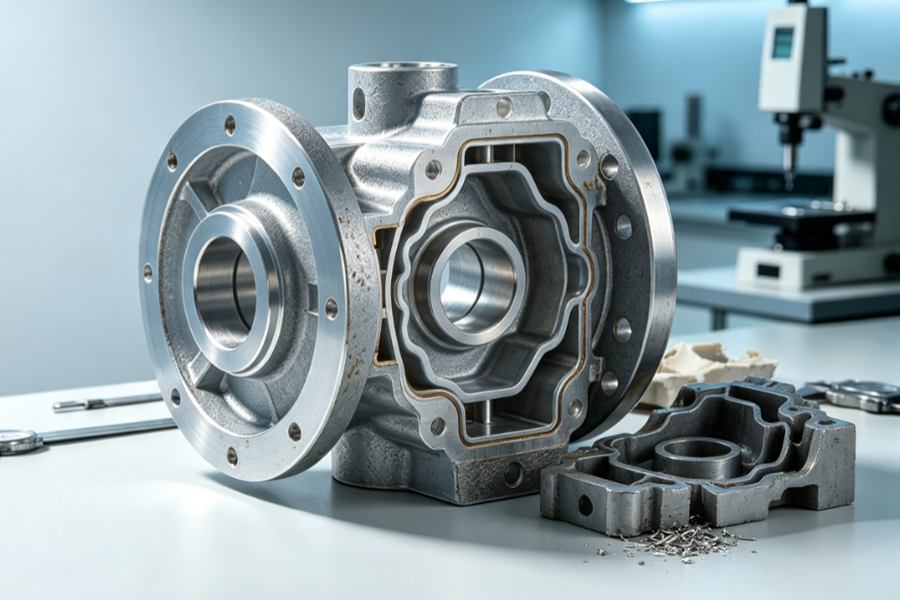
Precision casting forms grooves, holes, ribs, curved passages, and irregular shapes directly in the mold, reducing machining, tooling, fixtures, assembly steps, material waste, and overall production complexity for complex parts.
Comparison
| Comparison | Billet Machining | Precision Casting |
| Grooves & Holes | Multiple machining steps | Near-net-shape forming |
| Internal Cavities | Limited by tool access | Core-formed |
| Curved Shapes | Long CNC cycle | Mold-reproduced |
| Ribs & Bosses | Machined separately | Integrated directly |
| Material Use | More waste | Higher utilization |
| Best For | Simple, low-volume parts | Complex, repeat parts |
Precision Casting for Complex Geometric Components
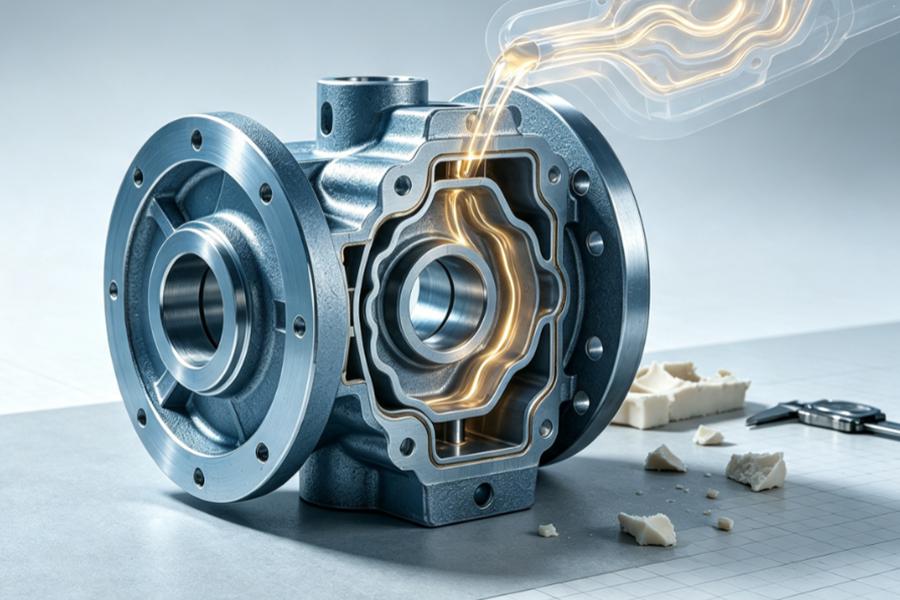
The precision casting process starts with a master pattern replicating the target geometry. A ceramic shell mold is fabricated surrounding the pattern; once the pattern is removed, molten alloy fills the hollow mold cavity to form the required part.
Several features can be produced during the same pour:
- Grooves
- Recesses
- Bosses
- Ribs
- Flanges
- Curved profiles
- Internal cavities
- Non-symmetrical contours
Investment casting is particularly useful for detailed components because wax patterns and ceramic molds can reproduce small features without a conventional split mold. Our investment casting process is designed for near-net-shape parts, complex forms, thin walls, and reduced post-processing.
The Superiority of Precision Casting in Producing Grooves
Grooves appear simple on a drawing, but their machining cost can rise quickly. A part may contain sealing grooves, retaining-ring channels, lubrication paths, guide tracks, or decorative recesses.
Precision casting allows many grooves to be formed together with the main body.
Key Benefits
- Fewer cutting passes: Rough groove geometry is produced during casting.
- Lower fixture demand: The part does not need repeated repositioning for every feature.
- Better shape freedom: Curved and irregular grooves are easier to form.
- Reduced stock removal: Less surrounding material must be machined away.
- Repeatable geometry: One qualified pattern can reproduce the same feature across a production batch.
Cast curved grooves near net shape, then machine critical depths, widths, fits, and finishes for reliable sealing and assembly performance.
The Need for Customized Hole Fabrication Methods
Large through holes, mounting openings, weight-reduction holes, and internal flow passages can often be formed by wax features or cores. Small threaded holes and high-accuracy bearing holes are normally better left for secondary machining.
Hole Selection Guide
| Hole Type | Recommended Production Route | Main Reason |
| Large Through Hole | Cast near net shape | Removes substantial drilling work |
| Mounting Opening | Cast and finish-machine | Maintains position and assembly accuracy |
| Blind Recess | Cast where core support is stable | Reduces deep tool access |
| Threaded Hole | Cast pilot hole, then drill and tap | Protects thread accuracy |
| Bearing Bore | Cast allowance, then bore or ream | Controls diameter and roundness |
| Curved Internal Passage | Core-formed during casting | Cannot be produced by straight drilling |
| Small Deep Hole | Machine after casting | Core stability may be insufficient |
| Intersecting Passages | Cast main channels, machine connections | Balances complexity and inspection access |
Only essential hole geometries shall be formed by casting. Critical inner bores need mechanical finishing, long cores demand reliable support, and dimensional detection follows functional specifications.
Enhanced Practicality of Internal Flow Paths
Precision casting forms curved internal passages directly, avoiding cross-drilling, plugs, welding, and multi-piece assembly in complex fluid-control components efficiently.
This brings several advantages:
- Fewer plugs and welded joints
- Shorter assembly time
- Lower leakage risk at joined sections
- More compact component design
- Smoother transitions between flow paths
- Reduced dependence on deep-hole machining
For critical flow components, design review should address core location, cleaning access, minimum passage size, internal transition radii, and the method used to confirm that the cavity is clear.
Complex Shapes Can Be Consolidated into One Part
Precision casting consolidates bodies, brackets, flanges, ribs, and connectors into one component, reducing assembly, welding, inventory, and dimensional variation risk.
Consolidation Advantages
- Fewer individual part numbers
- Less welding and mechanical fastening
- Reduced assembly labor
- Fewer dimensional stack-ups
- Lower risk of missing components
- Simplified purchasing and inventory control
- More consistent finished assemblies
Precision casting reduces material waste, CNC time, fixtures, and assembly, becoming more economical as complex-part production volume increases across orders.
Precision Casting vs. Full Machining
| Cost Factor | Billet Machining | Precision Casting |
| Material Use | More stock and waste | Near-net-shape use |
| CNC Time | Longer | Focused on critical areas |
| Fixtures | More setups | Fewer setups |
| Tooling | Lower initial cost | Casting tooling required |
| Assembly | May need multiple parts | Features integrated |
| Repeat Orders | Stable machining cost | Better cost with volume |
Precision casting requires upfront tooling, but repeated complex orders reduce CNC work and improve long-term production cost efficiency and consistency.
Geometry Details That Improve Casting Results
Complexity alone does not make a part suitable for precision casting. The geometry must support metal flow, shell strength, core stability, solidification, cleaning, and inspection.
Smooth Wall Transitions
Abrupt changes from thin to thick sections can produce uneven cooling. Gradual transitions make the part easier to fill and reduce local thermal concentration.
Practical Corner Radii
Sharp internal corners may be difficult to fill and can concentrate stress. Suitable radii improve metal flow while supporting better mechanical performance.
Controlled Wall Thickness
Very thin walls may cool before the cavity is filled. Excessively thick areas can extend solidification time and increase shrinkage concerns. Balanced wall sections are generally more stable.
Supported Cores
Internal cavities and holes depend on core position. Long unsupported cores are more likely to move, deform, or break.
Clear Machining Datums
The drawing should identify surfaces used to locate the casting during machining. Without reliable datum pads, near-net-shape production may still require complicated fixtures.
Purposeful Machining Allowance
Uniform machining allowance adds weight and cost; insufficient allowance risks incomplete cleanup, so assign it selectively according to surface function.
Mandatory Machining Features for Cast Parts
Some buyers attempt to cast every visible feature to reduce machining. That approach can create more cost than it removes.
The following areas commonly justify secondary machining:
- Bearing seats
- Precision sealing grooves
- Threads
- Shaft bores
- Mating faces
- Locating holes
- Press-fit diameters
- High-flatness surfaces
- Closely controlled concentric features
Non-critical ribs, exterior contours, support bosses, recesses, and large openings are stronger candidates for as-cast production.
Circumstances Where Precision Casting Fails to Be Optimal
Precision casting is effective for geometric complexity, but it is not a universal replacement for machining.
Another route may be more practical when:
- The part is a simple plate, ring, or shaft
- Only one or two prototypes are required
- Most surfaces need final machining anyway
- The component is too large for economical tooling
- Internal holes are extremely narrow and deep
- Design changes are expected after every batch
- Production quantity cannot absorb tooling cost
For a simple rectangular block with six machined faces, casting adds little value. For a housing containing ribs, bosses, curved walls, recesses, and internal channels, the cost logic changes completely.
Selecting Guide
| Process Route | Suitable Geometry | Production Consideration |
| Silica Sol Investment Casting | Fine grooves, thin walls, detailed profiles | Better control for precision components |
| Water Glass Investment Casting | Larger or moderately detailed steel parts | More economical for general industrial use |
| Shell Mold Casting | Repeat parts with ribs and defined surfaces | Suitable for medium to higher production |
| Gravity Casting | Thicker aluminum or copper alloy parts | Appropriate for structurally solid components |
| Die Casting | Thin-walled non-ferrous parts | Well adapted to high-output manufacturing |
| Casting with CNC Finishing | Functional bores, grooves, and mounting faces | Balances geometry and final accuracy |
Boberry selects methods by geometry, material, volume, and finish; detailed parts favor silica sol, while cost-sensitive parts suit water glass.
Precision casting converts complex geometry into repeatable production, reducing machining, assembly, material waste, and long-term costs without sacrificing critical performance.