
Gravity die casting is often a better fit than high pressure die casting when production volumes are moderate, sections are relatively thick, pressure integrity is important, heat treatment is required, or internal geometry depends on sand cores.
Gravity Die Casting Against HPDC
| Project-related Factor | Gravity Mold Casting | High-Pressure Die Cast Process |
| Production Volume | Low–medium | Medium–very high |
| Tooling Investment | Lower | Higher |
| Typical Sections | Medium–thick | Thin |
| Filling Speed | Relatively slow | Very fast |
| Gas Entrapment | Generally easier to control | More sensitive without vacuum |
| Heat Treatment | More practical | More restricted |
| Sand-Core Use | Well suited | Difficult |
| Production Cycle | Minutes | Seconds |
For sourcing decisions, cycle time should not be considered on its own. Tooling, machining, inspection, heat treatment, quality losses, and lifetime quantity all contribute to the actual cost of a finished casting.
Case 1 — Low-Volume Projects Favor Gravity Casting
HPDC normally requires a substantially larger upfront investment in the die and production setup. Its lower recurring cost becomes worthwhile only when enough components are produced to distribute that additional investment.
Consider an aluminum housing with the following estimated costs:
| Cost Item | Gravity Die Casting | HPDC |
| Tooling | $14,000 | $47,000 |
| Casting Cost/Part | $8.20 | $5.20 |
| Additional HPDC Tooling | — | $33,000 |
| HPDC Unit-Cost Advantage | — | $3.00 |
A $33,000 tooling difference divided by a $3.00 unit saving gives a break-even quantity of roughly 11,000 components. At only 3,000 pieces, the total is about $38,600 for gravity casting compared with approximately $62,600 for HPDC.
Gravity die casting therefore makes more sense for projects such as:
- Replacement components:Demand is limited or irregular
- Specialty machinery:Production runs remain relatively small
- Low-volume vehicles:Output does not justify expensive HPDC dies
- Developing products:Geometry may still change after initial production
When lifetime demand is uncertain, reducing the initial tooling commitment also reduces purchasing risk. Paying significantly more for HPDC capacity has little value if the project never reaches the volume needed to recover it.
Case 2 — Structural Parts Suit Gravity Casting Better
The ability to fill thin sections rapidly is one of HPDC’s major strengths. That benefit becomes less important when the component already contains substantial walls, reinforced bosses, broad flanges, or heavy mounting areas.
A 6 kg industrial housing with an average wall of 7 mm has very different production requirements from a thin 2 mm electronics enclosure.
Typical process tendencies are:
- 5–3 mm:HPDC usually has a clear advantage
- 3–5 mm:Either process may be suitable
- 5–8 mm:Gravity casting becomes increasingly practical
- 8–12+ mm:Structural geometry can favor gravity casting
These figures should be treated as design references rather than strict casting limits. Alloy choice, flow distance, component size, mechanical requirements, and production quantity can all shift the preferred process.
For example, producing 4,000 housings annually at a five-minute gravity casting cycle requires roughly 333 production hours. If that capacity already satisfies yearly demand, paying for an HPDC system capable of much higher output may bring little economic benefit.
Case 3 — Pressure-Tight Parts Favor Gravity Casting
Pressure-containing castings are evaluated differently from ordinary covers or brackets because internal porosity can directly affect whether the component passes leak testing. Hydraulic housings, pump bodies, valve components, and compressor parts therefore require more attention to metal flow and trapped gas.
Gravity filling takes place at a lower velocity, which generally makes turbulent air entrainment easier to manage. This does not eliminate porosity, but it can make gravity casting attractive when pressure integrity is more important than maximum output.
Common candidates include:
- Pump and hydraulic housings
- Valve bodies
- Compressor components
- Fluid-handling castings
- Leak-tested aluminum enclosures
A basic casting quotation can also hide the real cost difference:
| Cost Item | HPDC | Gravity Casting |
| Basic Casting | $7.80 | $9.10 |
| Impregnation | $0.70 | — |
| Additional Leak Inspection | $0.25 | $0.10 |
| Rejection Allowance | $0.30 | — |
| Effective Cost | $9.05 | $9.20 |
The initial $1.30 price gap shrinks to only $0.15 per accepted component after quality-related costs are added. On a 20,000-piece program, a 1.5% rejection rate also represents 300 components, or around $2,700 in finished-part value before sorting, retesting, replacement production, and freight are counted.
Case 4 — Heat Treatment Favors Gravity Casting
Gravity die casting deserves stronger consideration when a component requires T5/T6 treatment, solution treatment, welding, or improved mechanical performance. Conventional HPDC can retain gas from high-speed filling, and this trapped gas may expand during high-temperature treatment and increase the possibility of blistering.
This consideration matters greatly when specs mandate:
- T5 or T6 properties:Strength depends on post-casting treatment
- Welding:Downstream joining is part of the assembly route
- Higher structural strength:Heat treatment can replace reinforcement
- Fatigue resistance:Mechanical performance matters more than cycle speed
A comparison based only on the foundry quotation can therefore be misleading:
| Cost Item | HPDC | Gravity Casting |
| Basic Casting | $7.40 | $9.00 |
| Heat Treatment | — | $1.20 |
| Reinforcement Plate | $2.00 | — |
| Additional Assembly | $1.20 | — |
| Finished Component Cost | $10.60 | $10.20 |
Although the gravity-cast blank starts at a higher price, the completed part saves $0.40 each because reinforcement and an assembly step are removed. The same saving becomes about $4,000 at 10,000 pieces, $20,000 at 50,000 pieces, and $40,000 at 100,000 pieces.
Case 5 — Complex Cavities Favor Gravity Casting
Another important advantage of gravity die casting is its ability to work with disposable sand cores. These cores can form enclosed, curved, or interconnected cavities that are difficult to release with conventional rigid HPDC tooling.
This capability is useful for components containing:
- Water jackets and cooling channels
- Pump chambers
- Internal valve passages
- Hollow motor housings
- Manifold flow paths
Suppose a pump housing requires a curved internal passage. A gravity-cast sand core may add around $1.30 per component, while producing the same geometry through HPDC followed by two CNC operations could add approximately $3.20.
That $1.90 difference equals about $19,000 over 10,000 parts. The machining route can also introduce fixtures, cutting-tool consumption, chip handling, extra machine capacity, and additional dimensional inspection.
In this case, gravity casting is not selected simply because it is a lower-volume process. It is better suited because the casting itself can incorporate more of the required internal geometry and reduce secondary manufacturing work.
When Gravity Die Casting Becomes the Better Choice?
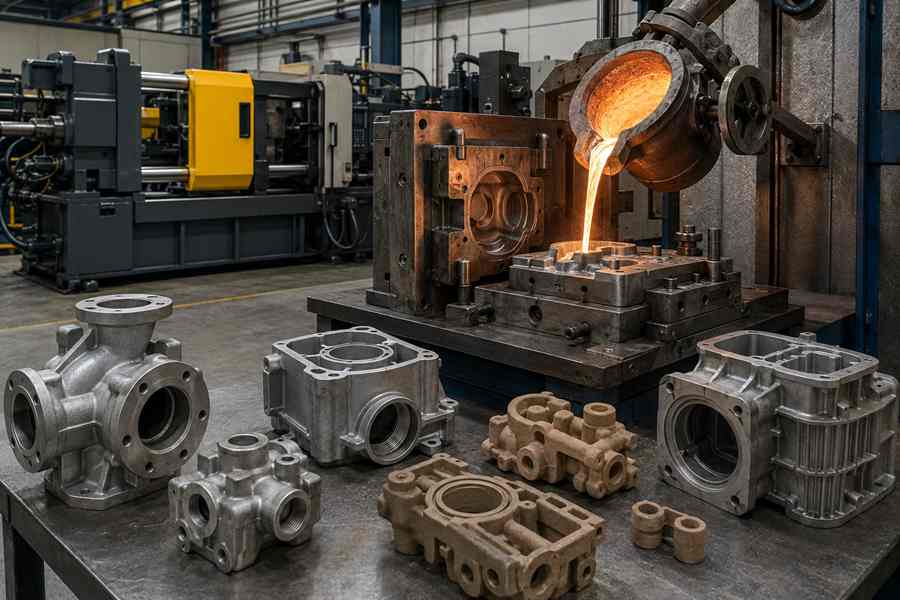
Gravity die casting becomes increasingly attractive when several of the conditions discussed above appear in the same project. The more a component depends on moderate production quantities, substantial sections, pressure integrity, heat treatment, or sand-core geometry, the less important HPDC’s high production speed becomes.
| Project Condition | Why Gravity Die Casting Can Fit Better |
| Low to Medium Volume | Lower tooling cost is easier to recover |
| Thick Structural Sections | Thin-wall HPDC capability provides less benefit |
| Pressure-Tight Requirements | Gas entrapment can be easier to manage |
| Heat Treatment Required | T5/T6 processing is generally more practical |
| Complex Internal Cavities | Sand cores can form enclosed passages directly |
| HPDC Needs More Secondary Work | Finished-part cost may favor gravity casting |
A component does not need to meet every condition. A 7 mm-wall pump housing produced at 8,000 pieces per year and requiring leak testing, for example, already combines several factors that point toward gravity die casting.
The final evaluation should therefore compare tooling + casting + machining + heat treatment + testing + scrap, rather than unit casting price alone. When gravity die casting avoids unnecessary tooling investment or removes enough downstream processing, its slower cycle can still deliver the more economical finished component.