
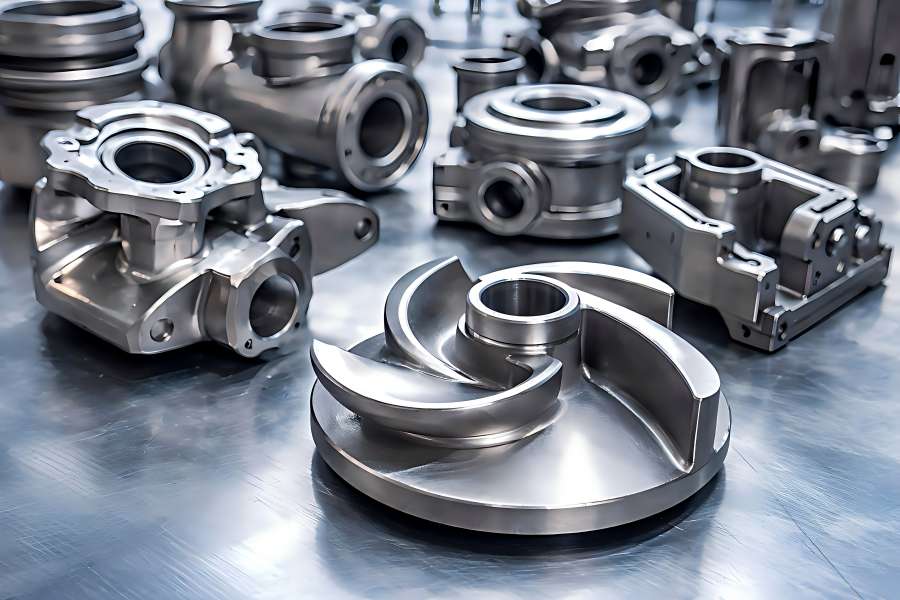
ASTM 304 is a widely used austenitic stainless steel grade defined under standards set by ASTM International. Because of its composition, it is often called “18-8 stainless steel”:
- Chromium (Cr): 18–20%
- Nickel (Ni): 8–10.5%
- Carbon (C): ≤0.08%
This composition creates a stable austenitic microstructure, giving ASTM 304 its key characteristics:
- Strong resistance to oxidation and corrosion
- Good strength and toughness
- Excellent formability and weldability
- Non-magnetic properties in the annealed condition
The chromium content forms a thin, invisible oxide layer on the surface, which protects the material from rust and environmental damage. This passive layer can self-repair when exposed to oxygen, making ASTM 304 particularly durable in many industrial environments.
What Are Precision Steel Castings?
Precision steel castings are components produced using high-accuracy casting techniques, most commonly investment casting, also known as the lost-wax process. This technique enables producers to create components with:
- Complex geometries
- Thin walls and intricate details
- Tight dimensional tolerances
- Smooth surface finishes
Unlike traditional casting methods, precision casting reduces the need for extensive machining and secondary operations. When combined with ASTM 304 stainless steel, it results in components that are both precise and highly resistant to corrosion.
nd surface quality, making it ideal for high-performance applications.
Key Properties of ASTM 304 Precision Steel Castings
Corrosion Resistance
ASTM 304 provides strong resistance to oxidation, moisture, and many chemicals. It performs well in:
- Humid environments
- Mild acidic conditions
- Industrial atmospheres
Mechanical Strength
While not the strongest stainless steel grade, ASTM 304 offers sufficient strength for most structural and mechanical applications.
Temperature Performance
It remains stable over a broad temperature range, making it well-suited for both low-temperature environments and moderately elevated heat conditions.
Surface Finish and Aesthetics
Precision casting combined with stainless steel provides a clean, attractive finish, often requiring minimal polishing.
Hygiene and Cleanability
Its non-porous surface helps prevent bacterial growth and contamination, making it highly suitable for applications requiring strict hygiene standards.
Weldability and Machinability
ASTM 304 offers excellent weldability and machinability, providing greater flexibility during fabrication and assembly processes.
Advantages of ASTM 304 Precision Steel Castings
Excellent Corrosion Resistance
ASTM 304 contains chromium and nickel, which help form a protective surface layer against rust and oxidation. This makes it suitable for humid, mildly corrosive, and industrial environments.
Complex Shape Capability
Precision casting allows ASTM 304 to be made into complex shapes, thin walls, and detailed structures that are difficult to produce through traditional machining.
High Dimensional Accuracy
The process enables the production of near-net-shape components with precise tolerances, minimizing the need for secondary machining and enhancing overall efficiency.
Good Surface Finish
ASTM 304 precision castings usually offer a smooth, clean surface, which helps reduce finishing work and improves appearance.
Hygienic and Easy to Clean
Its non-porous surface makes ASTM 304 a good choice for food processing, medical, and pharmaceutical applications where cleanliness matters.
Balanced Performance and Cost
ASTM 304 provides a good balance of corrosion resistance, strength, and cost, making it a practical choice for many industrial components.
Limitations of ASTM 304 Precision Castings
Limited Corrosion Resistance in Harsh Environments
Although ASTM 304 works well in most situations, it is less resilient to saltwater and chlorides. In marine or highly corrosive environments, higher-grade materials like 316 are often preferred.
Moderate Mechanical Strength
ASTM 304 offers good overall strength, but it is not ideal for applications requiring very high load-bearing capacity or extreme mechanical stress compared to alloy steels.
Work Hardening During Machining
The material tends to harden during machining, which can increase tool wear and require more careful processing, potentially raising manufacturing costs.
Not Suitable for Extreme Temperatures
Although it performs well across a wide temperature range, ASTM 304 is not the best choice for very high-temperature or highly fluctuating thermal environments.
Higher Cost Than Carbon Steel
Compared to carbon steel, ASTM 304 is more expensive, which may not be ideal for cost-sensitive applications where corrosion resistance is not a priority.
Where Are ASTM 304 Precision Steel Castings Used?
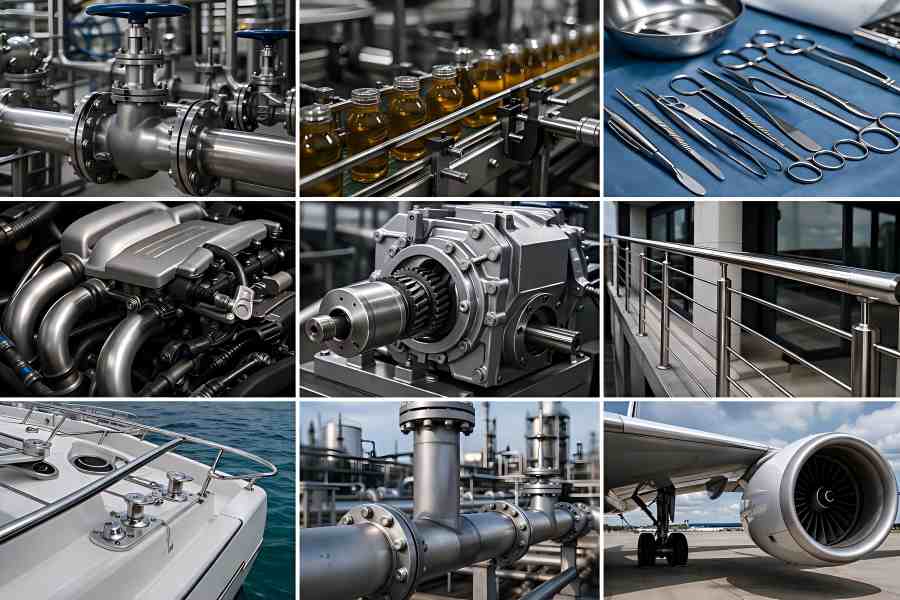
ASTM 304 precision steel castings are used across numerous industries due to their balance of performance and cost.
Pump and Valve Industry
Precision cast components are widely used in fluid control systems, including:
- Valve bodies
- Pump housings
- Impellers
- Flanges
These components require corrosion resistance and durability, especially when handling water, chemicals, or industrial fluids.
Food and Beverage Industry
ASTM 304 is a preferred material for food-grade applications because of its hygienic properties.
Typical components include:
- Mixing blades
- Conveyor parts
- Processing equipment
- Sanitary connectors
The material’s ease of cleaning and resistance to contamination are critical in maintaining food safety standards.
Medical and Pharmaceutical Equipment
In medical environments, ASTM 304 precision castings are used for:
- Surgical instrument components
- Equipment housings
- Sterilization systems
Its non-reactive nature and corrosion resistance support strict hygiene requirements.
Automotive Industry
Automotive applications benefit from ASTM 304’s durability and heat resistance.
Common uses include:
- Exhaust system parts
- Structural brackets
- Sensor housings
- Engine components
Precision casting allows for lightweight yet strong designs.
Industrial Machinery
Heavy-duty equipment relies on precision steel castings for:
- Gear housings
- Couplings
- Mounting brackets
- Mechanical connectors
ASTM 304 ensures reliability in demanding environments.
Construction and Architectural Applications
Precision castings that meet ASTM 304 standards are frequently utilized in construction for both decorative and structural uses:
- Door and window hardware
- Railings and fittings
- Facade components
- Structural connectors
Its aesthetic appeal and corrosion resistance make it suitable for indoor and outdoor use.
Marine and Offshore Applications
While ASTM 304 is not the best choice for highly saline environments, it is still used in:
- Boat fittings
- Deck hardware
- Marine accessories
for applications with limited exposure to saltwater.
Energy and Chemical Processing
In energy and chemical industries, ASTM 304 precision castings are used for:
- Pipeline components
- Storage systems
- Equipment exposed to mild chemicals
They offer a balance between cost and corrosion resistance.
Aerospace and Defense
Although more advanced alloys are often preferred, ASTM 304 is used in non-critical aerospace components where corrosion resistance and cost efficiency are important.
ASTM 304 vs Other Materials
| Material | Corrosion Resistance | Strength Level | Cost Level | Typical Use |
| ASTM 304 | Good (general environments) | Medium | Medium | Balanced performance; widely used, versatile |
| ASTM 316 | Excellent (chloride/marine) | Medium–High | Higher | Superior corrosion resistance; marine, chemical |
| Carbon Steel | Poor (prone to rust) | Medium–High | Low | Low cost; requires coating or protection |
| Alloy Steel | Moderate | High | Medium–High | High strength; heavy-duty mechanical applications |
Design Considerations for ASTM 304 Precision Castings
Uniform Wall Thickness
Maintaining consistent wall thickness helps ensure even cooling and solidification, reducing the risk of shrinkage, warping, or internal defects.
Draft Angles and Fillets
Although investment casting allows complex shapes, adding proper draft angles and smooth fillets improves mold filling and reduces stress concentration in critical areas.
Tolerance and Machining Allowance
Precision casting provides tight tolerances, but critical surfaces may still require machining. Designers should leave appropriate allowances for finishing operations.
Surface Finish Requirements
If the component requires a high-quality or polished surface (e.g., food or medical use), this should be considered early in the design to minimize additional processing.
Shrinkage and Dimensional Control
ASTM 304 experiences shrinkage during solidification. Proper mold design and compensation factors are essential to achieve accurate final dimensions.
Service Environment Consideration
The operating environment—such as exposure to chemicals, moisture, or temperature—should guide material selection and design features to ensure long-term performance.
Assembly and Joining Needs
If the part will be welded or assembled with other components, the design should allow for proper access, joint strength, and compatibility with ASTM 304’s welding characteristics.
Quality Control and Standards
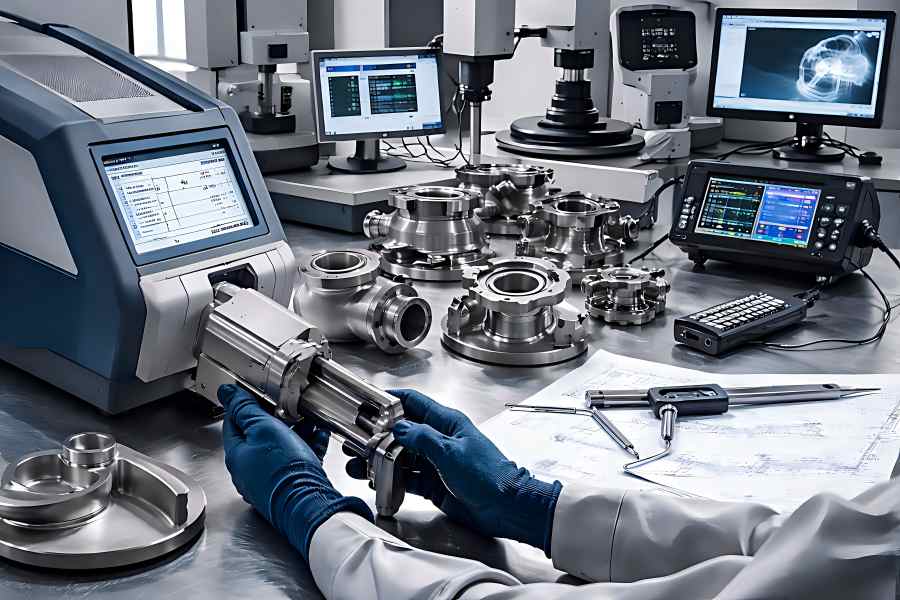
Ensuring the quality of ASTM 304 precision steel castings requires strict control throughout the entire production process, from raw material selection to final inspection.
Chemical Composition Verification
Raw materials must meet ASTM 304 standards for chromium, nickel, and carbon content. To ensure this, finished castings are often subjected to spectrometer (spectral) testing, which accurately verifies the chemical composition and confirms material compliance.
Process Control and Traceability
Each production step—wax pattern making, shell building, pouring, and cooling—is carefully controlled and documented. Batch traceability ensures that any issue can be tracked back to its source.
Dimensional Inspection
Precision measuring tools such as calipers, gauges, or CMM (Coordinate Measuring Machines) are used to confirm that parts meet specified tolerances and design requirements.
Mechanical Property Testing
Tests such as tensile strength, hardness, and impact resistance may be performed to ensure the casting meets performance expectations.
Surface and Internal Defect Inspection
Visual inspection and non-destructive testing (NDT) methods—such as dye penetrant testing or X-ray inspection—are used to detect surface cracks, porosity, or internal defects.
Compliance with Standards
ASTM 304 precision castings are typically produced in accordance with international standards such as ASTM, ISO 9001, and customer-specific requirements, ensuring consistent quality and reliability.