
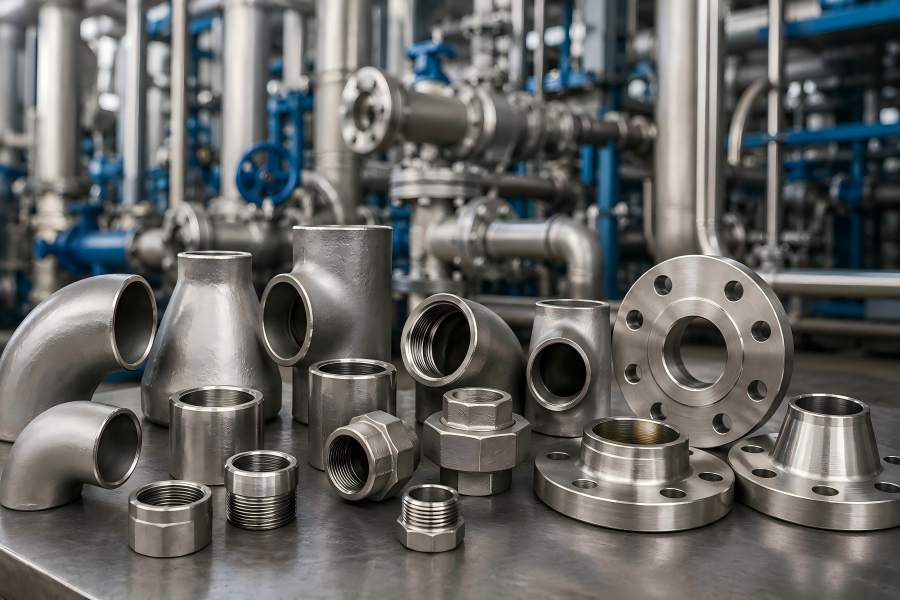
Metal pipe fittings include adapters, caps, couplings, elbows, flanges, tees, unions, and more. Because of their strength, resilience, and capacity to withstand high pressure, steel fittings are frequently utilized in sectors like manufacturing, water treatment, and oil & gas. Choosing the correct fittings based on pressure, temperature, and chemical compatibility helps prevent leaks, failures, and energy loss.
Common Types of Metal Pipe Fittings
Adapters
Adapters help connect pipes with different ends or sizes. You use adapters to join threaded pipes to plain-end pipes. They also let you switch from steel to brass pipes. Adapters are used in plumbing, hydraulic systems, and chemical plants. Brass and stainless steel make up their construction. These materials follow industry standards like ASME 31.3. Adapters make leak-tight connections in homes and factories.
Bushings
Bushings make a pipe opening smaller. You use bushings to connect a big pipe to a small one. Most bushings are made from steel, brass, or special plastics like PTFE and PEEK. Steel bushings resist corrosion and heat. They work well in tough places. Bushings are found in chemical plants and water treatment systems. They save space and money by needing fewer fittings.
Caps
Caps seal the ends of pipes to stop flow and prevent contamination. Available in various sizes and materials, caps are suitable for permanent sealing, high-pressure applications, and sanitary environments.
Common uses for caps:
- Seal unused pipe ends in construction
- Isolate sections for testing or repair
- Protect pipes during transport or storage
Couplings
Couplings connect two straight pipes for permanent or temporary joints. Full couplings create strong full-pipe connections, while half couplings are suitable for tight spaces or temporary setups. They are commonly used in pump, valve, and gas line connections.
| Feature | Full Coupling | Half Coupling |
| Connection Type | Connects two pipes fully, providing a strong bond | Connects to one pipe end, allowing for flexibility |
| Installation | Installation More intricate; both ends must be secured | Easier to install and suitable for confined places |
| Strength | Ideal for high-pressure applications | Suitable for various materials and temporary setups |
| Application Scope | Used in heavy-duty industrial settings | Versatile, used in plumbing and maintenance |
Elbows
Elbows change the direction of pipes. You use elbows to go around corners or obstacles. 45°, 90°, and 180° are the most typical angles. Elbows help keep flow smooth and reduce pressure loss. They are used in process piping, HVAC, and boiler loops. One male end and one female end make up a street elbow. This makes them easy to connect in tight spots.
You should use elbows to:
- Turn pipes around corners
- Connect perpendicular pipes
- Make gentle turns for better flow
Extenders
Extenders lengthen pipes, adjust fitting distances, and replace damaged sections, especially in hydraulic systems. They simplify maintenance, inspection, and leak prevention without welding.
Flanges
Flanges provide a sturdy junction between pipes, valves, or other equipment. Flanges are used in systems that require high pressure or frequent maintenance. Among the several kinds of flanges are weld neck, slip-on, blind, and ring flanges.
For hot or high-pressure systems, weld neck flanges work well. Slip-on flanges work well for lower pressure and are simple to install. Choose the appropriate flange according to the material and pressure class. Observe ANSI/ASME guidelines.
| ASME Pressure Class | Typical Pressure | Common Uses |
| Class 150 | Low pressure (285 psi) | Water systems, HVAC, fire protection |
| Class 300 | Medium pressure (740 psi) | Process piping, compressed air systems |
| Class 600 | High pressure (1480 psi) | Oil & gas, steam applications |
Nipples
Nipples are short pipes with threads on both ends. They come in standard lengths and thread types such as NPT and BSPT, which must be matched to prevent leaks or damage. They are commonly used for pipe extension, valve connection, or repairs.
Plugs
Plugs seal the ends of internally threaded pipes or fittings, providing temporary or removable closures. They are used to close test ports or access points and can be easily installed or removed with hand tools. Plugs are suitable for cleaning, sampling, or testing, but not for permanent or sanitary sealing.
Tees
Tees split or combine flow in pipes. You use tees to make branch lines or connect three pipes. There are many types of tees:
| Classification Type | Description |
| Equal Tee | joins pipes with the same diameter to provide equal flow. |
| Reducing Tee | Has a smaller branch to reduce flow from the main line. |
| Buttweld Tee | Welded for a strong, permanent joint. |
| Socket Weld Tee | Fits smaller pipes, connects by socket insertion. |
| Clamp Tee | Uses compression fittings for easy installation. |
| Threaded Tee | Joins pipes with threads for flexibility. |
| Straight Tee | The branch and the main run are perpendicular. |
| Lateral Tee | Branch is at an angle, good for tight spaces. |
Tees are used in utility lines and distribution headers. They help run many branches from a main supply. Tees are needed for simple and complex pipe layouts.
Unions
Unions join two pipes together but make it simple to disassemble them. You use unions when you need to disconnect pipes without cutting them. Unions are common in systems that need lots of inspection or cleaning. They stop pipes from twisting and help align pipes. Unions are also used to connect containers or equipment.
Wyes
At a 45-degree angle, wyes connect three pipes. You use wyes to merge or split fluid streams with less turbulence than tees. Wyes are common in factories, especially for moving slurries or fluids with solids. The angled shape helps stop blockages and improves flow.
Benefits of wyes:
- Reduce turbulence
- Prevent buildup of solids
- Improve flow in merging or splitting lines
Crosses
Four-way connectors called crosses create numerous branches in pipelines. Crosses are used in specific design to join four pipes at right angles. Crosses are not as common as tees. They are used in complex systems with many branch lines. Tees are usually enough, but crosses give more options for advanced designs.
Quick Reference:
- Metal pipe fittings include adapters, bushings, caps, couplings, elbows, extenders, flanges, nipples, plugs, tees, unions, wyes, and crosses.
- Pick fittings based on material, pressure, and your system’s needs.
Specialized Pipe Fittings
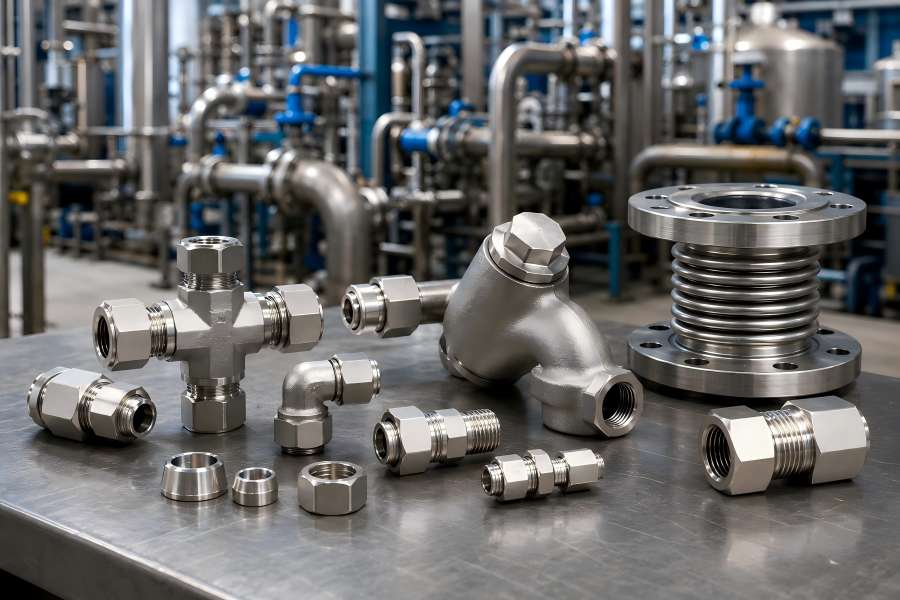
Specialized pipe fittings help fix special problems in plumbing and factories. These fittings are used where safety and performance matter a lot. Some types are very important.
Instrumentation Fittings
You use instrumentation fittings for very accurate and tight connections. They are best for systems that measure flow, pressure, or temperature. You see them in chemical plants and food factories. They are also used in medicine making. Instrumentation fittings are made to handle high pressure and stop leaks.
| Feature | Instrumentation Fittings | Standard Pipe Fittings |
| Precision | Made for jobs needing high accuracy | Used for general jobs, less accuracy |
| Pressure Ratings | Can handle more pressure | Usually for lower pressure |
| Leak-free Performance | Built to stop leaks | Might not always stop leaks |
Traps
Traps keep bad gases and dirt out of pipes. You use traps in drains and vents to block sewer gases. Traps hold water in a curve, making a barrier. You find traps in sinks and floor drains. They are also in waste pipes in factories. Stainless steel pipe fittings make traps last longer and stop rust.
Expansion Joints
Expansion joints protect pipes from damage when temperatures change. Pipes get bigger or smaller when they heat up or cool down. Expansion joints use metal bellows and tie rods to absorb movement. They also have covers. Without these fittings, pipes can bend or break.
Expansion joints can be found in chemical plants and heating systems. They are also found in facilities that treat water. Pipe fittings made of stainless steel are utilized because they can withstand stress and don’t rust.
Common materials for expansion joints:
- Stainless steel
- Aluminum
- Rubber
- Braided fiber
Compression Fittings
Compression fittings join pipes without heat or welding. You use a nut and ferrule to make a tight seal. It is simple to install and remove these fittings. This helps when you need to fix pipes. Stainless steel pipe fittings work well for high-pressure jobs. They also stop leaks. You use compression fittings with copper or plastic pipes.
| Feature | Compression Fittings | Other Metal Fittings |
| Installation Method | Uses nuts and ferrules to seal | Often uses solder or pressing |
| Leak Prevention | Uses metal-to-metal contact, may need tightening | Uses O-rings or force |
| Ease of Disassembly | Easy to take apart and use again | May need special tools or cutting |
Specialized metal pipe fittings are important in food factories and medicine making. Water treatment facilities and chemical factories also use them. To maintain your system safe and functional, you must choose the appropriate fittings.
Choosing Fittings for Your System
Selection Factors
When choosing pipe fittings, there are a lot of factors to consider. Every component contributes to the efficiency and security of your system.
- Your choice of material is crucial. Metals like brass or stainless steel are available. Plastics like PVC are another option. Metal pipe fittings are durable and robust. They work best in occupations with a lot of strain. For easier tasks, plastic fittings work well. They are also less expensive.
- The fitting’s size is crucial. You must accurately measure your pipes. The flow will be poor if you choose the incorrect size. Energy may be wasted in this way.
- You need to verify the temperature and pressure ratings. The fittings need to be suitable with your system’s pressure and temperature. PVC works well under low pressure. For high pressure, metal pipe fittings are preferable.
- The place where you use the fittings matters. Very hot or cold places can hurt some fittings. Harsh chemicals can also cause damage. You need to pick materials that do not rust and stay strong.
- How you connect the pipes is important. You can use threaded, flanged, groove, or welded connections. Each way works for different jobs and places.
- Your decision will be aided by the requirements of your project. You ought to be aware of the type of fluid you have. Additionally, you must understand where your system will be deployed and how it is configured.
- The product’s quality and brand are crucial. Better fittings are provided by high-quality brands. They also assist you in the event that you have difficulties later.
- It matters what you receive for your money and how much it costs. First, you should consider how much you spend. The cost of using and maintaining the system going forward should also be taken into account.
Application Examples
You can see that picking fittings is different for each job. The table below shows two common systems and the fittings they use.
| System Type | Maximum Pressure | Maximum Temperature | Fluid Medium | Fitting Selection |
| High-Pressure Steam System | 125 psi | 353°F (178°C) | Steam and condensate | Class 150 black iron or galvanized couplings and fittings |
| Potable Water System | 200 psi (test) | Ambient | Potable or non-potable water | Class 150 galvanized malleable iron couplings and fittings |
You use metal pipe fittings in steam systems. They can handle high pressure and heat. For water systems, you use galvanized iron fittings. These fittings protect water and prevent rust. You must pick the right fitting for the job to get the best results.
Choosing the right metal pipe fittings helps you keep your system strong and efficient. High-grade stainless steel fittings last longer and resist rust. These fittings handle high pressure and big temperature changes. You get better flow and less waste.
- Stainless steel alloys like 316 or 201 work best in tough places.
- These fittings support eco-friendly projects because you can recycle them.
You should learn about each fitting’s job before you buy. For complex systems, check product guides or ask a professional. Following standards like ASTM and ASME keeps your system safe.
FAQ
What is the best way to prevent leaks in metal pipe fittings?
Always utilize the appropriate fitting type and size. Tighten connections properly. Use thread sealant or Teflon tape for threaded joints. Check for damage before installation.
Can you mix different metals in pipe fittings?
Mixing metals can cause corrosion. You should avoid connecting metals like steel and copper directly. If you must mix, use a dielectric union to separate the metals and prevent damage.
How do you know which fitting to use for high-pressure systems?
Check the pressure rating on the fitting. Choose fittings made from strong metals like stainless steel. Look for markings that show the pressure class. Always follow the system’s requirements.
Are metal pipe fittings safe for drinking water?
Indeed, a lot of metal fixtures are suitable for drinking water. You should use fittings labeled as lead-free and approved for potable water. Stainless steel and brass are common choices.
How often should you inspect metal pipe fittings?
Inspect fittings at least once a year. Look for signs of rust, leaks, or loose connections. Early inspections help you avoid more serious issues later.