
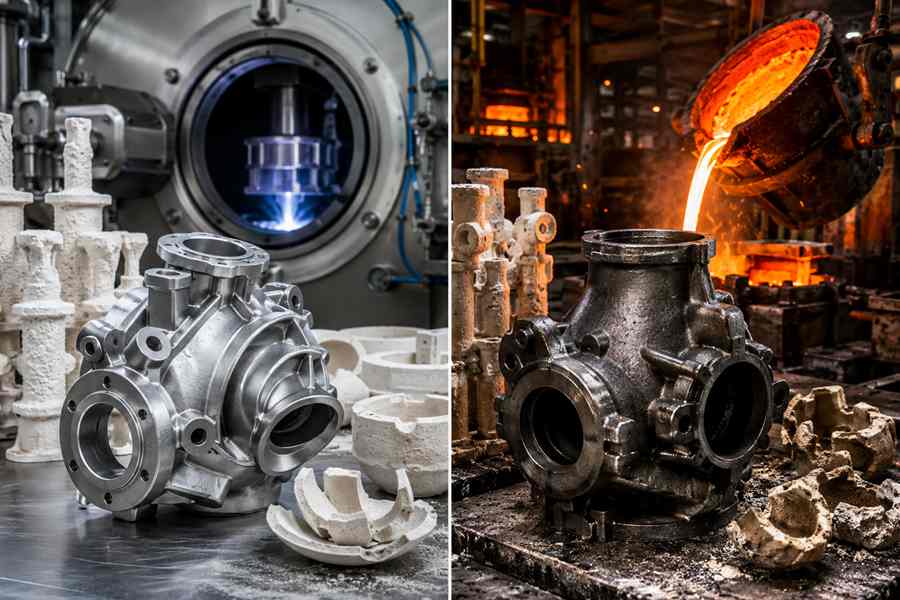
Titanium and steel investment casting can both manufacture accurate parts with complex shapes. Titanium provides lower weight and better corrosion protection, while steel delivers higher rigidity, more alloy choices, and a lower overall cost.
What Is Titanium Investment Casting?
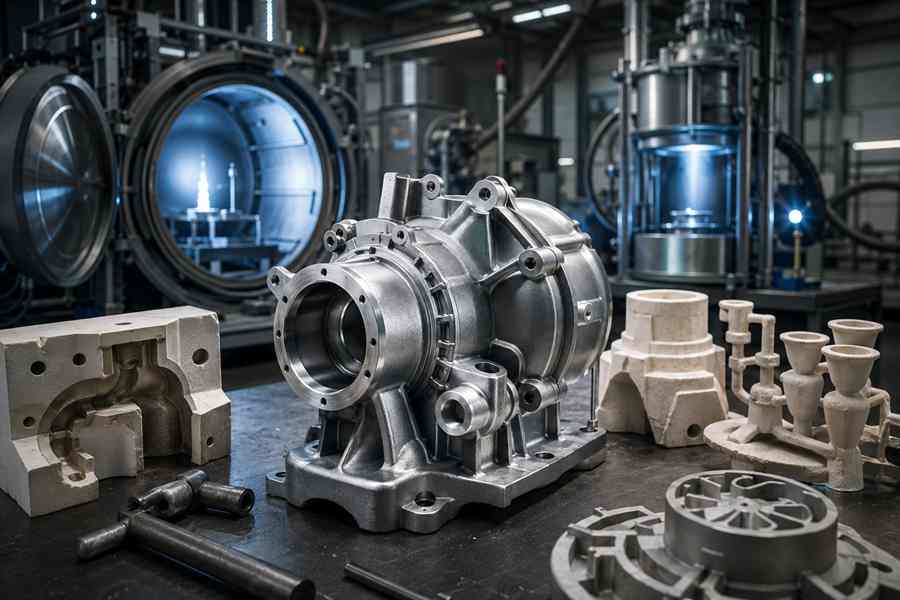
Titanium investment casting produces precision titanium components by combining disposable wax patterns with ceramic shell molds.
Because molten titanium reacts strongly with air and standard mold materials, the process needs protected melting, compatible ceramic shells, and strict contamination management.
Key Characteristics of Titanium Investment Casting
- Relatively low material density
- Excellent strength in relation to weight
- High resistance to seawater and chloride exposure
- Suitable for complicated one-piece designs
- Requires vacuum or inert-gas melting conditions
- Higher production and inspection expenses
Typical Manufacturing Steps
- Wax Pattern Manufacturing
Wax replicas are injected to match the required component geometry. - Pattern Assembly
Multiple wax patterns can be connected to one central runner system. - Ceramic Shell Formation
The wax assembly is covered with several layers of specialized ceramic material. - Wax Removal and Shell Heating
The wax is eliminated before the ceramic mold is heated for pouring. - Protected Titanium Melting
Titanium alloy is melted in a vacuum or inert atmosphere to limit contamination. - Metal Pouring and Cooling
The molten titanium enters the shell and solidifies under controlled conditions. - Cleaning and Final Processing
Finished castings are separated, cleaned, checked, and machined where necessary.
What Is Steel Investment Casting?
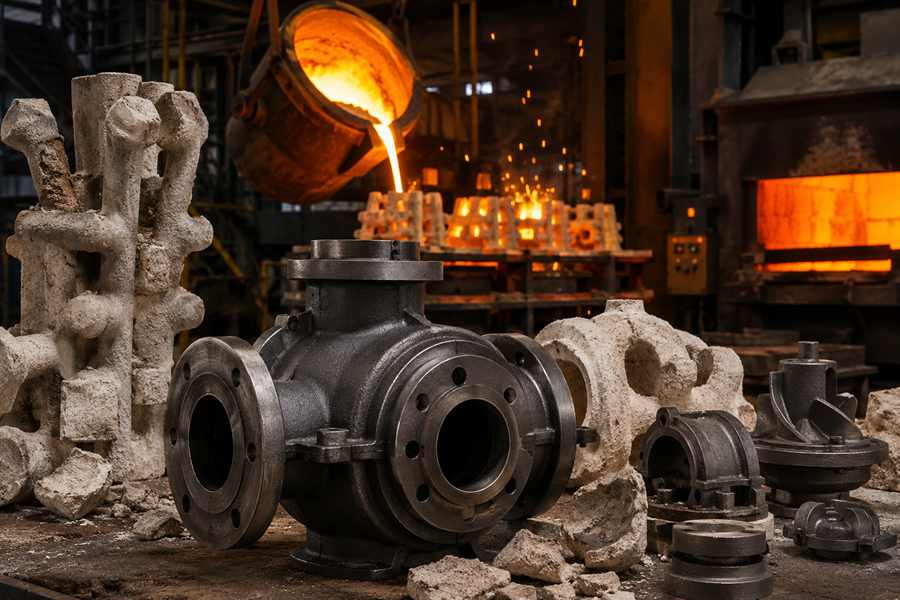
Steel investment casting manufactures accurate steel components by filling a ceramic shell, previously formed around wax patterns, with molten steel.
A larger number of suppliers and well-established manufacturing equipment support steel casting. It is usually the more practical option for industrial components where substantial weight reduction is unnecessary.
Key Characteristics of Steel Investment Casting
- Extensive range of available steel grades
- Strong rigidity and load-bearing capability
- Multiple heat-treatment possibilities
- Appropriate for components exposed to wear
- Easier access to qualified suppliers
- Lower manufacturing cost than titanium
Typical Manufacturing Steps
- Wax Pattern Manufacturing
The supplier produces wax replicas based on the final part design. - Tree Assembly
Individual wax patterns are connected to a shared runner for batch production. - Ceramic Shell Coating
Several ceramic slurry and sand layers are applied around the assembly. - Wax Removal Stage
Thermal treatment strips away wax residues, meanwhile prepping the ceramic shell ready for molten metal casting. - Steel Melting and Casting
The chosen steel alloy is melted before being poured into the ceramic cavity. - Ceramic Shell Removal
Once the steel cools, the surrounding ceramic material is broken away. - Heat Treatment and Secondary Finishing
Castings may be heat treated, blasted, machined, coated, or passivated afterward.
Important Distinctions Between Titanium and Steel Investment Casting
Manufacturing Process
- Titanium Casting:Molten titanium must remain separated from oxygen, nitrogen, and incompatible shell materials. Even minor process deviations may lead to surface contamination or weaker mechanical properties.
- Steel Casting:Molten steel is less reactive and works with more conventional shell systems. This characteristic enables the manufacturing workflow to be replicated effortlessly and scaled up to fulfill bulk order demands.
Manufacturing difficulty and the number of capable suppliers can directly affect delivery schedules and the overall practicality of a project.
Material Strength
- Titanium Casting:Delivers a high strength-to-weight ratio and reliable cyclic-load performance when alloy composition and casting quality are properly managed.
- Steel Casting:Provides strong absolute load capacity and greater stiffness across carbon steel, alloy steel, and stainless steel options.
Titanium is beneficial when a part must remain strong while reducing overall mass. Steel is often more appropriate when resistance to bending and structural rigidity take priority.
Size and Dimensional Capabilities
| Design Factor | Titanium Casting | Steel Casting |
| Typical Part Range | Small and medium-sized precision components | Small components through larger industrial castings |
| Thin Sections | Achievable with close process management | Usually easier to fill and maintain |
| Complex Internal Shapes | Possible with a properly developed shell | Suitable for many complex geometries |
| Heavy Sections | More challenging and costly to produce | Better suited to large load-bearing sections |
| Tight Dimensions | Commonly completed through finish machining | Easier to machine and inspect consistently |
Both options can manufacture components close to their final shape. However, increasing titanium casting size raises melting, shell-building, filling, and inspection risks more rapidly than it does for comparable steel parts.
Weight and Density
- Titanium Casting:Common titanium alloys have a density of approximately 4.5 g/cm³.
- Steel Casting:Many standard steel grades have a density of about 7.8 g/cm³.
This density difference can noticeably affect the performance of systems where movement, energy efficiency, transportation, or manual handling matters.
For stationary machinery and permanently installed equipment, however, reducing weight usually brings less value, making production cost a more important factor.
Corrosion Resistance
- Titanium Casting:Develops a protective oxide film that performs well in seawater and many chloride-rich conditions.
- Steel Casting:The resistance against rust differs drastically among carbon steel, alloy steel and diverse stainless steel grades.
Material decisions should be based on the actual operating environment and maintenance plan instead of assuming that the most advanced alloy is always required.
Cost Comparison
| Cost Factor | Titanium Investment Casting | Steel Investment Casting |
| Raw Material Cost | Approximately US$20–40/kg | Approximately US$2–6/kg |
| Casting Process Cost | Approximately US$30–80/kg | Approximately US$10–25/kg |
| Machining Cost | Approximately US$15–40/kg | Approximately US$5–15/kg |
| Inspection and Quality Control | High, often 10%–20% of total cost | Moderate, often 5%–10% of total cost |
| Typical Finished Part Cost | Approximately US$80–200/kg | Approximately US$20–60/kg |
Across raw materials, manufacturing, machining, and inspection, titanium investment casting generally carries a substantially higher cost than steel investment casting.
Advantages and Disadvantages of Titanium Investment Casting
Titanium investment casting is useful when a single component must provide low weight, corrosion protection, and detailed geometry. It may also replace structures previously assembled from several welded or machined parts.
Advantages
- Lowers the weight of individual parts and complete assemblies
- Withstands seawater and chloride-containing environments
- Provides dependable fatigue behavior
- Enables detailed one-piece component designs
- Reduces the need for protective surface coatings
- Performs effectively under demanding service conditions
Disadvantages
- Higher expense for raw material and manufacturing
- Needs specialized equipment and tighter process management
- More difficult to machine than most steel grades
- Smaller pool of capable casting suppliers
- Greater inspection and quality assurance requirements
Advantages and Disadvantages of Steel Investment Casting
Steel investment casting combines dependable strength, high stiffness, broad alloy availability, and manageable purchasing costs. It is suitable for prototype development, replacement components, and routine industrial orders.
Advantages
- Large selection of carbon, alloy, and stainless steels
- Reliable strength for load-bearing applications
- Adjustable hardness through different heat treatments
- Established and repeatable manufacturing process
- Simpler machining and secondary surface treatment
- More economical pricing per finished component
Disadvantages
- Greater component weight than titanium
- Corrosion resistance varies by alloy and may require coating
- Lower strength relative to material weight
- Additional surface protection may be needed in severe environments
Application Comparison
Material choice should reflect the real working conditions of the finished part. Selecting titanium when steel already meets the design requirements may raise costs without adding meaningful performance.
Aerospace and Medical
Titanium: Appropriate for aerospace structural components and medical implants where low mass and corrosion resistance are essential.
Offshore and chemical industrial application fields
Steel: Ideal for offshore hardware and chemical production machinery, which requires a balance of decent anti-rust properties and cost-effective budgets.
Automotive and Machinery
Steel: Commonly used for vehicle and machinery parts such as housings, gears, brackets, and other durable load-bearing components.
General Industrial Equipment
Titanium: Suitable for industrial systems exposed to severe corrosion when a longer service life can justify the higher material investment.
When to Select Titanium vs Steel Investment Casting
The chosen alloy should address a clear production, performance, or purchasing requirement. A technically advanced material is not automatically the most suitable option.
Choose Titanium Investment Casting When:
- Lower part weight improves overall equipment performance
- Components remain continuously exposed to seawater
- Chlorides or aggressive chemicals cause rapid steel damage
- Frequent coating repair needs to be avoided
- A strong strength-to-weight ratio is essential
- Extended operating life can recover the higher purchase cost
Choose Steel Investment Casting When:
- Structural stiffness and load capacity are more important
- The equipment is stationary or weight has little influence
- Lower initial and finished-part costs are required
- The project benefits from a wider range of alloy grades
- Quick sampling or repeat-order flexibility is important
- Coated steel or stainless steel provides sufficient corrosion protection
Titanium investment casting is better suited to lightweight components and highly corrosive service conditions.
Steel investment casting remains the more balanced option for most industrial parts because it delivers dependable strength, simpler manufacturing, and more predictable cost.