
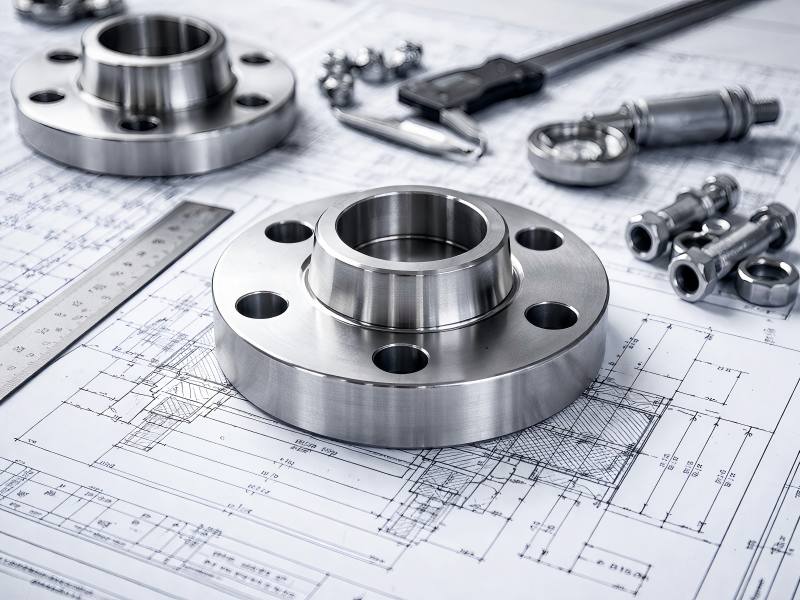
Socket weld flanges are widely used in high-pressure piping systems with small pipe diameters, providing strong and reliable sealing connections.
Among global flange standards, ASME B16.5 is the most widely used specification for socket weld flanges, defining dimensions, pressure classes, tolerances, materials, and marking requirements for industrial piping flanges.
This article introduces ASME B16.5 socket weld flange dimensions, pressure ratings, and sizing systems, providing practical tables and explanations to help engineers and buyers correctly interpret flange specifications.
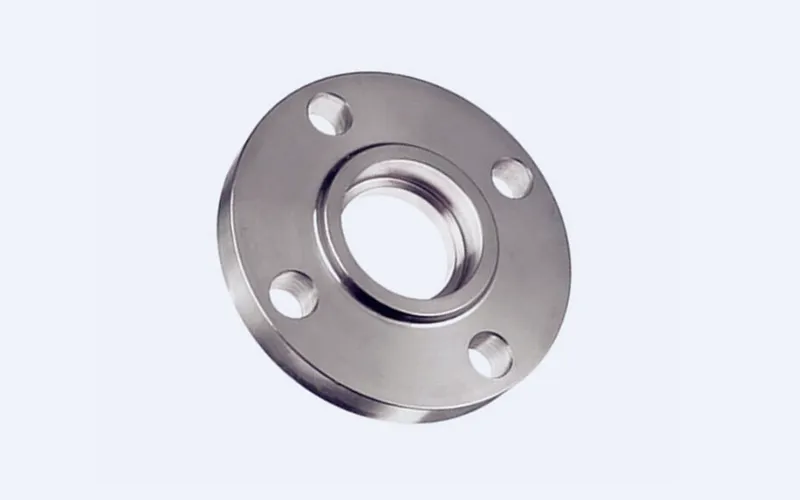
A Synopsis of Socket Welding Flanges
The counterbore socket on a socket weld flange (SW flange) enables the pipe to be placed into the flange prior to welding. The pipe is then welded around the hub area, forming a secure connection.
Crucial Elements
- A recessed socket is filled with a pipe.
- Perfect for small-diameter high-pressure piping
- Perfect for small-diameter high-pressure piping
- Guarantees a smooth bore within.
- Reduces turbulence and erosion
Socket weld flanges are particularly common in:
- Chemical processing plants
- Pipelines for oil and gas transportation
- Steam-powered systems
- Hydraulic and high-pressure services
Compared with slip-on flanges, socket weld flanges provide stronger connections for smaller pipes and help maintain internal flow integrity.
Requirements for Socket Weld Flanges As stated in ASME B16.5
The ASME B16.5 standard defines dimensions and tolerances for pipe flanges ranging from NPS ½ inch to 24 inches. Weld neck, slip-on, threaded, blind, lap joint, and socket weld flanges are among the several types of flanges that are included.
In particular, the standard offers the following for socket weld flanges:
- Dimensional requirements
- Pressure-temperature ratings
- Bolt circle and bolt hole dimensions
- Materials and marking standards
- Tolerances and inspection rules
According to ASME B16.5:
- Socket weld flanges typically cover sizes NPS ½″ to NPS 3″.
- The pressure classes are 150, 300, 400, 600, 900, 1500, and 2500.
- Dimensions are specified in both inch and metric units.
For larger flanges (above 24 inches), the ASME B16.47 standard is used instead.
Pressure Classes in ASME B16.5
Socket weld flanges are categorized by pressure classes, which determine their allowable pressure-temperature limits.
Common Pressure Classes
| Pressure Class | Typical Application | Pressure Capability |
| Class 150 | Low-pressure systems | Water pipelines, HVAC |
| Class 300 | Medium pressure | Chemical pipelines |
| Class 600 | High-pressure systems | Oil & gas processing |
| Class 900 | Severe pressure conditions | Refineries |
| Class 1500 | Very high pressure | Steam and high-temp systems |
| Class 2500 | Extreme pressure | Power plants |
Higher pressure classes generally require:
- Thicker flange bodies
- Larger bolt diameters
- Stronger materials
These classes ensure compatibility with different piping system pressures and temperatures.
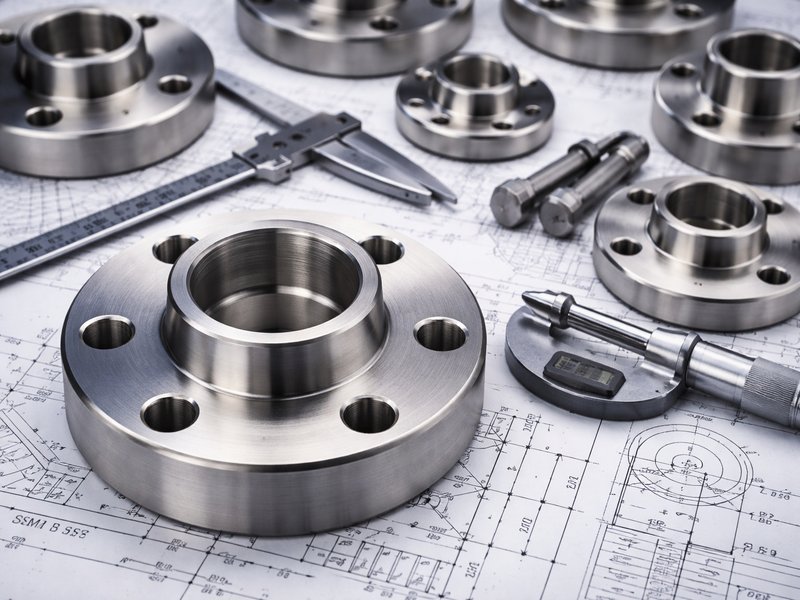
Key Dimensions of Socket Weld Flanges
The ASME B16.5 standard defines several critical dimensions that engineers must consider when specifying socket weld flanges.
Main Dimensional Parameters
| Dimension Symbol | Description |
| O | Outside diameter of flange |
| T | Flange thickness |
| R | Raised face diameter |
| Y | Length through hub |
| X | Hub diameter |
| B1 | Pipe bore diameter |
| B2 | Socket bore diameter |
| D | Socket Depth |
| C | How big is the bolt circle? |
| N | The number of bolt holes |
These parameters determine how the flange fits with the pipe, gasket, and bolts.
For example:
- The socket depth (D) ensures proper pipe insertion before welding.
- The bolt circle (C) ensures bolt alignment with the mating flange.
- The raised face diameter (R) supports gasket sealing performance.
Standard Dimensions for Class 150 Socket Weld Flanges
Below is an example of Class 150 socket weld flange dimensions for small pipe sizes.
Class 150 Socket Weld Flange Dimensions
| NPS | Outside Diameter (in) | Thickness (in) | Raised Face Diameter (in) | Bolt Circle (in) | Bolt Holes |
| 1/2 | 3.50 | 0.44 | 1.38 | 2.38 | 4 |
| 3/4 | 3.88 | 0.50 | 1.69 | 2.75 | 4 |
| 1 | 4.25 | 0.56 | 2.00 | 3.13 | 4 |
| 1 1/4 | 4.63 | 0.63 | 2.50 | 3.50 | 4 |
| 1 1/2 | 5.00 | 0.69 | 2.88 | 3.88 | 4 |
These dimensions illustrate how flange size increases with pipe diameter.
Example Dimensions for Class 300 Socket Weld Flanges
Class 300 flanges are thicker and stronger than Class 150.
Class 300 Socket Weld Flange Dimensions
| NPS | Outside Diameter | Thickness | Raised Face | Bolt Circle | Bolt Holes |
| 3/4 | 4.63 in | 0.63 in | 1.69 in | 3.25 in | 4 |
| 1 | 4.88 in | 0.69 in | 2.00 in | 3.50 in | 4 |
| 1 1/4 | 5.25 in | 0.75 in | 2.50 in | 3.88 in | 4 |
| 1 1/2 | 6.13 in | 0.81 in | 2.88 in | 4.50 in | 4 |
| 2 | 6.50 in | 0.88 in | 3.63 in | 5.00 in | 8 |
These dimensions demonstrate the increased thickness and bolt circle diameter required for higher pressure ratings.
Socket Weld Flange Socket Dimensions
The socket chamber, where the pipe is put prior to welding, is one of the most notable characteristics of socket weld flanges.
Important Socket Dimensions
| Dimension | Description |
| Socket Bore | Diameter matching pipe OD |
| Socket Depth | Depth of pipe insertion |
| Clearance Gap | Small gap for thermal expansion |
| Bore Diameter | Internal pipe bore alignment |
To avoid thermal stress during operation, a tiny expansion space is usually left between the pipe end and the socket’s bottom.
In many specifications, the socket depth is defined only for pipe sizes up to 3 inches, while larger sizes may be determined by the manufacturer.
Materials Used for Socket Weld Flanges
ASME B16.5 specifies dimensional standards but allows a variety of materials depending on application requirements.
Common Materials
| Material | Typical Standard | Application |
| Carbon Steel | ASTM A105 | General industrial piping |
| Stainless Steel | ASTM A182 F304 / F316 | Corrosive environments |
| Alloy Steel | ASTM A182 F11 / F22 | High temperature |
| Duplex Steel | ASTM A182 F51 | Offshore pipelines |
| Nickel Alloys | Inconel / Monel | Chemical processing |
Material selection depends on:
- Pressure and temperature
- Corrosion resistance
- Mechanical strength
- Industry regulations
Pressure-Temperature Ratings
The ASME B16.5 standard also includes pressure-temperature ratings, which define the allowable pressure for a given material and temperature.
Example Pressure Ratings (Carbon Steel)
| Temperature | Class 150 | Class 300 |
| 100°F | 285 psi | 740 psi |
| 400°F | 200 psi | 515 psi |
| 800°F | 95 psi | 245 psi |
Higher temperatures reduce allowable pressure due to material strength limitations.
Socket Weld Flange Facing Types
Different types of sealing faces can be used in the production of socket weld flanges.
Common Face Types
Raised Face (RF)
The most common sealing surface used in industrial piping.
Flat Face (FF)
Utilized with low-pressure systems or cast iron flanges.
Ring Type Joint (RTJ)
Utilized in pipes with high pressure that need metal-to-metal sealing.
The raised face design is widely used because it improves gasket compression and sealing performance.
Installation Considerations
Proper installation of socket weld flanges is essential for safe operation.
Installation Steps
- Insert the pipe into the flange socket
- Leave expansion gap (approx. 1.5 mm)
- Perform fillet welding around the hub
- Inspect weld integrity
- Install bolts and gasket
Tighten bolts using the proper torque sequence
Advantages of socket weld installation include:
- Strong structural connection
- Reduced leakage risk
- Good fatigue resistance
However, these flanges are generally not recommended for corrosive environments where crevice corrosion may occur inside the socket.
Inspection and Quality Control
To ensure compliance with ASME B16.5, manufacturers must perform several quality checks.
Typical Inspection Methods
- Dimensional inspection
- Material certification
- Ultrasonic testing
- Visual weld inspection
- Pressure testing
Inspection verifies that flange dimensions match the standard and ensures safe pipeline operation.
Socket Weld Flanges’ Benefits
For small pipe systems, socket-weld flanges have a number of advantages.
Key Advantages
- High structural strength
- Good sealing performance
- Smooth internal bore
- Reduced turbulence
- Suitable for high-pressure pipelines
Limitations of Socket Weld Flanges
Despite their advantages, socket weld flanges also have some limitations.
Common Disadvantages
- Limited to small pipe sizes
- Crevice corrosion risk
- Welding required
- Not suitable for frequent disassembly
For larger pipes or corrosive environments, engineers may prefer weld neck flanges instead.
In industrial piping systems that need high pressure and small pipe diameters, socket weld flanges are frequently utilized.. The ASME B16.5 standard defines their dimensions, pressure ratings, and design requirements to ensure safety and compatibility.
Key dimensions—such as outside diameter, flange thickness, socket depth, bolt circle, and pressure class—are essential for proper system design. Following ASME B16.5 helps engineers achieve reliable sealing and long service life.
Socket weld flanges remain a dependable solution for compact, high-strength connections in demanding industrial environments.