
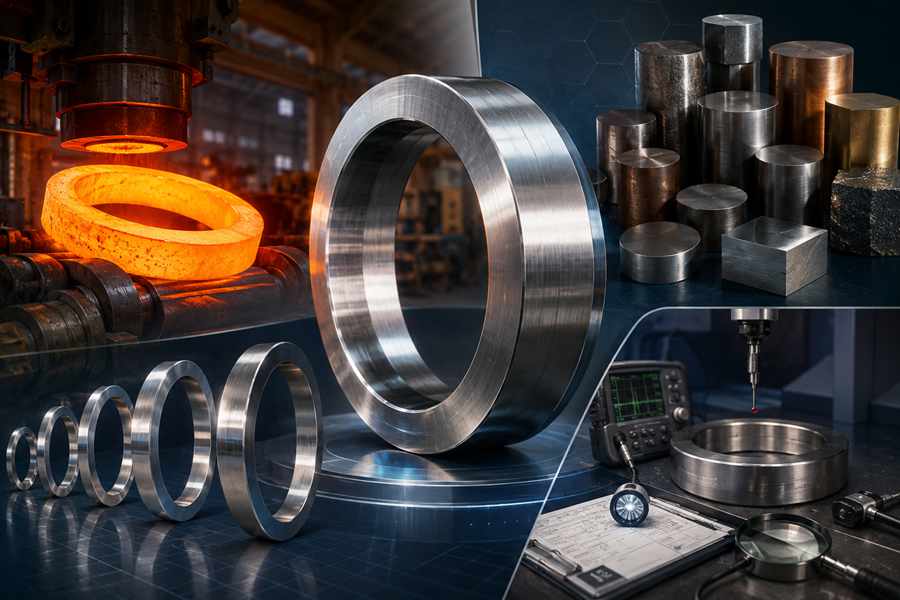
A seamless rolled ring is formed by piercing a heated billet and enlarging it through controlled ring rolling. Its final price is mainly shaped by ring dimensions, alloy selection, delivery condition, and the inspection package requested.
Seamless Rolled Ring Price Overview
The figures below are broad budgeting references rather than fixed market quotations. Final offers vary with order volume, production region, material supply, delivery terms, and technical requirements.
| Price Factor | Approximate Price Influence | Main Cost Driver |
| Size | Difficult dimensions may raise the base price by 15%–60% | Forged weight, diameter, wall thickness, and equipment capacity |
| Alloy Grade | About $3–$50+ per kg | Raw material value, forgeability, heat treatment, and availability |
| Inspection Cost | About $100–$2,000+ per order, batch, or ring | Test method, acceptance level, reporting, and third-party involvement |
These three factors should be evaluated together. A large carbon-steel ring with routine inspection can still cost less than a smaller nickel-alloy ring requiring extensive certification.
1. How Size Affects Seamless Rolled Ring Price
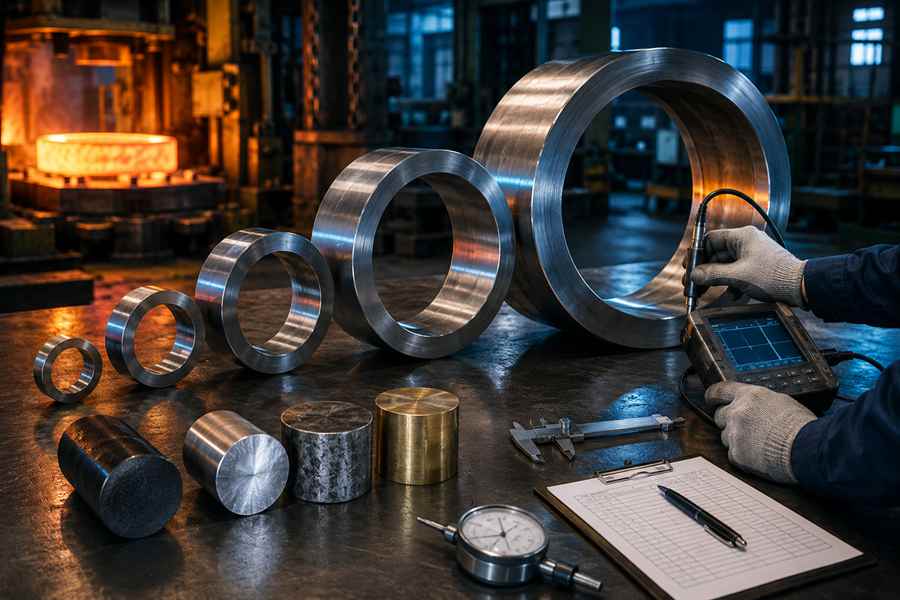
The size of forged rolled rings determines billet weight, furnace occupancy, rolling time, equipment capacity, machining stock, and freight planning. Price usually rises with mass, while unusual dimensional ratios may increase the unit rate even when the finished ring is relatively light.
Diameter, Height, and Forged Weight
Suppliers calculate the starting billet from the outside diameter, inside diameter, axial height, scale loss, and machining allowance. Buyers therefore pay for the rough-forged mass, not only the finished component.
A larger ring requires more:
- Raw material
- Heating energy
- Furnace space
- Rolling force
- Lifting capacity
- Handling time
- Packaging strength
When a ring exceeds the supplier’s normal equipment range, a larger mill or subcontracted operation may be needed. This can increase the base quotation by roughly 15%–40%.
Oversized diameter also changes logistics. Rings that cannot fit standard containers may require flat-rack, open-top, or break-bulk transport.
Buyers should provide:
- Finished outside diameter
- Finished inside diameter
- Finished height
- Rough-forged dimensions
- Estimated finished weight
- Required machining allowance
- Order quantity
Complete dimensional data lets the supplier calculate material use with less uncertainty. An inquiry containing only outside diameter and alloy grade often receives a wider safety allowance.
Wall Thickness and Shape Complexity
Wall thickness influences both forming load and dimensional stability. Heavy sections demand greater rolling force, while thin sections are more likely to move during rolling, heat treatment, cooling, or shipping.
Higher-cost size combinations include:
- Large diameter with a thin wall
- Small bore with a heavy wall
- High axial height
- Large diameter-to-height ratio
- Tight roundness requirements
- Unequal wall sections
- Stepped or tapered profiles
Challenging proportions may add about 10%–30% compared with a standard rectangular ring of similar mass. The premium covers slower rolling, repeated checking, correction work, and greater rejection exposure.
Profiled rings may also require:
- Special rolling tools
- Extra forming passes
- Lower rolling speed
- More inspection points
- Rough machining
- Additional allowance
For small orders, machining the required profile from a rectangular blank may cost less than dedicated tooling. For repeat production, shaped rolling can improve material yield and reduce the long-term unit price.
Machining allowance is part of the size calculation because it increases purchased weight. Every extra millimeter must be bought, heated, rolled, transported, and removed.
The allowance should cover:
- Rolling tolerance
- Surface scale
- Heat-treatment movement
- Roundness variation
- Flatness variation
- Final machining needs
Using one allowance rule for every ring size rarely delivers the best value. Large thin-wall rings and compact thick-wall rings need different stock strategies.
Pre-machining may raise the supplier’s quoted price while reducing the total landed cost. Rough turning and facing can remove scale, lower freight weight, and confirm that enough stock remains for finish machining.
2. How Alloy Grade Changes Rolled Ring Price
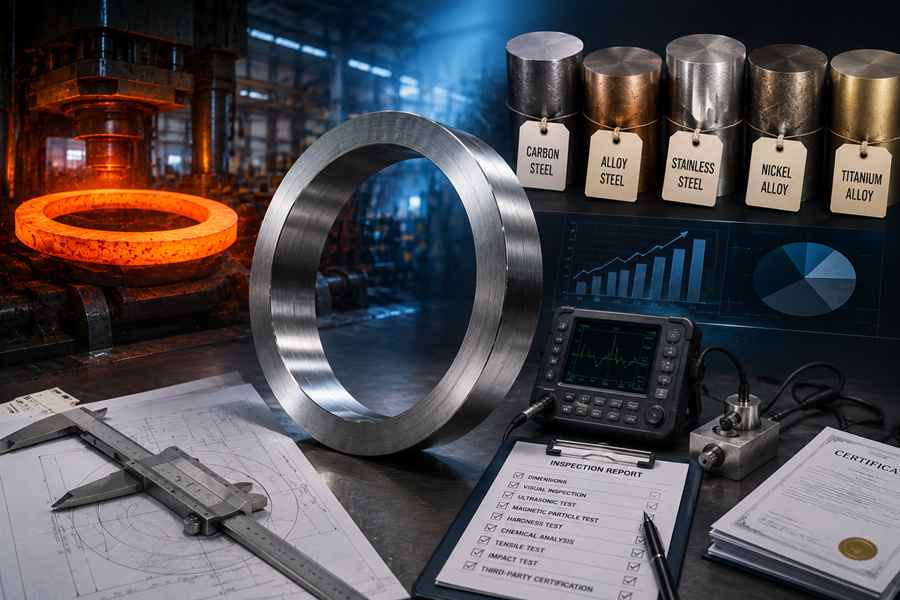
Alloy grade affects billet value, heating range, forming speed, heat treatment, tool wear, and inspection scope. Material choice can create a larger price gap than geometry alone.
Carbon and Low-Alloy Steel Prices
Carbon steel generally offers the lowest rolled-ring price because supply is broad and forging behavior is relatively predictable. It is widely used for flanges, gears, bearings, structural parts, and general machinery.
Approximate budget ranges include:
- Carbon steel: $3–$6 per kg
- Low-alloy steel: $4.5–$9 per kg
- Higher-strength alloy steel: $6–$12 per kg
These ranges normally apply to rough-rolled or heat-treated rings with standard commercial requirements. Machining, advanced testing, and third-party certification are often quoted separately.
Carbon-steel pricing is influenced by:
- Billet availability
- Order quantity
- Forged weight
- Heat-treatment condition
- Mechanical properties
- Material certification
- Surface requirements
Low-alloy steels cost more because they contain elements such as chromium, molybdenum, nickel, or manganese. They may also need tighter temperature and cooling control.
Quenched-and-tempered alloy rings add cost through:
- Multiple furnace cycles
- Quenching equipment
- Tempering time
- Hardness inspection
- Mechanical testing
- Straightening or correction
Additional heat treatment may raise the price by around 5%–20%. Large rings can cost more because a single piece may occupy most of the furnace capacity.
Choosing a higher alloy only as a safety margin can increase material, heat-treatment, and machining expenses without improving service performance. The grade should match the actual load, temperature, corrosion, and fatigue requirements.
Stainless Steel and Nickel Alloy Prices
Stainless steel carries a higher material value and often needs slower, more controlled forming. Temperature sensitivity, scale formation, and alloy behavior can also extend production time.
Approximate planning ranges include:
- Austenitic stainless steel: $7–$15 per kg
- Duplex stainless steel: $10–$20 per kg
- Nickel-based alloys: $18–$50+ per kg
The exact grade matters greatly. Common stainless grades usually cost less than special duplex, precipitation-hardening, or high-temperature alloys.
Stainless steel and nickel alloy costs are affected by the following factors:
- Nickel and chromium content
- Material availability
- Minimum purchase quantity
- Melting route
- Forging temperature range
- Surface conditioning
- Heat-treatment complexity
- Certification level
Nickel-based alloys often require smaller reductions and closer temperature control. Lower output raises furnace, press, and labor costs per ring.
Extra surface removal may also be necessary to eliminate oxidation or contaminated layers. This raises starting weight and reduces material utilization.
Critical applications may require:
- Vacuum-melted material
- Electroslag-remelted material
- Controlled inclusion levels
- Restricted chemical composition
- Grain-size limits
- Elevated-temperature testing
- Full heat traceability
Such requirements can move the offer well above a standard kilogram range. Small orders are especially expensive when the supplier must purchase a full billet or meet a mill minimum.
Quotations should be compared on the same material standard and delivery condition. An annealed stainless ring and a solution-treated, fully tested ring are not equivalent buying options.
3. How Inspection Requirements Add to the Price
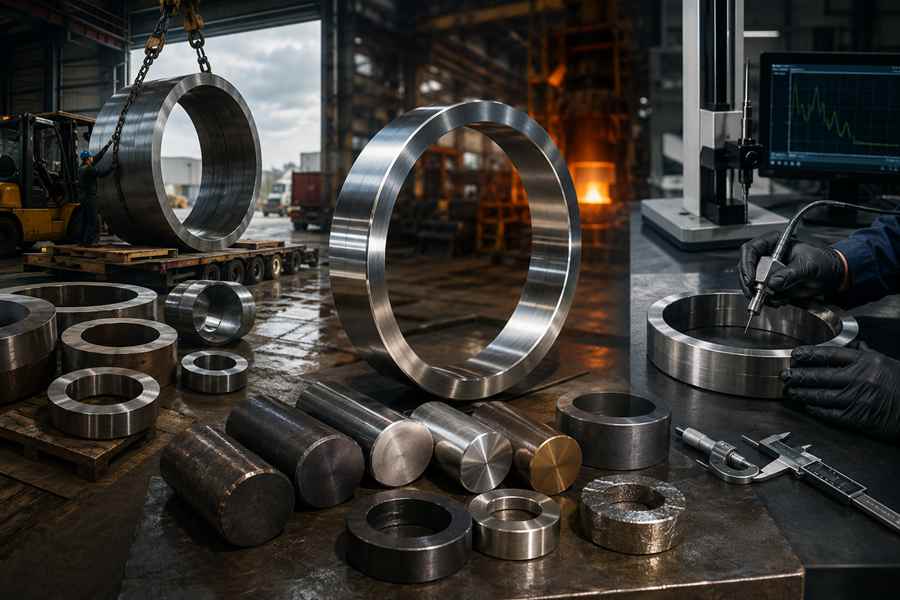
Inspection cost depends on the test method, acceptance standard, ring size, quantity, and document scope. Routine checks may be included in the base offer, while advanced examination is usually charged separately.
Standard Inspection Cost
Standard inspection verifies material identity, dimensions, surface condition, and supply status. The exact coverage should appear in the quotation rather than remain assumed.
Basic inspection may include:
- Visual examination
- Dimensional measurement
- Material certificate
- Heat-number traceability
- Hardness testing
- Heat-treatment record
- Surface-condition check
For commercial rings, these items may already be included in the unit price. Individual reports, extra measuring points, or customer-specific forms can add inspection and administrative charges.
Dimensional cost rises when tighter control is requested for:
- Outside diameter
- Inside diameter
- Axial height
- Roundness
- Flatness
- Parallelism
- Concentricity
Rough-rolled parts should not receive finish-machined tolerances unless machining is part of the supplier’s scope. Unnecessary limits add measuring time and may force extra cutting.
Buyers should also confirm whether inspection is completed:
- Per ring
- Per production batch
- Per heat number
- Before heat treatment
- After heat treatment
- After rough machining
Per-ring reporting provides stronger traceability but costs more than batch-level inspection. For repeat orders, a combined batch and sampling plan often gives better value.
Advanced Testing Cost
Advanced testing is common for pressure equipment, turbines, wind power, mining systems, aerospace parts, and other critical applications. Charges vary with ring dimensions, standard, acceptance level, and coverage.
Approximate cost ranges include:
- Ultrasonic testing: $150–$800 per ring or batch
- Magnetic particle testing: $100–$400
- Dye penetrant testing: $100–$350
- Tensile and impact testing: $200–$1,000+
- Metallographic testing: $200–$800+
- Third-party inspection: $500–$2,000+
Ultrasonic testing becomes more expensive as diameter, section thickness, and scan area increase. Stricter acceptance classes also require more calibration, scanning time, and reporting.
Magnetic particle inspection identifies surface-breaking and shallow subsurface defects in ferromagnetic steel materials. Dye penetrant testing is commonly used for stainless steel, nickel alloys, and other nonmagnetic materials.
Mechanical testing may include:
- Tensile strength
- Yield strength
- Elongation
- Reduction of area
- Impact energy
- Hardness
- Grain size
Specimen location changes the price. Samples taken from a prolongation or sacrificial section require extra forged material and machining.
Third-party inspection may add travel, witnessing, document review, and certification fees. Production can also be delayed when the inspector’s schedule does not match the manufacturing plan.
For an accurate testing offer, the RFQ should identify:
- Inspection standard
- Acceptance class
- Test method
- Scanning area
- Test frequency
- Reporting format
- Witness requirements
- Certificate language
The phrase “full inspection” is too broad for reliable pricing. Different suppliers may include very different work under the same wording.
Compare the Complete Seamless Rolled Ring Price
A useful quotation separates material, forging, heat treatment, machining, inspection, packaging, and freight. This makes the source of each price difference easier to understand.
Compare the following items:
- Price per kilogram
- Rough-forged weight
- Finished weight
- Alloy grade
- Heat-treatment condition
- Machining allowance
- Inspection scope
- Report quantity
- Packaging method
- Delivery terms
A cheaper ring may include excessive stock or exclude required testing. The missing cost can later return through machining, freight, supplementary inspection, or rejected components.
The strongest offer usually combines controlled forged weight, a suitable alloy, clear inspection coverage, and a delivery condition matched to the final application. That combination provides a more reliable total cost than the lowest figure shown on the first quotation page.