
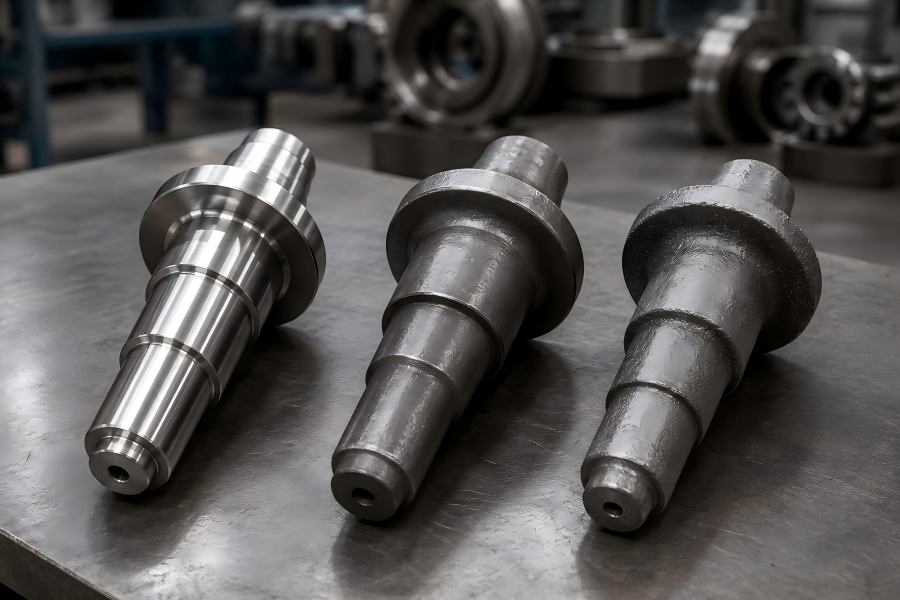
Shafts are key components in mechanical systems for torque transmission and alignment. Common manufacturing methods include machined, forged, and cast shafts, each differing in strength, fatigue resistance, cost, and application suitability for various industrial and high-load conditions.
A Quick Comparison
| Criteria | Machined Shaft | Forged Shaft | Cast Shaft |
| Manufacturing Method | Machined from solid bar | Deformed under high pressure | Molten metal poured into mold |
| Material Strength | Moderate | Very high | Moderate to low |
| Fatigue Resistance | Moderate | Excellent | Low to moderate |
| Surface Finish and Tolerance | High | Moderate to high | Low to moderate |
| Load-Bearing Capacity | Moderate | Very high | Moderate |
| Cost | Moderate | High | Low to moderate |
| Suitable Applications | Precision tools, moderate loads | Heavy machinery, automotive, aerospace | Pumps, low-load industrial machinery |
| Lead Time | Medium | Medium to long | Short |
| Weight | Solid | Solid | Solid or near-net shape |
| Defect Risk | Low | Low | Higher (porosity, shrinkage) |
What Is a Machined Shaft?
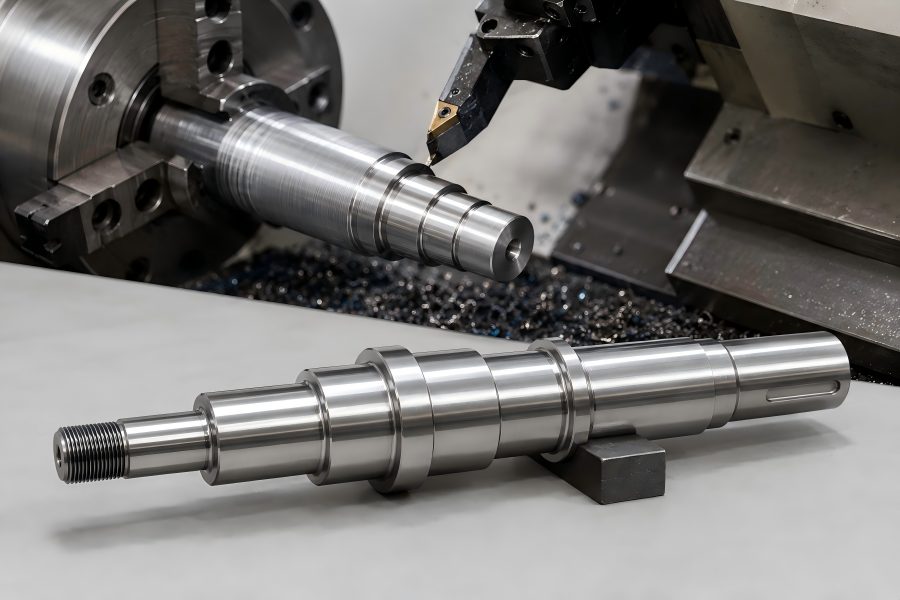
A machined shaft is manufactured from a solid billet or bar using precision cutting, turning, and grinding operations. Machining allows engineers to achieve tight dimensional tolerances, specific diameters, and functional features such as shoulders, keyways, and threads. Machined shafts are widely used in applications where precision and surface finish are critical, but they rely solely on the properties of the base material.
| Pros | Cons |
| High-dimensional accuracy | Fatigue strength limited by base material |
| Customizable design | Can be expensive for large or complex shafts |
| Excellent surface finish | Machining solid bars can result in material waste |
| Easy to inspect and maintain | Limited torque capacity under extreme loads |
Typical Applications
- Precision machine tools and spindles
- Laboratory or measurement equipment
- Small electric motors and actuators
- Low- to medium-load industrial shafts
Machined shafts excel in precision-critical environments but are less suitable for applications involving high torque or dynamic, cyclic loading because the grain structure of the raw material is not enhanced by the manufacturing process.
What Is a Forged Shaft?
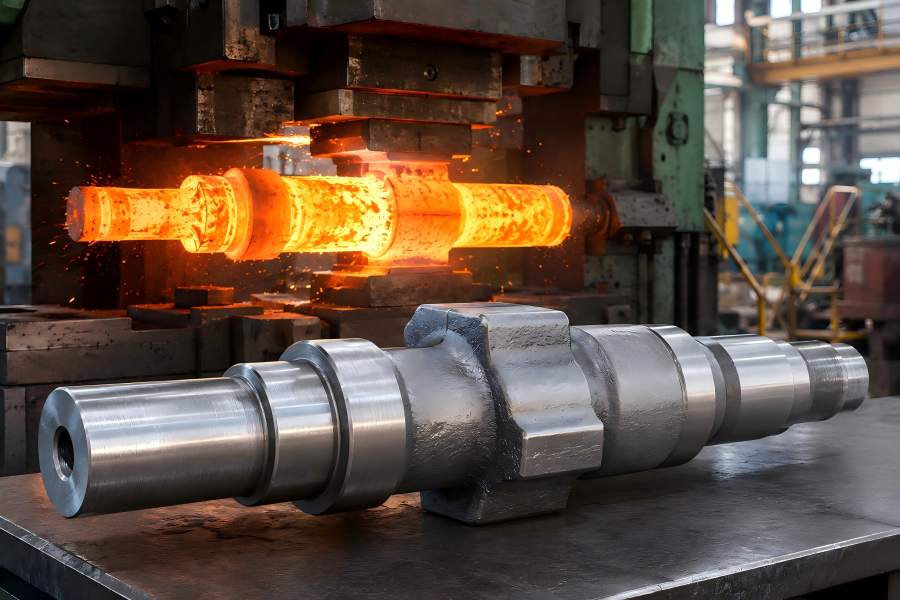
A forged shaft is produced by plastically deforming a metal billet under high pressure, typically using a die or hammer press. The forging process aligns the metal grain structure with the shaft geometry, greatly enhancing strength, toughness, and fatigue resistance. Forged shafts typically require secondary machining to obtain accurate dimensions and surface finishes.
| Pros | Cons |
| Excellent tensile, torsional, and fatigue strength | Higher initial manufacturing cost |
| Superior durability under cyclic loads | Secondary machining required |
| Optimized grain flow for stress distribution | Die limitations can restrict maximum size |
| Can withstand shocks and dynamic loading | Longer lead times for custom designs |
Typical Applications
- Automotive drive shafts, crankshafts, and axles
- Heavy industrial machinery spindles
- Aerospace rotors and turbine shafts
- High-performance drives in mining and manufacturing
- Rotors and shafts in power generation equipment
Forged shafts are the most reliable choice for heavy-duty, high-torque applications. The combination of aligned grain structure and post-forging machining ensures long service life under extreme operational conditions.
What Is a Cast Shaft?
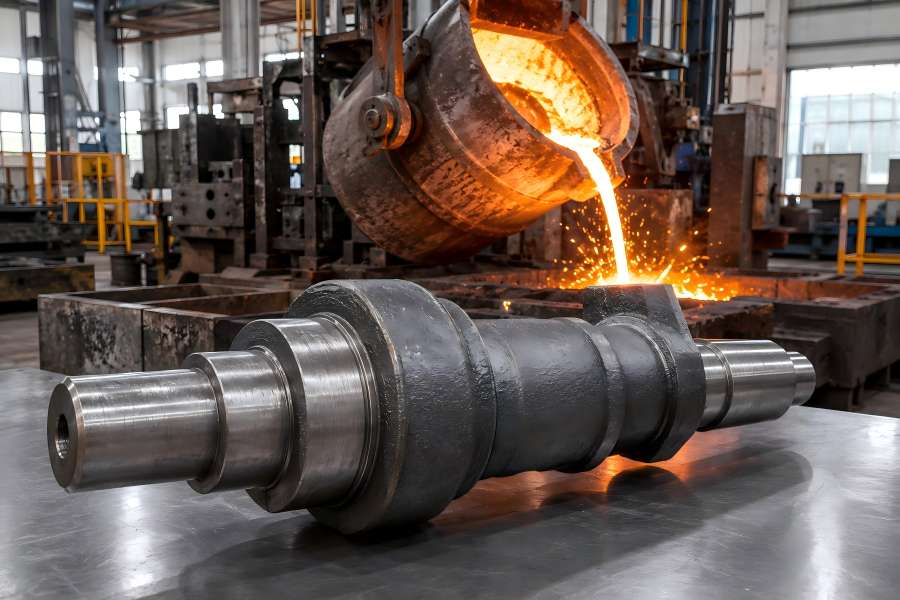
A cast shaft is made by pouring molten metal into a mold, enabling the formation of large and complex shapes with minimal machining. However, cast shafts generally have coarser grain structures and may contain internal porosity, which reduces mechanical strength and fatigue resistance.
| Pros | Cons |
| Can produce large and complex geometries | Lower mechanical strength compared to forged shafts |
| Cost-effective for high-volume production | Internal defects may reduce reliability |
| Minimal secondary machining required | Lower fatigue resistance |
| Suitable for low-to-medium loads | Surface finish may require post-processing |
Typical Applications
- Pumps, fans, and blower shafts
- Low-speed conveyors and industrial rollers
- Industrial mixers and agitators
- Applications where cost and shape complexity outweigh torque or fatigue demands
Cast shafts are suitable for budget-sensitive, low-to-medium load applications, but are generally not recommended for high-torque or fatigue-critical components due to potential defects and lower mechanical strength.
Performance Comparison by Key Factors
Torque Transmission
- Forged shafts withstand the highest torque, thanks to grain alignment and superior material properties.
- Machined shafts handle moderate torque, limited by the raw material.
- Cast shafts perform poorly under high torque due to potential internal defects.
For applications with high torque or heavy loads, forged shafts are preferred.
Fatigue Resistance
- Forged shafts excel in cyclic load conditions due to grain flow alignment.
- Machined shafts depend on base material; fatigue life is moderate.
- Cast shafts are most susceptible to cracks under repeated loads.
Stress Distribution
- Stepped or forged shafts can be designed for optimized stress distribution.
- Machined shafts have uniform stress but may concentrate stress at keyways or shoulders.
- Cast shafts may have weak points from shrinkage or porosity.
Dimensional Accuracy and Surface Finish
- Machined shafts achieve the tightest tolerances and smooth surfaces.
- Forged shafts require secondary machining for critical tolerances.
- Cast shafts typically need machining at bearing or gear locations.
Weight and Material Efficiency
- Cast shafts support near-net shape casting, helping reduce material waste.
- Forged shafts are slightly smaller for the same strength, balancing weight and durability.
- Machined shafts often waste material when cut from solid bars.
Cost vs Performance Trade-Off
| Factor | Machined Shaft | Forged Shaft | Cast Shaft |
| Material Cost | $50–$150 | $120–$350 | $30–$120 |
| Machining Cost | High | Moderate (after forging) | Low |
| Torque Capacity | Moderate | Very high | Low–moderate |
| Fatigue Life | Moderate | Excellent | Low |
| Surface Finish | High | Moderate | Moderate |
| Lead Time | Medium | Long | Short |
| Best Use Case | Precision, moderate load | High load, critical shafts | Low-load, cost-sensitive |
- Torque Capacity: Forged shafts withstand 150–200% more torque than cast shafts of equivalent diameter.
- Fatigue Life: Forged shafts may last 2–3× longer than cast shafts under cyclic loading.
- Weight Savings: Cast shafts can reduce material usage by 20–30% for large diameters.
Application-Based Selection Guide
Machined Shaft
- Ideal for high-precision machinery with tight tolerances
- Suitable for moderate torque and load
- Often used in low- to medium-speed rotational systems
- Compatible with keyed, splined, or clamped hubs
Applications: CNC spindles, small gear drives, actuators, precision instruments
Forged Shaft
- Best for high-torque, high-stress applications
- Suitable for dynamic, high-speed, or shock-loaded systems
- Can support multiple bearings, gears, and couplings
- Preferred in critical and safety-sensitive components
Applications: Automotive axles, turbine rotors, industrial spindles, heavy machinery drives
Cast Shaft
- Best for cost-sensitive, low-to-medium load applications
- Suitable for complex or large-diameter components
- Ideal for systems where near-net shape casting reduces machining
- Not recommended for high-stress or high-speed applications
Applications: Industrial fans, pump shafts, blower shafts, low-speed conveyors
Real-World Industry Examples
Automotive Industry
- Forged shafts: Applied in drive axles, crankshafts, and high-load transmission parts. These shafts must withstand torsional loads exceeding 10,000 Nm and dynamic cyclic stresses while maintaining precise alignment.
- Machined shafts: Employed in control shafts, electric motor rotors, and steering mechanisms. Tolerances as tight as ±0.01 mm are commonly applied to ensure smooth operation and reduce vibration.
- Cast shafts: Found in fan drives, auxiliary components, and low-torque systems where cost efficiency and complex shapes outweigh high-stress performance.
Industrial Machinery
- Forged shafts: Heavy-duty spindles in gearboxes, presses, and rolling mills. These shafts handle repetitive loads exceeding 100 MPa and operate continuously under high torque.
- Machined shafts: Actuators, precision tool drives, and conveyor rollers that require tight dimensional tolerances and smooth surface finishes.
- Cast shafts: Industrial pumps, blowers, and mixers where moderate torque and low-speed operation are sufficient, reducing material costs without compromising functionality.
Aerospace Applications
- Forged shafts: Turbine rotors, actuator drives, and landing gear components. These components endure extreme dynamic loads, high-speed rotation, and temperature variations up to 600 °C.
- Machined shafts: Precision control shafts and instrumentation rotors in aircraft systems, where micron-level tolerances are required for accurate operation.
- Cast shafts: Rarely used in critical aerospace applications, but may be applied in low-stress structural elements or auxiliary systems where lightweight, near-net shapes reduce machining.
Power Generation
- Forged shafts: Turbine rotors, generator shafts, and gear-driven systems in power plants. Shafts often handle continuous loads of 50–200 kN·mand operate at high rotational speeds for decades.
- Machined shafts: Small auxiliary drives, instrumentation shafts, and precision alignment components where tight tolerances are critical.
- Cast shafts: Cooling fan shafts, blower drives, and non-critical pumps where torque and fatigue requirements are moderate.
Robotics and Automation
- Hollow forged shafts: High-speed robotic joints where weight reduction improves acceleration and reduces motor torque requirements. Hollow designs can reduce mass by 30–50% without compromising strength.
- Machined shafts: Actuators and precision linkages, requiring tight dimensional accuracy and low runout to ensure repeatable motion.
- Cast shafts: Conveyor or handling systems where speed is low, and torque requirements are moderate.
Heavy Equipment and Mining
- Forged shafts: Cranes, lifts, excavators, and heavy-duty drive systems that experience shock loads exceeding 150 MPa and continuous cyclic stress.
- Machined shafts: Precision control shafts in hydraulic actuators or sensor-linked drives.
- Cast shafts: Rollers, low-speed drives, and support components where cost and geometry flexibility are more important than extreme mechanical performance.
Construction and Flood Restoration
- Forged shafts: Pump drives and winches used in dewatering or heavy lifting, ensuring reliability under intermittent high torque.
- Machined shafts: Precision rollers or small drive shafts in temporary installations or mobile equipment.
- Cast shafts: Support shafts for low-speed fans or blowers used in site ventilation and drying processes.