
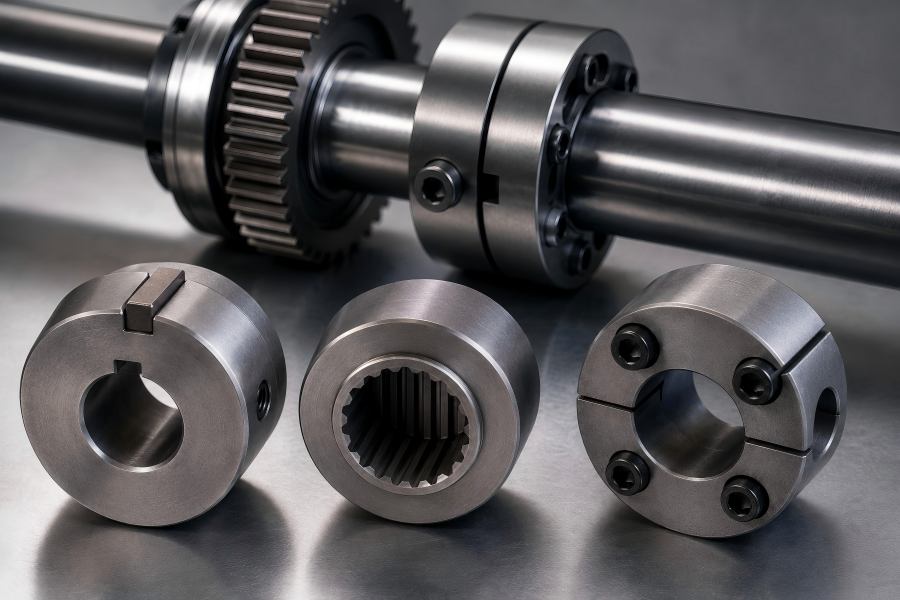
Keyed hubs, spline hubs, and clamp hubs are widely used for shaft-to-hub connections in mechanical systems. Each design offers different torque transfer performance, assembly methods, and maintenance advantages, making proper selection essential for efficiency, durability, and reliable power transmission.
A Quick Comparison
| Criteria | Keyed Hub | Spline Hub | Clamp Hub |
| Torque Capacity | Moderate | High | Moderate to high |
| Load Distribution | Concentrated at key | Even along multiple splines | Even along friction surface |
| Assembly Complexity | Simple | Complex | Moderate |
| Maintenance | Easy | Moderate | Moderate |
| Cost | Low | High | Moderate |
| Shaft Damage | Keyway required | Precision machining | None if properly installed |
| Replacement | Easy | Challenging | Easy |
| Best Use Case | Low to medium torque | High torque, precision | Adjustable or removable connections |
What Is a Keyed Hub?
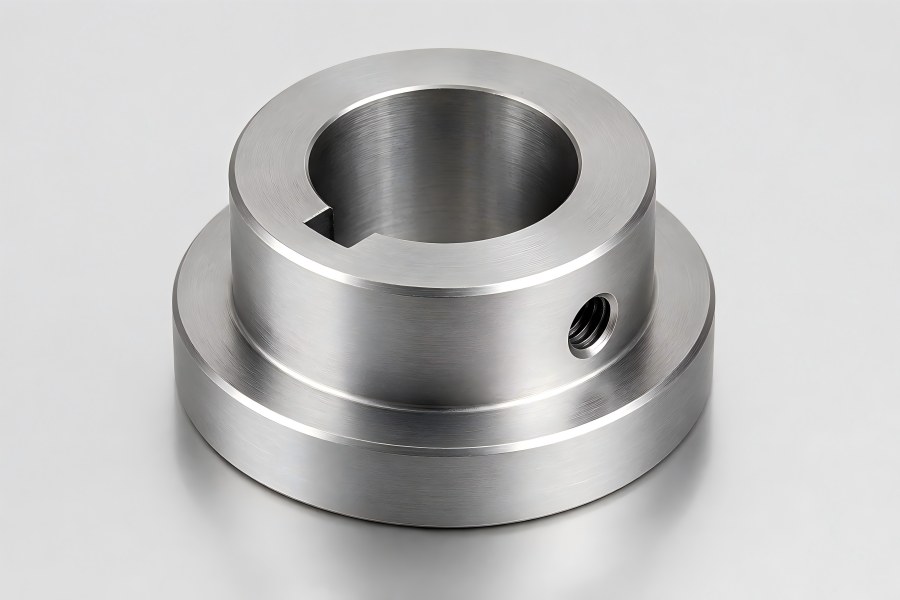
A keyed hub is a mechanical design in which a protruding key on the shaft fits into a matching keyway in the hub. This key prevents relative rotation between the shaft and hub, allowing torque to be transmitted efficiently.
Key Characteristics
- Uses a single key or multiple parallel keys
- Engages via keyway slots on the shaft and hub
- Provides moderate torque capacity
- Simple and cost-effective design
- Requires precise machining of keyway and key
| Pros | Cons |
| Simple and easy to manufacture | Torque capacity limited by key size |
| Cost-effective | Stress concentration at keyway |
| Widely used in general machinery | Susceptible to wear over time |
| Easy assembly | Not ideal for high-torque, high-speed applications |
Typical Applications
- Small to medium-sized gearboxes
- Electric motors and pumps
- Light-duty couplings
- General industrial machinery
Keyed hubs are best suited for applications where cost and simplicity are priorities and torque demands are moderate. Their design makes them easy to install and replace but limits maximum torque transmission capacity due to stress concentrations at the key.
What Is a Spline Hub?
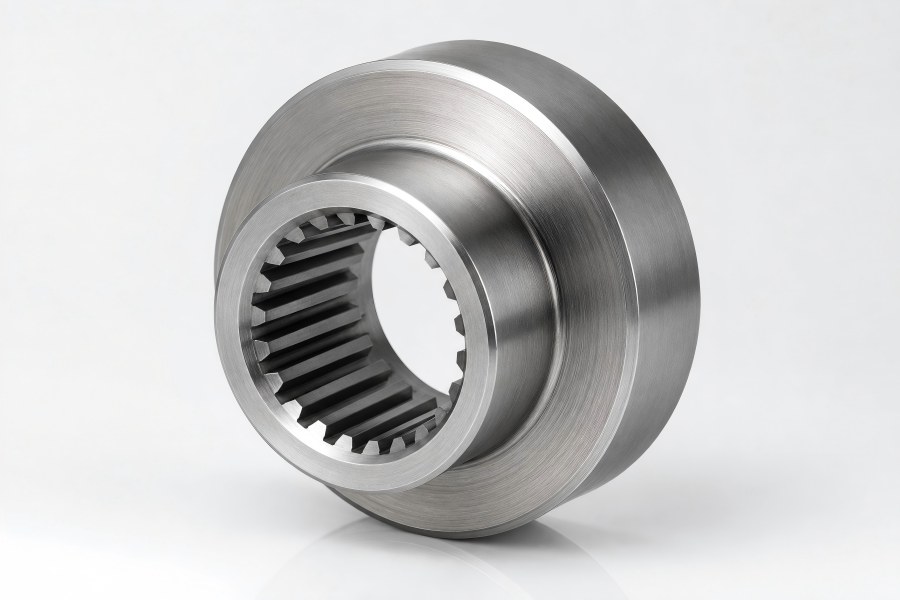
A spline hub features multiple longitudinal teeth (splines) on the shaft that fit into corresponding grooves in the hub. This design provides distributed torque transfer along the length of the engagement area, significantly increasing load capacity.
Key Characteristics
- Multiple teeth distribute torque evenly
- Can be straight, involute, or crowned splines
- High torque transmission capability
- Requires precision machining for alignment
- Suitable for high-speed and high-load systems
| Pros | Cons |
| High torque capacity | Complex and costly manufacturing |
| Even load distribution | Requires precise machining |
| Suitable for high-speed systems | More difficult to assemble than keyed hubs |
| Reduced wear due to multiple contact points | Replacement can be more challenging |
Typical Applications
- Automotive drive shafts
- Aerospace actuators
- Heavy-duty industrial drives
- High-torque couplings
- Robotics and precision machinery
Spline hubs are ideal for applications requiring high torque, precision, and durability. Their multi-tooth engagement reduces stress concentration, distributes load evenly, and ensures smooth torque transmission even under cyclic loads. However, they are costlier and require precise alignment during assembly.
What Is a Clamp Hub?
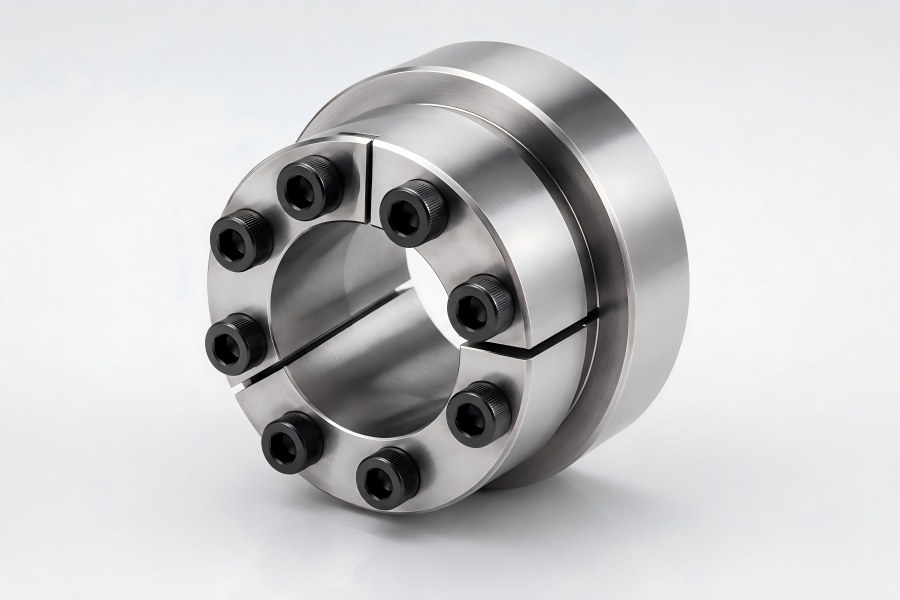
Clamp hubs (also called shrink-fit or tapered clamping hubs) use axial or radial clamping force to create a friction-based connection between the hub and shaft. The hub is designed to tighten around the shaft using screws or a tapered bushing, generating a secure grip without relying on keys or splines.
Key Characteristics
- Friction-based torque transfer
- Can be single or double split for easy installation
- Quick and adjustable clamping
- Suitable for moderate to high torque systems
- Eliminates keyway machining
| Pros | Cons |
| Easy installation and removal | Constrained by friction coefficient and surface finish |
| Even torque distribution around the shaft | May slip under extreme loads if not properly tightened |
| No keyway machining required | Initial cost higher than keyed hubs |
| Clean shaft and hub surfaces preserved | Requires proper maintenance of clamping screws |
Typical Applications
- High-speed motor couplings
- Precision machinery
- Pulleys, sprockets, and gear mounting
- Temporary or adjustable installations
- Servo motors and automation equipment
Clamp hubs provide an adjustable, high-precision connection without the need for keyways. They are ideal for applications where assembly and disassembly are frequent, or where keyways might weaken the shaft. Correct installation and maintenance are essential to avoid slippage under load.
Performance Comparison by Key Factors
When comparing keyed, spline, and clamp hubs, several performance dimensions should be considered beyond basic torque capability. These include load distribution, alignment, speed performance, wear, maintenance, and installation requirements.
Torque Transmission Capacity
- Spline hubs offer the highest torque capacity due to multi-tooth engagement.
- Clamp hubs provide moderate-to-high torque via friction, limited by surface finish and clamping force.
- Keyed hubs are suitable for moderate torque but may fail at high loads due to key shear or stress concentration.
Spline hubs are ideal for high-torque, high-load applications.
Load Distribution and Stress Behavior
- Keyed hubs concentrate stress at a single key, increasing risk of wear and deformation.
- Spline hubs evenly distribute load across multiple teeth, reducing localized stress.
- Clamp hubs distribute torque circumferentially along the shaft-hub interface, lowering stress concentration.
Even load distribution prolongs service life and reduces fatigue, giving splines and clamps an advantage.
Alignment and Concentricity
- Keyed hubs depend on precise keyway alignment; minor misalignment can cause vibration.
- Spline hubs maintain excellent concentricity and reduce vibration due to multiple engagement points.
- Clamp hubs allow self-centering when tightened correctly.
For precision systems, spline and clamp hubs outperform keyed hubs.
Installation and Maintenance
- Keyed hubs are simple to install but require key selection and keyway machining.
- Spline hubs require precision alignment, making installation more complex.
- Clamp hubs are quick to install or remove, especially split designs.
Clamp hubs offer the best convenience for frequent assembly/disassembly.
Wear Resistance and Service Life
- Spline hubs reduce wear by distributing load across multiple teeth.
- Clamp hubs to preserve shaft integrity and prevent localized keyway wear.
- Keyed hubs experience localized wear at the key interface, potentially requiring periodic replacement.
Spline and clamp hubs generally offer longer service life under repeated or high-load conditions.
Speed Capability
- Clamp hubs are suitable for high-speed applications as no keyway stress is introduced.
- Spline hubs handle high-speed rotation well but require precision machining.
- Keyed hubs may generate stress and vibration at high speeds.
Clamp and spline hubs are preferred in high-speed applications.
Cost vs Performance Trade-Off
| Factor | Keyed Hub | Spline Hub | Clamp Hub |
| Relative Unit Cost | Low ($10–$50) | High ($50–$200) | Moderate ($30–$120) |
| Torque Capacity | Moderate | High | Moderate-High |
| Installation Complexity | Low | High | Moderate |
| Maintenance Frequency | Low | Moderate | Moderate |
| Replacement Ease | High | Low | High |
| Best Use Case | General machinery | High-torque systems | Adjustable/removable connections |
- Keyed hubs offer a cost-effective solution for low to moderate torque applications.
- Spline hubs justify higher cost with superior torque transmission and durability.
- Clamp hubs balance performance with ease of installation.
Application-Based Selection Guide
Choose Keyed Hub When:
- Torque requirements are moderate
- Low-cost, simple design is preferred
- Installation and replacement simplicity are desired
- Misalignment tolerance is acceptable
Typical Industries: General machinery, light-duty motors, conveyors
Choose Spline Hub When:
- High torque or cyclic loads are present
- Precision alignment is required
- High-speed operation is needed
- Long service life is essential
Typical Industries: Automotive drives, heavy industrial equipment, aerospace actuators
Choose Clamp Hub When:
- Adjustable or removable connection is required
- Shaft integrity is important
- High-speed or precision alignment is needed
- Quick installation and maintenance are priorities
Typical Industries: Servo systems, automation equipment, pulleys, sprockets
Real-World Industry Examples
Automotive Industry
- Spline hubs are widely used in drive shafts and transmission systems for high torque and precise alignment.
- Keyed hubs are applied in auxiliary systems like pumps and accessories.
- Clamp hubs enabling quick maintenance in test rigs and adjustable couplings.
Industrial Machinery
- Spline hubs handle heavy-duty drives.
- Keyed hubs are used in medium-duty conveyors and motors.
- Clamp hubs are applied in adjustable pulley systems and modular drives.
Robotics and Automation
- Clamp hubs are preferred for adjustable motion systems.
- Spline hubs are used in high-torque robotic joints.
- Keyed hubs are used in simple low-load drives.
Power Generation
- Spline hubs transmit high torque in turbines.
- Clamp hubs allow easy installation of maintenance-critical components.
- Keyed hubs are utilized in small auxiliary drive systems.