
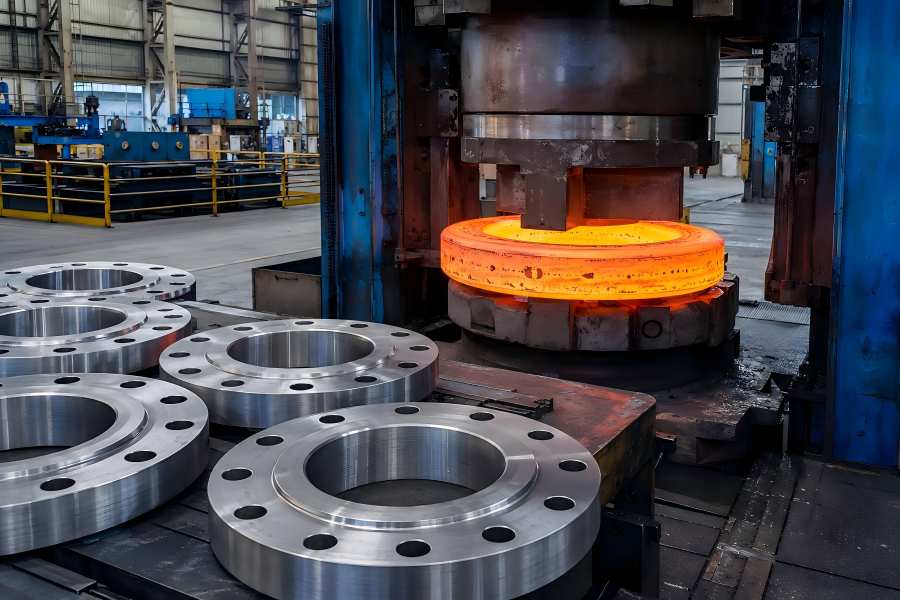
You see forged flanges manufactured through a precise process that transforms raw metal into high-performance components. The main steps include:
- Preparing the billet by selecting and cutting steel.
- Heating and forging to shape the flange.
- Machining for accurate dimensions and bolt holes.
- Heat treatment and finishing to enhance durability.
- Rigorous inspection to ensure quality.
Forged flanges stand out for their superior strength, wear resistance, and reliability. You benefit from their durability and stability, especially in demanding environments where flanges must perform under extreme conditions.
Key Takeaways
- Forged flanges are made through a precise process that includes selecting, heating, forging, machining, and inspecting materials.
- Choosing high-quality metal is crucial. It affects the flange’s performance and lifespan, so always verify material certifications.
- Proper cutting and preparing of the billet ensure uniformity and reduce waste, leading to better quality flanges.
- Heating billets to the correct temperature improves their plasticity, making them easier to forge into shape.
- Different forging methods, like drop-forging and press forging, offer unique advantages for various flange types and applications.
- Heat treatment enhances the mechanical properties of flanges, increasing their strength and durability for demanding environments.
- Precision machining is necessary to achieve tight tolerances, ensuring flanges fit properly and operate reliably.
- Final inspection and quality control are vital steps that guarantee each flange meets industry standards before delivery.
Raw Material Selection for Forged Flanges
Choosing High-Quality Metal
Selecting the right metal forms the foundation of reliable flanges. You must consider several criteria to ensure the material suits the intended application and meets industry standards.
| Criteria | Description |
| Material Selection | Match materials to the application conditions and fluid characteristics. |
| Compliance with Standards | Ensure material conformity with standards such as ASTM A182 or A105. |
| Quality Certifications | Confirm the availability of quality certificates and test reports from the manufacturer. |
Common Metals Used
The main component of forged flanges is steel. While 304 stainless steel provides strong corrosion resistance in most situations, 316 stainless steel provides better resistance in situations that are high in chloride. Because of its strength and longevity, carbon steel is frequently utilized in high-pressure applications.
Importance of Material Quality
Material quality directly affects the performance and lifespan of flanges. You benefit from strict control over material selection and manufacturing techniques. High-quality flange manufacturing prevents defects such as coarse grains and hardening cracks. Mechanical properties like strength, plasticity, impact toughness, hardness, and fatigue properties must align with the intended use of the flange. If you choose inferior materials, you risk premature failure and costly downtime.
Material Inspection
Before you proceed with the forging process, you must inspect the raw materials thoroughly. Inspection ensures that the billets meet all required specifications and are free from defects.
Standards and Specifications
You must confirm that the raw materials meet accepted standards like EN or ASTM. Incoming raw material verification checks the chemical composition of billets against these standards. Material verification methods confirm that the alloy composition matches the specification stamped on the rim.
| Inspection Method | Description |
| Incoming Raw Material Verification | Checking chemical composition of billets against ASTM standards before forging. |
| Material Verification Methods | Ensures that the alloy composition matches the ASTM or EN specification stamped on the rim. |
| PMI Testing (Positive Material Identification) | Critical for stainless steel and high-alloy flanges, using XRF or OES to analyze elemental composition. |
Inspection Methods
To make sure the steel is intact, you should employ a number of examination methods. Visual inspection helps you spot surface defects. Dimensional measurement confirms that billets meet size requirements. Mechanical performance testing evaluates properties such as strength and toughness.
Common defects found during inspection include:
- Thread damage, which can cause leaks or improper fits.
- Misalignment, leading to premature wear or cracking.
- Corrosion, weakening flanges and increasing the risk of failure.
- Gasket failure, resulting from unsuitable materials or improper installation.
- Material defects, such as impurities or incorrect mechanical properties, may cause cracking under pressure.
By carefully selecting and inspecting raw materials, you lay the groundwork for producing flanges that deliver superior performance and reliability in demanding environments.
Cutting and Preparing the Billet
You begin the flange manufacturing process by cutting and preparing the billet. The entire forging process is built upon this stage. When you handle this step with precision, you ensure that the final flange will meet strict industry standards for strength and reliability.
Cutting to Size
You must cut the raw steel into billets of precise dimensions. This step determines the amount of material available for forging and helps you avoid waste.
Equipment Used
You typically use heavy-duty equipment for this task. Common machines include:
- Band saws: These provide straight, clean cuts for most steel grades.
- Shearing machines: You use these for rapid, high-volume cutting.
- Abrasive cutting wheels: These work well for harder alloys and thick sections.
Each machine offers unique advantages. You select the equipment based on the size and type of steel you need to process.
Ensuring Consistency
Consistency in billet size is critical. You must check each piece for uniform length and flatness. If you cut billets unevenly, you risk defects in the forging process. Use calibrated measuring tools to verify dimensions..
Preparing for Forging
After you cut the steel, you move to preparing the billet for the next stage. This involves shaping and sometimes surface cleaning.
Shaping the Billet
You may need to round the edges or chamfer the ends of each billet. This shaping step helps you achieve better metal flow during forging. You can use hydraulic presses or rotary swaging machines for this purpose. When you shape the billet correctly, you reduce the risk of internal defects and improve the microstructure of the steel.
The way you prepare the billet affects every subsequent step. Controlled heating during this stage prevents issues like decarburization. Managing the microstructure enhances the material’s properties by refining grain structure and eliminating internal flaws. You set the stage for a strong, reliable flange by focusing on these details.
Tip: Always inspect billets for surface impurities before forging. Clean, well-shaped billets lead to better mechanical properties and fewer defects in the finished product.
By mastering the art of preparing the billet, you ensure that your forged flanges will deliver the performance and durability required in demanding applications.
Heating in the Flange Manufacturing Process
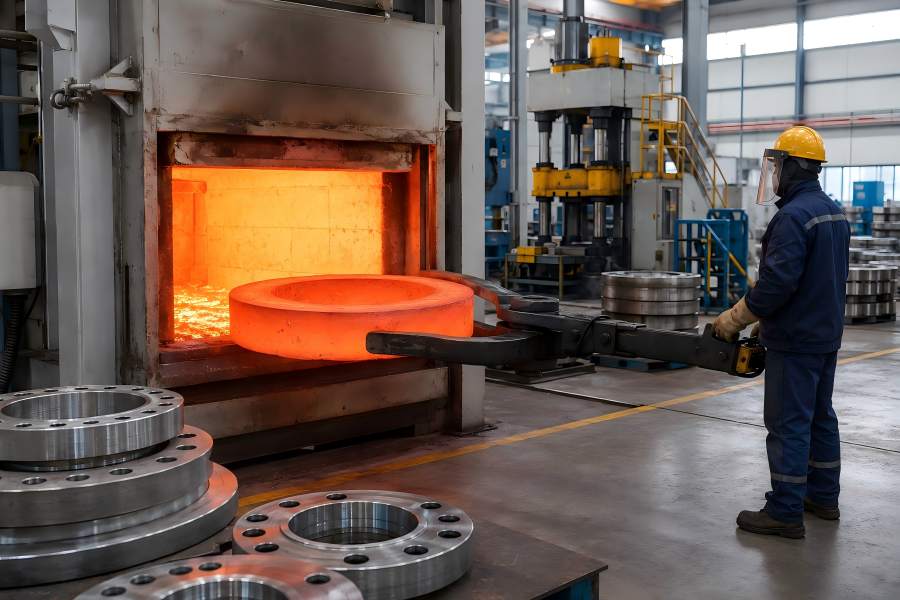
Heating billets is a critical step in flange manufacturing. Every billet needs to be heated to the proper temperature for forging. This process improves the metal’s plasticity and prepares it for shaping.
Furnace Setup
You start by selecting the right furnace for heating billets. Common options include gas stoves and electric furnaces. Each type offers unique advantages for efficiency and uniform heating. You need to understand the role of the furnace as a metallurgical preparation unit. The furnace delivers billets at the right temperature and uniformity, which is essential for quality forging.
You follow these steps for an effective furnace setup:
- Check the firing zones to avoid overheating or underheating. This ensures uniform heating across all billets.
- Manage billet residence time by following the heating curve for different sizes and grades. This prevents decarburization and oxidation.
- Optimize burner firing ratios and minimize idle time. You reduce energy costs and improve efficiency.
- Regularly inspect equipment and monitor for gas leaks. Safety and maintenance discipline protect your team and facility.
- Track fuel consumption and scale losses. Benchmarking performance and identifying areas for improvement are made easier with data-driven operations.
- Synchronize billet charging with rolling demand. Teamwork with the rolling mill ensures smooth workflow and prevents delays.
Temperature Control
Temperature control is vital during heating. You must preheat the billet to improve plasticity and reduce deformation resistance. The kind and thickness of the material affect the preheating temperature. You control this temperature carefully to avoid overheating.
After preheating, you heat the billet to the forging temperature. This step ensures uniform temperature throughout the steel. You select the forging temperature based on material properties like plasticity and deformation resistance. The temperature must exceed the recrystallization point for effective softening.
You use temperature control systems to monitor and adjust heating parameters. These systems regulate heating temperature, time, and speed. You adjust time and speed based on billet size and heating efficiency. Proper control prevents structural damage and ensures consistent quality.
Heating the Billet
You place the billet in the furnace and monitor its progress. The heating process follows a specific curve tailored to the steel grade and billet size. You must avoid rapid heating, which can cause internal stress and defects.
You rely on common heating equipment such as electric furnaces and gas stoves. These tools provide the necessary heat and uniformity. You ensure that the billet reaches the desired temperature before moving to the forging stage.
Safety Considerations
Safety is a key priority during heating. You routinely inspect furnace equipment for leaks and faults, train staff in safe furnace and billet handling, and use protective gear like gloves and face shields to prevent burns and injuries.
You create a safe environment by following strict protocols and maintaining equipment. This approach protects both personnel and product quality.
Flange Forging Process
The flange forging process transforms heated steel billets into robust, high-performance flanges. You play a crucial role in this stage, as the techniques you choose directly impact the strength, durability, and reliability of the finished product.
Forged Production Method
You have several forged production methods at your disposal. For various flange kinds and applications, each technique has special benefits. The table below summarizes the main forging methods used in the flange manufacturing process:
| Forging Method | Description | Applications |
| Drop-Forging | A hammer drops onto the workpiece, refining grain structure. | Slip-on and socket weld flanges |
| Press Forging | Applies slow, continuous pressure for shaping, allowing complex designs. | Weld neck and threaded flanges |
| Ring Rolling | Increases diameter by reducing thickness, creating stronger components. | Large diameter flanges for heavy equipment |
| Open-Die Forging | Freely shapes a billet into required form, suitable for simple parts. | Large flange blanks in small batches |
| Closed-Die Forging | Uses fixed dies for high accuracy and complex shapes. | Flanges requiring high mechanical performance |
Power Hammer vs. Press
You can choose a power hammer or a hydraulic press for forging. A power hammer uses rapid blows, suitable for smaller or simpler flanges, and helps refine grain structure and density. A hydraulic press applies steady pressure, ideal for larger or complex flanges, enabling precise shapes and dimensions.
Shaping the Flange
Once you select the appropriate forged production method, you move on to shaping the flange. This step defines the final geometry and mechanical properties of the component.
Achieving Desired Form
You follow a series of steps to achieve the desired form during the flange forging process:
- Pre-forging: You shape the billet to a rough outline, which reduces deformation during final forging.
- Final forging: You use open-die or closed-die techniques to press or hammer the steel into the exact flange shape.
- Trimming: You remove excess material from the edges to ensure a clean, accurate profile.
- Cooling: To improve the grain structure and reduce internal tensions, you can regulate the rate of cooling.
You must pay close attention to the forging temperature and pressure. These factors influence the steel’s plasticity and the final properties of the flange. Closed-die forging, for example, uses fixed dies to create complex shapes with high dimensional accuracy. This method is ideal for flanges that require exceptional mechanical performance.
The way you shape the flange has a direct impact on its internal structure. Forged flanges exhibit a dense, non-porous structure, which eliminates potential leak paths found in castings. The forging process orients the grain flow to maximize strength, especially important for flanges used in high-pressure or critical environments. You achieve superior toughness and resistance to brittle fracture, making forged flanges the preferred choice for demanding applications.
By mastering the flange forging process, you produce components that outperform those manufactured by other methods. The techniques you use consolidate the metal, refine the grain structure, and create a product with unmatched strength and reliability.
Heat Treatment of Flanges
Heat treatment is a key stage in flange manufacturing that modifies the steel’s internal structure, improving mechanical properties, durability, and overall reliability for demanding applications.
Enhancing Mechanical Properties
You use various heat treatment methods to improve flange performance, each enhancing properties like strength, toughness, and fatigue resistance. Common processes include:
- Annealing: You soften the material, making it easier to machine and increasing ductility.
- Quenching: You rapidly cool the flange to increase hardness and strength, enhancing fatigue resistance and wear resistance.
- Tempering: You reheat the flange after quenching to maintain hardness while reducing brittleness, which enhances toughness and impact resistance.
- Normalizing: You cool the flange in air after heating, refining the grain structure and improving strength, ductility, and toughness.
- Stress-relieving: You gradually cool the flange after moderate heating to reduce residual tensions and prevent warping or cracking.
Heat treatment significantly improves mechanical properties: yield strength rises notably in hot forged samples, ultimate tensile strength increases slightly, and fatigue life improves, especially in as-machined and hot forged flanges. Cold rotary forged flanges can reach 750–1000 MPa fatigue strength after treatment.
Normalizing
You use normalizing to heat and air-cool steel flanges, refining grain structure and improving strength and toughness. It reduces internal stress and increases resistance to impact and pressure, ensuring material stability.
Normalizing refines grain structure, leading to better mechanical properties.
The process increases both strength and toughness, making flanges more reliable under stress.
You reduce the risk of deformation or cracking by relieving internal stresses.
Quenching and Tempering
Quenching and tempering are often combined to balance hardness and toughness in flanges. Quenching rapidly cools the flange to increase hardness and strength, but may cause brittleness. Tempering reheats it to reduce brittleness and increase toughness.
| Process | Purpose | Benefits |
| Quenching | Increase hardness and strength | Provides maximum hardness for tool and die applications, increases load-bearing capacity, enables longer service life under stress |
| Tempering | Relieve stresses from quenching | Balances hardness and toughness, enhances fatigue resistance, prevents unexpected cracking in service |
You see that quenching gives flanges the hardness needed for heavy-duty applications. Tempering ensures that the flange does not become too brittle, which could lead to sudden failure. This combination increases the flanges’ lifespan and qualifies them for usage in challenging conditions.
Relieving Internal Stress
You must address internal stresses that develop during forging and machining. These stresses can cause deformation or cracking if left untreated. You use inductive stress relieving as an effective method. This process heats the flange to a specific temperature, holds it there for a set period, and then cools it slowly. Induction stress relieving reduces internal tensions, ensuring the integrity of the flange during use.
You find stress-relieving essential in flange manufacturing. It prevents warping and cracking, especially after processes like welding or machining. By relieving internal stress, you guarantee that each flange maintains its shape and performance throughout its service life.
You complete the heat treatment stage with confidence, knowing that your flanges now possess the mechanical properties and stability required for the most demanding applications. This attention to detail in manufacturing sets your flanges apart in terms of quality and performance.
Machining and Finishing
When you reach the machining and finishing stage, you transform forged flanges into precise, high-quality components. This phase ensures that each flange meets strict dimensional and surface requirements, ready for demanding industrial applications.
Precision Machining
You rely on advanced machining techniques to achieve the exact dimensions required for flanges. These methods guarantee that every flange fits perfectly and performs reliably in service.
Achieving Tolerances
You must meet tight tolerances during machining the flange.
| Tolerance Type | Typical Value | Verification Method |
| Face Runout | 0.05mm | Ensures perpendicularity with the bore |
| Bolt-Hole Position | 0.1mm | Prevents bolt binding during assembly |
| Bore Concentricity | ±0.05mm | CNC machining ensures centering |
| Linear Dimensions | ±0.02mm to ±0.10mm | Varies with flange diameter |
You use CMM inspection, dial indicators for runout, and surface plates or laser systems for flatness. Before proceeding, these tools assist you in verifying that flanges fulfill all requirements.
Creating Bolt Holes
You create bolt holes with specialized tooling and CNC machines. This step requires careful measurement to ensure each hole aligns perfectly. Proper calibration of the facing machine and the use of suitable cutting tools for the material are essential. You check bolt-hole position and diameter to avoid assembly issues. Accurate bolt holes allow for secure connections and reliable sealing in your piping systems.
Surface Finishing
After machining, you focus on the finish of each flange. A high-quality finish improves both appearance and performance.
Cleaning and Polishing
You start by cleaning the flange to remove any machining debris or oil. Polishing follows, which enhances the surface finish and prepares the flange for further protection. You may use CNC techniques for better surface finishes and accurate measurements for flat sealing surfaces. Common finishing processes include coating, plating, oxidation, and shot peening. These methods increase corrosion resistance and improve the overall look of the flanges.
You select the finish based on the application. For example, you might choose polishing for a smooth, reflective surface or apply a protective coating for harsh environments. Nitriding and plating add extra layers of defense against wear and corrosion.
You may produce flanges that satisfy the highest requirements for quality, longevity, and beauty by becoming an expert in machining and finishing. Each step you take in this stage adds value and ensures your flanges perform flawlessly in the field.
Final Inspection and Quality Control
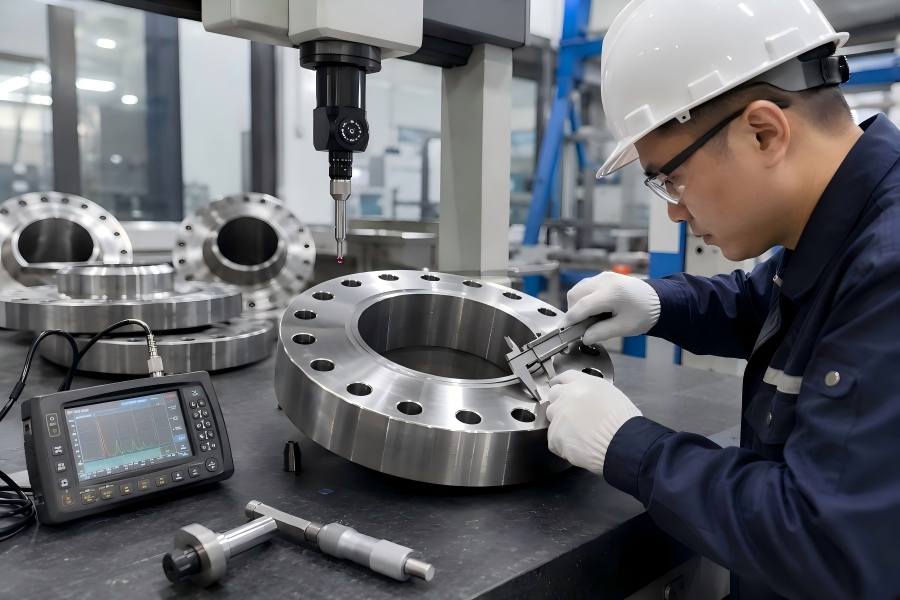
You reach the final stage of the flange manufacturing process with inspection and quality control. This step ensures that every flange meets strict industry standards before it leaves the factory. You protect your reputation and your customers’ safety by following a thorough inspection routine.
Visual and Dimensional Checks
You start with a careful visual inspection. You look for surface defects such as cracks, pores, or inclusions. You also check for any signs of corrosion or improper finishing. A clean, defect-free surface increases corrosion resistance and extends the service life of flanges.
Next, you measure all critical dimensions. You confirm that the outer diameter (OD), inner diameter (ID), and thickness match the design specifications. You also check the bolt circle diameter and hub dimensions, which are vital for proper assembly and butt-welding accuracy.
Measuring Tools
You use a range of precision tools to verify dimensions:
- Vernier calipers for OD and ID
- Micrometers for thickness
- Dial indicators for runout
- Coordinate Measuring Machines (CMM) for complex profiles
Non-Destructive Testing
You cannot rely on visual checks alone. Some flaws hide beneath the surface. To find internal or near-surface flaws without harming the flange, you employ non-destructive testing (NDT) techniques.
Ultrasonic and Magnetic Particle
- Ultrasonic Testing: You send high-frequency sound waves through the flange. If the waves bounce back from a flaw, you spot internal cracks or voids.
- Magnetic Particle Testing: You sprinkle iron particles on the flange’s surface after magnetizing it. The particles gather at discontinuities, revealing surface or near-surface cracks.
You may also use eddy current or radiographic testing for special applications. These NDT methods help you guarantee the integrity of forged flanges, especially for critical or high-pressure uses.
Certification and Delivery
Before you ship flanges, you complete a final review. You check that each flange complies with standards such as ASME B16.5, ASTM A182, or EN 10204 3.1. You prepare quality certifications, test reports, and dimensional inspection records. You also include a packing list and certificate of origin.
You ensure that packaging protects flanges from rust and mechanical damage. You use rust inhibitors and thread protectors as needed. Only flanges that pass all inspections and have complete documentation move to delivery.
By following these inspection and quality control steps, you deliver flanges that meet the highest standards for safety, reliability, and performance.
You see how each stage in the forged flange process—from billet selection to final inspection—ensures that flanges meet strict quality standards. Forged flanges gain superior strength and reliability because you control grain flow and refine dimensions through advanced forging and machining. You benefit from flanges that withstand high pressure and harsh conditions.
FAQ
What are forged flanges used for?
Forged flanges are used to join pipes, valves, pumps, and related equipment in piping systems, ensuring secure and leak-resistant connections under high-pressure and temperature conditions.
How do forged flanges differ from cast flanges?
You get higher strength and better grain structure with forged flanges. They resist cracking and fatigue more effectively than cast flanges, making them ideal for demanding industrial applications.
Why is material selection important for flanges?
You ensure the durability and performance of flanges by choosing the right material. Proper selection prevents corrosion, cracking, and premature failure in harsh environments.
Can flange sizes and shapes be customized?
Yes, you can request custom flanges to meet specific project requirements. Manufacturers provide various sizes, shapes, and drilling patterns to match your system requirements.
What standards do flanges need to meet?
You should look for flanges that comply with standards like ASME, ASTM, or EN. These standards guarantee quality, safety, and compatibility in your piping systems.
How do you maintain forged flanges?
Maintain forged flanges through regular inspections for leaks, corrosion, and mechanical damage while cleaning and tightening connections when necessary for long-term reliability.
Are forged flanges appropriate for high-pressure applications?
Yes, you can rely on forged flanges for high-pressure and high-temperature environments. Their dense construction and exceptional strength make them ideal for critical systems.