
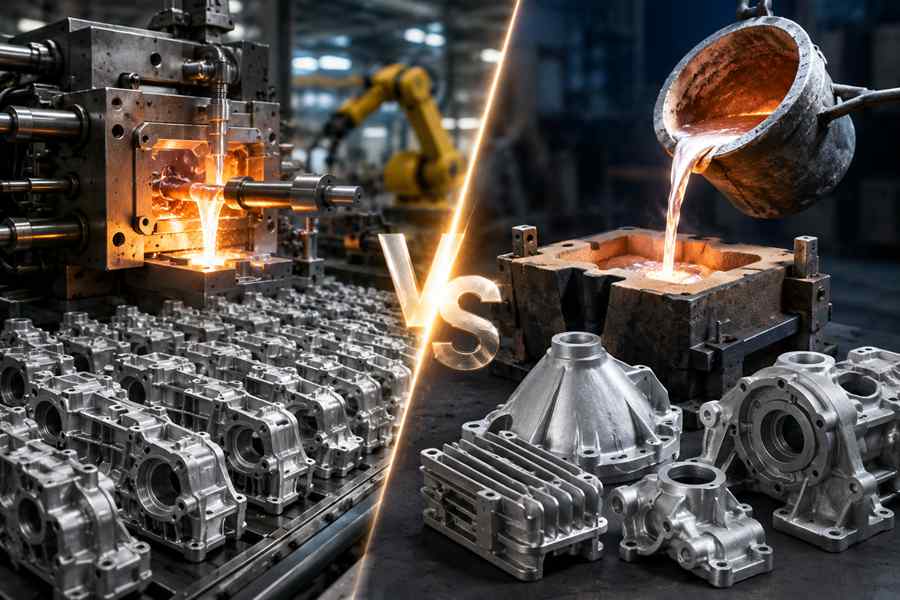
High pressure die casting and gravity casting are two widely used methods for manufacturing aluminum components. High pressure die casting reduces cost in mass production, while gravity casting offers value for small batches and customized projects.
What Is High Pressure Aluminum Die Casting?
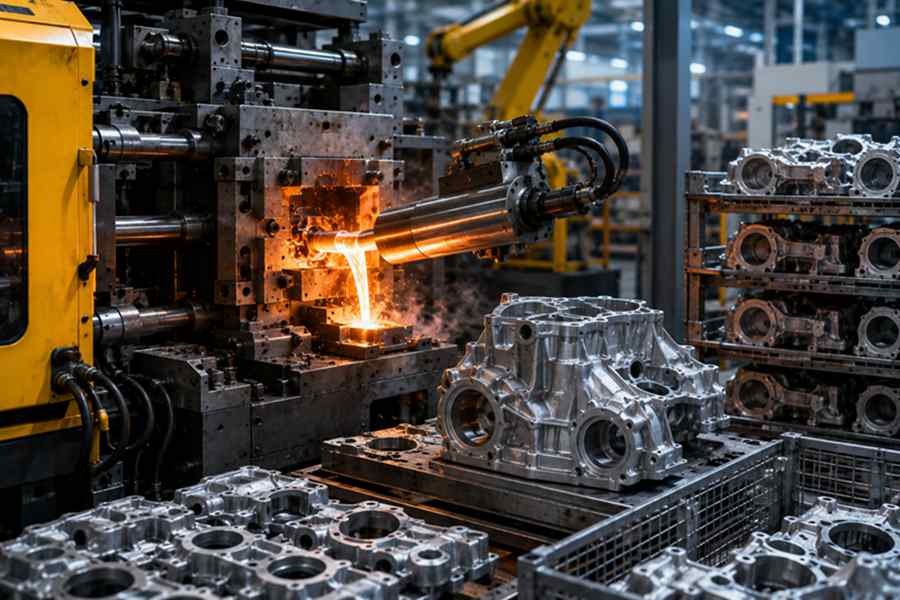
High pressure aluminum die casting forms parts by forcing molten aluminum alloy into a precisely machined steel die at high velocity and pressure. This rapid filling method helps create components with close tolerances, consistent dimensions, and repeatable quality.
This process is widely used for large-scale production because it provides fast cycles, consistent quality, and excellent repeatability.
Production Stages of High Pressure Aluminum Die Casting
Production is generally carried out through the following stages:
- Mold Preparation:A precision steel die is designed and manufactured according to the required part structure.
- Aluminum Melting:Aluminum alloy is heated until it reaches the suitable casting temperature.
- Pressure Filling:Molten aluminum enters the die cavity rapidly under controlled injection pressure.
- Cooling and Ejection:The casting solidifies inside the die and is removed from the mold.
- Trimming and Finishing:Excess material is removed, followed by machining, coating, or other surface treatments if required.
Advantages of High Pressure Aluminum Die Casting
- High Production Efficiency:The fast injection cycle allows manufacturers to produce large quantities in a short time.
- Excellent Dimensional Accuracy:The fixed steel mold helps maintain consistent part dimensions during repeated production.
- Good Surface Quality:Parts usually require less secondary finishing, which can reduce additional processing costs.
- Suitable for Complex Structures:The high-pressure filling process supports thin walls, ribs, and detailed designs.
Disadvantages of High Pressure Aluminum Die Casting
- Higher Tooling Investment:Precision steel dies require higher upfront costs.
- Higher Cost of Design Revisions:Once the tooling has been completed, later changes to the part design may require costly mold reworking.
- Not Ideal for Small Orders:Low-volume projects may not fully recover the initial mold investment.
What Is Gravity Aluminum Casting?
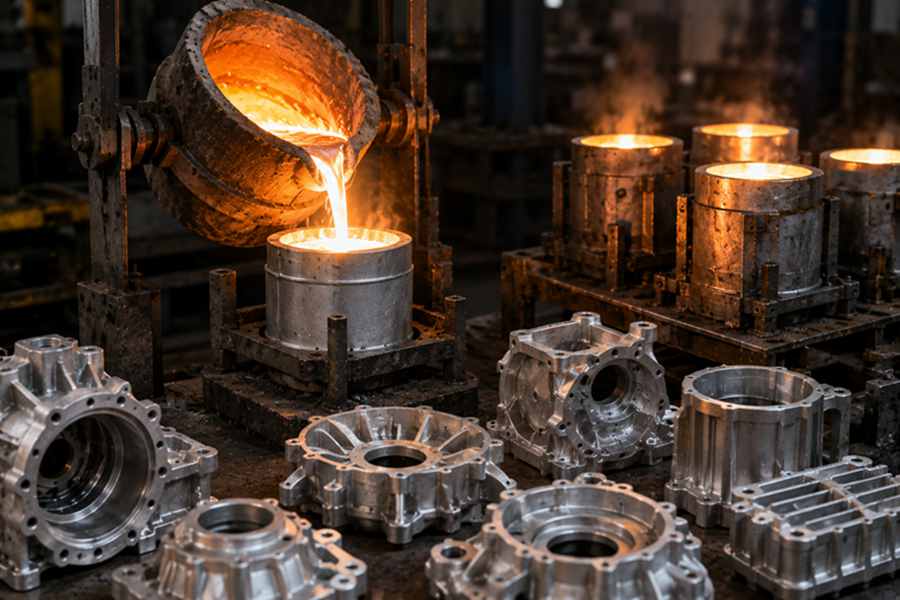
Gravity aluminum casting is a process where molten aluminum alloy is poured into a mold cavity and fills the mold mainly through natural gravity. Unlike high pressure die casting, it does not rely on external injection pressure.
This method uses simpler equipment and provides more flexibility for customized products, prototypes, and small to medium production runs.
Production Stages of Gravity Aluminum Casting
The main production steps include:
- Mold Preparation:A reusable metal mold or other casting mold is prepared according to the product design.
- Aluminum Melting:Aluminum alloy is heated until it reaches the required casting temperature.
- Gravity Pouring:Molten aluminum is poured into the mold cavity without high-pressure injection.
- Cooling and Solidification:The aluminum alloy cools naturally and forms the required shape.
- Casting Ejection and Secondary Processing: After solidification, the component is released from the die and may undergo trimming, machining, polishing, coating, or other finishing operations.
Advantages of Gravity Aluminum Casting
- Lower Initial Investment:Simpler molds reduce the upfront tooling cost.
- Flexible Production:It is suitable for prototypes, customized parts, and smaller production quantities.
- Suitable for Larger Sections:The process can handle thicker walls and larger components.
- Easier Process Adjustment:Design changes are generally easier to manage compared with precision die casting.
Disadvantages of Gravity Aluminum Casting
- Slower Production Speed:The filling and cooling process takes more time compared with high-pressure injection.
- Lower Automation Level:More manual operations may be involved during production.
- Higher Unit Cost at Large Volume:The slower cycle time makes it less competitive for mass production.
Comparing High Pressure and Gravity Methods for Aluminum Casting
| Comparison Factor | High Pressure Aluminum Die Casting | Gravity Aluminum Casting |
| Tooling Investment | Higher initial mold cost | Lower startup cost |
| Production Volume | Best for high-volume production | Suitable for small and medium batches |
| Part Complexity | Better for thin walls and complex structures | Better for thicker and simpler designs |
| Production Efficiency | Faster cycle time and higher automation | Slower but more flexible |
| Cost Advantage | Lower unit cost in mass production | Lower investment for small orders |
Tooling Investment
Tooling investment is a major consideration when buyers compare different aluminum casting methods.
- High Pressure Aluminum Die Casting:
Requires precision steel dies with higher manufacturing costs. Upfront costs are generally higher because the die requires precision manufacturing, strong tool steel, and sufficient durability for repeated production cycles. - Gravity Aluminum Casting:
Uses simpler molds with lower tooling requirements. It is more suitable for projects where buyers need to control startup costs or where future demand is uncertain.
Production Volume
Production quantity directly affects which process provides better economic value.
- High Pressure Aluminum Die Casting:
This process is developed for stable, automated, and high-volume manufacturing. The fast casting cycle and automation capability make it suitable for thousands or millions of repeated parts. - Gravity Aluminum Casting:
Works better for small and medium production quantities. It provides more flexibility when buyers need customized components or production demand is not stable.
Part Complexity
Different casting methods provide different levels of design flexibility.
- High Pressure Aluminum Die Casting:
The high-pressure filling process allows molten aluminum to reach small areas of the mold cavity, making it suitable for thin walls, ribs, complex geometries, and detailed surfaces. - Gravity Aluminum Casting:
Is better suited for thicker structures and simpler designs. It is commonly selected when part size and flexibility are more important than fine details.
Production Efficiency
Production efficiency affects delivery time, labor requirements, and overall manufacturing cost.
- High Pressure Aluminum Die Casting:
Provides shorter cycle times and higher automation potential. It helps manufacturers maintain stable output and consistent product quality for large production projects. - Gravity Aluminum Casting:
Has a slower production process but allows easier adjustment during manufacturing. It is practical for customized products and lower-volume orders.
Cost Advantage
The final cost depends on tooling investment, production quantity, cycle efficiency, and finishing requirements.
| Cost Factor | High Pressure Aluminum Die Casting | Gravity Aluminum Casting |
| Tooling Cost | Around $5,000–$50,000+ | Around $1,000–$15,000+ |
| Small Batch Cost | Around $5–$30+ per part | Around $3–$25+ per part |
| Large Volume Cost | Around $0.5–$10+ per part | Around $2–$20+ per part |
| Best Cost Situation | 10,000+ repeat parts | Hundreds to thousands of parts |
- High Pressure Aluminum Die Casting:
Usually provides better cost efficiency for large-volume production because the higher mold investment can be spread across many parts. - Gravity Aluminum Casting:
Usually provides better cost control for small orders because buyers can avoid expensive tooling investment.
Application Cases
Automotive Components
Recommended Process: High Pressure Aluminum Die Casting
Automotive suppliers often choose high pressure aluminum die casting for motor housings, battery components, and structural brackets. These parts require lightweight structures, accurate dimensions, and efficient mass production.
Industrial Equipment Parts
Recommended Process: Gravity Aluminum Casting
Manufacturers producing pump bodies, machine components, and replacement parts often select gravity casting. A lower mold investment makes gravity casting more economical for small orders and projects with limited production quantities.
Consumer and Electronic Products
Recommended Process: High Pressure Aluminum Die Casting
Electronic housings and consumer products often require consistent appearance, accurate assembly dimensions, and large production quantities. High pressure die casting provides better efficiency for these applications.
Selecting the Right Aluminum Casting Method
High pressure aluminum die casting is generally the preferred option when:
- Production volume is high
- Product design is stable
- Thin walls and complex structures are required
- Fast production speed is important
- Lower unit cost is needed for long-term manufacturing
Choose gravity aluminum casting when:
- Production quantity is limited
- Initial tooling investment needs to be controlled
- Product designs may change
- Larger or thicker parts are required
- Flexible production is more important than speed