
The performance and reliability of lap joint flange connections rely heavily on the correct selection of gaskets. Improper gasket material, size, or installation can lead to leaks, reduced service life, or even catastrophic failure.
The Role of Gaskets in Lap Joint Flange Connections
Gaskets seal flange faces by filling surface irregularities. They act as a barrier against fluids under pressure and varying temperatures. In lap joint flanges, the gasket is often subjected to:
- Pressure fluctuations from fluid flow or system startups/shutdowns.
- Temperature variations, especially in steam, chemical, or thermal systems.
- Chemical exposure, which can degrade materials if not resistant.
- Mechanical stress, including bolt torque, vibration, and flange rotation.
These factors make choosing the right gasket absolutely essential. Using incompatible gaskets can lead to leakage, corrosion under the gasket (CUG), or flange surface damage.
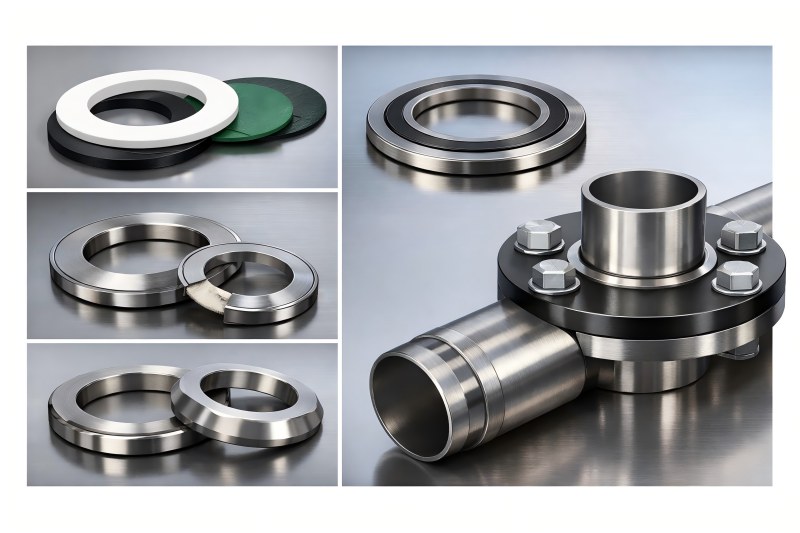
Key Considerations for Gasket Selection
Several factors influence gasket compatibility for lap joint flange connections:
Material Compatibility
The gasket must resist the process fluid chemically. Common chemical compatibility issues include swelling, softening, or cracking when exposed to acids, bases, or solvents.
| Gasket Material | Compatible Fluids | Incompatible Fluids | Notes |
| PTFE (Teflon) | Acids, bases, water, many chemicals | Molten alkali metals, fluorine | Excellent chemical resistance, wide temperature range |
| Graphite | Steam, hydrocarbons, high-temperature gases | Oxidizing acids at high temperatures | Excellent thermal stability and compressibility |
| Nitrile (Buna-N) | Oils, petroleum products, water | Strong acids, ketones | Good sealing under moderate temperatures, not for high heat |
| EPDM | Water, steam, alkaline solutions | Hydrocarbons, oils | Flexible and resilient, poor oil resistance |
| Neoprene | Refrigerants, oils, water | Strong acids | Moderate chemical resistance and durability |
Pressure and Temperature Ratings
Lap joint flanges are used in ASME Class 150–600. Gasket selection should consider system pressure and temperature ranges. Overstressed gaskets can extrude, crack, or fail.
| Pressure Class | Maximum Pressure (psi) | Typical Temperature Range | Recommended Gasket Materials |
| Class 150 | 285 | -20°C to 200°C | PTFE, Graphite, Nitrile |
| Class 300 | 740 | -20°C to 400°C | Graphite, Spiral Wound, PTFE |
| Class 600 | 1480 | -20°C to 500°C | Graphite, Metal Jacketed, Spiral Wound |
Observation: Metal-reinforced gaskets are preferred in higher pressure and temperature applications to prevent blowout and maintain sealing integrity.
Flange Face and Surface Finish
Lap joint flanges can have:
- Flat Face (FF): The simplest design, suitable for lower pressures and softer gaskets.
- Raised Face (RF): Provides a concentrated sealing surface for high-pressure applications.
- Gasket Selection Tip: Ensure the gasket thickness matches the flange face finish to achieve uniform compression without over-stressing the material.
Bolting and Torque Considerations
Even the best gasket material will fail if bolt torque is insufficient or uneven. Recommendations for lap joint flanges:
- Follow the correct bolt tightening sequence: Typically a star pattern ensures uniform compression.
- Use calibrated torque wrenches: Avoid manual over-tightening or under-tightening.
- Consider the gasket stress: For spiral wound gaskets, ensure stress falls within manufacturer specifications.
Lubricate bolts: This reduces friction and ensures consistent load transfer.
| Flange Size (in) | Bolt Size | Recommended Torque (ft-lb) | Notes |
| 2 – 4 | 3/4″ | 40 – 50 | Medium pressure |
| 6 – 12 | 7/8″ | 80 – 120 | High-pressure applications |
| 14 – 24 | 1 1/8″ | 150 – 250 | Critical systems, often metal gaskets |
Environmental Considerations
System environment also influences gasket selection:
- Outdoor applications: UV-resistant and weather-resistant gaskets such as PTFE or EPDM.
- Cryogenic systems: Gaskets that remain flexible at low temperatures, such as PTFE or flexible graphite.
- Corrosive environments: Stainless steel or alloy-reinforced gaskets.
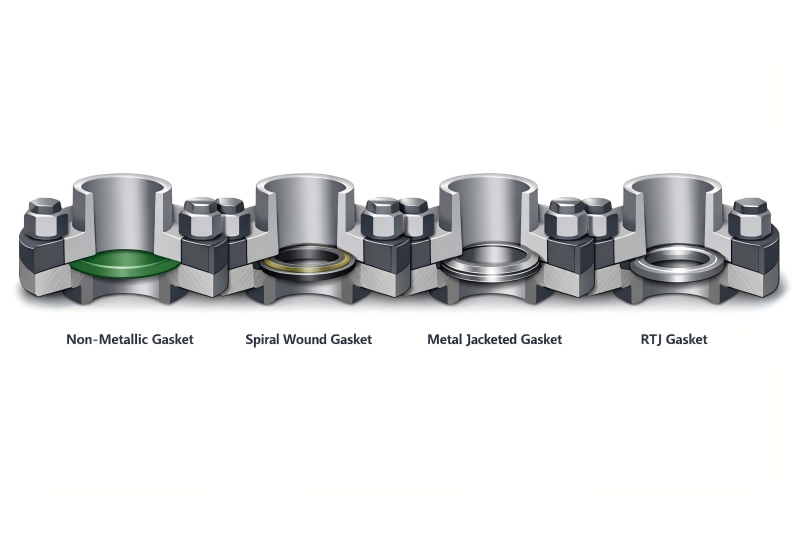
Common Gasket Types for Lap Joint Flanges
Non-Metallic Gaskets
- Soft materials: PTFE, rubber, Nitrile, EPDM.
- Advantages: Chemical-resistant, compressible, and economical.
- Limitations: Unsuitable for high-pressure, high-temperature.
Spiral Wound Gaskets
- Construction: Metal layers with flexible filler
- Advantages: High-pressure and temperature resistance, suitable for RF lap joint flanges.
- Applications: Steam lines, chemical plants, high-pressure pipelines
Metal Jacketed Gaskets
- Construction: Metal core wrapped in soft material.
- Advantages: High-pressure sealing, resistant to blowout.
- Applications: Petrochemical, oil refineries, high-temperature fluid systems.
Ring Gaskets (RTJ – Ring Type Joint)
- Construction: Solid metal rings.
- Advantages: Perfect for high-pressure, high-temperature.
- Applications: Hydrocarbon pipelines, high-pressure reactors.
| Gasket Type | Pressure Range | Temperature Range | Best Application |
| Non-metallic (PTFE, Nitrile) | Low to moderate | -50°C to 200°C | Water, oils, low-pressure chemicals |
| Spiral Wound | Moderate to high | -50°C to 450°C | Steam, chemicals, oil & gas |
| Metal Jacketed | High | -50°C to 550°C | Refineries, chemical reactors |
| RTJ | Extreme | Up to 650°C | High-pressure pipelines, reactors |
Selection Guidelines for Lap Joint Flange Gaskets
When choosing a gasket:
- Identify fluid type: Determine chemical composition, viscosity, and reactivity.
- Assess pressure and temperature: Consult ASME B16.5 or API standards.
- Choose suitable material: Based on chemical resistance, compressibility, and environment.
- Verify dimensions: Ensure gasket fits flange ID, OD, bolt circle.
- Consider installation and maintenance: Reusable gaskets can reduce downtime in high-maintenance systems.
- Practical Tip: Consult manufacturer and test compatibility before final installation.
Common Mistakes in Gasket Selection
- Ignoring chemical compatibility: Causes swelling, cracking, degradation.
- Overlooking pressure rating: Soft gaskets may blow out in high-pressure systems.
- Incorrect dimensions: Misalignment or leakage due to undersized or oversized gaskets.
- Uneven bolt torque: Causes flange warping or uneven gasket compression.
- Environmental neglect: Selecting gaskets unsuitable for UV, cryogenic, or high-corrosion environments.
Case Study: Selecting Gaskets for Chemical Plant Lap Joint Flanges
A chemical plant uses lap joint flanges in a high-temperature acid transfer line:
- Process fluid: Sulfuric acid at 250°C.
- Flange class: ASME B16.5 Class 300 RF.
- Environmental condition: Outdoor exposure, potential UV radiation.
Gasket Selection:
- Material: PTFE or graphite for chemical resistance.
- Type: Spiral wound gasket to withstand pressure fluctuations.
- Installation: Bolts torqued to manufacturer specifications with lubrication.
- Outcome: Correct gasket selection prevented leakage, ensured plant safety, and reduced maintenance costs.
Lap Joint Flange Gasket Care
- Periodic inspection: Inspect for leaks, deformation, or chemical damage.
- Re-torque bolts after initial operation: Compensates for gasket relaxation.
- Use compatible lubricants: Avoid chemical reactions with the gasket.
- Replace gaskets during disassembly: Particularly in hot or highly corrosive environments.
Gasket compatibility and selection are critical to the reliable performance of lap joint flange connections. Engineers and maintenance personnel must consider material compatibility, pressure and temperature ratings, flange face type, environmental factors, and proper installation procedures. Tables and manufacturer guidelines can serve as a valuable reference to minimize leakage risks, prevent equipment damage, and ensure long-term service life. Selecting the right gasket is not merely a technical requirement; it is an essential step for safety, efficiency, and cost-effective operations.