
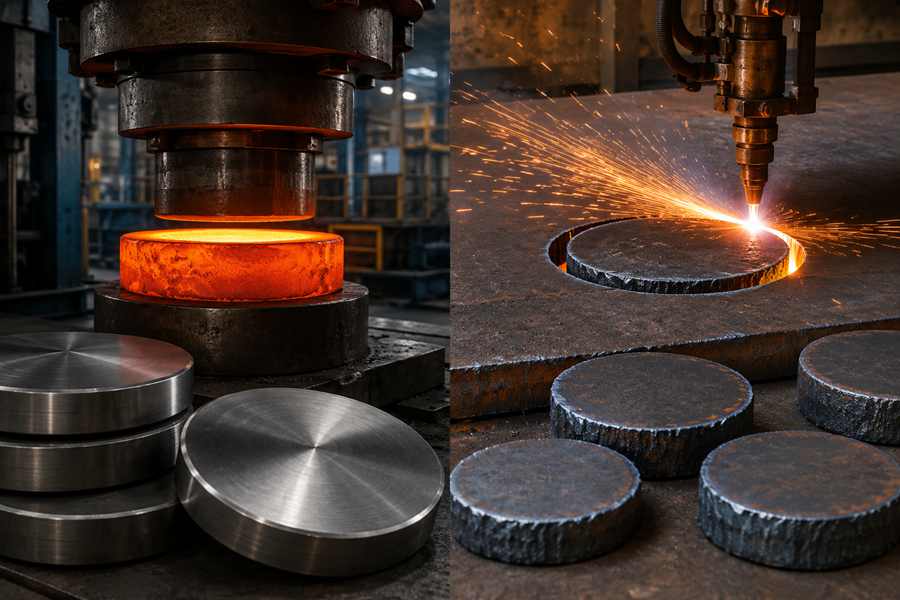
Forged discs and flame-cut steel discs meet different production needs: flame-cut blanks suit simple, flat, cost-sensitive parts, while forged discs perform better in thick, heavily loaded, or precision-machined components requiring reliable stability.
Forged Steel Discs
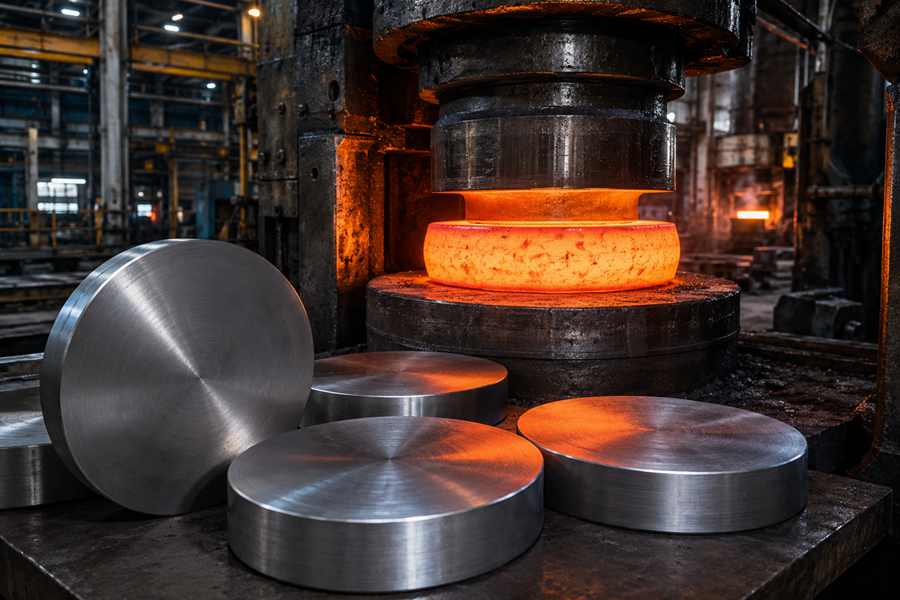
Forged steel discs are manufactured by heating a steel billet or ingot before forming it under controlled force. The applied pressure compacts the steel and creates a more continuous internal grain structure.
Following forging, the forged disc may receive heat treatment, surface descaling, preliminary machining, ultrasonic inspection, or complete finish machining.
Flame-Cut Steel Discs
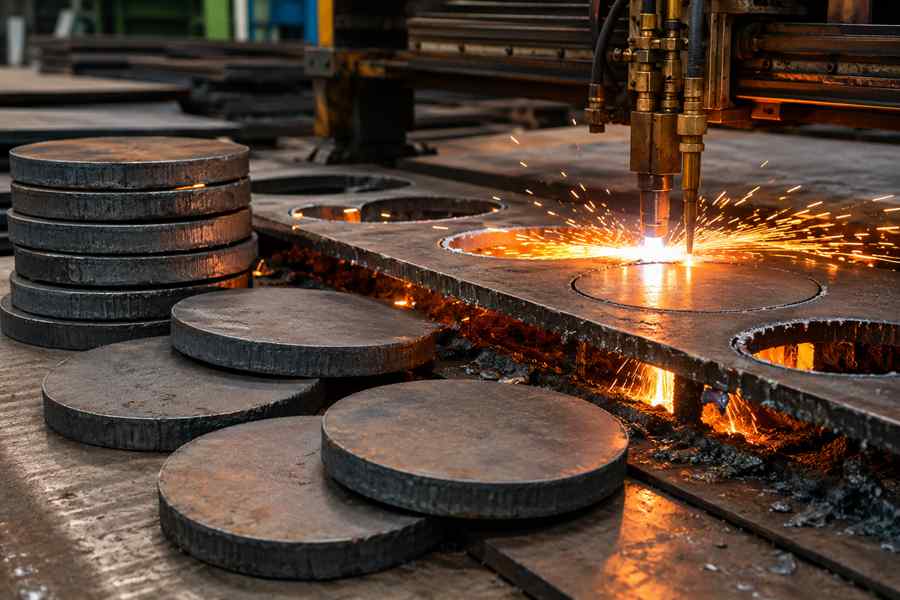
Flame-cut steel discs are produced directly from steel plate through oxy-fuel cutting. The programmed cutting route defines the outer diameter, while the original plate thickness determines the thickness of the blank.
After cutting, scale and irregular material around the circumference generally need to be removed. Both flat faces may also require machining when the finished part has stricter thickness or flatness tolerances.
How the Two Discs Are Produced
Forged Disc Production
The supplier chooses a suitable billet according to the finished disc weight and the required machining allowance. A typical manufacturing sequence includes the following steps:
- The billet is heated until it reaches the specified forging temperature.
- The hot steel is upset and flattened to distribute its volume more uniformly.
- Controlled forging operations then form the material into a circular disc blank.
- The completed forging is cooled under regulated conditions to limit internal stress.
- Heat treatment can be added to obtain the specified hardness, strength, or metallurgical structure.
Flame-Cut Disc Production
A standard flame-cut steel disc is generally manufactured through the following procedure:
- Steel plate with the required grade and thickness is positioned on the cutting table.
- The required disc diameter and cutting profile are entered into the equipment.
- An oxygen and fuel-gas torch follows the programmed circular cutting path.
- Once cutting is completed, the round blank is separated from the remaining plate.
- The thermally affected circumference is normally cleaned or machined before subsequent processing.
This production method is quick and adaptable, although further machining is commonly necessary before the blank can be used as a precision component.
Advantages and Limitations
Forged Discs
Key advantages include:
- Compact internal structure with continuous grain flow
- Stronger performance under cyclic or heavy loading
- Greater stability during deep and extensive machining
- Suitable for thick sections and high-strength components
- Compatible with carefully controlled heat-treatment processes
- More convenient internal inspection for critical parts
Key limitations include:
- Higher upfront manufacturing expense
- Longer overall production and delivery cycle
- Additional material allowance for forging and machining
- Higher unit prices for low-volume purchases
- Possible need for special preparation or forging tooling
Flame-Cut Steel Discs
Key advantages include:
- Efficient manufacturing from readily available steel plate
- Lower initial expense for uncomplicated circular blanks
- Faster production for commonly stocked steel grades
- Flexible quantities for prototypes and small orders
- Broad diameter options without dedicated forging dies
- Convenient sourcing when the correct plate is available
Key limitations include:
- Thermally affected edges need machining or inspection
- Internal performance is closely related to plate quality
- Greater residual stress may remain in thicker blanks
- Extensive material removal can release internal stresses
- Properties may vary across different plate orientations
- Less suitable for some fatigue-sensitive or heavily loaded components
Forged Discs vs Flame-Cut Steel Discs
| Comparison Factor | Forged Discs | Flame-Cut Steel Discs |
| Material & Grain | More material waste, dense uniform grain flow | High plate utilization, original rolled directional grain |
| Machining & Tolerance | Stable heavy cutting, consistent post-treatment dimensions | Stress-induced deformation, precise cutting with extra edge machining |
| Production Cycle | Long lead time with full forging & heat treatment steps | Fast delivery if standard steel plates are in stock |
| Cost | Higher blank cost, low scrap and machining failure risk | Cheap raw blanks; extra finishing may increase total expense |
| Application | Mass-produced thick, heavy-load critical components | Prototypes, simple discs and small general batches |
Among these factors, price depends on material grade, size, heat treatment, and testing requirements. For standard carbon steel discs:
- Forged Discs:About US$2.5–4.5/kg, with heat treatment or ultrasonic testing adding around 10%–25%.
- Flame-Cut Steel Discs:About US$1.3–2.5/kg, while edge machining and stress relief may add US$0.4–1.2/kg.
- Finished Cost:Flame-cut discs are usually 15%–30% cheaper for simple parts, while the gap may fall to 5%–15% for heavily machined components.
Practical Purchasing Scenarios
Thick Gear or Hub Blank
- Recommended: Forged Disc— A practical option for thick sections, deep cutting, and high-load parts where dimensional stability must be maintained.
- Reason— Its more uniform internal condition helps limit machining deformation and reduces the possibility of rejected components.
Flat Machine Cover
- Recommended: Flame-Cut Steel Disc— Well suited to flat and uncomplicated parts that require only limited machining.
- Reason— It provides lower purchasing cost and efficient plate usage without adding unnecessary internal-performance requirements.
Prototype Flange
- Recommended: Flame-Cut Steel Disc at the Initial Stage— Suitable for prototypes, samples, and small trial orders.
- Reason— Shorter production time provides greater freedom for changing dimensions or improving the design.
- Later-Stage Option: Forged Disc— This option can be evaluated after the design is confirmed and regular production begins.
Repeated Precision Component
- Recommended: Forged Disc— A better match for recurring orders with demanding dimensional-consistency standards.
- Reason— More predictable batch performance limits machining differences and supports smoother production.
Information to Send the Supplier
A clear quotation request should contain more information than only the required material grade and disc diameter.
Buyers should submit:
- Final component drawing
- Required blank diameter and thickness
- Steel grade or material standard
- Specified heat-treatment condition
- Required machining allowance
- Expected surface condition
- Mechanical performance requirements
- Ultrasonic inspection standard
- Critical dimensional tolerances
- Estimated annual purchasing quantity
- Required production or delivery date
- Intended application and service environment
The manufacturer should also be informed when a large amount of material will be removed from only one face. This detail helps the supplier decide whether forging, stress-relief treatment, or an adjusted machining procedure should be used.
Which Steel Disc Should You Choose?
Select flame-cut steel discs when the component is flat, simple in construction, needed quickly, or ordered in limited quantities. They make effective use of standard steel plate while keeping the initial blank cost relatively low.
Select forged discs when stable machining, dependable internal quality, fatigue performance, or repeatable production matters more than the lowest purchase price. They are particularly suitable for thick, extensively machined, rotating, or load-carrying components.