
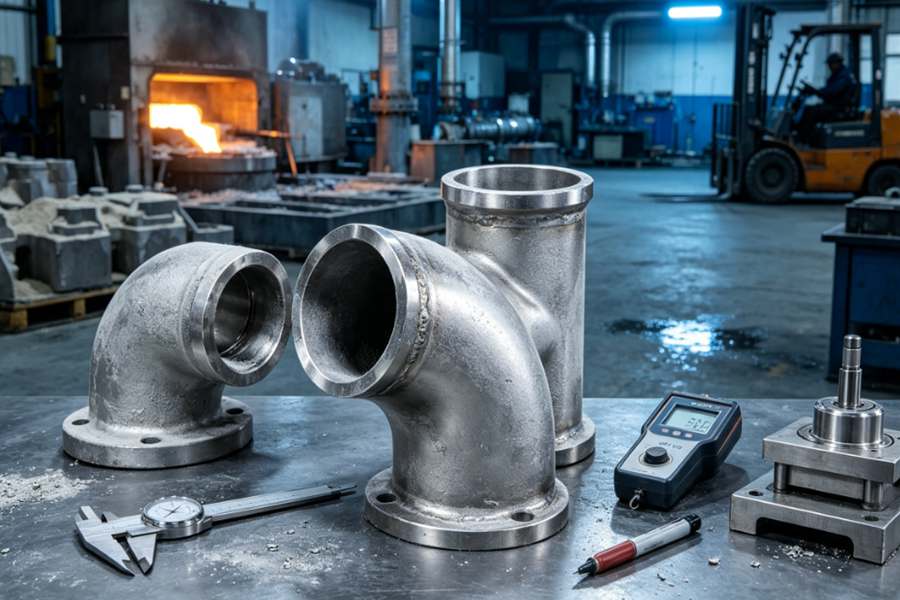
Duplex stainless steel castings provide corrosion resistance, strength, and durability for seawater cooling components, helping reduce maintenance risks when alloy selection, casting quality, and operating conditions are properly controlled.
Definition
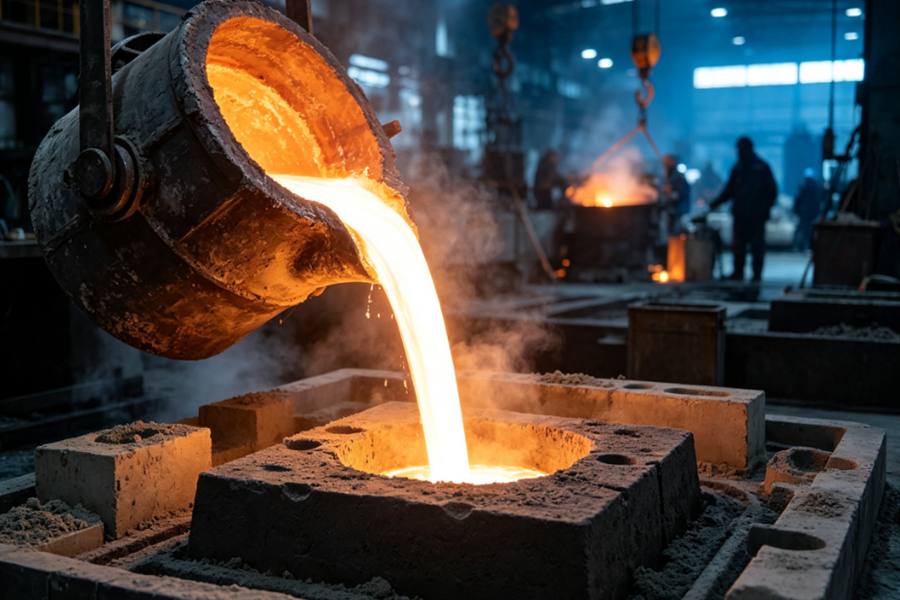
Duplex stainless steel castings are manufactured from stainless steel alloys containing a mixed ferritic and austenitic microstructure.
Duplex casting grades we providing include S31803, S31500, S32750, and related cast equivalents selected according to corrosion severity, pressure, temperature, and component design.
Unlike conventional austenitic stainless steel, duplex grades are designed to provide a more balanced combination of:
- Chloride corrosion resistance
- Mechanical strength
- Pitting resistance
- Stress corrosion cracking resistance
- Weldability
- Casting flexibility
Material Challenges in Seawater Cooling Systems
Seawater is not simply ordinary water with a higher salt content. It creates several interacting forms of material damage.
Chloride Exposure
Chloride ions can damage the passive protective layer on stainless steel surfaces. Once this layer becomes unstable, localized corrosion may develop even when the surrounding surface still appears intact.
Pitting and Crevice Corrosion
Narrow gaps, gasket interfaces, bolt areas, deposits, and low-flow zones can retain chloride-rich water. These areas are more difficult to inspect and may corrode faster than open surfaces.
Flow and Erosion
Pump impellers, elbows, valve passages, and narrow channels experience continuous fluid movement. Sand, shell fragments, and other suspended particles can increase surface wear.
Temperature Variation
Warm seawater generally increases corrosion risk. Cooling systems may also experience repeated start-stop cycles, stagnant periods, and changing thermal loads.
Mechanical Loading
Components must resist internal pressure, vibration, bolt loading, pump forces, and occasional pressure fluctuations. A material with acceptable corrosion resistance but insufficient strength may require a heavier section.
Main Advantages
Strong Resistance to Localized Corrosion
In seawater cooling systems, localized corrosion is often more dangerous than uniform surface loss. A component may retain most of its original appearance while a small pit penetrates deeply into a pressure-bearing wall.
Duplex grades provide a more stable material option for components exposed to:
- Natural seawater
- Brackish water
- Chloride-containing cooling water
- Intermittent wet and dry conditions
- Deposits and stagnant flow areas
The practical advantage is a wider operating margin when compared with many standard stainless or carbon steel castings.
Higher Strength for Pressure-Bearing Components
Duplex stainless steel generally offers higher yield strength than common austenitic stainless steels. In casting design, this delivers support for the following aspects:
- Reduced wall thickness
- More compact valve bodies
- Lighter pump casings
- Smaller structural ribs
- Improved pressure capacity
- Lower component weight
Reducing unnecessary wall thickness can decrease raw material consumption, casting weight, machining time, and handling difficulty.
Better Stress Corrosion Cracking Resistance
The duplex microstructure generally provides better resistance to chloride stress corrosion cracking than conventional austenitic stainless steel. This is valuable for:
- Pump bodies under continuous pressure
- Valve bodies with bolted connections
- Components near warm cooling-water outlets
- Parts exposed to vibration
- Castings with welded attachments
- Equipment operating under repeated thermal cycles
Improved Resistance to Flow-Related Damage
With superior strength and corrosion resistance, duplex stainless steel castings can resist seawater erosion, cavitation and flow-caused damage, serving as qualified materials for impellers, valves, diffusers and high-velocity structural parts.
Suitable for Complex Casting Geometries
By combining sophisticated structures into unified components, duplex stainless steel castings cut down welding and assembly procedures. They also enhance flow performance, dimensional uniformity and pressure reliability of seawater cooling equipment.
Reduced Dependence on Protective Coatings
Due to their built-in corrosion resistance, duplex stainless steel castings eliminate heavy reliance on surface coatings and liners. Such material advantages reduce surface protection specifications, maintenance frequency and long-term operational costs for seawater handling equipment.
Longer Maintenance Intervals
Cooling-water equipment is often located in areas where maintenance is expensive or disruptive.
Replacing a pump casing, valve body, or seawater strainer may require:
- System shutdown
- Pipeline drainage
- Equipment lifting
- Flange disassembly
- Replacement gasket installation
- Pressure testing
- Recommissioning
A higher initial material cost can be justified when it reduces the frequency of these operations.
Comparative Overview
| Comparison | Austenitic Stainless Steel Casting | Duplex Stainless Steel Casting | Carbon Steel Casting |
| Corrosion Resistance | Moderate | High | Low without coating |
| Pitting Resistance | Better | Excellent for chloride service | Limited |
| Strength | Medium | High | Good |
| Stress Corrosion Resistance | Moderate | Better | Limited |
| Casting Control | Moderate | Strict process control | Easier |
| Heat Treatment | Important | Critical | Conventional |
| Weight | Medium | Potentially lighter | Thicker sections |
| Coating Requirement | Depends on environment | Less dependent | Usually required |
| Cost | Medium | Higher | Lower |
| Best Application | Moderate corrosion areas | Critical cooling systems | General seawater parts |
Carbon steel may remain suitable for large, low-cost housings with reliable internal linings. Austenitic stainless steel may be sufficient in treated cooling water or lower-chloride conditions. Duplex stainless steel becomes more attractive when corrosion exposure and mechanical loading are both significant.
Applications
Seawater Pump Casings
With pressure and corrosion resistance combined, duplex stainless steel pump casings adopt monolithic casting to refine flow layout, dimensional consistency and stability in seawater cooling service.
Pump Impellers
Duplex stainless steel impellers provide corrosion resistance and mechanical durability for seawater circulation under flow, pressure, and cavitation conditions.
Valve Bodies and Discs
Deposits, crevice areas, sealing surfaces, and stagnant water increase localized corrosion risk. Duplex stainless steel castings are suitable for butterfly valve bodies, gate valve bodies, check valve parts, and flow-control components.
Strainers and Filter Housings
Featuring strong resistance to seawater corrosion and sediment fouling, duplex stainless steel strainers leverage tailor-made casting processes to consolidate elaborate structures into dependable filter housings.
Heat Exchanger Water Boxes
Duplex stainless steel water boxes reduce corrosion and leakage risks in heat exchangers through durable seawater-resistant casting structures.
Factors to Consider
- Seawater Temperature
A grade suitable for cool open seawater may not provide the same safety margin in warm, stagnant, or concentrated chloride conditions.
- Flow Velocity
Low flow may encourage sediment and biological deposits. Excessive flow may increase erosion, turbulence, and cavitation.
- Chloride Concentration
Natural seawater, brackish water, recirculated water, and concentrated discharge water do not create identical conditions.
Alloy grade should match the actual chloride exposure rather than the general description “seawater.”
- Component Geometry
Complex geometry can create hidden corrosion zones and casting defects.
- Maintenance Accessibility
A component that can be replaced during routine maintenance may not require the same material investment as a submerged or difficult-to-access part.
- Operating Consequences
The cost of leakage or unexpected shutdown should influence material selection.
Critical cooling-water components often justify a larger corrosion and strength margin.
Key Production Controls for Final Component Performance
| Control | Focus | Result |
| Composition | Alloy control | Stable properties |
| Melting | Process control | Cleaner castings |
| Solidification | Feeding design | Fewer defects |
| Heat Treatment | Phase balance | Better performance |
| Machining | Surface quality | Improved reliability |
With integrated anti-corrosion capacity, high strength and flexible casting forming, duplex stainless steel castings act as a well-rounded solution to extend the service reliability of seawater cooling devices.