
Socket weld flanges serve as key components in high-pressure pipelines across oil & gas, petrochemical, power, and industrial applications. When standard flanges cannot meet project requirements, custom designs provide optimized performance through tailored sizes, materials, and surface treatments.

What Are Socket Weld Flanges?
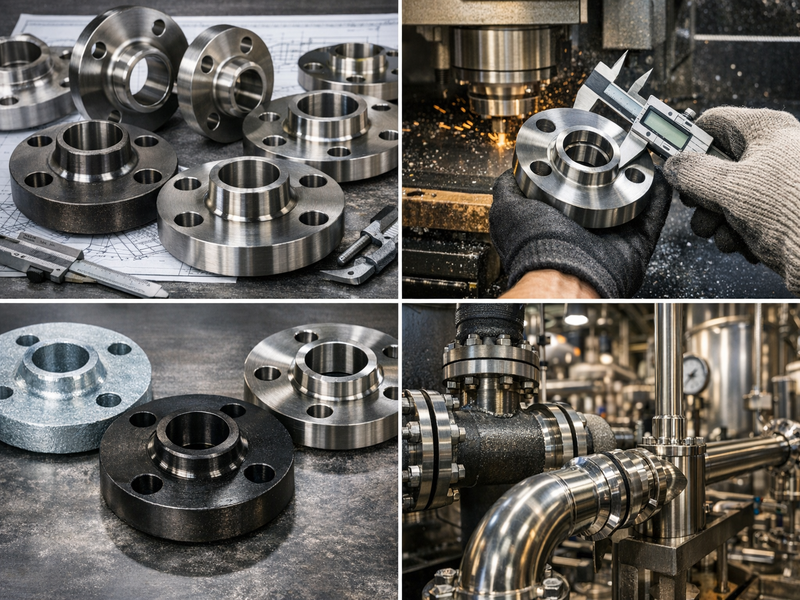
A socket weld flange is a kind of flange that attaches to a piping system through a socket where the pipe slips before the hub is fillet-welded. Unlike slip-on or weld-neck flanges, the pipe doesn’t pass through the flange bore, minimizing turbulence and potential erosion at the weld zone.
Key benefits include:
- Improved strength and leak-resistance
- Ease of alignment during installation
- Reduced disturbance of flow
- Ideal for high-pressure, small-diameter pipes
Custom versions go beyond stock specifications to align precisely with unique design codes, space constraints, or material performance requirements
Custom Socket Weld Flange Sizing Options
Sizing is foundational to flange performance. A poorly sized flange can cause assembly issues, uneven stress distribution, and early failure.
Standard Reference Tables
Socket weld flanges typically refer to ASME B16.5 (covering sizes from ½″ to 24″) and API 6A for oil-field applications. Standard sizes include:
| Nominal Pipe Size (NPS) | Outer Diameter (OD) | Bolt Circle Diameter (BCD) | No. of Bolts |
| ½″ | 3.50″ (88.9 mm) | 2.75″ (69.85 mm) | 4 |
| 1″ | 4.75″ (120.65 mm) | 3.75″ (95.25 mm) | 4 |
| 2″ | 6.50″ (165.1 mm) | 5.00″ (127 mm) | 8 |
Note: These represent typical ASME values; custom projects often adjust beyond standard bolting patterns or thicknesses.
Custom Size Considerations
a) Non-standard Nominal Sizes
Certain industrial pipelines may require fractional or extended sizes like 1.25″, 2.5″, 3.5″, etc. Custom machining enables:
- Modified bore diameter
- Special bolt hole spacing
- Altered outer diameter for space-limited installations
b) Thickness & Pressure Ratings
Flange thickness directly correlates with pressure rating. Custom socket weld flanges can be engineered to meet:
- ANSI Class 300, 600, 900, 1500, 2500
- Special designs for high-pressure test headers
In practice, a Class 600 custom flange may have a thicker body and reinforced hub compared to a stock equivalent to withstand stress cycles at high temperatures.
c) Hub and Fillet Design
Custom profiling of the hub radius and fillet weld seating affects:
- Stress distribution at the weld
- Flow turbulence minimization
- Ease of welding in confined spaces
To verify these geometry modifications, engineering teams employ finite element analysis (FEA).
Material Selection for Custom Socket Weld Flanges
Selecting the right flange material influences corrosion resistance, mechanical strength, weld competency, and cost.
Carbon Steel Flanges
Popular grades: A105, A350 LF2
Carbon steel is widely chosen for general industrial service:
Advantages
- Lower cost
- Good strength
- Easy weldability
Limitations
- Requires coatings for corrosion protection
- Not suitable for aggressive chemical environments
Applications: Water lines, steam piping, low-alloy service.
Stainless Steel Flanges
Typical grades: 304, 304L, 316, and 316L
When corrosion resistance is crucial, stainless steel is essential:
Advantages
- Excellent resistance to oxidation and corrosion
- Suitable for sanitary and chemical services
Special Options
- Duplex and Super Duplex (e.g., S32205, S32750) – high strength + corrosion resistance
- High-Temperature Grades (e.g., 310) – stability at elevated temperatures
Applications: Food processing, pharmaceuticals, offshore systems, seawater environments.
Alloy Steel and Nickel Alloys
For extreme environments, higher-performance materials are chosen:
| Material | Key Benefits | Typical Use |
| Alloy Steel (e.g., A182 F11/F22) | High strength + creep resistance | Power plants, refinery furnaces |
| Nickel-based Alloys (e.g., Inconel, Hastelloy) | Exceptional corrosion resistance | Chemical reactors, flue gas desulfurization |
| Titanium | Lightweight + corrosion resistance | Aerospace, chemical piping |
These materials often require specialized machining and welding procedures.
Material Certification & Traceability
Custom flanges typically come with traceability documentation:
- Mill Test Reports (MTRs)
- Material composition analysis
- Heat treatment records
These certifications are essential for regulatory compliance in pressure systems.
Surface Treatment Options
Surface treatments enhance corrosion protection, wear resistance, and aesthetic appearance. Custom socket weld flanges often undergo tailored finishes based on application conditions.
Black Oxide / Oiled Finish
A basic protective layer:
- Black oxide conversion coating
- Light oil application
- Ideal for short-term, general industrial environments
Galvanizing
Hot-dip galvanizing coats the flange in zinc:
- Superior rust resistance
- Good for outdoor or damp environments
- Not suitable where welding post-galvanizing is required
Electroplating
Electroplating applies metals like:
- Nickel – decorative & corrosion resistance
- Chrome – wear resistance
- Zinc / Cadmium – sacrificial protection
Plating thickness may be specified based on environmental severity.
Passivation
Primarily for stainless steels:
- Removes free iron from surface
- Enhances corrosion resistance
- Especially important in sanitary and chemical systems
Painting & Powder Coating
Suitable for carbon steel flanges:
- Epoxy, polyurethane, or powder coatings
- Color specification (e.g., ANSI / plant coding)
- Provides barrier protection against oxidation
Custom Laser Etching & Labeling
Engraving the flange with:
- Part numbers
- Size/pressure rating
- Traceability codes
This aids inventory control and maintenance traceability.
Manufacturing & Quality Assurance
Custom socket weld flanges undergo rigorous production and inspection processes.
Forging & Machining
- Warm or hot forging to shape the blank
- Precision machining for accurate bores and bolt patterns
- Turning the centerline to minimize eccentricity
- Deburring and chamfering
High-precision CNC centers ensure tolerances meet engineering requirements.
Welding & Heat Treatment
When specialty features are added:
- Pre-weld stress relief
- Post-weld heat treatment (PWHT)
- Controlled cooling
These processes optimize mechanical properties and minimize residual stress.
Non-Destructive Testing (NDT)
Custom flanges typically undergo NDT such as:
- Magnetic Particle Inspection (MPI)
- Dye Penetrant Testing (PT)
- Ultrasonic Testing (UT)
- Radiographic Testing (RT)
Certification reports accompany delivery in critical projects.
Dimensional and Fit-Up Inspection
Calipers, CMM (Coordinate Measuring Machines), and gauges verify:
- Bore concentricity
- Bolt hole alignment
- Face flatness
- Critical diameters per drawings
High accuracy is essential for proper socket fit and welding quality.
Application Considerations
Understanding where and how custom socket weld flanges are used helps guide specifications.
High-Pressure & High-Temperature Services
In refinery heaters, steam headers, and pressure vessels:
- Thicker flange faces
- Alloy steels with creep strength
- Temperature-resistant surface treatments
System engineers often specify custom pressure classes beyond stock offerings.
Corrosive Environments
Chemical, offshore, and seawater services demand:
- Duplex or super-duplex stainless
- Nickel-based alloys
- Enhanced surface treatments (passivation, plating)
These options minimize corrosion and maximize service life.
Sanitary and Food Processing
Food, beverage, and pharma industries require:
- Polished stainless finishes
- Electropolishing
- Traceability marking
- Hygienic weld transitions
Custom flanges can be polished to Ra ≤ 0.4 μm.
Critical Infrastructure & Safety Systems
Systems with zero-tolerance for leaks (like fire suppression) benefit from socket weld connections:
- Predictable joint integrity
- Reduced undercut welding risks
- Custom materials based on code requirements
Procurement & Specification Best Practices
Engineers and procurement teams should follow these steps when ordering custom socket weld flanges:
Start with a Detailed Datasheet
Include:
- Nominal size
- Pressure class or allowable stress
- Material grade and standard (ASTM/ASME)
- Surface treatment requirements
- NDT requirements
- Heat treatment and certification
Clarify Tolerances
Critical dimensions like:
- Bore diameter
- Hub ID and OD
- Flange thickness
- Fillet radius
Require tolerance limits on drawings.
Define Project Standards
Flanges must meet designated specs such as:
- ASME B16.5 / API 6A
- NACE for sour service
- PED (Pressure Equipment Directive) for EU projects
Validate Welding Procedure Specifications (WPS)
Especially for custom alloys or special thicknesses, ensure:
- Qualified WPS
- Welder qualification
- Documentation
This prevents field issues and rejects.
Custom socket weld flanges provide tailored performance through optimized size, material, and surface treatment. Collaboration between design, manufacturing, and quality teams ensures reliable installation, lower lifecycle costs, and long-term system performance.